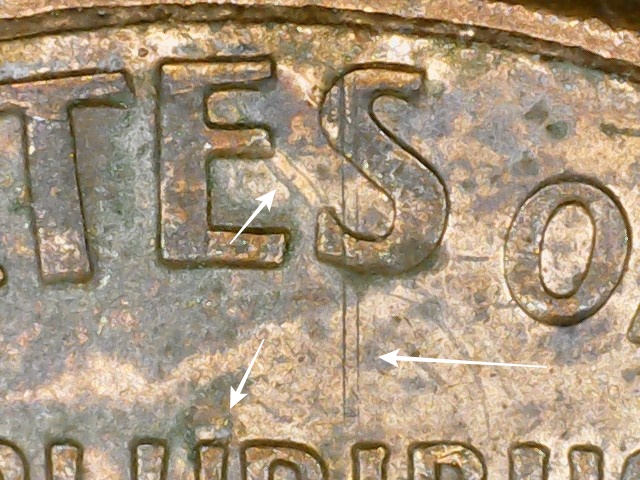
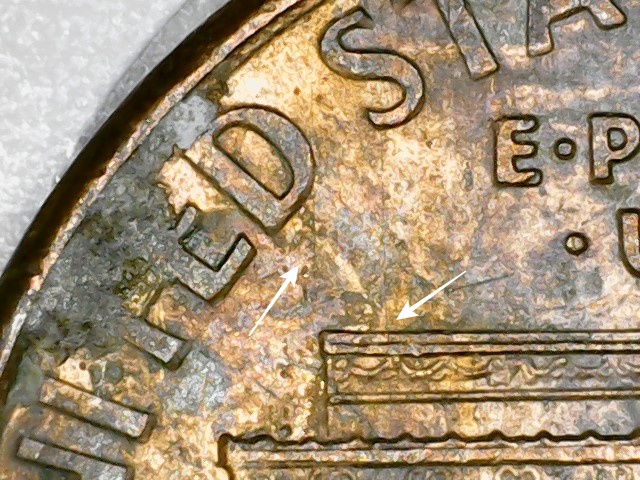
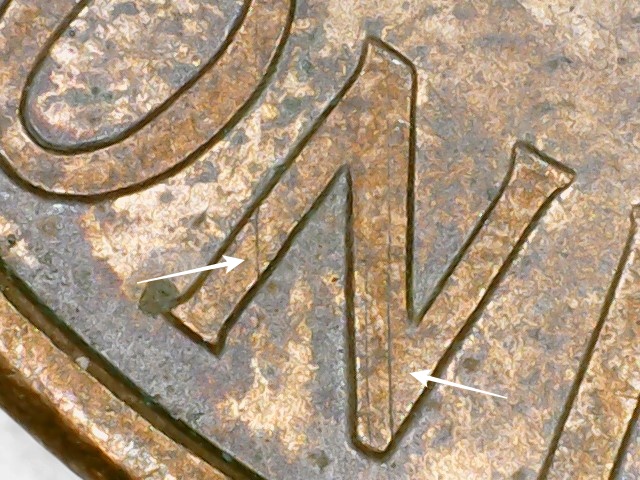
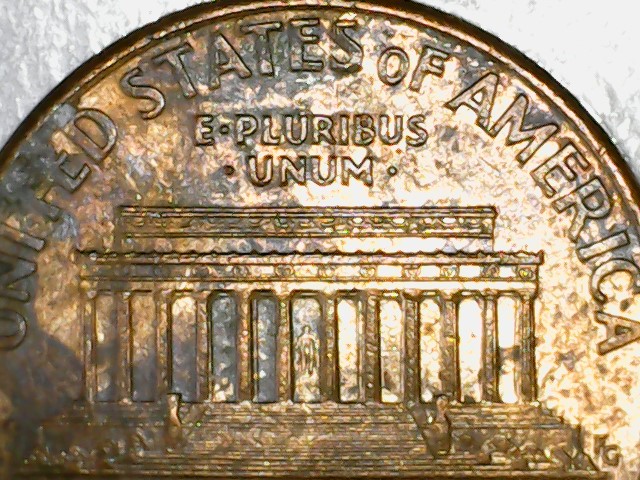
All the areas where there is an incuse mark on the devices, that is coin damage. Something was squeezed onto the coin on those areas that make this incuse damage to the coin.
)).jpg)
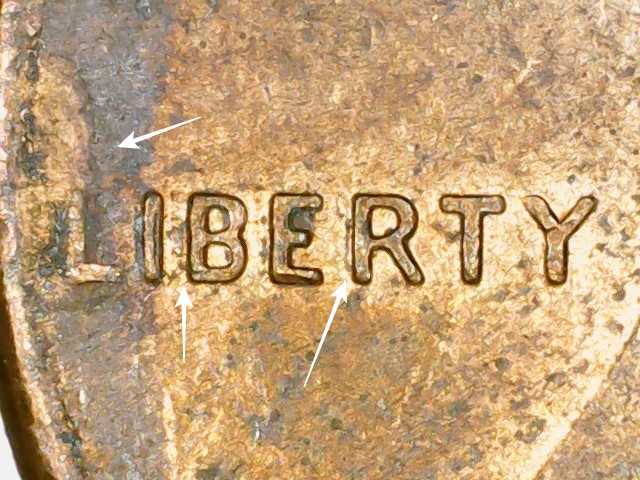
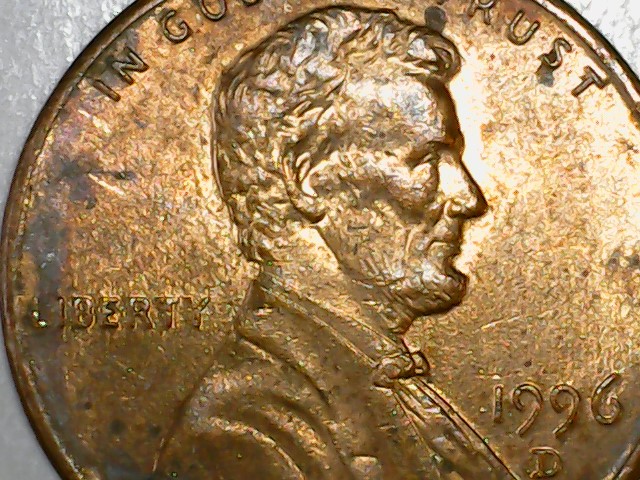
On the obverse, if you see gray on the devices showing on the left sides of Liberty, that is where the plating was split. Also some flattening of some of the devices. The bottom of the 'E' is a push from coin contact on that area of that device. If other devices would have been affected, then it could be
Machine Doubling. But so far it appears to be mostly contact damage. 99% of the incuse marks are coin damage on coins. Only 1% are mint errors. So keep that in mind. Damage regardless of how it happened reduces value to a coin. After one larger example, some coins are turned into a coin a cull coin. Reducing it to face damage. New ones need to learn what to look for on coins if they are looking for mint errors or coin varieties. Check the sites to know what to look for and skip over coins that are post strike damage. Take quick study on what to look for when you are looking at sites for :
(Knowledge is what you can skim from this site.) Rest is for exact identification of examples you did find.
Sites for Cents and other denomination Varieties":
(Doubled dies and RPMs) Coppercoins.comhttps://www.coppercoins.com/advsearch.php (Search for Cent Varieties)Variety Vista
(All denominations)https://www.error-ref.com/Wexler's doubled dies:http://doubleddie.com/1801.htmlHome page. A lot of information are on these pages, but the information to look for on varieties are:
Doubled Die Listings (All denominations)RPMs: (Re-Punched-Mintmarks)http://doubleddie.com/307764.htmlDifferent denominations. Nickles are on a different site, but the notation is on the site.What do I mean by studying these sites? Not that you have to memorize all of the listings, but look for what the Variety is. When you see these, your eyes are being trained, to know what to look for on the coin you are searching. Changes are on some years the same areas are affected by die varieties. I figure, remember these affected areas, and search for these. Also keep in mind that some varieties are seen on some of the past die setups, and when they changed to the new setups happened, the doubled dies are no longer found on the same areas.
What?Multi hub process of the past: On these dies the doubled dies tend to be more on the outer areas of the devices.
Single squeeze newer die process:The doubled dies tend to be in a different location. On the central areas of the designs.
So what can appear on some years in the past, will not be found on the newer die processes.So if you are looking for one type of hub doubling, you will be missing what is the new doubled dies. And the opposite can happen.
Recommended:Start a paper to know what areas to look for doubled dies, by creating this list, you will be training your eyes on what areas to concentrate on for varieties. The more information you add, you are training you eyes to concentrate on certain areas. Eventually you will have this information in mind and won't need the list any longer, but adding it to paper (Small spiral notebook) you can review the information and have it for a quick reference. You can add more information as you go So leave spaces in the notebook to add new information.
IE "Cents": Probably this second could be as much as half of this notebook. Continue with 'Nickels" as several pages and so on. Each thing you make a notation on, your eyes will remember during your searches. Best way to search is to go through the coins, find something interesting? Set it aside to look up later. Continue to search and look up and add information later on. You could only write on one side of the pages on information and flip the book over and use that other direction of pages for different information. Could use a different color of pen to write on one side of the pages, a different color for the other direction. The more you study, the more your eyes will be trained. The more you will find, that you are really looking for.
Some die events are just part of the aging process. When they are found, I know what they are and don't spend much time on these. Some have a light premium. Others are just common change. When I see these I know what they are. That helps me move on to the next coin. Examples of the different examples of these are on the boxes below:
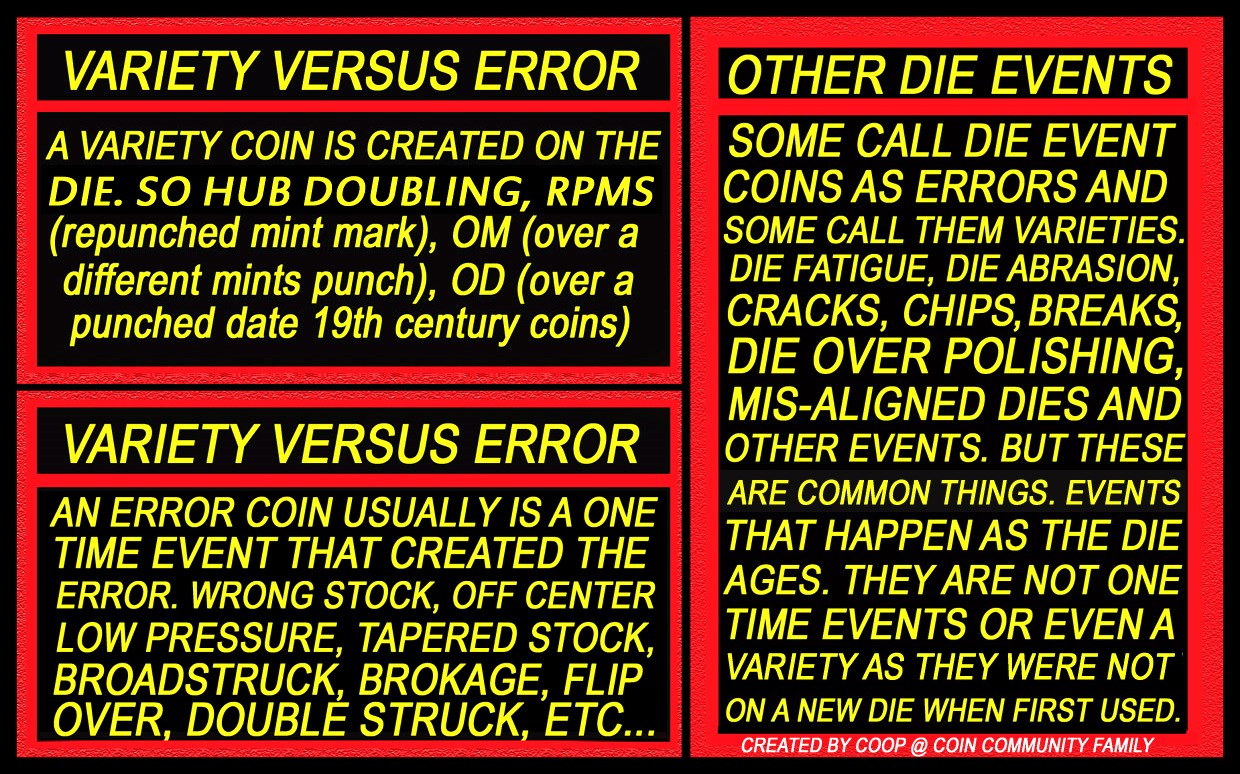
Note there are three boxes. If there were a fourth box, it would be damaged coins. These are of no interest to me. So I never made a box for them. They are common events.
(Whats a common event?) IE: As mentioned on the last box. Die events that after this happens on the dies, these will continue to be used and as much as 50% or move of these events can happen before the dies are retired. So they are not a variety, they are a die event. As you advance in knowledge, you will realize that if you started saving these, you will realize later that it was a waste of time.
(Not a premium of most of these) As soon as you realize this, then you will stop saving these. Hope this helps.
I'll be adding this information to a new thread. But it snowballed into a larger subject, rather than just a response.
CoopHome:
Why study the sites? eye training will increase you knowledge on a subject.






 Posted 10/31/2022 4:01 pm





 with all of the above. Just damage.


