Why Study The Sites For Information Other Than Just For The Listings?
What could you be missing? If something happens on one die is a certain range, a New Listing could be found, by searching what happened on other doubled dies during that period of time. So check the sites to know what to look for, and you can skip over coins that are post strike damage/machine doubled coins. Take quick study on what to look for when you are looking at sites for :
(Knowledge is what you can skim from this site.) Rest is for exact identification of examples you did find.
Sites for Cents and other denomination Varieties":
(Doubled dies and RPMs) Coppercoins.comhttps://www.coppercoins.com/advsearch.php (Search for Cent Varieties)Variety Vista
(All denominations)https://www.error-ref.com/Wexler's doubled dies:http://doubleddie.com/1801.htmlHome page. A lot of information are on these pages, but the information to look for on varieties are:
Doubled Die Listings (All denominations)RPMs: (Re-Punched-Mintmarks)http://doubleddie.com/307764.htmlDifferent denominations: Nickles are on a different site, but the notation is on the site.
What do I mean by studying these sites? Not that you have to memorize all of the listings, but
look for what makes a Variety on those years. When you see these, your eyes are being trained, to know
what to look for on the coins you are searching. Changes are on some years coins can affect the same areas as doubled die varieties. I figure, remember these affected areas,
and search for other new examples on other years. Also keep in mind that some varieties are seen on some of the past older die setups, and when they changed to the new setups, different types/location changed, the doubled dies are no longer found on the same areas.
What?Multi hub process of the past: On these dies the doubled dies tend to be more on the outer areas of the devices.
The Single squeeze newer die process:These doubled dies tend to be in a different locations on the designs. More on the central areas of the designs. So when looking for these new doubled dies, it helps to read over some of the listed examples to know what to look for.
So what can appear on some years in the past, will not be found on the newer die processes. So if you are looking for one type of hub doubling (Multi hub dies), you maybe missing what is happening on the newer doubled dies (single squeeze dies). And the opposite can happen. What makes it hard to tell the when the change over happened, it was gradual. Not all done at the same time. On quarters the big change over was in 1999 on both sides of the coins. So the Doubled Dies on these will be found on the central areas on both sides on these coins. Seem that these are continuing to be used on all the examples starting with the States quarters forward.
On cents, it was gradual. The obverses were changed over about the time the zinc cents started. But on the reverse they were the same for a time and when we start seeing the 'Bar' Cents, then we know the change over happened during that time. Even on some year both Different styles of die were used. So you have some with one type of doubled die and another different area affected by the new Single Squeeze die processes. So as you see the change over, they can be all a once, or gradual. I feel they were using the dies that were already (Memorial dies) created, and then when they were all used up, they moved over to the new process of die creation. (The single Squeeze dies). I figure the same happened on the all of the other denominations as well. So no exact cut off date that I've figured out. But when they changed to the new designs, they are the Single squeeze dies.
Recommended:Start a notebook to know what areas to look for doubled dies, by creating this list. You will be training your eyes on what areas to concentrate on for die varieties.
The more information you add, you are training you eyes to concentrate on certain areas. Eventually you will have this information in mind, and won't need the list any longer but adding it to paper, (Small spiral notebook) you can review the information and have it for as quick reference for specific details. You can add more information as you, go so leave spaces in the notebook to add new information.
IE "Cents": Probably this section could be as much as half of this notebook. You could make areas for obverse designs on certain years, or divide up areas on new designs to make the subject clearer. You continue with 'Nickels" as several pages and so on. Each thing you make a notation on, your eyes will remember during your coin searches. Best way to search is to go through the coin listings. When you find something interesting record that information for a quick review as needed. So having this information is is easier to look up later as needed. Continue to search and look up and add information later on. If you want to include a die number so you can look back later on the site. The more you added, then you will have it as a quick reference.
You could only write on one side of the pages on information and flip the book over and use that other direction of pages for different information. You could use a different color of pen to write on one side of the pages, and different color for the other direction. The more you study, the more your eyes will be trained. The more you will find, that you are really looking for.
Some die events are just part of the aging process. When they are found, I know what they are and don't spend much time on these. Some have a light premium. Others are just common change. When I see these I know what they are. That helps me move on to the next coin. Examples of the different examples of these are on the boxes below:
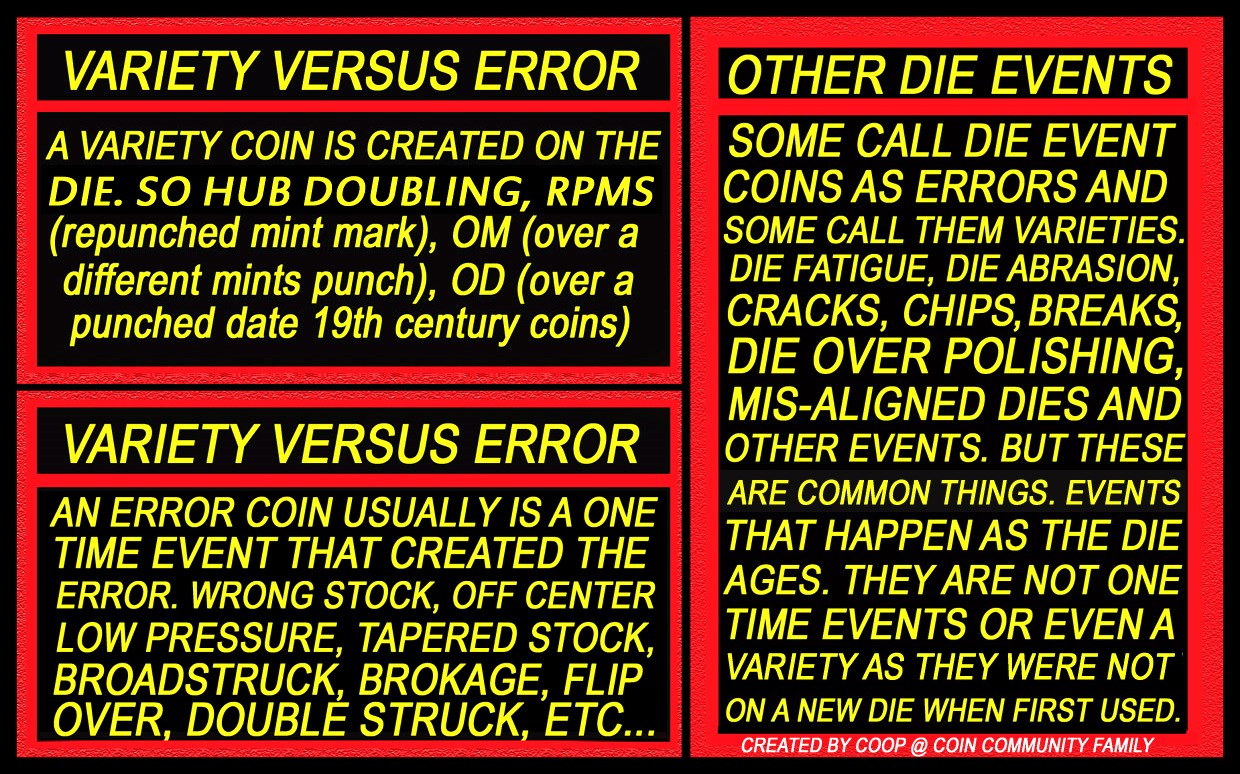
Note there are three boxes. If there were a
fourth box, it would be damaged coins. These are of no interest to me. So I never made a box for them. They are common coin damage events.
(Whats a die event common event?) IE: As mentioned on the last box on the image above. These are Die events that happens on the dies during the aging process. These dies will continue to be used with these dies events and as much as 50% or move of these events can happen before the dies are retired. So they are [u]not a variety,[/b] they are a die event. As you advance in die knowledge, you will realize later that if you started saving these, you will realize that it was a waste of time although at that time it seem important.
(Not a premium of most of these) As soon as you realize this, then you will stop saving these. Hope this helps. Part of the clashes and die polishing events seem interesting, but once you realize it is just part of the striking/aging/altering process. But the information helps during the searches, as you will know what it is and can move on to the next coin quicker. (When it doubt, set it aside for later study) Probably more I could add, but these will be covered more often when these die errors/varieties/events happen on other coins. Happy searching. Knowing what to look for is like looking at a map and seeing the direction you should take. It is a lot faster to know where your going, rather than just seeing where this road goes? You find more when you know what to look for.
CoopHome:
Why study the sites? eye training will increase your knowledge on a subject.










 Posted 10/31/2022 5:17 pm


