| Author |
 Replies: 14 / Views: 3,419 Replies: 14 / Views: 3,419 |
|
|
New Member
Netherlands
36 Posts |
First off, I know there will be a lot of people saying "no" to cleaning coins - I agree and I never clean my coins (except for acetone dip), UNLESS it is badly corroded - I believe corroded coins should be cleaned not only to remove the corrosion but also to conserve and prevent the further possible spread of it. So, recently I've received this 1 rouble coin from 1897 (90% silver) in a decent AU condition, but with a pretty badly corroded upper part (any thoughts on what might have caused it?).   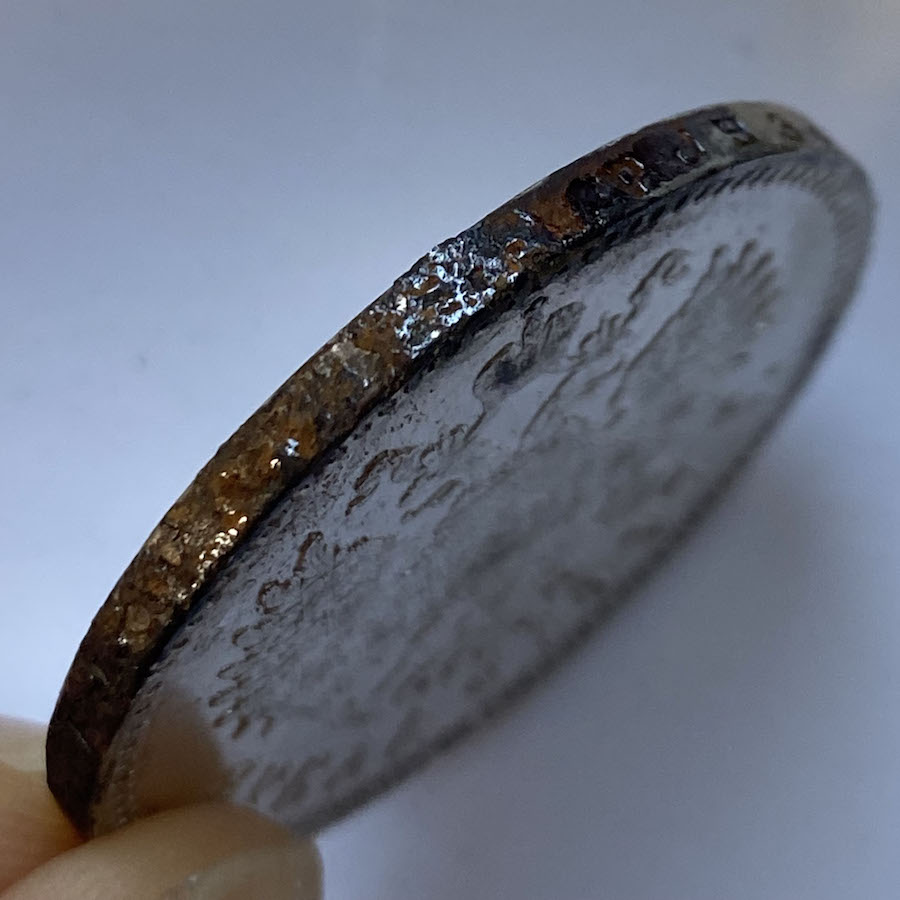 After doing thorough research, I have found numerous threads about cleaning corroded copper coins, but almost nothing about corroded silver. I believe this was the only decent thread with "before" and "after" photos: http://goccf.com/t/197889, where a decent result was achieved by dipping a coin in disodium EDTA solution. So I've found some soap with disodium EDTA and no acids in the ingredients list, made a solution out of it, and let the coin sit in it for 3 days. Result: no change whatsoever, rust was so stubborn, it couldn't be scratched off with a fingernail. So next I tried to squeeze some fresh lemon juice into a small dish (I used an aluminum holder of a tea candle). I know from before that citric acid does affect the metal surface and most threads advise against using it, but I thought I will give it a try. I placed a coin in a way, that only the corroded part would be submerged in juice and no longer than 30 minutes at a time - after each dip, parts of the corrosion could be easily removed with a fingernail. After repeating this about 5 times, almost all the corrosion was gone and I don't see any damage to the surfaces that were submerged. Here are the 'after' photos: 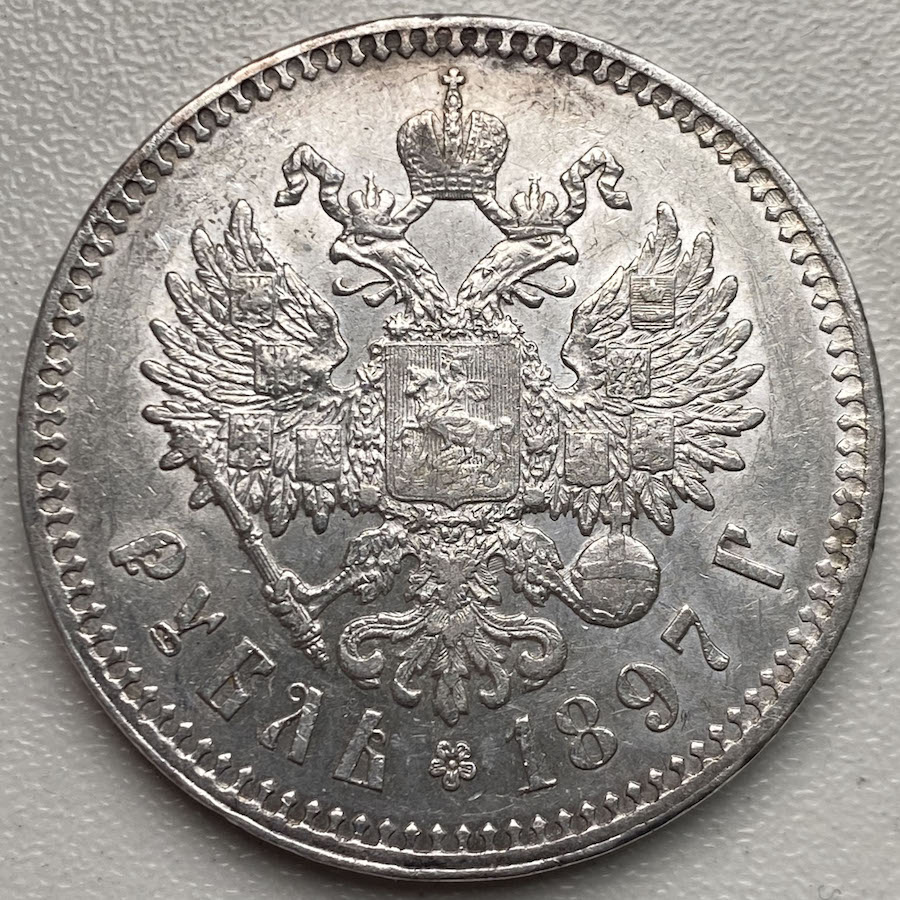 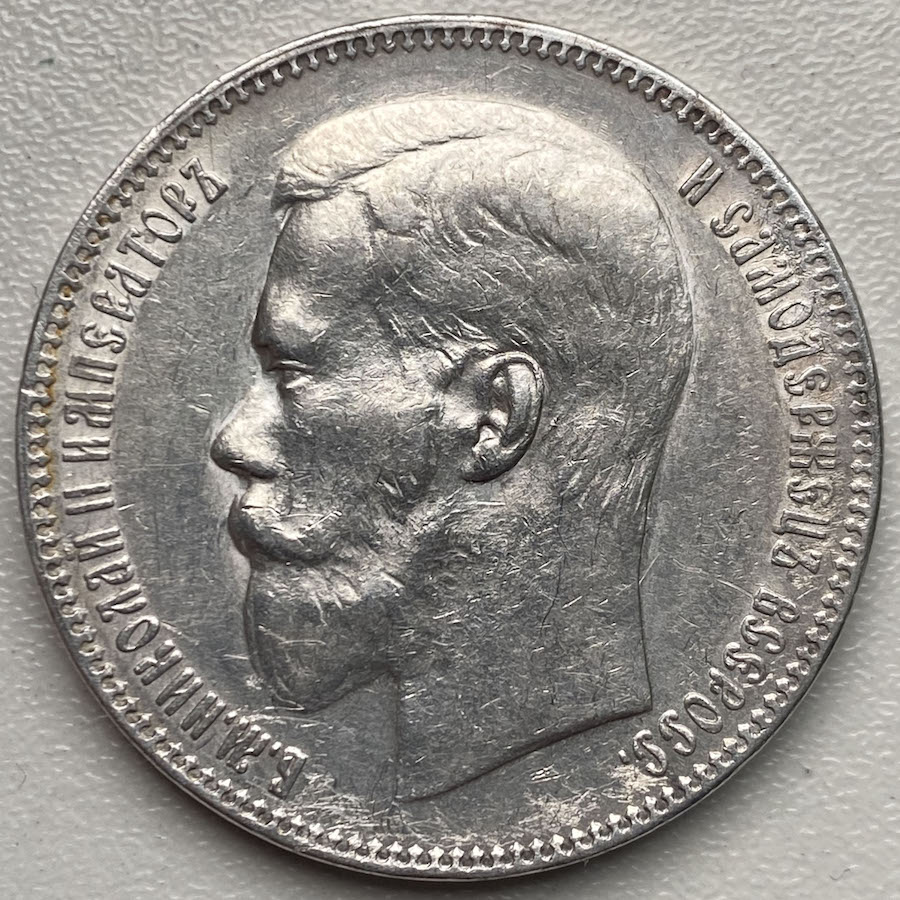  If someone has a similar issue, I hope they will find this thread useful in the future! |
|
|
|
Bedrock of the Community
United States
94367 Posts |
Very impressive!  |
|
Moderator
 United States
56855 Posts |
Much improved If you sent in to be graded, do you think it would get a details grade? John1  |
|
Moderator
United States
54286 Posts |
It does "look cleaned" now.
Show your financial support of the Coin Community Family (click here)See my topic on Mexican Numismatic Medals (click here) |
|
Pillar of the Community
Canada
557 Posts |
I suppose it would have got tagged with details either before or after. Impressive result, but definitely looks cleaned.
|
|
Rest in Peace
United States
18456 Posts |
 Nice turnout but would receive a details cleaned grade . |
|
Pillar of the Community
United States
753 Posts |
The coin looks much better. Did you just place the rim in the solution or the entire coin? It looks like the light level might have affected the photos of the before and after. Maybe I'm wrong. The rim is amazing after the cleaning!
|
|
Moderator
Australia
16898 Posts |
Quote:
...with a pretty badly corroded upper part (any thoughts on what might have caused it?). My best guess: a fire. With the damage restricted mostly to the rim, I'd guess it was inside a roll of coins that got caught in a fire; the paper burned and charred. My second-best guess: perhaps it was sitting on/with a piece of iron, and the iron rusted and the rust attached itself to the coin. Either way, it seems the underlying coin itself was not damaged (as was largely the case with my own experiment, which you've already linked to). 90% silver shouldn't and ordinarily wouldn't corrode like that, so it's more a case of something else nearby that's been doing the corroding. If you really want to find out what caused it, you could keep the solution you used to dissolve the corrosion, and have the solution chemically analysed. Don't say "infinitely" when you mean "very"; otherwise, you'll have no word left when you want to talk about something really infinite. - C. S. Lewis
|
|
Moderator
United States
15641 Posts |
Impressive results. Take a look at my other hobby ... http://www.jk-dk.art |
|
Valued Member
United States
191 Posts |
Interesting, and informative, discussion. Thanks to all the knowledgeable contributors.
|
|
Moderator
United States
191235 Posts |
Much improved. |
|
Pillar of the Community
Canada
6244 Posts |
Interesting test. Actualy the coin show clear was clean and not restore. Residues of chemical reactions could be easy detected. It is not a blame or such but trying it is a start. Before you go for please check the chemical formulas first and the reactions of such elements.
Now: First the EDTA. It is an acid Ethylenediaminetetraacetic acid (name) C10H14N2Na2O8 (formula). This could be dangerous because will decompose and form nitric acid which is disastrously for Ag and Cu.
Second the citric acid which it is mild acid (anhydrous) C6H8O (formula) and react with the Al (mistake to put on) and form an salt which react with the Ag molecules. This salt very white we can see now on the surface of the coin.
Third: Next time you try use ceramic surfaces of the container if you do not have glass. This will let your solutions to interact just with the coin and no other reactions will be.
Very interesting try. If we do not try, will never come to the correct side of the street.
My suggestion for home (I do not give you the formula and how we restore the coins here) for those 850 and more Ag coins:
1. soak the coin in sulfuric acid 30% (better 40%) at 50 deg for 1 hour or more (do not over 3 hours)
2. Rinse well in cold water (distillate)
3. Boil in 40% solution of boric acid 2 to 3 min. Look the coin. If need repeat this step.
4. After rinse with hot water and dry, boil in borax solution of 50% for 3 min.
5. Wash well in hot water and dry. Do not froth the coin during the dry.
Add PS: If after step 2 not much detach, we can soak the coin in onion (yellow strong) jus for a few hours.
Like this you do not loose the times patina and the coin could be graded. Do not expect have a coin as come from restoration because is different procedures.
Good Luck on the next experiment.
Edited by silviosi
12/15/2022 5:20 pm
|
|
Pillar of the Community
Canada
6244 Posts |
Forgot to say that for drying I use goldsmith cloth. Alternative will be glasses cloth.
|
|
Bedrock of the Community
United States
26154 Posts |
silviosi said:
"First the EDTA. It is an acid Ethylenediaminetetraacetic acid (name) C10H14N2Na2O8 (formula). This could be dangerous because will decompose and form nitric acid which is disastrously for Ag and Cu."
-EDTA is a very weak acid - it is a chelator that scavenges metal ions. It will not turn into nitric acid under normal usage.
"My suggestion for home (I do not give you the formula and how we restore the coins here) for those 850 and more Ag coins:
1. soak the coin in sulfuric acid 30% (better 40%) at 50 deg for 1 hour or more (do not over 3 hours) "
- Silviosi is worried about EDTA, but soaks coins in 30% H2SO4 at 50 deg for an hour? I shudder to think about the damage done. Hard to imagine that there would be much left after that abuse.
Inordinately fascinated by bits of metal with strange markings and figures
|
|
Pillar of the Community
Canada
6244 Posts |
@Hondo Boguss: H2SO4 it is a strong acid. The folk believe that the strong acids destroy or damage any metal . The reality it is not. Those acids act very hard on magnetic metals (ex: special with iron base alloys) Just thing at your car battery: has lead and cooper (both non magnetic) and the anode and cathode never go out staying in 35-40% H2SO4. This believe it is a folks. To be very clear on acids and Ag, Cu and Au. Only mild acids can dissuade those metals. The problems with those acids are those metals alloy are in (ex: zinc). For purity of 850 and more is no problem. I give the time cut in half for safety. The lowers acids are the most dangerous because has the capability to interact at short time and long time also. they exchange the ions very fast and deposit in any small cavity. For EDTA: You talk about Chelation?: Quote:
Chelation is the reaction between a metal ion and an organic complexing agent resulting in the formation of a ring structure that encompasses the metal ion and removes it (Olson, 2004). The most removal ions are lead, zinc. To use this EDTA for coins? why? Is good for dissuade the Ca and destroy the components of the alloy. Do not try use on nickel, will be a funny result. Edited by silviosi
12/17/2022 04:00 am
|
| |
Replies: 14 / Views: 3,419 |
|







 Posted 12/11/2022 11:34 am





