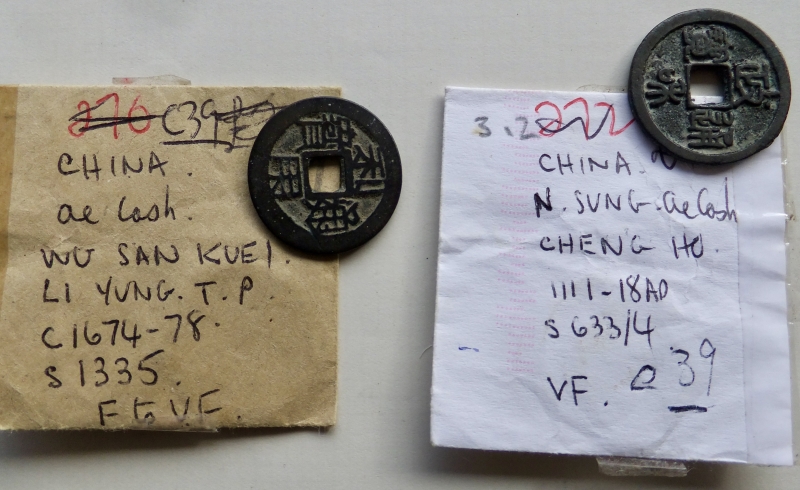
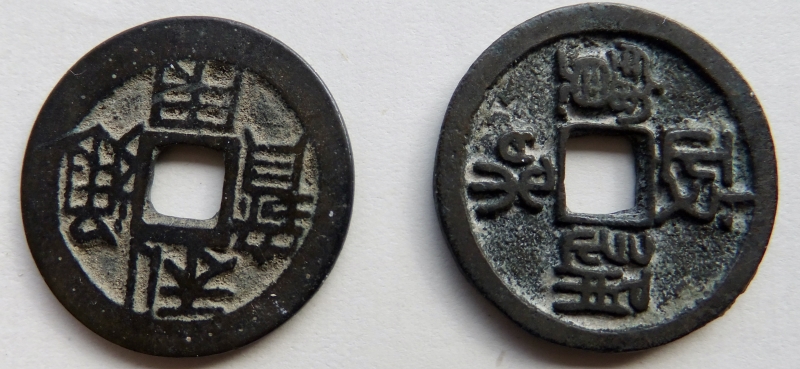
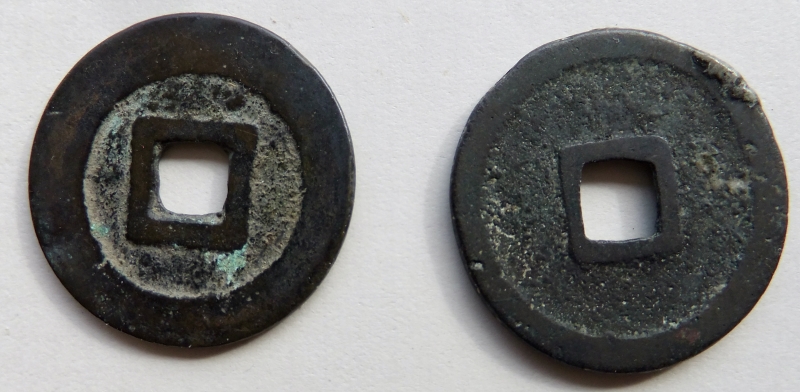
The descriptions are essentially correct (though it does use the old-fashioned Westernizations of the names). ANd just for your inforamtion: "right way up", for your larger pics, the coin on the left is upside-down, the coin on the right should be rotated 90 degrees anticlockwise.
Coin number 1 (on the left): The inscription (In Chinese) reads Li Yong tong bao). See this zeno.ru database page for similar coins:
https://www.zeno.ru/showgallery.php?cat=1603"Li Yong" was the reign-name of a rebel leader by the name of Wu Sangui. Wu Sangui was the Ming dynasty general who had opened the gates of the Great Wall at the Shanhai Pass in 1644, letting the northern Manchu invaders through to conquer China and establish the Qing Dynasty. Wu Sangui switched sides and fought for the Qing, hunting down the remnants of the Ming Dynasty in the western provinces. As a reward, the Qing made him governor of the southern province of Yunnan, which he ruled as a de-facto independent principality. Thirty years later, in 1674, the Qing Dynasty felt it was strong enough to abolish his province and demote him. In response he openly rebelled, issuing the Li Yong coins, but his rebellion was crushed by the Qing a few years later. Due to his betrayal of both his Ming Dynasty and Qing Dynasty overlords, he is regarded as a traitor in modern China; his name is used much like the name "Benedict Arnold" is used in America.
Coin number 2: Issued by the Northern Song Dynasty emperor Hui Zong, when he was using the Zheng He reign-name. Zeno.ru page:
https://www.zeno.ru/showgallery.php?cat=553A quick explanation of "reign-names" is perhaps in order. The Chinese believed an Emperor's personal name was too holy to be used by commoners, so instead, the emperor picked a catchy slogan they would rather be known by on their coins. It would be kind of like calling U.S. President F.D. Roosevelt "the New Deal President" - you knew who you were talking about, without having to actually use their name. Some emperors, particularly the later ones, picked a single reign-name and used it for their entire rule. Others, particularly the Song Dynasty, changed their reign-name every few years or so. Emperor Hui Zong reigned from 1101 to 1125, but the Zheng He period only lasted 1111 to 1117.
The Song Dynasty fancied themselves as artistic, and also strongly supported coin collecting. This is evident by the series of coins with different script styles they would issue, often in "sets" of two, three or four coin styles which were issued simultaneously. There is no rational reason why the government would issue equal quantities of coins with different script styles from the same mint, unless people were collecting those coins by script, and we know that coin collecting was indeed popular with the middle and upper classes in medieval China - the oldest surviving coin catalogues in the world date from the Song Dynasty. It is even possible that the Song reign-names changed so frequently just to give the coin collectors something different to collect. Your coin is written in "seal script", which is a much rounder, more archaic style of writing Chinese characters than the "regular" script used on your other coin; Zheng He coins come in both seal script and regular script flavours.
Don't say "infinitely" when you mean "very"; otherwise, you'll have no word left when you want to talk about something really infinite. - C. S. Lewis









 Posted 02/27/2023 12:52 pm





