










 Posted 02/26/2023 8:17 pm


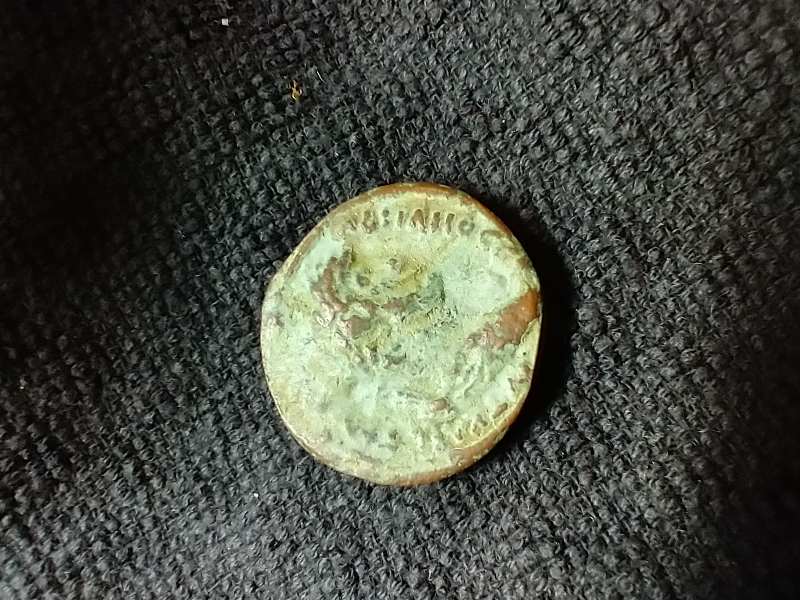
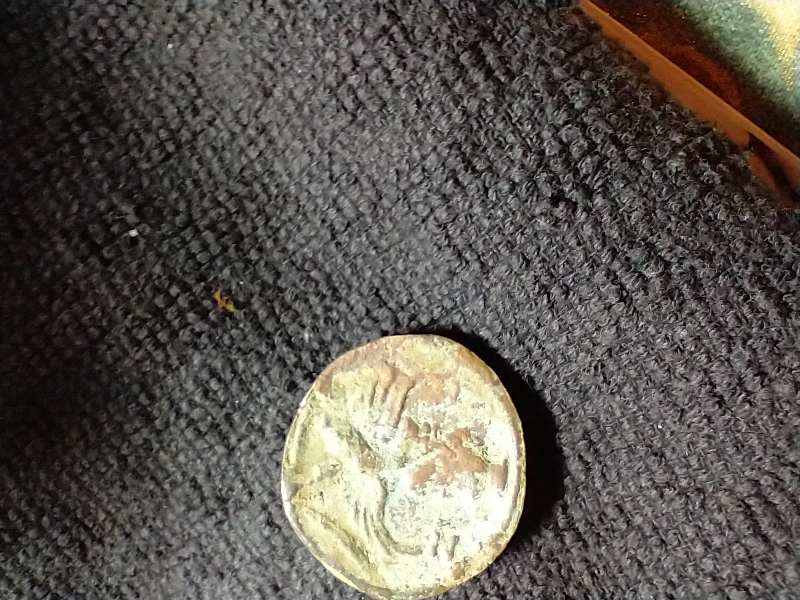
This is not a regular Roman coin that you are likely to find in a British garden. Rather, it is (or claims to be) a coin from Roman Egypt. Looks like a bronze drachm of Emperor Hadrian, Year 17 (AD 132/133), with the Egyptian winged god Serapis on the reverse. See this Wildwinds index page, then scroll all the way down to the coins labelled "Milne 1370".
Two things concern me about it's authenticity. First, I am a little concerned about the colour - it appears to be a thin layer of pale green corrosion, with brass/bronze underneath. I don't think ancient bronze should be turning that colour, nor should the green patina be that thin.
Second, One does have to wonder exactly how this coin came to Britain. In the time of Hadrian, Egypt was not like other Roman provinces, it was the personal property of the Emperor and had a closed economy (hence the separate coinage system). If you were a merchant doing business with Egypt, you weren't supposed to take any Egyptian coins with you when you left, and such coins would have been worthless outside of Egypt. Which means very, very few such coins are ever found in an archaeological context outside of Egypt.
Which leads me to assume that it's more likely to be a modern "tourist copy", of the kind frequently sold in tourist markets in Egypt. Selling genuine ancient coins to tourists is illegal in Egypt, but selling fakes is perfectly OK.
Two things concern me about it's authenticity. First, I am a little concerned about the colour - it appears to be a thin layer of pale green corrosion, with brass/bronze underneath. I don't think ancient bronze should be turning that colour, nor should the green patina be that thin.
Second, One does have to wonder exactly how this coin came to Britain. In the time of Hadrian, Egypt was not like other Roman provinces, it was the personal property of the Emperor and had a closed economy (hence the separate coinage system). If you were a merchant doing business with Egypt, you weren't supposed to take any Egyptian coins with you when you left, and such coins would have been worthless outside of Egypt. Which means very, very few such coins are ever found in an archaeological context outside of Egypt.
Which leads me to assume that it's more likely to be a modern "tourist copy", of the kind frequently sold in tourist markets in Egypt. Selling genuine ancient coins to tourists is illegal in Egypt, but selling fakes is perfectly OK.
Don't say "infinitely" when you mean "very"; otherwise, you'll have no word left when you want to talk about something really infinite. - C. S. Lewis


