At first glance, a coin for Groton, MA might seem like a strong candidate for the "Most Obscure" list, but, IMO, a direct link to Franklin Delano Roosevelt moves it to a half-step beyond inclusion on the list. (More about obscure US commemorative coins can be found here:
Most Obscure Classic-Era US Commemorative Coins.)
Groton, MA is a relatively small town in Massachusetts located west of Boston. Its roots are traced to a trading post established by John Tinker in 1655 - it was intended for trade with the area's Native Americans (primarily, the Nashaway). Others soon came to the area (i.e., farmers, tradesmen, etc.) to settle and quickly expanded the area's population. In that same year, Tinker, along with several others, petitioned the General Court of the Massachusetts Bay Colony to establish the Plantation/Town of Groton; the petition was granted in July 1655.
(Note: Groton was referred to as "Groaton" in the official papers at the time.)Seal of Town of Groton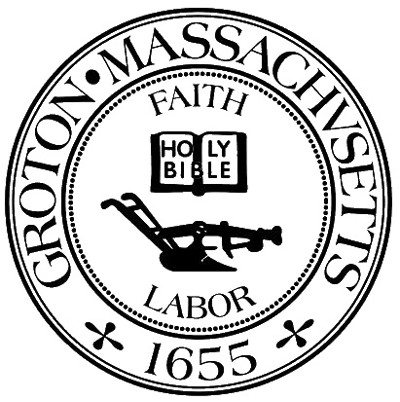 (Image Credit: Town of Groton. Public Domain.)
The Town continued to grow, and various mills (e.g., saw, grist, pewter) and factories (e.g., brick) eventually called it home. None rose to national prominence, however.
Groton's most enduring legacy is likely the two private preparatory schools founded in the town: Lawrence Academy (established in 1793) and the Groton School (founded in 1884); both continue to operate as prestigious, academically-elite, private co-ed college preparatory boarding schools. Franklin Delano Roosevelt attended and graduated from the Groton School (1896-1900).
Mrs. Edith Nourse Rogers (R-MA) introduced a bill in the 83rd Congress - another in the 84th Congress (1954 and 1955) - that called for "special 50-cent pieces in commemoration of the three-hundredth anniversary of the founding of Groton, Massachusetts."
The bills sought a commemorative half dollar that was, apparently, to be struck for circulation alongside the
Franklin half dollar (vs. replacing it) with the coin's mintage left up to the Secretary of the Treasury. Though the bills did not specify, they most likely were intended to authorize a one-year issue - the Groton Tercentenary year of 1955. The bills did not list a sponsor/beneficiary for the coin, nor language authorizing sale above par value - indicators of an intended circulation issue.
Each of the bills was referred to the House Committee on Banking and Currency, but neither was reported out. When their respective Congress adjourned, each bill died for lack of action.
For more of my topics on commemorative coins and medals, including many more What If? stories, see:
Commems Collection.







 Posted 03/07/2023 7:39 pm





