| Author |
 Replies: 13 / Views: 1,713 Replies: 13 / Views: 1,713 |
|
|
Pillar of the Community
United States
3356 Posts |
I received some medieval billon coins recently. The black ones don't bother me, but the ones with splotchy orange stains did. Since they're not very valuable I tried some silver test solution on them, which immediately removed the stains and left some rainbow hue. Can anyone explain the staining itself? "Two minutes ago I would have sold my chances for a tired dime." Fred Astaire
|
|
|
|
Moderator
 United States
34531 Posts |
@thq, a "before" pic would definitely help. Was it maybe so-called desert patina?
"If you climb a good tree, you get a push."
-----Ghanaian proverb
"The danger we all now face is distinguishing between what is authentic and what is performed."
-----King Adz
|
|
Pillar of the Community
United States
5825 Posts |
Too many possibilities.
Stains are often caused by improper storage conditions.
Or just improper handling.
|
|
Pillar of the Community
 United States
3356 Posts |
Lot 890 in CNG auction 535. https://auctions.cngcoins.com/lots/...ilver-issuesThe worst was on the 3 kreuzer, but the soldino was pretty bad too. All gone now. It wasn't hard to find many similar examples of orange blotches and discoloration on ebay, many in grading company holders. The Potosi 2R cob was my main interest. Philip II, Rincon mintmaster, from ca 1574-76. Not rare but very early. "Two minutes ago I would have sold my chances for a tired dime." Fred Astaire
Edited by thq
04/08/2023 1:25 pm
|
|
Moderator
United States
34531 Posts |
Ok definitely not a patina, but rather surface staining. I'd be interested to see an "after" pic. Here is the "before" for posterity: 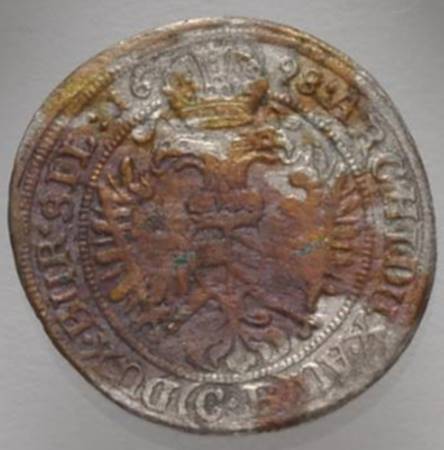 "If you climb a good tree, you get a push."
-----Ghanaian proverb
"The danger we all now face is distinguishing between what is authentic and what is performed."
-----King Adz
|
|
Pillar of the Community
United States
3356 Posts |
Here's "after" 5 seconds of silver test solution 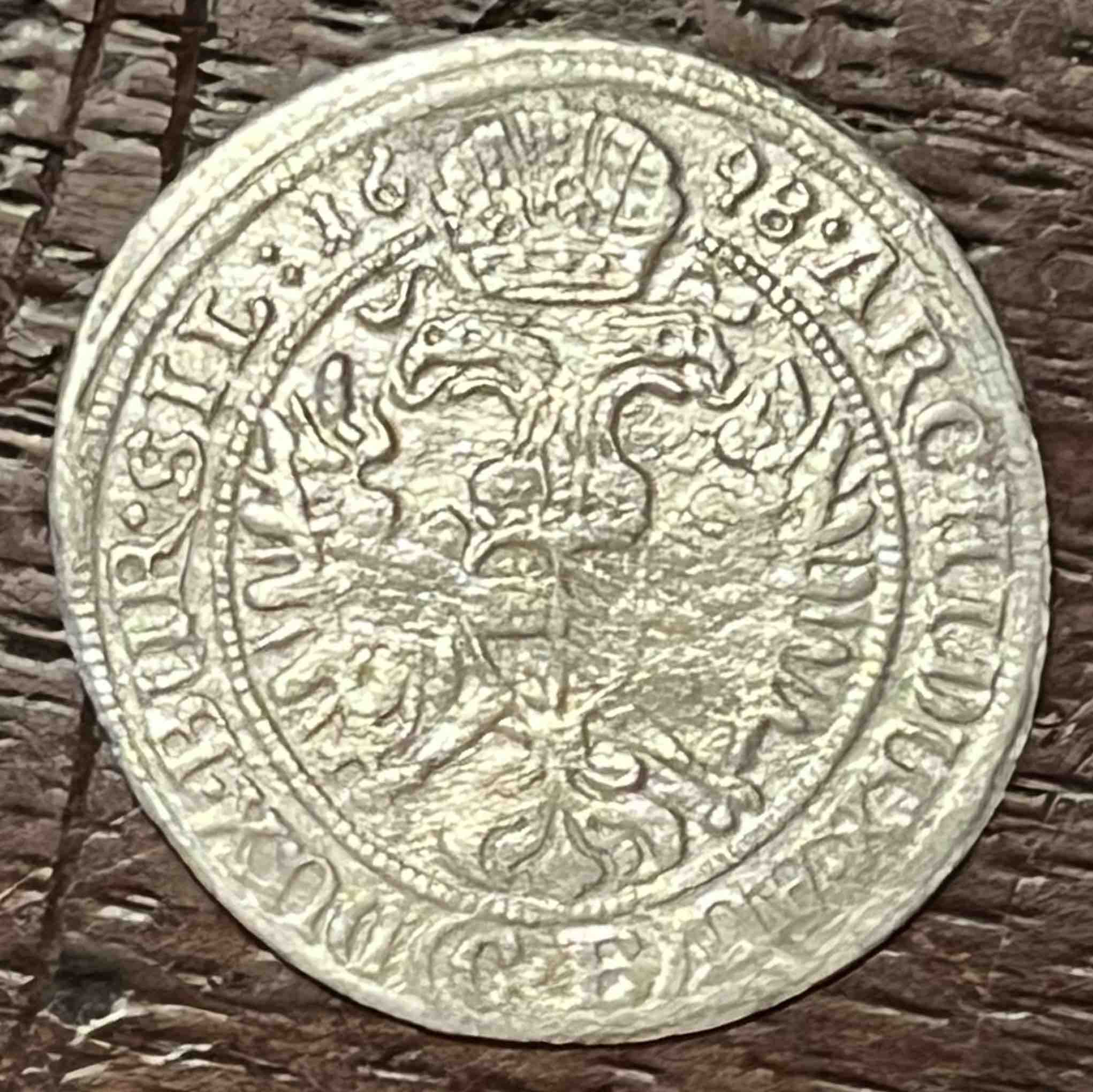 Maybe the naval jelly or lemon juice remedies would have worked too, but test solution gets results fast. From what I've read Roman billon is really hard to clean. The surface wrinkling/pitting was already there and can be seen more easily on the 6K. Test solution didn't help it, but my photo highlights it more. "Two minutes ago I would have sold my chances for a tired dime." Fred Astaire
Edited by thq
04/08/2023 3:20 pm
|
|
Pillar of the Community
 United States
8032 Posts |
One of the copper oxides is brown (cupric?). Billon normally has a fair amount of copper.
If the coin was not uniformly exposed, it could give a pattern like that.
I'm almost tempted to think that the stained coins came from the same collection, and were in a haphazard pile, with parts of the coins exposed, and parts in contact with other coins.
|
|
Pillar of the Community
United States
3356 Posts |
Possibly. Even the 2R had a little, as if they were in a rusty can.
"Two minutes ago I would have sold my chances for a tired dime." Fred Astaire
|
|
Rest in Peace
United States
632 Posts |
Did you use Silver Test Acid to clean it up? Please don't do that again... try 25% CLR immersion for a bit, rinse, pat dry and try some wiping with some sulphured vaseline to restore a surface to it
|
|
Pillar of the Community
United States
3768 Posts |
I've got a few old billon coins, and a couple of them have similar heavily-stained appearances. Other than an acetone soak to get off some crud, I've left them as is, however.
|
|
Pillar of the Community
United Kingdom
725 Posts |
I think it comes from deposits when coins are in a hoard, where others lay on top of them and keep bits of the surface fresh. This happens with silver coins all the time, not just billon. The deposits can be anything - for example, there may have been copper coins above them that leached their contents over everything beneath. I imagine these coins were left as is because it's how they were found. Anyone could clean an accidental stain with acetone.
Edited by JohnConduitt
04/09/2023 8:54 pm
|
|
Moderator
Australia
16962 Posts |
As a general rule, the more substances that get added to an alloy, the more chemically reactive it becomes. You have to carefully craft an alloy to make it the same or better corrosion resistance than the pure elements. And billon... isn't carefully crafted for corrosion resistance. Billon is designed to "look silvery" when freshly minted; what happens to it after that was not the government's concern.
As for the staining patterns, it may result from poor mixing of the alloy, or it may result from the circumstances under which they were kept or buried.
Don't say "infinitely" when you mean "very"; otherwise, you'll have no word left when you want to talk about something really infinite. - C. S. Lewis
|
|
Pillar of the Community
United Kingdom
1578 Posts |
Quote:
Here's "after" 5 seconds of silver test solution Wrong or not, I have used silver testing fluid for years to rid stains off of coins. I think on 'ancient' coins especially, it is down to the owner to decide how clean they want them. I do, however, only do this to coins that I keep in my own collection and not to coins that I sell on various sites. |
|
Pillar of the Community
United States
3356 Posts |
Silver test solution is not something I use on coins with high value. It has been useful for unexpected purposes, like removing this stain. It will take silver solder off of gold jewelry coins sometimes, and I have a nice-looking 1/2 escudo as a result. I used it to reveal a worn-off date on a Seated dollar once. It is an 1844, and the test solution revealed the ghost of last 4, like Nic A Date does on Buffalos. After reading about the file-and-sandpaper methods used to remove crud from Roman billon, silver test solution seemed pretty mild. "Two minutes ago I would have sold my chances for a tired dime." Fred Astaire
Edited by thq
04/10/2023 8:48 pm
|
| |
Replies: 13 / Views: 1,713 |
|





 Posted 04/08/2023 11:49 am





