









 Posted 06/12/2023 2:22 pm


To complete the story ...
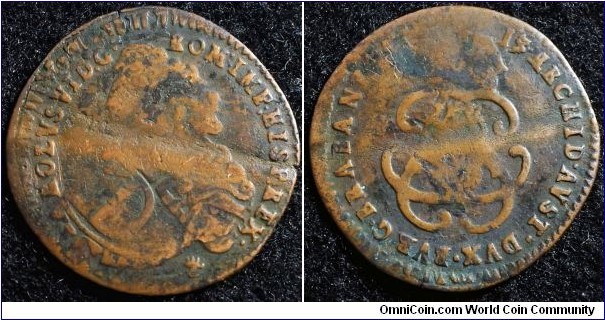
When the war of the Spanish Succession was settled, and Charles VI of Austria took possession of the Low Countries, the small change situation was a mess, so he promulgated a new copper coinage toward the end of 1711, which went into effect in 1712. All the old liards were declared obsolete, and could be turned in at the mint (Brussels and Antwerp) at a rate of 7 old ones for 6 new ones.
Each mint was authorized to strike 50,000 marks of new liards (about 3.1 million). The Brussels mintmaster prepared new blanks, but the Antwerp mintmaster struck them on the old liards, though this had been forbidden.
(A. de Witte, Histoire Monetaire des Comtes de Louvain, Ducs de Brabant, et Marquis du Saint Empire Romain, Vol III (1890), p.255-257).
Here are two others like yours:
https://www.acsearch.info/search.html?id=7307185
https://www.acsearch.info/search.html?id=3904547
When the war of the Spanish Succession was settled, and Charles VI of Austria took possession of the Low Countries, the small change situation was a mess, so he promulgated a new copper coinage toward the end of 1711, which went into effect in 1712. All the old liards were declared obsolete, and could be turned in at the mint (Brussels and Antwerp) at a rate of 7 old ones for 6 new ones.
Each mint was authorized to strike 50,000 marks of new liards (about 3.1 million). The Brussels mintmaster prepared new blanks, but the Antwerp mintmaster struck them on the old liards, though this had been forbidden.
(A. de Witte, Histoire Monetaire des Comtes de Louvain, Ducs de Brabant, et Marquis du Saint Empire Romain, Vol III (1890), p.255-257).
Here are two others like yours:
https://www.acsearch.info/search.html?id=7307185
https://www.acsearch.info/search.html?id=3904547
Edited by tdziemia
06/12/2023 2:28 pm
06/12/2023 2:28 pm


