Two US territories in the South Pacific were the subject of a proposed US commemorative silver dollar during the 103rd Congress: Guam and the Northern Mariana Islands. Each of the territories was the site of intense fighting during World War II, and was later the site of a Historical/Memorial Park created to honor the sacrifices made durinng the War.

The Pacific National Historical Park on Guam was established in 1978 to recognize those who served in the Pacific Theater of World War II.
The American Memorial Park was also established in 1978. It honors the American military personnel and Mariana Islands residents who fought in the Marianas Campaign of World War II; the Marianas Campaign pitted US forces and allies against those of the Japanese Imperial Army in a battle that lasted from June 1944 into November 1944.
Both parks are administered/managed by the US National Park Service.
In the 103rd Congress (1993-94), a busy time for commemorative coin proposals, the two parks were included in a commemorative silver dollar proposal introduced in the House of Representatives by Robert D Underwood (D-GU) for himself and 13 of his fellow US Representatives (eventually, over 200 cosponsors would sign on to the bill). The bill was referred to the Committee on Banking, Finance and Urban Affairs.
The bill called for 1.5 million silver dollars to be struck in 1994 with a design "emblematic of the heroism of the American forces that liberated Guam and the Northern Mariana Islands in World War II." The issue price of each silver dollar was to include a surcharge of $10.
The coins were to be struck for the benefit of the US Department of the Interior. The Interior was designated to receive the collected surcharges for its use in constructing two museum/visitor center complexes: one on Guam, and one on Saipan in the Marianas.
While introducing the bill, Representative Underwood remarked "... 1994, marks the 50th anniversary of the Marianas campaign of World War II. This event is especially significant to the people of Guam who have the distinction of being the only American territory occupied during World War II. After more than 2-1/2 years of occupation, the people of Guam emerged from a dark chapter of their history to find their world, their lives, and their island forever transformed by the war experience and the post-World War II years. The sense that Guam suffered, as no other American civilian community did, is basic to understanding the Guam of today. Anyone who understands the war experience understands why freedom and democracy are so vital to the people of Guam."
(Note: Per the US Department of the Interior, Guam was one of four US territories occupied by enemy forces during World War II, the territories were: Guam, the Philippines, Kiska and Attu in the Aleutian Islands of Alaska and Wake Atoll.)Despite the large number of co-sponsors of the bill, it did not gain the traction it needed and was not reported out of Committee or considered further by the House.
As noted, the bill would have aauthorized coins in support of a museum and visitors center for each historical Park. Though no commemorative coin was issued, each of the parks did eventually get a formal Visitors Center with museum exhibits.
2009 DC and US Territories Quarter - Guam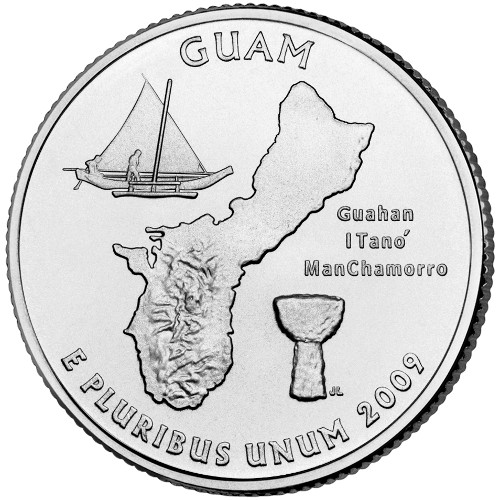 2009 DC and US Territories Quarter - Northern Mariana Islands
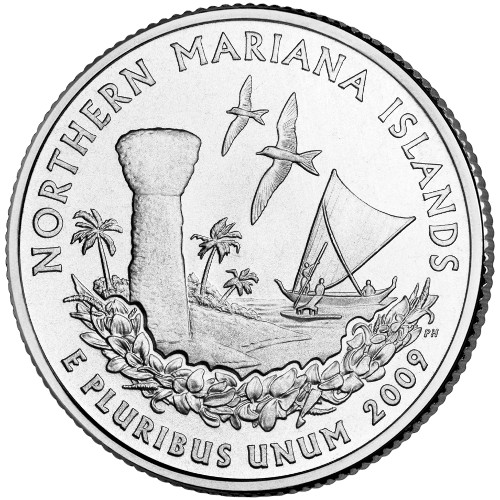 (Image Credits: US Mint media images. Fair use, education.)Note: The 2009 quarters did not collect surcharges to raise funds for the museums/visitor centers referenced above.
For more of my topics on commemorative coins and medals, including many more What If? stories, see:
Commems Collection.







 Posted 06/26/2023 11:14 am





