| Author |
 Replies: 20 / Views: 1,844 Replies: 20 / Views: 1,844 |
|
Pillar of the Community
United States
2265 Posts |
I have the 1946 edition of the Blue Book. Take a look at the value given for everyone's favorite Barber dime... I'm interested in comments! 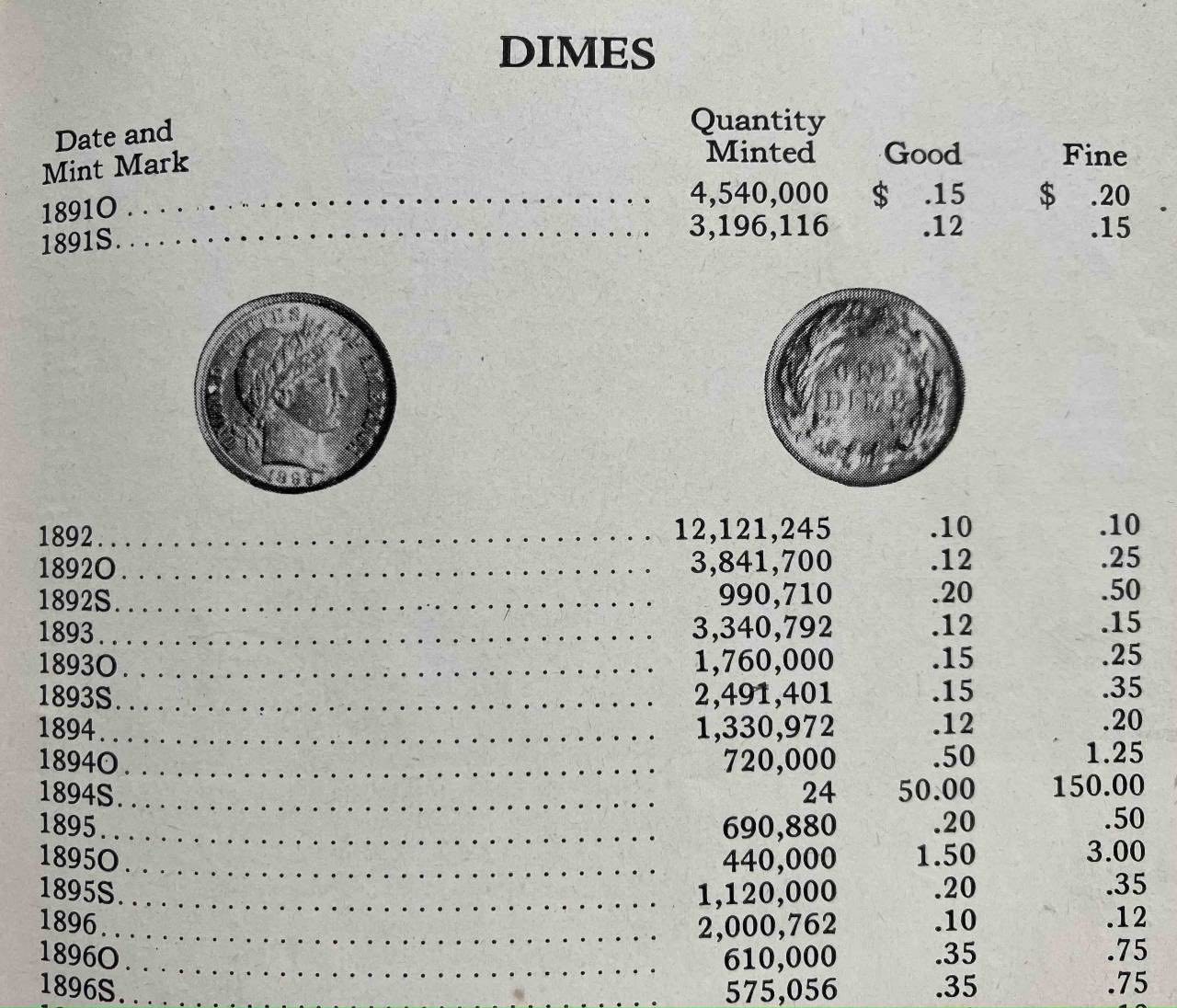 Edited by jpsned
07/05/2023 3:50 pm
|
|
|
|
Bedrock of the Community
 United States
27514 Posts |
"$150 in 1946 is equivalent in purchasing power to about $2,339.44 today"
Inordinately fascinated by bits of metal with strange markings and figures
|
|
Moderator
United States
110336 Posts |
$150.00 was a lot of money back then, However not knowing the exact amount minted was probably not well known kept the value down a bit compared to what it could have been.
|
|
Moderator
United States
198004 Posts |
Quote:
"$150 in 1946 is equivalent in purchasing power to about $2,339.44 today" From Numismedia: G4 is $81 and F12 is $100,000. If you bought one in 1946 at those prices you came out more than ahead.  |
|
Pillar of the Community
United States
2889 Posts |
|
|
Moderator
United States
198004 Posts |
More evidence that coins are not the best investment vehicle.  |
|
Bedrock of the Community
United States
94367 Posts |
Good grief!  |
|
Valued Member
United States
450 Posts |
Inflation is an enemy for all, even numismatists. I try to stick to Keys like this one, I was born in 1960. We were able to buy 6 Hershey bars for 25 cents plus 1 cent tax. (They were what is marketed now as King Size). In the seventies we still saw 90% silver in the circulating coinage, and I hoarded all of it, including the 40% Kennedy's from 65 to 69.
|
|
Valued Member
United States
202 Posts |
Not my series, but in the last 130 years has there ever even been a documented example of one in any grade below uncirculated condition?
|
|
Bedrock of the Community
United States
27514 Posts |
All 24 1894-S dimes were Proofs.
Inordinately fascinated by bits of metal with strange markings and figures
|
|
Moderator
United States
16015 Posts |
I say that is simply a made up value because they had to print something. Would have been more accurate to say N/A.
Take a look at my other hobby ... http://www.jk-dk.art |
|
Pillar of the Community
United States
3848 Posts |
Suffering from bust half fever. Want to learn how to attribute early half dollars by die variety? Click Here: http://goccf.com/t/434955Shoot me a PM if you are looking to sell bust halves. |
|
Moderator
United States
198004 Posts |
Quote:
All 24 1894-S dimes were Proofs. I did not realize that (not my series). I should have checked my Red Book first.  Now I wonder why Numismedia lists values for all circulation grades for it.  Quote:
I say that is simply a made up value because they had to print something. Would have been more accurate to say N/A. Seems that I have to agree. |
|
Pillar of the Community
 United States
2265 Posts |
Quote:
All 24 1894-S dimes were Proofs. While the coins may exhibit proof-like qualities, technically they are not proof coins. "Proof" refers to the way the coin was manufactured and not its condition. Many first-run coins exhibit proof-like qualities because the dies are new. The dimes should thus be properly referred to as "proof-like." There is no evidence that the dies were prepared as proofs. It's likely that people referred to them as proofs in order to make the seem more valuable. In any event, they are first business strikes, not proofs. |
|
Pillar of the Community
United States
2265 Posts |
Quote:
I say that is simply a made up value because they had to print something. Would have been more accurate to say N/A. I agree. In 1946, these coins were only 52 years old and the numismatic world knew a lot less about them than it does today. I can see the editors scratching their heads and thinking, "How do we assign a value to a coin with such a small mintage?", with the answer being, "I got an idea. Let's just say $50 and $150 and be done with it. That's a lot of money and people will be impressed." |
|
Pillar of the Community
United States
2265 Posts |
Quote:
Not my series, but in the last 130 years has there ever even been a documented example of one in any grade below uncirculated condition? Out of 24 coins minted, ten are known. Eight are graded as proofs (though technically they're not proofs, only proof-like). The ninth specimen--found in a Gimbel's department store junk cash box in 1957 and purchased for $2.40--is graded G4. The tenth coin is graded AG4. Edited by jpsned
07/06/2023 12:37 pm
|
| |
Replies: 20 / Views: 1,844 |







 Posted 07/05/2023 4:02 pm


 Uncirculated American Silver Eagles


