|
This page may contain links that result in small commissions to keep this free site up and running.

Welcome Guest! Registering and/or logging in will remove the anchor (bottom) ads. It's Free!
To participate in the forum you must log in or register. | Author |
 Replies: 10 / Views: 1,233 Replies: 10 / Views: 1,233 |
|
|
Pillar of the Community
United Kingdom
1273 Posts |
I just picked up this beautiful 'silvered' Jeton. It depicts the battle of Leipzig of 1813, where Napoleon lost to the allied powers. Leipzig was the biggest of the Napoleonic battles and also the largest prior to WW1. There were 560,000 soldiers, 2,200 artillery pieces, the expenditure of 400,000 rounds of artillery ammunition, and 133,000 casualties. The coalition armies of Russia, Prussia, Austria, and Sweden, led by Alexander I of Russia and defeated the French army of Napoleon I, Emperor. This one is particularly well preserved, with nice peripheral toning. Pleased to add it to my collection, and excited to see how NGC grades it. Hope you like it. 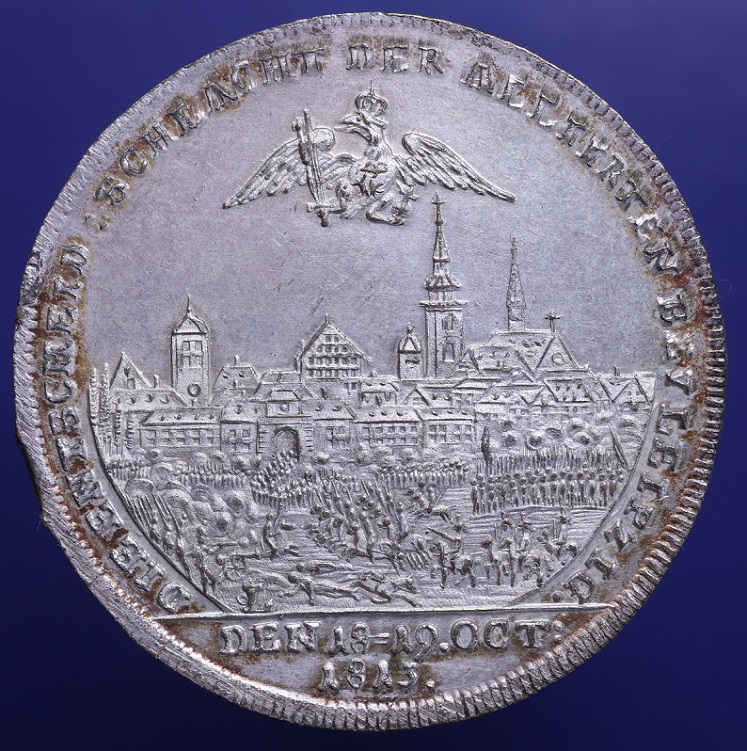 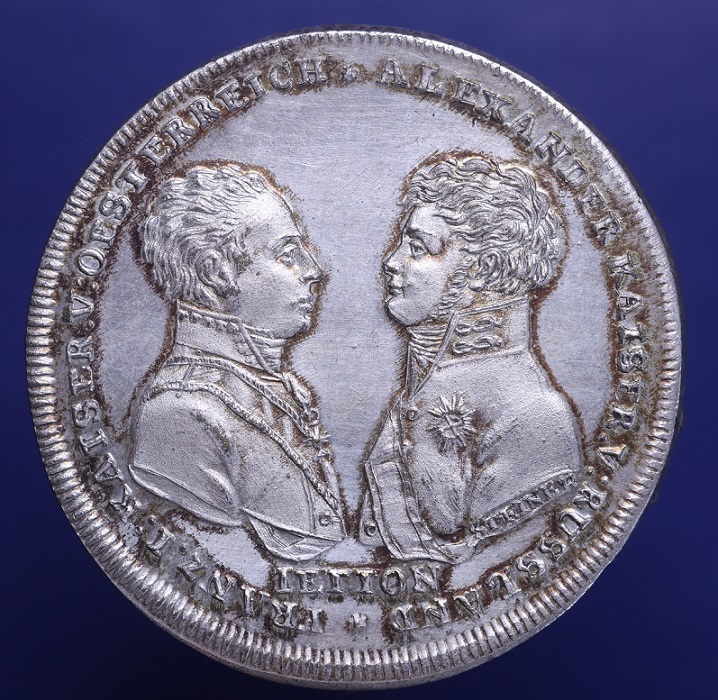 |
|
|
|
Pillar of the Community
Russian Federation
1559 Posts |
Great token  . Is it an old or a modern token ? |
|
Pillar of the Community
 United Kingdom
1273 Posts |
Old token made by JOHANN THOMAS STETTNER. I believe he died in 1840 so it was prior to then. Probably sometime after the battle itself.
Its also in the Bramsen catalogue of Napoleonic medals.
Edited by TobyJ
08/03/2023 11:52 am
|
|
Moderator
 United States
195300 Posts |
Very nice! |
|
Moderator
United States
34542 Posts |
That is a cool token. Thx for posting.
You may remember that several years ago we had an ongoing thread where we would post an attribute (e.g. smallest coin, coin with the fewest letters on it, etc.) I'm thinking that this token would win "most people depicted". There must be a couple hundred!
"If you climb a good tree, you get a push."
-----Ghanaian proverb
"The danger we all now face is distinguishing between what is authentic and what is performed."
-----King Adz
|
|
Pillar of the Community
United Kingdom
1273 Posts |
Brilliant, I think it be a contender for that!
|
|
Pillar of the Community
 Sweden
2124 Posts |
Wow, that is a great jeton! Congrats to a splendid acquisition!
A splendid jeton, but a horrible battle. Dead men and horses can be seen on the jeton. An eye witness in the Swedish troops wrote in a letter (my translation):
Leipzig on the 21st [two days after the battle]
The Lord has now taken us so far, but when you see the way here, you almost fear therefore. At a short distance from here there are already dead bodies; closer to the town, especially by a village they are piled up, you cannot imagine what it looks like there. One person next to another, and among those were still on the third day many who were still alive. In the town, it looks wretched. Dead horses lie everywhere, and among them here and there a man ...
The 30,000 Swedes participating in the battle were led by Swedish Crown Prince Charles John Bernadotte, who up until 1809 had fought on Napoleon's side, as one of his Marshals. He later became King of Sweden, the first of the House of Bernadotte (which still rules). I wonder what thoughts he had, now fighting the Grande Armee which he himself had been part of for so many years.
|
|
Pillar of the Community
United Kingdom
1273 Posts |
Wow that's amazing, thanks so much for posting that. What heck these people lived through, and not really that long ago too in the grand scheme of things. Didn't know that about the Swedish king. Currently reading a campaign book on Leipzig by Peter Hofscroer and one page reads: Quote:
"Charles John, Crown Prince of Sweden. Commander of the Army of the North and also a Marshal of Napoleon's, the then Jean Bernadotte accepted an offer of succession to the Swedish throne on the death of its childless holder. Bernadotte was always a controversial character who certainly knew how to look after his own interests best. Unpopular amongst his peers, regarded as a traitor by the French and an upstart by the Prussians, his successors still hold the crown of Sweden, the only surviving family to have received royal status during the Napoleonic Wars.
Swedish Forces in Germany:
Brandenburg, Corps Stedingk 23,449.
Mecklenburg as part of Wallmoden's Corps Brigade Bergenstrohla, 3,814.
The Baltic port of Stralsund was garrisoned with 2,452 men." Quote:
The Swedish army consisted of Swedes and Germans, the latter coming from areas of Germany then under Swedish control. The latter were organised into two regiments of infantry, a militia which was not used in active service and two small volunteer detachments. The ethnic Swedish troops were partly volunteers, men performing military service to the crown in return for a grant of farm land on completion of their service. The army's discipline, equipment, kit and armament were of a good standard. The officer corps was considered mediocre because of its lack of experience in the field. About half the army remained in Sweden, deployed along the border with Norway which, being under the Danish crown at the time, was fighting in alliance with the French. The Swedes were unenthusiastic participants in this war. Their small force was participating largely for political reasons so that the Crown of Sweden could claim representation at the peace talks, hoping for territorial aggrandisement. |
|
Pillar of the Community
Sweden
2124 Posts |
Quote:
About half the army remained in Sweden, deployed along the border with Norway which, being under the Danish crown at the time, was fighting in alliance with the French. The Swedes were unenthusiastic participants in this war. Their small force was participating largely for political reasons so that the Crown of Sweden could claim representation at the peace talks, hoping for territorial aggrandisement. ... and being successful in that: Denmark had to cede Norway to Sweden after the war, making Charles John King of Norway as well as of Sweden. Thus there are coins from both Norway and Sweden with his portrait. Quote:
Bernadotte was always a controversial character who certainly knew how to look after his own interests best. Unpopular amongst his peers, regarded as a traitor by the French and an upstart by the Prussians A tough start maybe.  Over time he became popular among the Swedish people - he modernised the country in many ways, from a backward agricultural society to the first steps into industrialisation. He never learnt Swedish though, which was probably not a problem, as most of the high nobility he associated with were well acquainted with French. |
|
Pillar of the Community
Russian Federation
1559 Posts |
I read a little about Jean-Baptiste Jules Bernadotte. And it seems there were no prerequisites for his removal from service in the Napoleonic army, except for rumors that Bernadotte is not loyal. Apparently Sweden made him an offer that he could not refuse (to become the king of Sweden). Quote:
He never learnt Swedish though, which was probably not a problem, as most of the high nobility he associated with were well acquainted with French. French was also popular in Russia. I think that all the upper class of Europe spoke French. This is a plus, you don't need to hire a translator. |
|
Pillar of the Community
United States
541 Posts |
|
| |
Replies: 10 / Views: 1,233 |
|
To participate in the forum you must log in or register.
 
- How Dan O'dowd Built One Of The World's Greatest Ancient Coin Collections
- Top Coin Collecting Stories For The Week Of September 18, 2026
- 1949 Lincoln 1c Damaged 4?
- Help With Identification Please.
- 1969-S Lincoln Cent Machine Doubling Or Double Die Obverse
- 1999 Lincoln Cent - Die Clash
- 1809 Half Cent For Grading
- 1987 - D Lincoln Cent Grade Check
- 1987- D Lhc Possible RPM Or DDO In Date
- You Know What I Want That Final Number To Be
- Bronze Coin To Id. Greek Or Roman?
- A Ridiculously Badly Written Computer Aided Book, Coin Collecting Bible, 2024
- Liberty Head 10/11 Stars Obverse With A Sick Looking Eagle On The Reverse Holed 0.59g 13.06mm
- The Tyrant Collector - PCGS Youtube Interview
- Counterfeit Detection: ANA Video - Introduction, With Brian Silliman And Jim Robinson Ep. 1
- Counterfeit Detection: ANA Video - Mistakes, Risk Factors, And Counterfeits & Alterations, Ep. 2
- Counterfeit Detection: ANA Video - Pimples And Pits, Looking At Cast Counterfeits, Ep. 4
- Counterfeit Detection: ANA Video - What Year Is That Cent? Key Date Coins, Ep. 5
- Counterfeit Detection: ANA Video - Diagnostics Of The 3, 5, And 10 Cent Coins, Ep. 6
- Counterfeit Detection: ANA Video, Counterfeit Quarter Dollar Diagnostics, Ep. 7
Disclaimer: While a tremendous amount of effort goes into ensuring the accuracy of the information contained in this site, Coin Community assumes no liability for errors. Copyright 2005 - 2026 Coin Community Family- all rights reserved worldwide. Use of any images or content on this website without prior written permission of Coin Community or the original lender is strictly prohibited.
Contact Us | Advertise Here | Privacy Policy / Terms of Use
|
| Coin Community Forum |
© 2005 - 2026 Coin Community Forums |
| It took 0.32 seconds to rattle this change. |
 |
|
| |
| |







 Posted 08/03/2023 11:45 am


