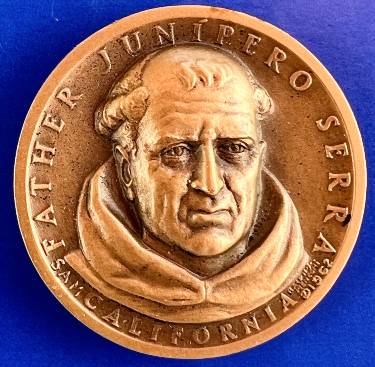
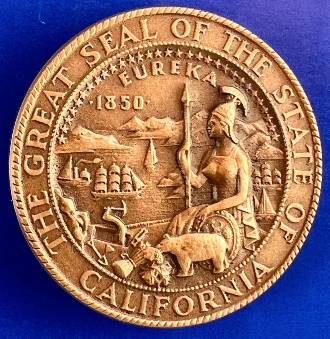
In February 1963, during the First Session of the 88th Congress, bills were introduced that called for the "striking of a medal in connection with the commemoration of the 250th anniversary of the birth of Padre Junipero Serra." Serra was a Catholic priest from Spain; he was a member of the Franciscan Order. (More on Serra below.)
Padre Junipero Serra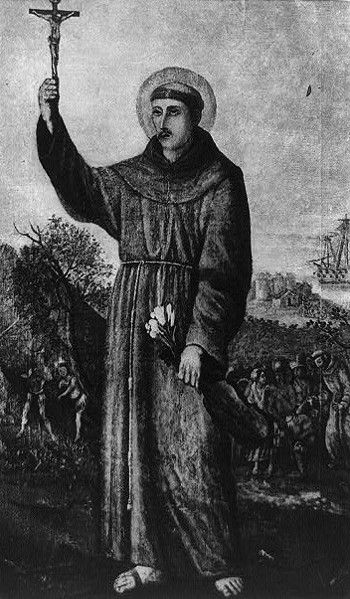 (Image Credit: Library of Congress, Prints and Photographs Division. Public Domain.)
In the House, all 33 Representatives from California introduced identical bills - 32 of them on February 7th, #33 on February 14th. On the same day, February 7, 1963, Senator Thomas Henry Kuchel (R-CA), on behalf of himself and Clair Engle (D-CA), introduced a near-identical bill.
The bills called for up to 300,000 medals to be struck for the benefit of the Padre Junipero Serra 250th Anniversary Association ("Association"). Authority for the striking of the medals was set to expire on December 31, 1964. The minimum order for the medals was 2,000, with the sizes and metals used for the medal planchets to be determined by the Treasury in consultation with the Association. The medal was designated a National Commemorative Medal (meaning a medal of national significance).
The House bills were all referred to the House Committee on Banking and Currency, the Senate bill to the Senate Committee on Banking and Currency.
At the time of its introduction, Senator Kuchel offered the following remarks:
"The years 1962 and 1963 have particular significance in the history and development of the State of California. In 1962 the State became the most populous one in our Federal Union. In 1963 Californians will honor the memory of a pioneer who probably never envisioned such rapid growth, but whose own efforts provided so much of the foundation for it-the Golden State's first citizen, Padre Junipero Serra.
This year marks the 250th anniversary of the birth of the Spanish friar who introduced Western civilization into the area which has become the modem State of California. At an age when many think of retirement, ·Padre Serra accepted the challenge of a new mission field. Remaining true to his motto, "Always to go forward and never to turn back," he devoted the final 15 years of his life to laboring among the Indians of California. Despite physical misfortunes and the despair of his associates, he established 9 of the 21 Franciscan missions which stood as milestones along El Camino Real, the trail he himself blazed through the wilderness.
Padre Serra exemplified the contributions made by many citizens of Spanish descent, in creating our unique California culture. His purpose was to Christianize Indians; but he accomplished much more. He developed temporal institutions - economic, political, and social - to bring order to a primitive, restless land. I think it is interesting to note that that was a few years before the time when other men of good will met to draft the Constitution which still guides the destinies of our Republic. The missions which Serra planned and established brought progress. Indians, who had enjoyed no familiarity with work or industry, were trained in more than 50 trades. Agriculture was developed to such an extent that during the peak year of the mission period - 20,000 natives were fed, housed, and clothed in mission settlements. By effectively colonizing the mission lands and civilizing their inhabitants, Padre Serra and his fellow Franciscans initiated a period of progress which we, 250 years later, still enjoy in the Golden State.
Mr. President [of the Senate], Californians will always remember the missionary, Junipero Serra, a man who truly matched our mountains. Some 30 years ago we recognized his memory by conferring the highest honor that any State can confer: We selected him, as one of our State's two representatives, to be honored by a statue to stand in Statuary Hall, in the Nation's Capitol. I think it is now time - during this anniversary year - to accord national recognition to.the endeavors of this venerable padre of the Mission Trail. One of the most effective methods we have of thus honoring our pioneering forebears is through the striking and issuance of a commemorative medal by the Treasury Department. These medals will be completely privately financed. I am delighted to author such an authorizing bill. My colleague from California [Mr. ENGLE] joins me, as do the members of the California delegation in the House of Representatives, in sponsoring this bill authorizing the Secretary of the Treasury to produce a Junipero Serra Medal, honoring our first citizen and pioneer."The Senate was the first to report the bill out of Committee; it reported the bill favorably with a recommendation for it to pass. The Committee made a small amendment to the title of the bill, correcting an accidental reference to the "250th anniversary of
the death of Padre Junipero Serra" to
"the birth." This death-to-birth change brought the title into alignment with the text of the bill.
The Senate considered the bill and passed it without objection. Its title was amended as recommended, and the bill was sent to the House for its consideration. Once received, the bill was sent to the House Committee on Banking and Currency. The Committee reported it without amendment and recommended that it pass. When considered by the House, the bill was passed without discussion/objection - this action ended the journey of the 33 House bills.
The Senate bill was examined and signed in each chamber and presented to the President for final approval. US President John Fitzgerald Kennedy signed the bill into law on October 16, 1963 - little more than a month before he was assassinated.
The Association had the Mint produce 2,000 medals in bronze, 10,000 in 0.900 fine silver and 25 in platinum. (Totals far from the 300,000 authorized.) All of the medals measure 1-5/16" in diameter.
Frank Gasparro was the designer of the piece (his "FG" initials are seen on the reverse, just off the southeastern portion of the California map).
1963 Padre Junipero Serra Commemorative Medal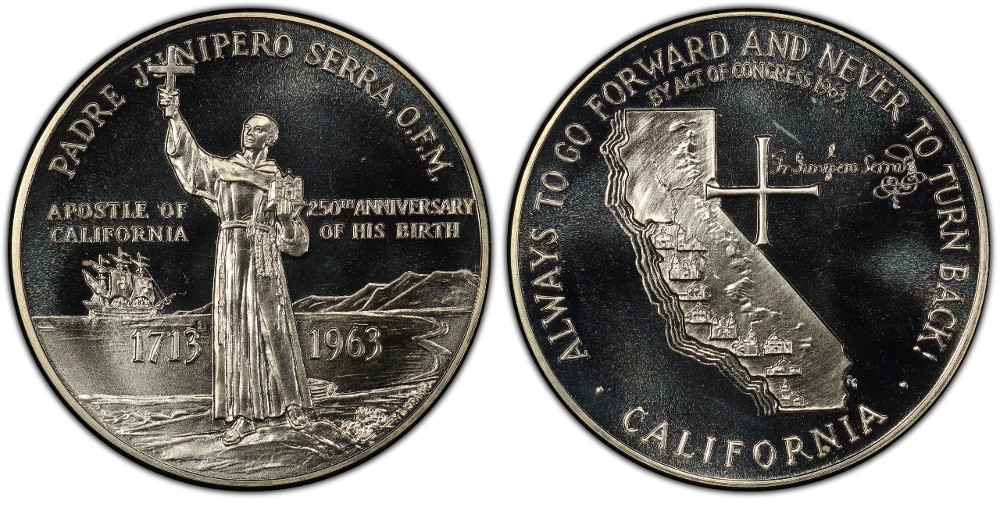 (Image Credit: PCGS CoinFacts. Fair use, education.)
Padre Serra standing on a California beach is the central figure on the obverse, with his upraised right arm/hand holding a cross. In his left arm is cradled a miniature church/mission (symbolic of his missionary work in California). "PADRE JUNIPERO SERRA, O.F.M." is inscribed above Serra at the rim, with the inscriptions "APOSTLE OF / CALIFORNIA" and "250th ANNIVERSARY / OF HIS BIRTH" flanking. The anniversary dates "1713" and "1963" also flank the figure of Serra. In the background is seen a Spanish sailing ship. (Note: "O.F.M." represents "Office of Foreign Missions.")
The reverse design presents an outline map of California, with the waters of the Pacific Ocean rippling along its shore. Miniature mission buildings are depicted along the coast, symbolic of the nine missions that Serra personally founded (out of 21 total California Missions). To the right of the map is a cross with Padre Serra's signature beside it. Encircling at the rim is the inscription "ALWAYS TO GO FORWARD AND NEVER TO TURN BACK! - CALIFORNIA -". Below the inscription, centered on the 12 o'clock position, is "ACT OF CONGRESS 1963".
I have bronze and silver examples of the Serra medal in my collection, including a silver example embedded in an acylic paperweight. I thought I had a bead on a platinum example one time, but it turned out to be a case of mistaken identity with a silver example. (I used a PCGS CoinFacts image here for convenience.)
For other of my posts about commemorative coins and medals, including other US Mint National Commemorative Medal posts, see:
Commems Collection.







 Posted 08/09/2023 10:49 am