| Author |
 Replies: 8 / Views: 1,162 Replies: 8 / Views: 1,162 |
|
|
Pillar of the Community
Italy
1132 Posts |
I feel there isn't too much interest in these papal medals but I like them and buy when I find them at a considerable discount. Pope Paul II and piazza Venezia... 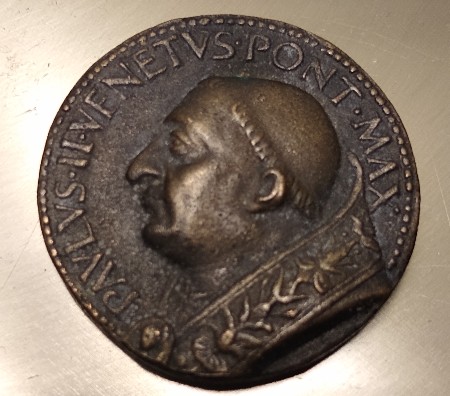 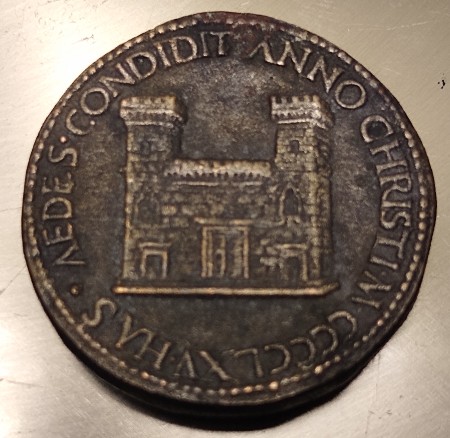 |
|
|
|
Pillar of the Community
 United States
7978 Posts |
Very nice! Sometimes when looking for late medieval Italian coins I see medallic works like these. So far, I have resisted the temptation  In particular, there are some medallic representations of the Este Dukes of Ferrara (at least one was done by Pisanello if I recall correctly). There are 19th century restrikes that are affordable (but still not cheap).. |
|
Pillar of the Community
 Italy
1132 Posts |
@tdz, I do not usually buy things think this, but the image of Paul and the Piazza interested me; the bronze sat unsold for nearly two months in a shop here, so the price discounted. I am assuming that bronzes are less collected; the silver papal medals are plentiful here, but also sell rather quickly. . . I pass through Piazza Venezia infrequently, but it is a major landmark in the city . . .
I do see A LOT of cast restrikes/ rusted die restrikes of papal medals. Surprisingly, those also get bought.
Edited by Roma2021
09/02/2023 2:45 pm
|
|
Pillar of the Community
United States
2284 Posts |
That Papal medal is cool. I have a few Papal coins.
Edited by livingwater
09/03/2023 10:25 am
|
|
Pillar of the Community
Portugal
695 Posts |
One information. Genuine italian late renaissance and early modern medals are cast, not struck. There are some very rare struck medals of this era, in silver mostly. Dealing with italian renaissance era medals is tricky. Because they were cast they are easy to copy. Interest in the late nineteenth century led to forgeries. Or copies to be kind. @tdziemia all Pisanello works that I read about are cast. The genuine ones are indeed unaffordable. The most extensive catalogs remain nineteenth century works. Never reprinted. The Cabinet des Medailles of Paris gathered a huge collection. Much of it remains hard to access and out of the modern catalogue of the french national library. A visitor to the museum sees only the best in exhibition. The old imperial collection of Vienna may have the second greatest collection. I have not seen them published in any recent work. Central Italy in the middle nineteenth century had wars. Many a ducal collection may have been moved to Vienna to keep them out of the greedy hands of the french and piedmontese. How easily can you find these medals in Rome? I would have thought a genuine bronze medal of the renaissance to be very expensive. I am sorry but I suspect the one pictured here can be a nineteenth century imitation. This is how an original cast should look, notice the bolder letters. https://vive.cultura.gov.it/en/pala...aul-ii-barbo |
|
Pillar of the Community
United States
807 Posts |
I've seen a Pisanello, actually "the" Pisanello, the medal on the Council of Constance which is often adduced as the first medal in the modern sense. This was in the Mint Museum, Quai de Conti, Paris. It was a gratifying moment for a numismatist.
Both the collection, and the library, of the State Numismatic Museum of Bavaria (originally the numismatic collection and library of the Wittelsbach Kings, and not neglected since the Revolution of 1918), are excellent, and it is no bad plan to consult the curators on disputed points.
|
|
Pillar of the Community
Portugal
695 Posts |
I should not be too hasty in condemning the medal. Want to stress that the differences only raise a question. I have seen examples of cast medals of this era with different casts in base metal.
If the personage or event that motivated the distribution of the medals was important enough then more than one mold would could have been used. To make a large number. And a pope is important and could want to distribute the medal to a number of other people attending. It is only less usual to see more than one version in base metal.
Where is more normal to see differences is between the base metal version, the noble metal version that would deserve work on after the cast, and any initial proofs in lead. Ancient medals are something I only dabble in, from curiosity.
The molds of the era would not be usable for more than a few copies. Now I noticed the date, this is an early, renaissance medal. Perhaps only one copy per mold? And the model would wear and need retouching as more molds were made?
@Roma2021 You may try to find this study from George Francis Hill, the medals of Paul II. It has a number of plates, may explains this medal. I could not find a open copy. It is from 1910 but remains locked down.
Edited by jecz79
09/07/2023 08:33 am
|
|
Pillar of the Community
Italy
1132 Posts |
@jecz, for Italian and papal medals I usually use Moruzzi Numicatics' website and "lamonet.it". The later is entirely in italian. These sites are good at identifying restrikes and recasts.
The examples of 19th century restrikes and recasts are typically done on poorly recreated dies or molds with ample evidence (rusting, putting, etc.) On the old dies and molds.
Edited by Roma2021
09/07/2023 12:08 pm
|
|
Pillar of the Community
Portugal
695 Posts |
|
| |
Replies: 8 / Views: 1,162 |
|










 Posted 09/02/2023 2:12 pm


