NGC -
Leading the Eastern Roman world typically meant a ruler was celebrated on coinage, but the job was one of history's most dangerous.Constantinople was dedicated in May 330 and captured by the Ottomans in May 1453. In those 11 centuries, more than a dozen leaders of the Roman world in the East perished as a result of political upheaval or palace intrigue.
Historians have widely ranging ideas about when the Roman Empire fell, and the so-called Byzantine Empire began. Among numismatists, the traditional date is the reign of Anastasius (A.D. 491-518), but we'll start our survey a little early, in the aftermath of Rome's first Christian emperor, Constantine I 'the Great' (A.D. 307-337).
Late Roman and Byzantine history is rife with betrayal and bloodshed, and in this column, we'll delve into some of the stories of emperors who met an unhappy fate.
 Check out Ancient Coins on ebay
.
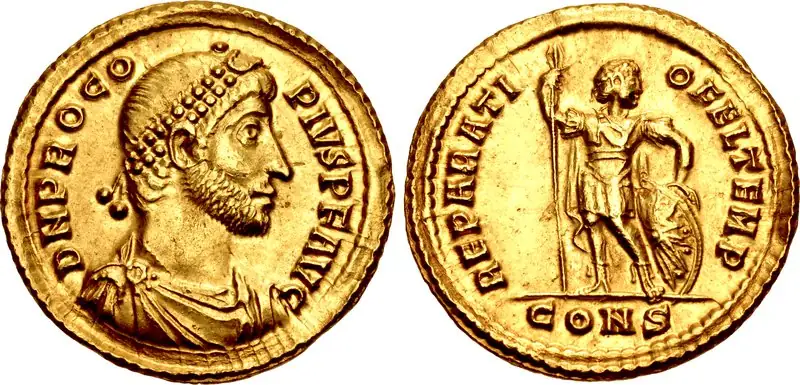
Procopius (A.D. 365-366) was a high-ranking official under Roman Emperor Julian II (A.D. 360-363), who died while fighting the Sasanids. In the aftermath, power was assumed by Valentinian I (A.D. 364-375) and his brother Valens (A.D. 364-378). While the latter was in distant Syria, Procopius bribed the legions in Constantinople to usurp power in September 365, which is around the time this gold solidus was struck. He held power for merely eight months before Valens reasserted control over the capital. Procopius fled but was later betrayed and beheaded.
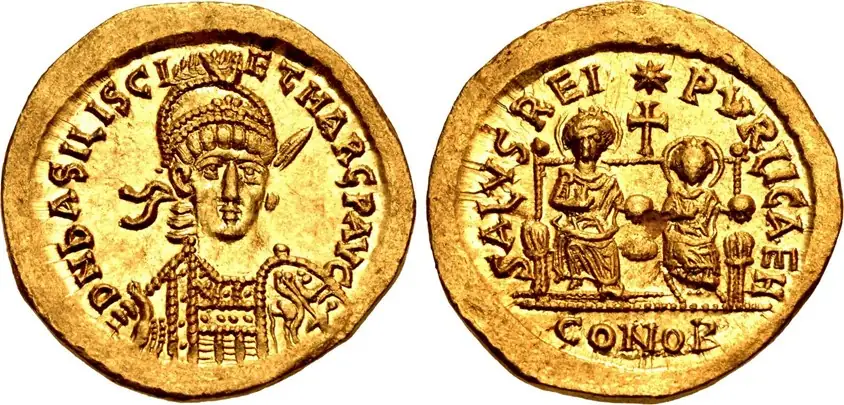
Basiliscus (A.D. 475-476) was the brother-in-law of Emperor Leo I, who died in 474. Leo's son-in-law, Zeno, became emperor later that year but his barbarian origins made him unpopular, and he was forced to flee as Leo's wife Verina, fomented an insurrection against him with the help of her brother, Basiliscus. Verina had intended for her lover Patricius to take the throne, but Basiliscus put him to death and seized power himself. During his reign, which lasted less than nine months, Basiliscus imposed high taxes, alienated the church, and was blamed for a devastating fire, all of which opened the door for Zeno to return. Basiliscus and his young son and co-emperor Marcus, shown on the reverse of this gold solidus, were subsequently thrown into a cistern and left to starve to death, thus allowing Zeno to kill them while still keeping his promise to shed none of their blood.
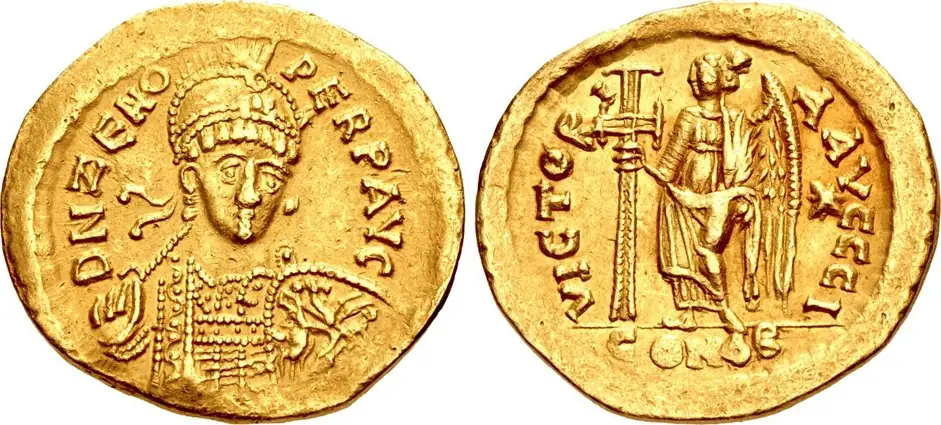
Zeno (A.D. 474-475 and 476-491) is shown on this gold solidus with Victory on the reverse. After taking back power in 476, he went on to reign until 491 and is generally believed to have died of illness around age 65. However, two chroniclers centuries later alleged that his wife Ariadne locked him in a tomb after he'd become incapacitated and left him to starve. Since Zeno had no surviving son, Ariadne chose to marry a courtier, who became the well-regarded emperor Anastasius I.
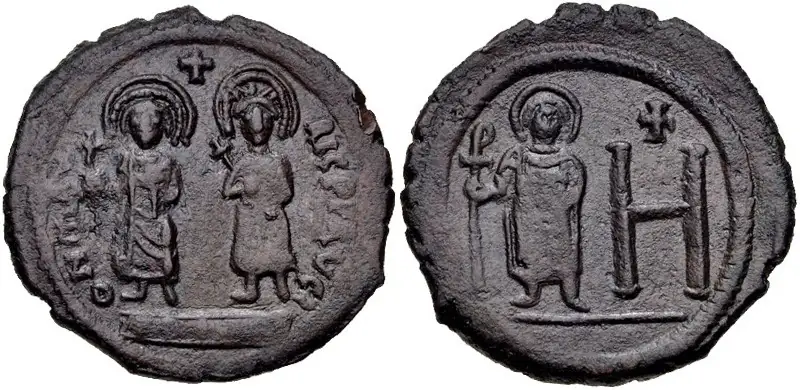
Maurice Tiberius (A.D. 582-602) reigned at a time when exhausted soldiers mutinied in favor one of their own, Phocas. After Phocas was crowned and entered Constantinople, his troops brought Maurice and his sons to a nearby harbor, where they were executed (though one son, Theodosius, might have escaped the slaughter). This base-metal follis from the mint of Cherson shows Maurice with his wife Constantina on the obverse and his son Theodosius on the reverse. Constantina and her daughters were initially sent to a monastery but later were executed amid accusations that they were plotting against Phocas.
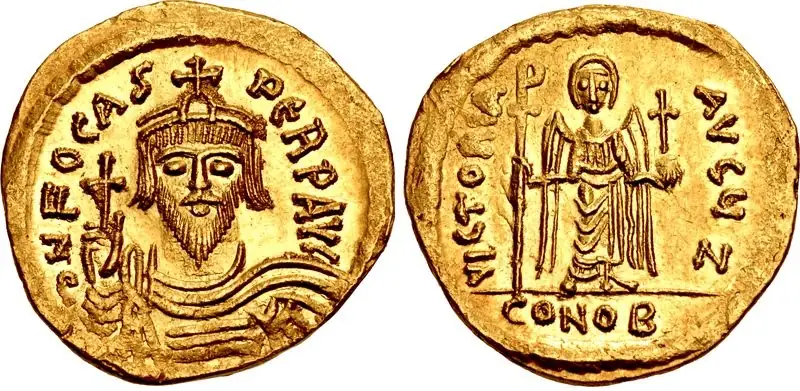
Phocas (A.D. 602-610), portrayed on this gold solidus holding a globus cruciger, ruled for just under eight years. He struggled with Constantinople's elite and fought invasions by foreign powers in Europe and Asia. His ruthlessness eventually inspired a revolt by Heraclius the Elder, launched from his power base in Africa. Heraclius' son took Constantinople in 610 and soon executed Phocas.
Check out Ancient Coins on ebay.
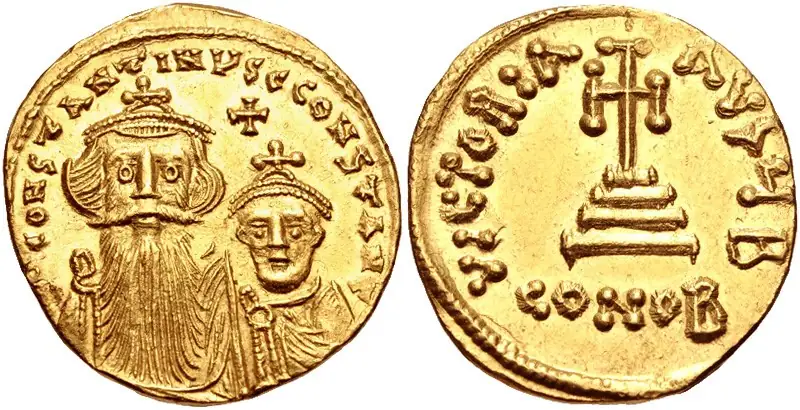
Constans II (A.D. 641-668) came to power through a truly byzantine pathway involving a sequence of uprisings and palace intrigues. Constans, shown on this gold solidus with his son Constantine IV, ruled at a tumultuous time, as Arab armies overran much of the empire and internal divisions on religious policy led to Constans arresting and exiling the Pope. For reasons that are still murky, Constans was assassinated in his bath by his chamberlain while traveling in Sicily in 668.
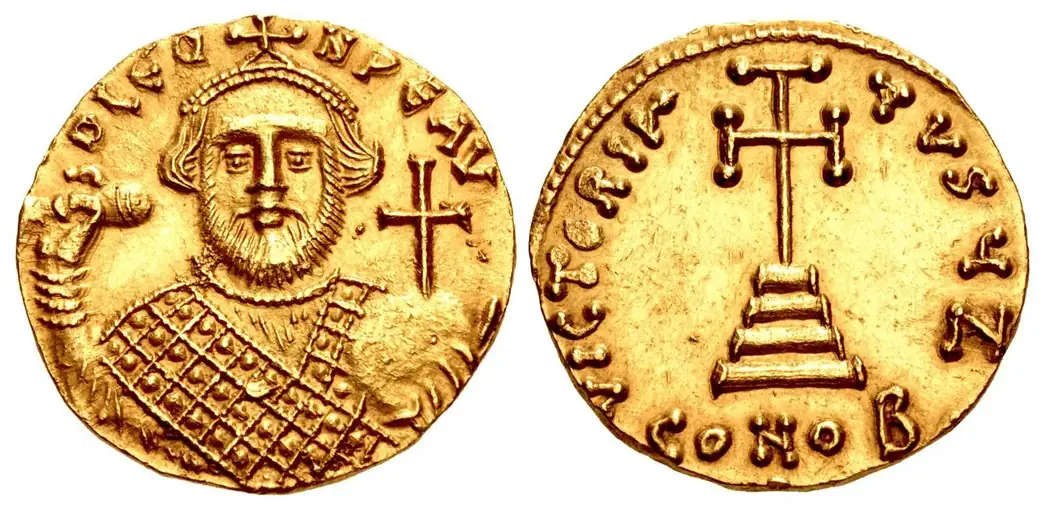
In A.D. 692, before he was emperor, Leontius (A.D. 695-698) led a Byzantine army in a losing effort against the Umayyads at the Battle of Sebastopolis. Afterward, he was imprisoned until 695, when he successfully led a rebellion and became emperor. Shown on this gold solidus, Leontius held power only until 698, when a military official he'd sent on an unsuccessful expedition rebelled against him. Leontius' face was mutilated, and he was sent to a monastery. Later, in 705, Leontius was executed.
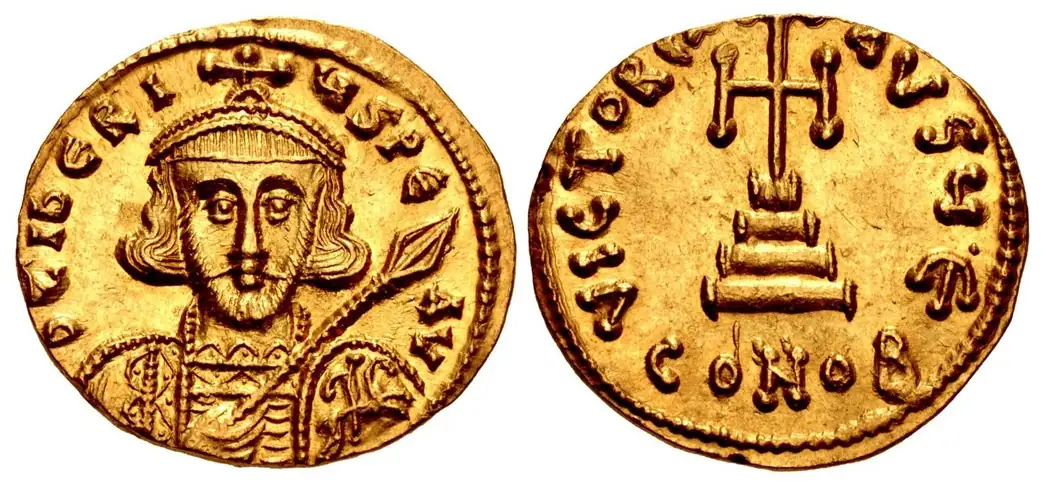
Tiberius III (A.D. 698-705), the military official who overthrew Leontius in 698, is shown on this gold solidus. He managed to hold onto power until 705, when a former emperor, Justinian I (see following coin) led an army of Slavs and Bulgars to reclaim Constantinople. After Justinian II seized a palace, Tiberius fled only to be captured. In 706, Justinian had both Tiberius and his predecessor, Leontius, beheaded.
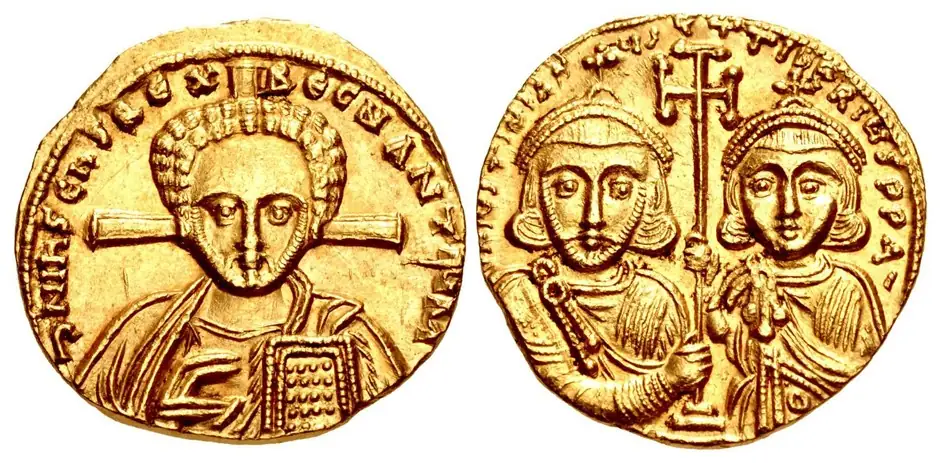
Justinian II (A.D. 685-695 and 705-711) has a reputation for dealing brutally with opposition, which led to two popular uprisings against him. Finally, in 711, he was arrested and executed, along with his 6-year-old son Tiberius IV. Justinian and Tiberius are shown on the reverse of this gold solidus of his second reign, part of a period dubbed by historians as the Twenty Years' Anarchy.
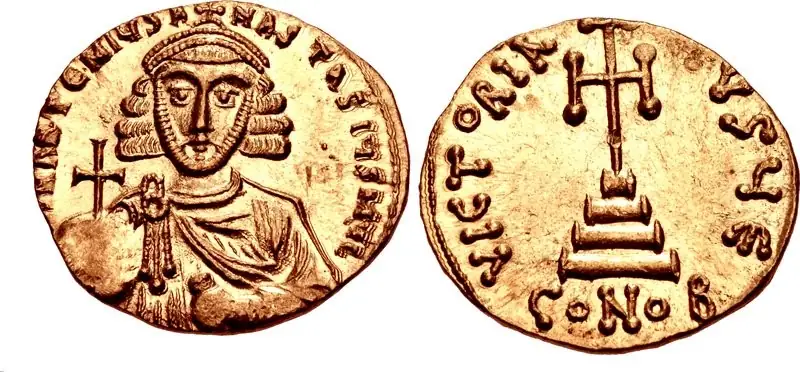
Anastasius II (A.D. 713-715), a prominent Byzantine bureaucrat, succeeded Philippicus (A.D. 711-713) as emperor. However, he didn't reign for long. Anastasius II was driven from power late in 715 by Theosodius III (A.D. 715-717), who himself was deposed by Leo III (A.D. 717-741). The start of Leo's reign was marked by a yearlong siege of Constantinople by the Umayyads and rumor spread that the capital had fallen. This encouraged Anastasius to try to reclaim power in 719 with the help of a Bulgarian army. His coup, however, was unsuccessful and he was executed.
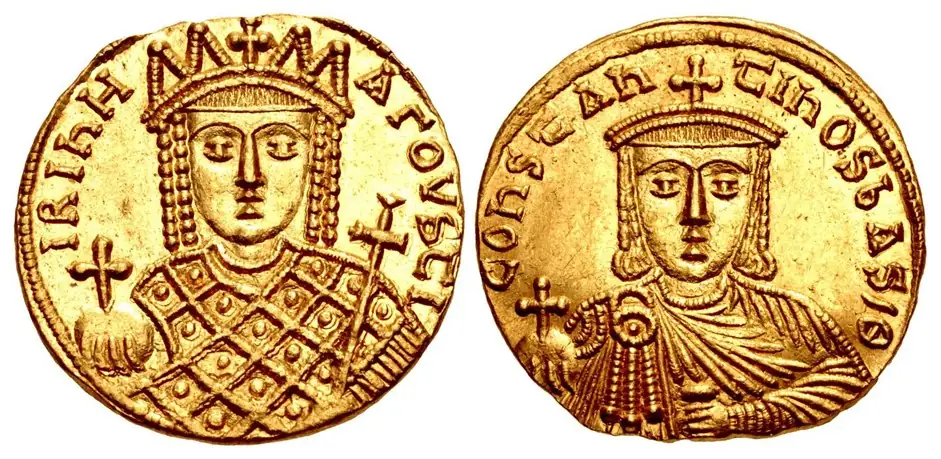
Constantine VI (A.D. 780-797) became emperor at age 9 with his mother, Irene, as regent. Irene held extraordinary power, which strained their relationship as Constantine VI neared being old enough to rule on his own. After an intense family rivalry in 790, mother and son managed to share power until 797, when Irene ousted him from power. Her agents captured Constantine VI and blinded him, and it's probable that he died shortly afterward.
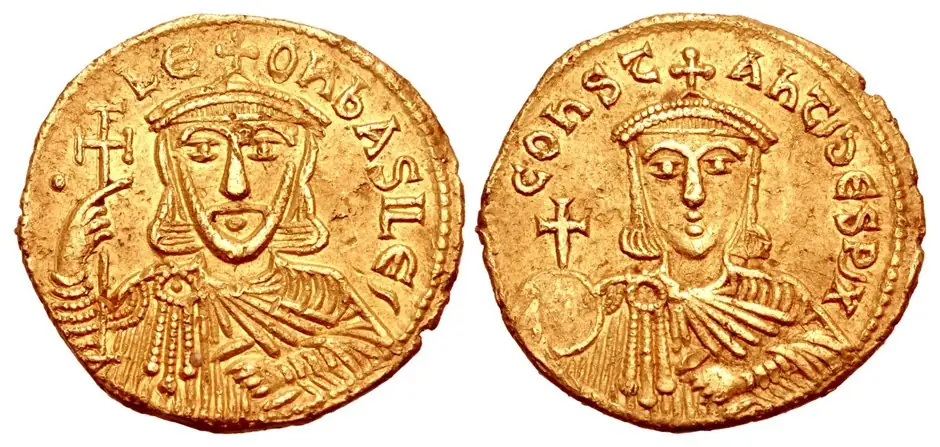
Leo V 'the Armenian' (A.D. 813-820) appears on the obverse of this gold solidus, while his stepson and co-emperor Constantine is on the reverse. Leo's decision to divorce his wife, marry his Armenian mistress and make her young son co-emperor was controversial. He eventually was assassinated in a chapel before the high altar of St. Sophia on Christmas Eve by supporters of a high-ranking soldier who became Emperor Michael II (A.D. 820-829). Young Constantine, fortunately, was exiled to a monastery.
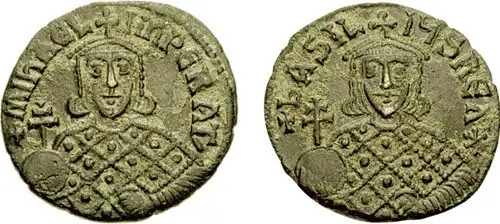
Michael III 'the Drunkard' (A.D. 842-867) is shown on this base-metal follis with his co-emperor, Basil; each holds a globus cruciger, a symbol of power. In a complicated story of palace intrigue, Michael III kept his mistress close by, having her marry his favorite courtier, a Macedonian peasant named Basil. By 866, Basil's close relationship with Michael III had earned him adoption and a promotion to co-emperor. But the following year, Michael III threatened to make another courtier co-emperor, prompting Basil to lead a coup to murder him at age 27. Basil ruled for another 19 years (867-886), until he died as the result of a hunting accident.
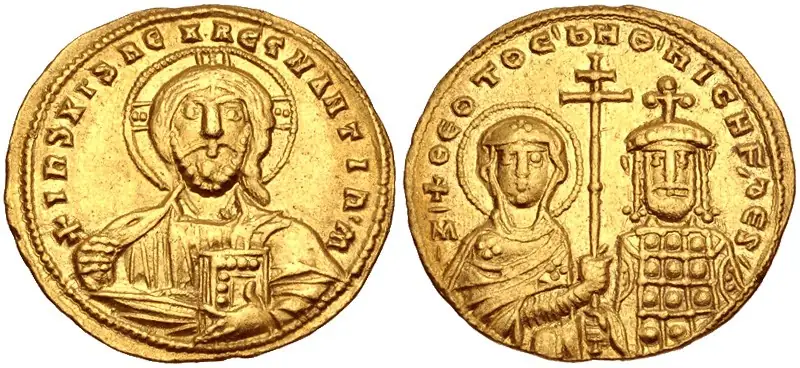
Nicephorus II (A.D. 963-969) is shown on the reverse of this gold histamenon nomisma alongside the Theotokos (Jesus' mother, Mary), while Christ Pantokrator is portrayed on the obverse. Nicephorus II leveraged his military success as a general to grab power in 963 when the previous emperor died unexpectedly in his mid-20s. Rumors spread that his wife, Theophano, had poisoned him, though she had no clear motive to do so. Her children were too young to rule, so to protect them, she married Nicephorus II. However, his ascetic lifestyle strained their relationship, and Theophano and her lover, the general John Tzimiskes, plotted to overthrow the emperor, which they did in 969 by murdering him in his private chambers. When Tzimiskes assumed power, he sent the unpopular empress into exile.
Check out Ancient Coins on ebay.
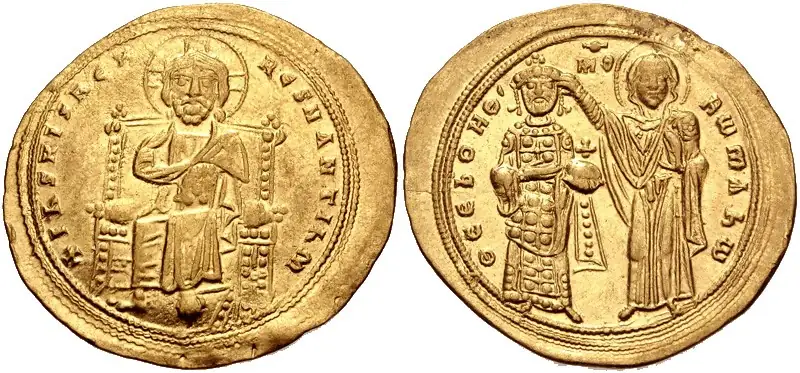
Romanus III (A.D. 1028-1034) is depicted on this gold histamenon nomisma that has similar themes to the one of Nicephorus II, and he met a similar end as Nicephorus II. Romanos' five and a half years of rule were ineffective, and he was found dead in his bath in 1034, a suspicious death allegedly the work of his wife Zoe and her lover, Michael. In fact, they married the day the emperor died and persuaded the patriarch of Constantinople to coronate him as Emperor Michael IV (A.D. 1034-1041) the next day. After Michael IV died in 1041, there was a brief transition period in which three people (including Zoe) ruled, after which, Zoe — a resourceful and ambitious survivor of court intrigues — married the man who became the next emperor, Constantine IX (A.D. 1042-1055).
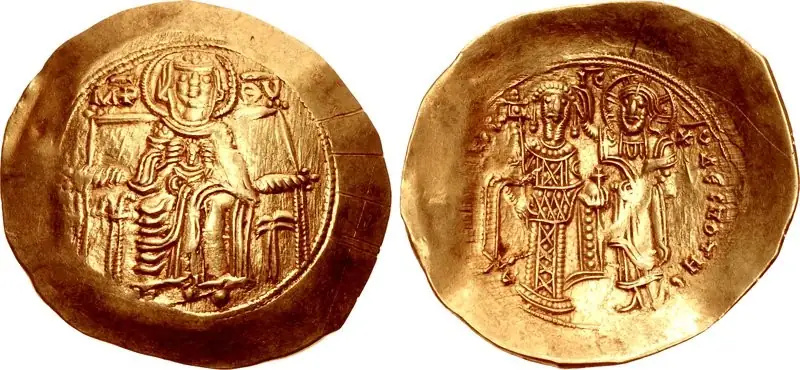
Alexius II (A.D. 1180-1183) was merely 14 years old when he was deposed and killed in 1183 by Andronicus, a relative of the imperial family who'd positioned himself as a protector of Alexius but who showed his true colors immediately after being named co-emperor. Andronicus I (A.D. 1183-1185), shown on this gold hyperpyron, alienated many of his subjects with his iron-fisted rule, while invaders captured Thessalonica and threatened the heart of the empire. The people of Constantinople rallied around a rebel, Isaac, who allowed them to lynch Andronicus in 1185.
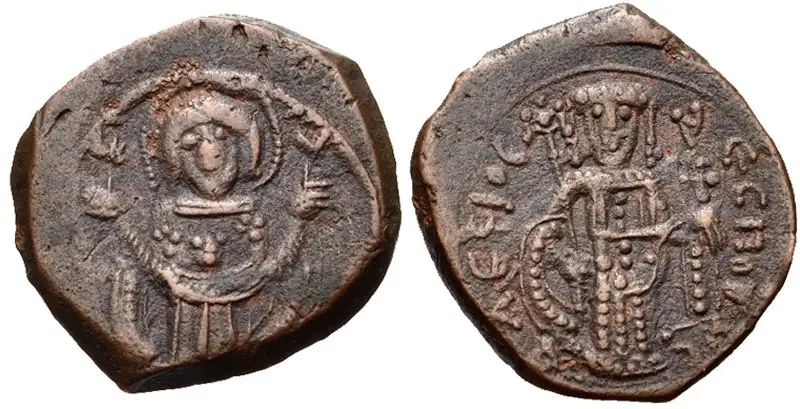
Isaac II (A.D. 1185-1195) ruled quite ineffectively, for he was unable to keep the newly powerful Bulgarian state in check. He was finally overthrown by his elder brother, Alexius, who cruelly blinded him. In the aftermath, Alexius reigned as emperor from 1195 to 1203, until Latin armies of the Fourth Crusade besieged Constantinople and forced Alexius to flee.
This event allowed the blinded Isaac II to return to the throne eight years after he'd been deposed. He shared rule with his son, Alexius IV (A.D. 1203-1204), who'd accompanied the Crusaders. Shown here is a base-metal tetarteron issued during Isaac's six-month second reign, which depicts the Theotokos opposite Isaac II.
It didn't take long for the Crusaders to alienate the people of Constantinople, who rioted in January 1204, resulting in the imprisonment of Isaac and his son, who they considered puppets of the Crusaders. The outcome for father and son was not pleasant, for Isaac allegedly died of shock upon his son being strangled to death.
Check out Ancient Coins on ebay.







 Posted 12/11/2025 2:38 pm


