| Author |
 Replies: 7 / Views: 1,017 Replies: 7 / Views: 1,017 |
|
|
New Member
Argentina
33 Posts |
Hi! Ricky Olcese from Argentina here. With a new topic and question! You see, in the Krause caption below, it is said that in 1881 5.647.000 50 centimos coins were minted. Not 5.647.001, nor 5.646.999. 5.647.000 is the exact number. 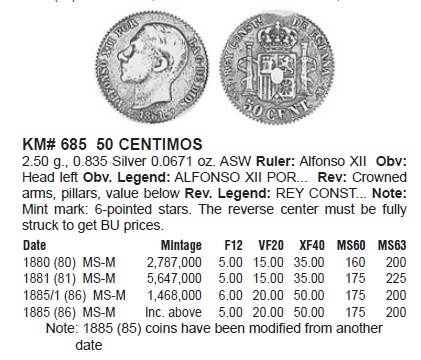 Meanwhile, Mr Janson, author ot the arguably most complete catalogue of Argentine coins, says that in 1916, only 835.059 - 20 cents nickel coins were minted in Argentina. Again, not 835.060, nor 835.058. 835.059 is the right number! 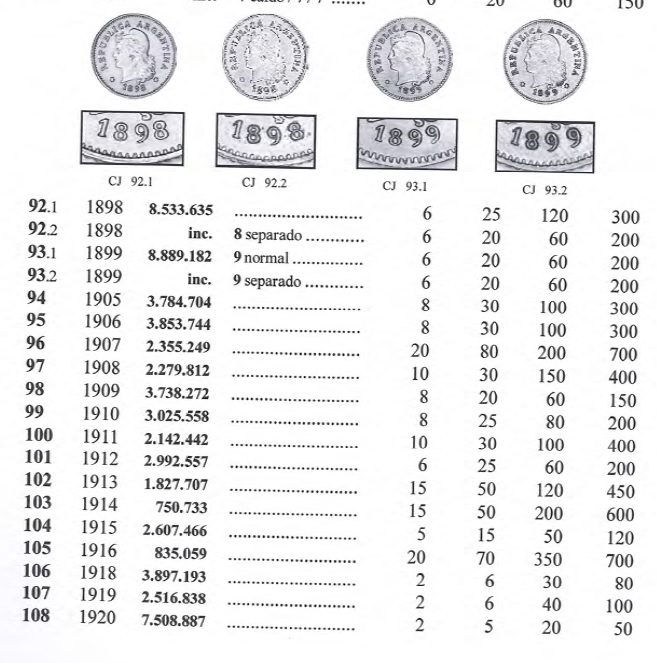 Now, the question is, how reliable are those figures? And mintage figures in general. There are some cases, for example some Bolivian coins, in which no mintage figure is given. But when mintage numbers are given, how do we know that we can trust them? |
|
|
|
Pillar of the Community
United States
1534 Posts |
I'm no expert on world coinage, but you're taking the word of the Argentine government from a century ago. If that government was reliable, the mintage figures probably are, too. In the U.S., we often see such precise figures, both for modern issues and in the past.
|
|
Pillar of the Community
 Sweden
2124 Posts |
It's a good question. It depends a bit on what you mean by having trust in the figures.
For modern coins (after 1800 or so), mintage figures usually come from the mint's records. Generally government controlled mints kept meticulous records (to prevent fraud, which was always a temptation for some, especially considering the scale of minting in a larger mint). Such a mintage figure should be trustworthy, in the sense that it corresponds to an official record. Then there is the question, whether the recorded figure states the number of coins ordered or the number of coins delivered. A number of coins will come out defect from the minting process, and should be removed (most likely melted down and put back into the process). The "uneven" numbers, like 835,059, I would think reflect delivered number of coins (with some margin for human error). A number like 25,000,000 is probably the number of coins ordered. Again depending on how strict policies that were in effect, it may also be the number delivered, or the number delivered is lower, but that figure is recorded elsewhere or only internally (or lost).
For more "irregular" mints, such as may occur during sieges or rebellions, it might be that minting records - if at all kept - are unreliable, or in many cases lost (depending on the outcome of the siege/rebellion, perhaps).
For older coins, minting records may have been precise and reliable, but may be lost. In some cases, more or less good estimates can be made. For example, France had a system where local mints across the country put one coin out of every 200 (for instance, the number depended on the denomination) in a sealed box, which was sent to Paris. In Paris, the boxes were opened, the coins counted (and inspected) and the number recorded. In cases where the local mint records have perished, there is usually still the box numbers, so a fairly good estimate can be made.
So, can you trust the mintage figures? Yes, in the sense that they should be traceable to an official record. More or less, in the sense of being accurate when it comes to coins actually delivered. With caution, for older/siege/rebellion/etc coins.
|
|
Valued Member
United States
59 Posts |
As I recall there was an Australian penny that was minted in good number, but most never released and instead melted down for subsequent years. So if you find one it is a rare coin despite high mintage.
In Honduras in the early release of a Peso (1880s or so) the mint came to recognize that the coins contained about 1% gold, so the mint was taking coins out of circulation to melt them for the gold. So those Peso's have a fairly high value despite the mintage numbers.
I believe there were whole mintages of Mexican crowns sent to China. If you got one without a chopmark it would be unusual I suppose.
There are other stories like this but they are unusual. In general mintage figures should give a good indication of coin rarity.
|
|
Bedrock of the Community
United States
36940 Posts |
On silver coins with all the melting that has gone on over the last 50 years, I don't have much faith in mintage figures depicting actual scarcity.
|
|
Pillar of the Community
Portugal
717 Posts |
In addition to all the issues already mentioned, another one. Dies could be used years after being made. This usually but now always only affects small issues. Because a die could be used to strike perhaps two thousand coins. Then a new one would have to be made and it would be easy to update the date. Dies were an expanse and they would not be just thrown away because the year had changed. But when they were used up.
In old eighteenth century issues I know also of cases of the same date used for decades and tens of thousands coins. But the end of the nineteenth century this should not be happening any more but sorry I never researched south american post colonial issues.
Another issue is accounting practices at mint houses. Sometimes the data for mintage was calculated from the quantity of the metal reported used by the mint house each fiscal year, for each issue. But the fiscal year did not match always with the calendar year
|
|
Pillar of the Community
United States
8042 Posts |
The way the original question is posed, my answer is: who cares? Certainly I don;t care if 5 million or 5 million and one coins were minted of a certain type.
The discussion of "how were mintage figures determined" is of more interest to me, and maybe some others.
For older coins, in many instances, nobody was counting. Instead, the mintage was estimated later from:
- the weight of the coin specified in the authorizing ordinance
- the composition of the coin specified in the authorizing ordinance
- the weight of precious metal delivered to the mint.
For example, a gold coin was specified at:
- 135 to the pound
- 23 karats (0.95833) fine
And the mint records record that 5,271 pounds of pure gold were delivered to the mint to make this coin.
We can calculate that the mintage of the coin should have been close to 5271 x 135 / 0.95833, with no more than 3 significant figures, so 743,000 would be the correct estimated mintage.
I would guess that many mintage figures we see that end with several zeroes were calculated something like this.
Edited by tdziemia
12/13/2023 4:37 pm
|
|
Moderator
 Australia
16976 Posts |
Mint records, if they have survived, are generally reliable as mints are (a) government-owned, and (b) are financially accountable to that government. So the amounts of coins produced are generally well-known.
What can be less certain is liking those mintage figures for specific dates on coins, because mints usually record things like "1 million 10 cent coins struck", without specifying that they were "1936 10 cent coins". If a Mint has a policy of using dies until they break, then coins made "old date" dies can run into the mintage figures for the following year.year, making those coins more common than the mintage figures indicate. It's also problematic for Mints that issue official mintage figures based on financial year (July to June), not calendar year - so people have to make educated guesses as to how many coins of specific years were produced.
Then, of course, there are emergencies to account for. Take the Australian 1930 penny as an example. What's the official mintage? Zero - no pennies were officially struck in 1930; due to low demand for coinage during the Great Depression, Treasury never placed any orders for pennies. Yet, 1930 pennies exist, as least several thousand of them. How? It is theorized that they made some during the Mint's down-time, to keep the mint labourers upskilled, and put the box of minted coins aside in the mint vault awaiting an order for pennies that never came. It is further hypothesized that that box of 1930 pennies stayed in the vault until the next financial emergency - World War II, when the vault was emptied and every coin in it was released for circulation. This hypothesis is evidenced by the fact that nobody ever saw a 1930 penny in change until 1942.
Don't say "infinitely" when you mean "very"; otherwise, you'll have no word left when you want to talk about something really infinite. - C. S. Lewis
|
| |
Replies: 7 / Views: 1,017 |
|
To participate in the forum you must log in or register.
Disclaimer: While a tremendous amount of effort goes into ensuring the accuracy of the information contained in this site, Coin Community assumes no liability for errors. Copyright 2005 - 2026 Coin Community Family- all rights reserved worldwide. Use of any images or content on this website without prior written permission of Coin Community or the original lender is strictly prohibited.
Contact Us | Advertise Here | Privacy Policy / Terms of Use
|
| Coin Community Forum |
© 2005 - 2026 Coin Community Forums |
| It took 0.28 seconds to rattle this change. |
 |
|










 Posted 12/02/2023 6:07 pm


