| Author |
 Replies: 14 / Views: 641 Replies: 14 / Views: 641 |
|
|
Pillar of the Community
United States
1915 Posts |
I'm organizing an assortment of coins from Taiwan.
It looks like Numista uses the spelling Jiao for Taiwan but Krause uses the spelling Chiao.
Which one is more appropriate to use?
|
|
|
|
Moderator
 United States
194816 Posts |
Go for a tiebreaker? Wikipedia says Jiao.  |
|
Pillar of the Community
United States
3505 Posts |
Edited by nfine
12/11/2023 5:00 pm
|
|
Moderator
United States
194816 Posts |
I do not believe that is correct... (from the M-W link).. 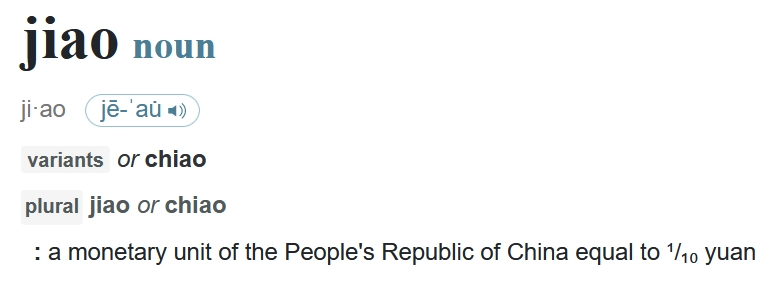 |
|
Moderator
Australia
16967 Posts |
Chinese is naturally written in Chinese characters, but this is unhelpful for Westerners who don't know Chinese characters. Unfortunately, there is no direct, easy correlation between the Chinese and Latin alphabets. This is further complicated by "Chinese" having one written language, but several spoken languages (eg. Mandarin and Cantonese), so "Chinese" itself doesn't have a unified, consistent way of pronouncing each character.
There are two popular ways of romanization, or "writing Chinese using the Western Alphabet". The older version, known as Wade-Giles, is still commonly used on Taiwan, Hong Kong, and among the Chinese diaspora outside of China proper. The newer version, known as "Pinyin", was invented by the Communists in the 1950s and is the version legally mandated within the People's Republic. Being a Communist invention, Pinyin is, understandably, traditionally not popular among ethnically Chinese people with anti-Communist sympathies, but since the end of the Cold War and the rise of Chinese soft power, it is becoming more common in the West, and has recently been adopted as the official transliteration version for use in Singapore. If you go to a conversational Chinese class anywhere in the west, or an online teach-yourself-Chinese website, it will almost certainly be Pinyin that they use.
"Jiao" is Pinyin. "Chiao" is Wade-Giles. They are the same Chinese character, just written differently in the two systems.
Which to use? Well, there are two schools of thought here. You can either:
1. Use whichever version that was or is officially used in the actual country of issue. So, call it "chiao" for Taiwanese coins, and "jiao" for mainland China coins.
2. Be consistent throughout the documentation for your collection. So, pick a system - Wade-Giles or Pinyin - and use that across the board. This then leads to a secondary question, "Which to pick?". For me, this depends on which reference books are being used, since whichever book you use is likely to be internally consistent. Most older books about Chinese coins (such as Yeoman and Krause) use Wade-Giles, newer ones tend to use Pinyin. Hartill, the current standard reference work for Chinese cash coins, uses Pinyin.
For myself, I tend to be inconsistent. I usually use option 1. I certainly use Wade-Giles to alphabetically sort my Chinese Provincial coins, since it is the Wade-Giles forms of the names that appears on the coins themselves. But for cash coins, I usually use Pinyin, since I'm using Hartill as my reference. In using "jiao" for a Taiwanese coin, it would seem that Numista is choosing option 2.
There is a third option, for these coins in particular: don't use either, and translate it, instead of transliterating it. You probably already call the Taiwanese primary currency unit the "dollar", rather than the "yuan", since that's the word that most modern coin catalogues use. "Dollar" is a translation for the Chinese character "yuan" (which is written the same in both Wade-Giles and Pinyin). So as far as I'm concerned, feel free to call the jiao/chiao a "dime" instead. I don't think anybody from China or Taiwan ever calls these coins "dimes" in English, though, since that's widely seen as a uniquely "American word".
Don't say "infinitely" when you mean "very"; otherwise, you'll have no word left when you want to talk about something really infinite. - C. S. Lewis
|
|
Pillar of the Community
 United States
1915 Posts |
This all gives me an idea: find a website someplace in Taiwan that sells goods or services and see which spelling they use for the selling price in coinage.
|
|
Pillar of the Community
 Canada
9902 Posts |
Thank you for that info Sap.
Very informative.
"Dipping" is not considered cleaning...
-from PCGS website
|
|
Moderator
Australia
16967 Posts |
Quote:
This all gives me an idea: find a website someplace in Taiwan that sells goods or services and see which spelling they use for the selling price in coinage. I think you would find that, just like nobody in America prices things in "dimes", nobody in Taiwan prices things in chiao; everything would be priced in dollars and cents (or yuan and fen, if you prefer). Furthermore, since the 1 dollar coin is currently the smallest denomination coin in circulation, the chiao/jiao is no longer in regular use. Which is why it is difficult to obtain an official government position on the name of the coin; the government hasn't needed to name it, since the coin has effectively ceased to exist. Back when the 1 chiao coin was current, the Taiwanese government definitely preferred Wade-Giles, as Pinyin had only just been invented. Official Taiwanese policy regarding romanization is to recognize that there are several different versions. Which version is government-preferred does tend to depend on which political party is in power: the Kuomintang is the most pro-Unification party and prefers Pinyin; the current administration (Democratic Progressive Party) prefers to promote Taiwanese distinctiveness and as such shuns Pinyin. The majority of everyday people prefer Wade-Giles for the names of people, places etc, as that is what their families have always used. However, if you want an "official Taiwanese government position" on the matter, the published English-language version of the Central Bank Act officially calls the currency units "yuan", "chiao" and "fen". See Article 15 here: https://law.moj.gov.tw/ENG/LawClass...ode=G0410001To confuse things, "Yuan" (with a capital Y) is also the word used for "branch of Government". So when that website talks about the "Executive Yuan", that's talking about the government, not the currency. Don't say "infinitely" when you mean "very"; otherwise, you'll have no word left when you want to talk about something really infinite. - C. S. Lewis
|
|
Moderator
United States
34538 Posts |
Quote:
For myself, I tend to be inconsistent. Me too. Sometimes I'm calling it a Half Groat and other times a Half Groschen. Different part of the world (Lithuania vs. China), but the same problem. "If you climb a good tree, you get a push."
-----Ghanaian proverb
"The danger we all now face is distinguishing between what is authentic and what is performed."
-----King Adz
|
|
Pillar of the Community
United States
1915 Posts |
I did some shopping in Taiwan grocery stores and found everything was in dollars.
The link to the Central Bank was greatly appreciated.
I didn't think to look in such a clever way.
I settled on Chiao as in the Article 15.
|
|
Pillar of the Community
United States
4616 Posts |
There is an international standard for currencies. Of course being ultimately under the control of the UN and thus following the PRC lead ... one might dispute even this per Sap's post above. https://www.iso.org/iso-4217-currency-codes.htmlIf you follow the links above and try to open "list 1" you will find it fails. It's actually an XML file masquerading as xls (Excel) and the online version won't open it. You need to download it locally and open it with Excel. Of course, and this is where life really goes for the twist... the international standard doesn't name the minor until, just indicates that it's 1/100th of the major unit. 2= 1/10^2 ENTITY Currency Alphabetic Code Numeric Code Minor unit TAIWAN (PROVINCE OF China) New Taiwan Dollar TWD 901 2 -----Burton 50+ year / Life / Emeritus ANA member (joined 12/1/1973) Life member: Numismatics International, CONECA Member: TNA, FtWCC, NETCC, EveryCountry (online) coin club Owned by three cats and a wife of 40+ years (joined 1983) Author: 3rd Edition of the Sample Slabs book, https://www.sampleslabs.info/ |
|
Moderator
United States
194816 Posts |
This has evolved into a very informative topic.  |
|
Pillar of the Community
United States
1915 Posts |
Sometimes the most simple questions take some effort to straighten out.
That Article 15 gave me confidence to edit all my album pages of Taiwan coins from Jiao to Chiao.
The coins are pictured and described among the album pages.
It's also evident that Numista and Krause don't always agree on facts, figures or names.
And old copy of Yeoman uses Chiao for Taiwan.
Interestingly, I was prompted to look up the People's Bank of China where there is a similar article 17 stating the unit of renminbi is Yuan and the units of the fractional currency of renminbi are Jiao and Fen.
So the official names of the topic coins in Taiwan are Chiao and the similar coinage in China are Jiao.
I'd regard the central banks of China and Taiwan as the authorities and others like Wikipedia, Numista, Krause, etc have some variance in the ways they describe the coinage.
Coming back to this topic, I've completed the Taiwan pages and moved on to the PRC coinage for the album where I see the word Jiao is actually on the coins themselves. That sort of makes it easy.
Edited by Albert
12/12/2023 9:07 pm
|
|
Moderator
United States
194816 Posts |
I am glad to see you got it all sorted out to your satisfaction!  |
|
Pillar of the Community
United States
4616 Posts |
You can always try and argue with the Numista page owner. Not sure what they will say. . Krause is dead, gone, dead, so you can't argue with them. Regarding the Westernization of phonetic characters, there was an interesting article in the NY Times a week or two ago about "unusual" names given to children in Japan. It turns out there can be more than one way to pronounce the Japanese characters that make up a name, and that allows people to call their kids names that nobody reading the name will come to. https://www.nytimes.com/2023/12/01/...y-names.html-----Burton 50+ year / Life / Emeritus ANA member (joined 12/1/1973) Life member: Numismatics International, CONECA Member: TNA, FtWCC, NETCC, EveryCountry (online) coin club Owned by three cats and a wife of 40+ years (joined 1983) Author: 3rd Edition of the Sample Slabs book, https://www.sampleslabs.info/ |
| |
Replies: 14 / Views: 641 |
|










 Posted 12/11/2023 5:00 pm


