| Author |
 Replies: 10 / Views: 1,393 Replies: 10 / Views: 1,393 |
|
|
New Member
United States
5 Posts |
|
|
|
|
Pillar of the Community
United States
954 Posts |
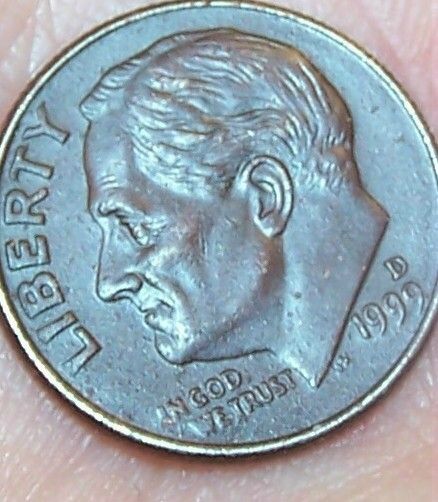
Is it red? It looks blue on my monitor....Best way to find out if it is an error is weigh it. Just looking at it, it doesn't appear to be struck on a planchet that was the wrong size, so weight would help.  |
|
Bedrock of the Community
United States
62064 Posts |
It would be impossible for another planchet to be used. The dime is the smallest coin and a Cent planchet wouldn't fit into the collar. It could have been tampered with. Heated/stained/magic markered and I sure others can think of other ways to make it look red. It looks bumpy.
|
|
Valued Member
United States
198 Posts |
Richard, You've heard the term "one red Cent", right? Well this is ten of them.  Ok, I agree with Becky, the pics are blue. If in real life that coin is red, it could be one of two things, a "clad missing" error or "Copper wash" which is cross contamination from a bath previously used to clean Cent planchets. ~ JimEdited by Jim Archibald
04/10/2009 7:20 pm
|
|
Pillar of the Community
United States
3507 Posts |
I saw this one in another post. It's not missing a layer. and it is not a copper wash.
The strong likelihood is that the coin was buried and afer some time was found by a metal detectorist.
My thought is that it was found in the ground somewhere in the North Eastern U.S.
Thanks,
Bill
|
|
Pillar of the Community
United States
5700 Posts |
Bill, is it your belief that this coin after being buried for some time, a chemical reaction took place?, I am just trying to better understand, thanks for your time..
Also why, if my question is right would you state that you believe this coin is from the north east, acidic soil? Mike
|
|
Bedrock of the Community
United States
10045 Posts |
I've heard of this before, and environmental damage seems a plausible explanation.
Since the cupronickel clad layer is actually 75% copper, it will tone much like copper given the right conditions.
I've also seen a few where the clad layer is hard to distinguish on the rim due to toning.
|
|
Valued Member
United States
198 Posts |
Interestingly, I live in Massachusetts, and have never seen a red (or blue) Dime although many do get darkly toned. I would suggest a dip, or liquid metal cleaner to test this theory. If I'm right, the damage will be minimal, but if I'm wrong, the supposed surface toning will be removed. I would not recommend this if the coin was uncirculated, but as it there's minimal value. ~ Jim
|
|
Pillar of the Community
United States
3507 Posts |
The reason I suggested that the coin was a metal detector find is that I metal detect and find clad coins as well as nickels that have reacted with the soil and the water that is in the soil. Many of the coins I dug when I lived on Long Island and then in Pennsylvania looked reddish to reddish brown if they were clad.
It seems that out here in WA, I find a lot that are dark brown to grayish and I expect that the soil conditions play a part in the decomposition of the coins.
It would be a chemical reaction with the various components of the soil. It is environmental damage in a literal sense.
Edited by foundinrolls
04/14/2009 12:45 am
|
|
Pillar of the Community
United States
5700 Posts |
Thanks Bill, Where on Long Island did you live,near the only 492 acre natural lake? Mike..PS: I love it here...
|
|
Pillar of the Community
United States
3507 Posts |
young years , brookklyn.... teen years, grew up in westbury then lived in various places on the north shore and then eastern nassau county:-)
I had relatives that lived near the lake:-)
Edited by foundinrolls
04/18/2009 01:33 am
|
| |
Replies: 10 / Views: 1,393 |
|












 Posted 04/10/2009 6:58 pm


