| Author |
 Replies: 13 / Views: 775 Replies: 13 / Views: 775 |
|
|
Pillar of the Community
United States
6887 Posts |
What first caught my eye about this coin is the area near Lib. In the ebay photos, it looked like it might be a clipped planchet, which is pretty rare for a proof nickel. The reverse is visibly out of alignment—the left rim is twice the thickness of the right rim. There is also a small damage to the obverse rim at the bottom, and a small anomaly near E from EPU. When I got the coin today, it turns out that it isn't a clip, the big rim anomaly is actually a sharp dent that lifted the metal. However, there doesn't appear to be any scuffing or scratching that would indicate rough treatment, the coin face is still proof pristine. From this point, I discovered a few more oddities. The proof nickel does not seem to be of uniform thickness, it seems to have a slight taper. The obverse rim strike corresponds almost exactly to where the reverse rim is thinnest. Straight across the coin face, where the rim is thickest, is the anomaly near E. There are numerous inside rim gouges in the thick rim region. Lastly, there is a visible seam that splits the coin edge around the whole circumference. It isn't so much like the edge of the coin has an indented seam, it's more like half the ring is smooth and the other half is rougher. I am wondering if this is a tilted strike, a frozen collar, or some flavor of partial collar error.  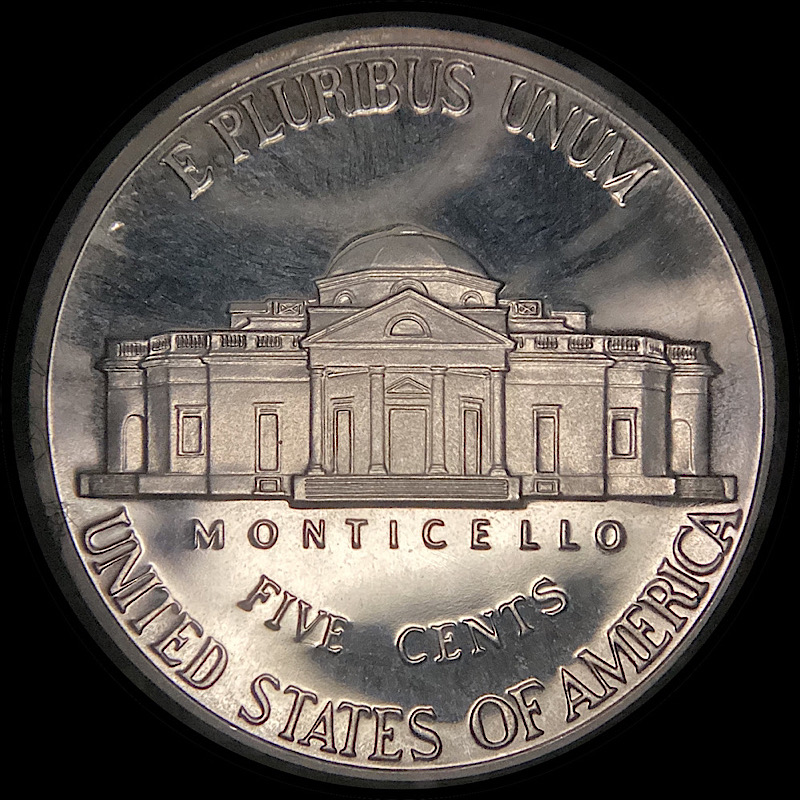 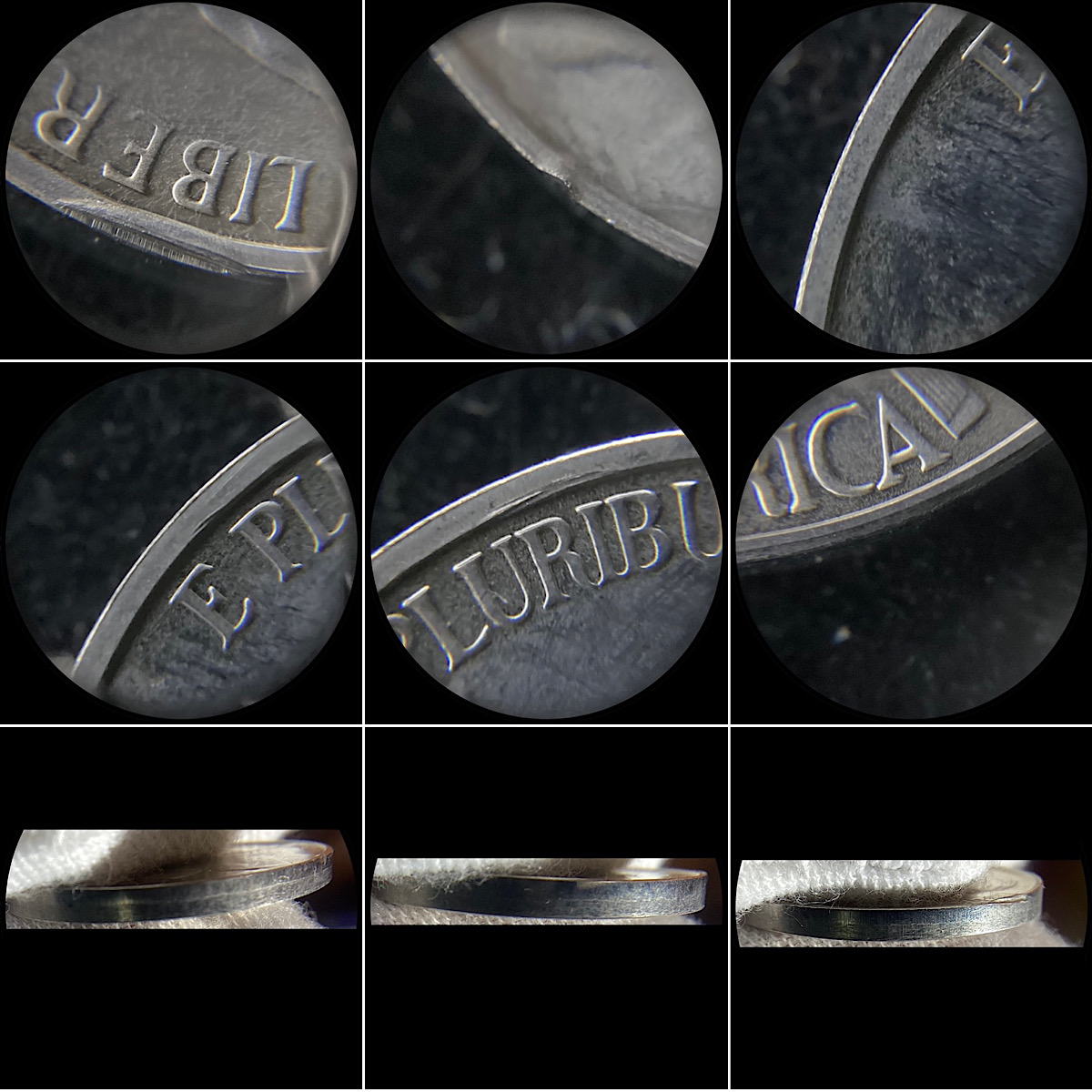 |
|
|
|
Bedrock of the Community
United States
78787 Posts |
This is a pretty interesting one.  Errers and Varietys.
|
|
Pillar of the Community
 United States
8975 Posts |
Very cool find! Definitely looks like a collar issue of some sort but could find nothing that quite aligns with this. This looks like a nice Mike Diamond coin.  -makecents-
|
|
Pillar of the Community
 United States
6887 Posts |
Yeah, I considered sending it to Mike Diamond straight off. But I want to be respectful of his time, so I thought the forum team could take a crack at it first. It reminded me of the horizontally misaligned die strike on the Washington presidential proof coins: https://www.ngccoin.com/news/article/917/Those examples are much more extreme. The dollar coin does have one face that looks properly proportioned, and the other face (presumably the anvil die) is misaligned with a much thicker rim across from a much thinner rim. However, the flange on the Washington proof is on the same side as the thickest rim. Mine is 180 degrees opposite. I don't know if that indicates something specific. Some of the metal on those $1 proof examples has a similar stretching metal effect. It's almost like a grilled cheese getting pulled apart. I think if it were just a dent on my nickel, the metal would be pushed in, not stretched like that. I speculated about partial collar because known examples of smooth rim coins have the "wagon wheel" effect. Again, most published examples are way more extreme, so I don't know if it's comparable or not. |
|
Pillar of the Community
United States
8975 Posts |
I was not actually suggesting that you send it to him, unless he would ask, of course but simply have him look in on the thread. Let's see what other say. I saw a few things it looked similar to but not quite like. As you said, I think this is a less dramatic example, and possibly something that is already on Error Ref.
-makecents-
|
|
Pillar of the Community
United States
8975 Posts |
Nice pics, by the way. -makecents-
|
|
Pillar of the Community
United States
6887 Posts |
|
|
Moderator
 United States
56855 Posts |
I think it is Mike worthy. John1  |
|
Moderator
United States
106320 Posts |
So I'll play 'Devils advocate' here. Just to get all options on the table.  Well it could be a collar issue, or possibly that 'seam' on the edge could be a result from the blanking machine as it punched our the blanks. The dent on the upper right of the coin (obverse side) could be the result of it getting dropped. It is a nice slight MAD strike - not often seen on the reverse of a coin. |
|
Pillar of the Community
United States
6887 Posts |
Along those lines, it's plausible that the coin reverse was the hammer die.
Anything is possible regarding damage. However, I challenge you to pull a nickel out of your change jar and drop it hard enough to lift metal like that. Nickels are pretty tough. Also, a ding would push the metal inwards, not lift it up and rip it like that. If you wanted to argue PMD/PSD, I think it would be easier to argue that the nickel was damaged during ejection or by another powerful machine.
|
|
Moderator
United States
106320 Posts |
All true Brand - any number of things could have happened here.
Have you emailed Mike yet?
|
|
Pillar of the Community
United States
6887 Posts |
I guess we have arrived at that point in the analysis. E-mail sent.
|
|
Pillar of the Community
United States
2752 Posts |
The ding in the coin's edge next to LIBER is evidently post-strike mint damage. The close-up just to the right of it is also post-strike edge damage. I'm not sure what's going in with the incisions in the design rim next to E PLURIBUS. I see nothing else that would fall outside normal specifications.
Error coin writer and researcher.
|
|
Pillar of the Community
United States
6887 Posts |
Thanks for the answer!
For $1, it was worth the gamble for curiosity's sake.
|
| |
Replies: 13 / Views: 775 |
|







 Posted 01/31/2024 9:22 pm





