










 Posted 02/19/2024 10:23 pm


Quote:
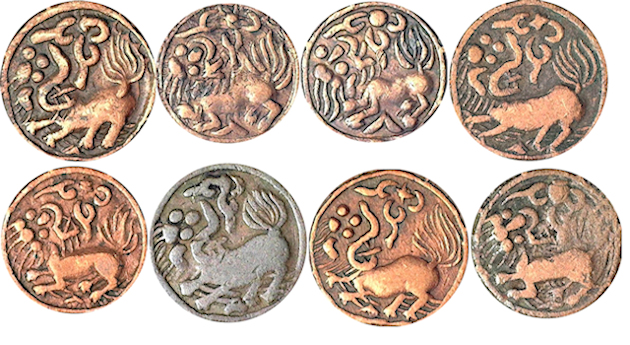
Is there any specific explanation as to why this part of the coin is so different?
Is there any specific explanation as to why this part of the coin is so different?
For the same reason that ancient and mediaeval coins can look "so different", despite being the same basic type:
The dies for these coins were handmade, and the coins themselves struck the old-fashioned way, without machinery. You're going to get considerable variation making coins this way.
Quote:
And what these characters represent?
And what these characters represent?
I would assume they are linked to Tibetan national symbolism that can be seen elsewhere - such as on the flag. The snow lion is unquestionably featured on both the coin and the flag, so it's reasonable to seek guidance from the flag for other features on the coin.
On the flag of Tibet, there's an object described as a "three-coloured jewel". This is said to symbolize the three core aspects of Buddhism: Buddha (the source of teaching), Dharma (the cosmic law at the foundation of the teaching) and Sangha (monastic community).
The central object appears sun-like or star-like; I would assume it analogous to the sun on the flag, which is said to represent "the equal enjoyment of freedom, spiritual and material happiness and prosperity by all beings in Tibet".
Don't say "infinitely" when you mean "very"; otherwise, you'll have no word left when you want to talk about something really infinite. - C. S. Lewis


