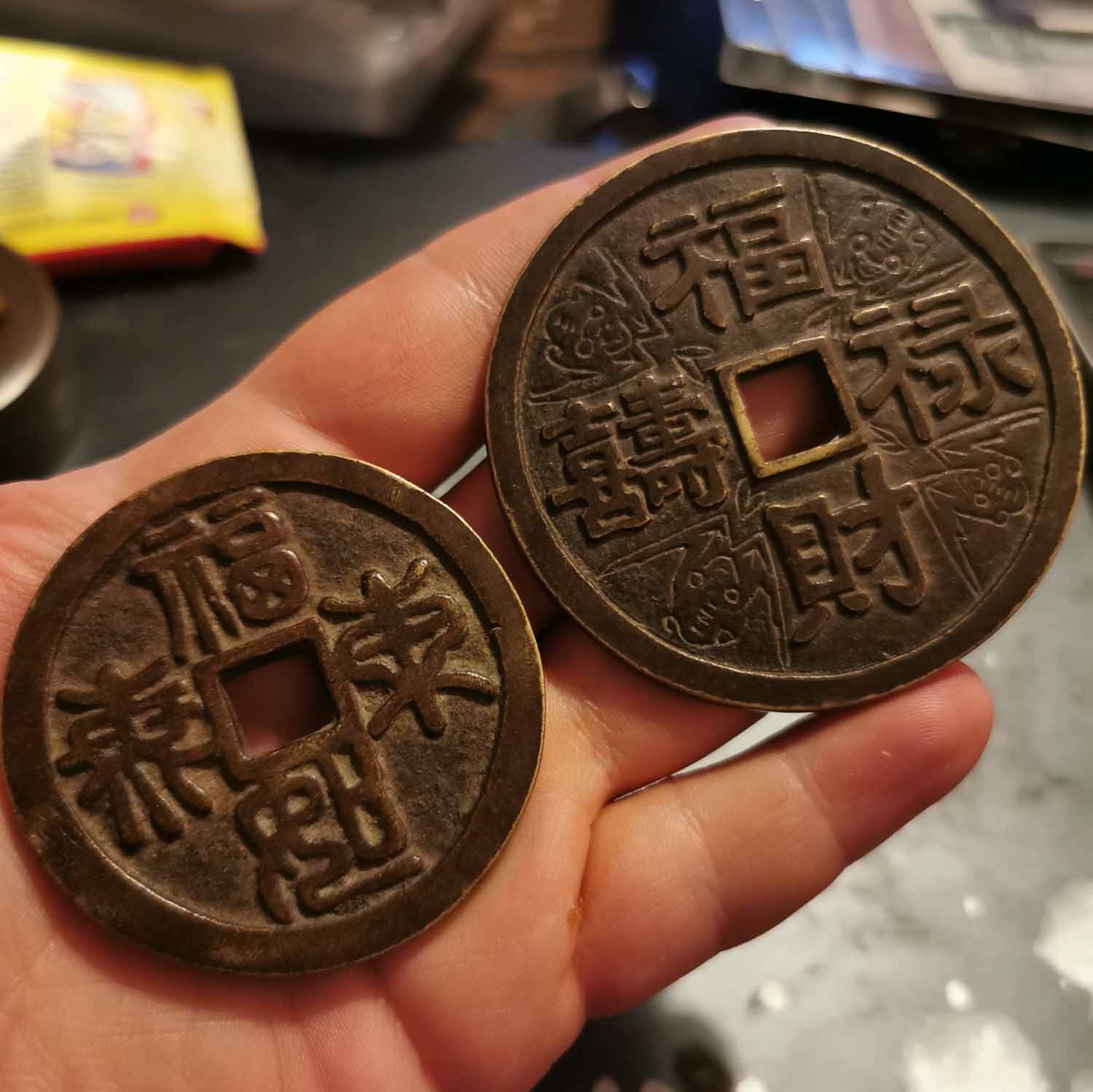
On the larger one, the four critters in the corners are bats. Bats are considered lucky in Chinese culture because the word/character for bat, "fu", is pronounced the same as the word/character for "fortune/good luck", indicating this is more of a specific good luck charm. "Fu" also is the character at the top, where the inscription starts: "fu cai lu..." and a character I can't translate. Fu is fortune, cai is wealth, and lu is something like "government salary", so the overall impression has to do with wealth and maybe getting a secure well-paid job. It's a monetary-blessings charm.
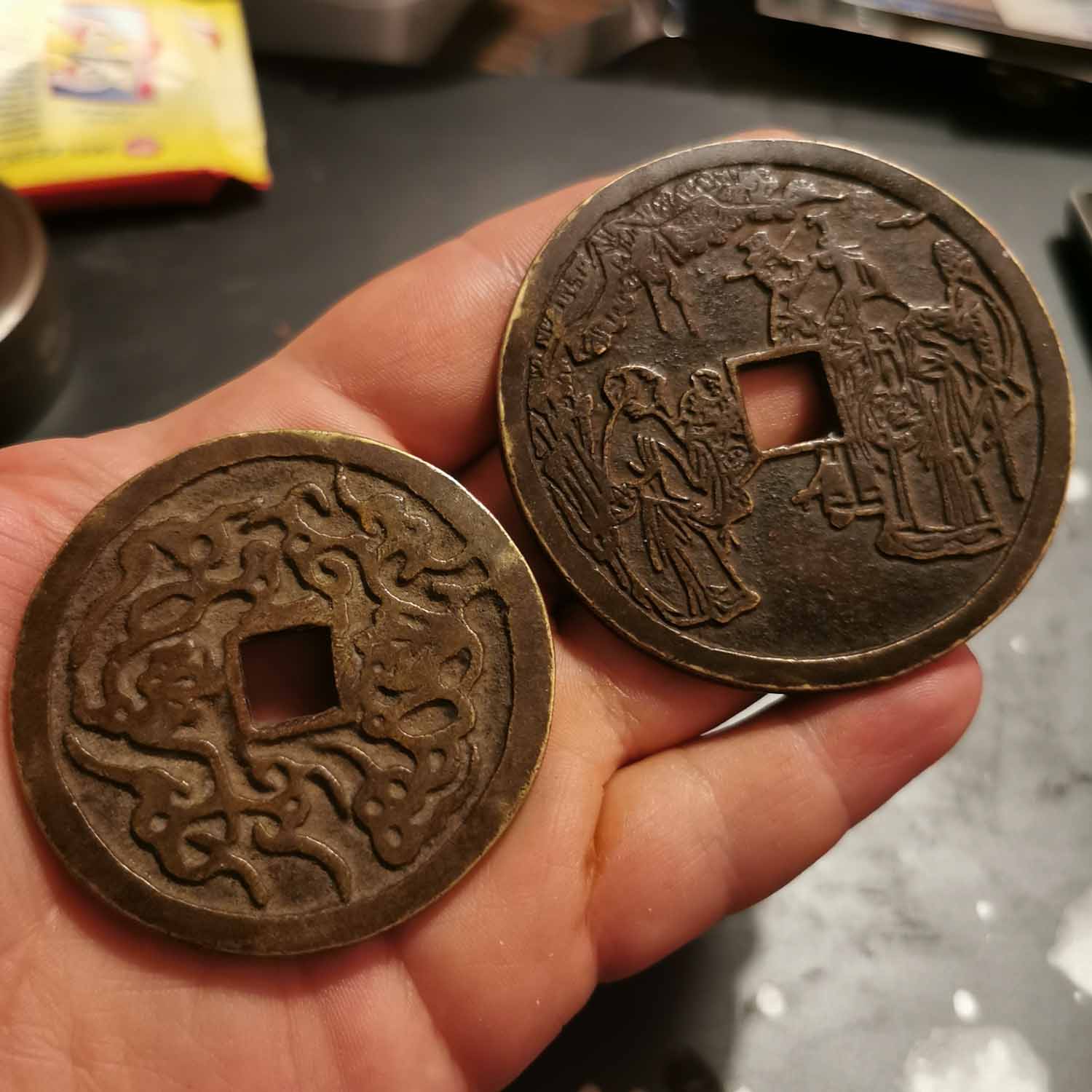
I'm not sure what the pictorial on the image is, but based on other Chinese charms, my best guess is a rendition of the legend of the Three Tian Brothers and the Weeping Tree. The legend goes that these three brothers could not agree on dividing their deceased parents estate, so they agreed to divide it scrupulously, evenly and fairly. They were doing well, until it came to a large redbud tree covered with beautiful flowers. They agreed the "fairest" thing to do would be to chop it up into three even pieces so they could each have a piece, even though one brother pointed out this process would likely do nothing but destroy the flowers and kill the tree. But when they turned up the next morning to do the deed, they found the tree had already withered from sadness at the brothers quarrelling and had lost all its flowers. "This tree is wiser than we are", the brothers agreed, so they resolved to quit their feuding and share the family wealth. The tree then recovered. The legend is widely seen as a story about getting along together to ensure family prosperity. Versions of the story are popular across East Asian cultures.
The smaller one on the right is a more generic blessing charm, written in archaic seal script, "fu shou kang ning" - a Chinese blessing that translates as "May you have fortune, long life, good health, and peace". The reverse design is a (very stylized) two dragons, signifying much the same thing as well as "happy marriage".
Don't say "infinitely" when you mean "very"; otherwise, you'll have no word left when you want to talk about something really infinite. - C. S. Lewis







 Posted 03/26/2024 2:18 pm