| Author |
 Replies: 163 / Views: 7,826 Replies: 163 / Views: 7,826 |
|
|
|
Pillar of the Community
  Sweden
2124 Posts |
CHAPTER 1: The Hardi
= Late 14th Century =Before talking liards, we must deal with the hardi. The two are like siblings: Clearly similar, but still different, came into existence close to each other in time, lead separate but parallel lives. Both worth 3 deniers (or thereabouts), both same size low grade silver (billon) coins, so it is really just a matter of naming (and local tradition). In 1368, the hardi sees the light of day in Duchy of Aquitaine, at that time ruled by the English. The liard is first mentioned in 1383, in the French feudality of Dauphine. But more about that in a later Chapter. The hardi will be gone a couple of centuries later, while the liard will be going strong quite a bit longer. So, let's tell the story of the hardi (scroll down 'til you see a coin, if you don't care about the background)! Edward the Black Prince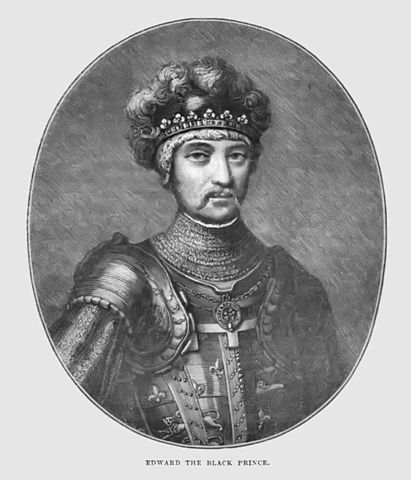 Edward of Woodstock, aka Edward the Black Prince. Edward of Woodstock, aka Edward the Black Prince.
Source: Illustration from Cassell's History of England - Century Edition - published circa 1902. Wikipedia, public domain.Aquitaine, AD 1362 - After decades of plague, devastating warfare with ravaging knights and pillaging mercenaries, Prince Edward, eldest son of King Edward III of England, was made Prince of Aquitaine and Gascony, and a period of relative calm followed. For more than two centuries, the English Plantagenet kings had laid claim to this part of France (and for long periods, they ruled it). That claim was part of the reasons for the Hundred Years' War (which began in 1337). After the Black Death had taken its grim toll in the 1350s, came Prince Edward, later known as the Black Prince, with his ruthless knights. By command of the English king, they ravaged the countryside of Aquitaine and southern France, burning, plundering, and killing without mercy. French king John II ("the Good") met up at Poitiers in 1356, at a battle that ended with disaster for the French: the king, his son, and several thousand French soldiers were captured. The country was thrown into utter chaos, and now the French nobles and mercenaries ran amok: without their king, they came down on towns and countryside, pillaging and mistreating the population. The Treaty of Bretigny in 1360 released king John in exchange for the whole of Aquitaine and Gascony being ceded to England (plus a ransom of 3 million gold ecus). It was made into a principality and given to Edward as a reward for his successful campaigns. Those harshly tried inhabitants that had survived the misfortunes of the past decades, could finally hope for some respite. 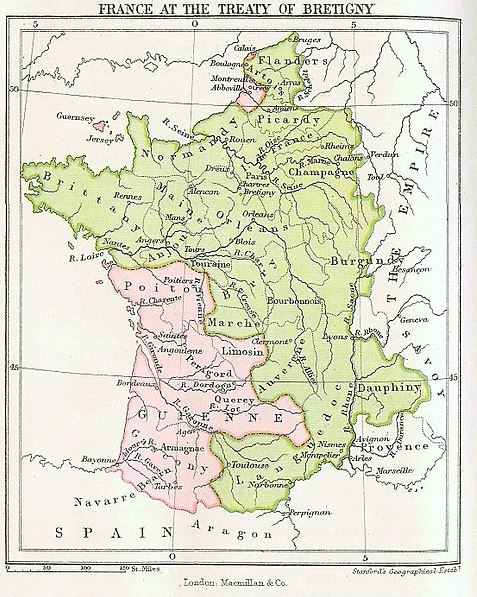 France after ceding territory to England at the Treaty of Bretigny in 1360. English territory in pink. France after ceding territory to England at the Treaty of Bretigny in 1360. English territory in pink.
Source: From History of the English People, 1877. Wikipedia, public domain.Once settled in Aquitaine, the Black Prince got himself involved in the prevailing political and military turmoil between different factions in the area. An extensive military expedition into Spain left the prince in financial difficulties. That may have been a factor behind the monetary reform he implemented in 1368. The Aquitaine sterling (or silver guyennois or guyennois d'argent, the contemporary name) was replaced by the silver hardi - hardi d'argent - which maintained the sterling's value but had its silver content lowered. This, the first hardi, is shown below: Hardi d'argent, Aquitaine 1368-1372, Edward the Black Prince, Poitiers. Silver/billon (ca 0.5?). 1.09 g, 19 mm. DupFeod 1126, Spink 8134. 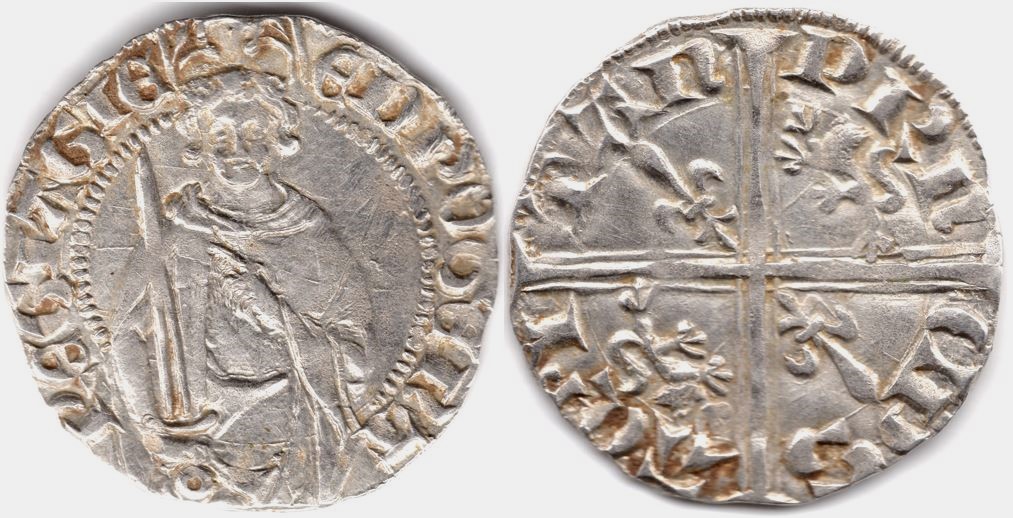 Obverse: ED PO GEnT REGI AGIE (Edwardus Primo Genitus Regis Anglie / Edward first born of the King of England). The prince (we can assume) facing with finger pointing at sword, diademed, arch above. Reverse: PRnCPS AQITAn (Princeps Aqvitanie / Prince of Aquitaine). Long cross with French fleurs-de-lis and English lions (leopards to a heraldist). Note the raised P after Q, mintmark for Poitiers. He didn't call himself "Black Prince" on his coins, he had other titles he liked better  . It is not known when or why he got that epithet, if it was at all during his lifetime (which did not last more than a few more years, until 1376). First known use is in a 16th century manuscript, without explanation as to why. It is known that he had a black shield (some think a black armor), another possibility is that he earned his byname through the unusual brutality he showed in battle and towards civilians who got in his way. In any event, on the hardi he looks, if not brutal, at least determined, standing there pointing at his sword. The design can be seen as a development of the portrait used on the precursor coin, the sterling. It is also most probably inspired by the contemporary French gold ecus (there was also a gold hardi, hardi d'or, with the same portrait), where the king stands under an arch, pointing at a scepter. Edward wanted perhaps to point out that there were other power tools than the scepter? Compare with the Aquitaine sterling and the French royal d'or shown below (neither of them mine, unfortunately ). 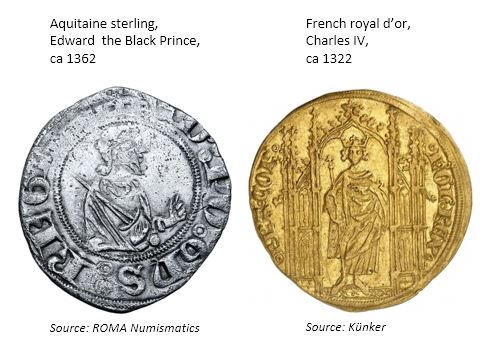 Obverse of Aquitaine sterling (left) and French royal d'or (right), likely inspirations for the hardi portraiture. Obverse of Aquitaine sterling (left) and French royal d'or (right), likely inspirations for the hardi portraiture.The hardi d'argent of Edward was worth . . . well, had only more of the minting records survived, that would have been easier to tell. It seems that the English, when they left Aquitaine in 1453, did not take the records with them, and the French who took over, did not care much about the leftovers of the English . . . So, we have to use whatever data we have and see what we can conclude indirectly (and since you are all clever, you have already guessed that we will arrive at something like 3 deniers ). What we know for certain, is that the value of the hardi was not expressed in terms of deniers tournois, (one of) the units used by the French (enemy). Aquitaine used the Bordeaux denier, or denier bourdelois (other spellings exist), since long considered a denier of good value. If the hardi maintained the value of the sterling, the coin it replaced, it was valued at 5 deniers bourdelois. Comparing known values for weight and fineness for the Bordeaux denier and the French denier tournois from the time, one arrives at that 1 denier bourdelois had the same silver content as 3/4 denier tournois. Hence, the hardi would correspond to 3.75 deniers tournois. This corresponds well with earlier and later documented values: A value of 4 deniers tournois for the "esterlin" (= sterling) in 1265 (decree by French king Louis IX) and a value of 3 deniers tournois in 1467, when the French had taken over Aquitaine and continued minting hardis. "Hardi"?Finally, the name. "Hardi", what on Earth does that mean? Again, had minting records survived, we might have known, now we have to guess. It is related to the English word "hard" and in French (and Medieval English) "hardi" means "be bold" or "make bold", "daring", or "harden". Does it relate to qualities of the guy on the coin, that is, Edward? He was certainly a tough and rough type. A contemporary of his, the Duke of Burgundy, was called Philip the Bold, or in French, Philippe le Hardi (and about a century earlier, another Philippe le Hardi sat on the French throne). Another theory is that it is a corruption of the word "farthing", which some mean might come out as something resembling "hardi" from a Gasconese mouth. Personally, I wonder whether it might more likely be a corruption of "Edward", which with a French tongue would be pronounced "Edouard". Maybe it will have to remain one of life's mysteries. What Happened Then?Edward never became king, he died (probably of dysentery) one year before his father, Edward III. The hardi (and double hardis) continued to be minted during the subsequent rulers, kings of England: Edward III, Richard II, Henry IV, V, and VI. It looked the same throughout, so let's stop here and wait for the next Chapter, taking us to 1453, the year the French took over Aquitaine! The TresinOr, wait, we'll make a short stop in 1423. That year, Henry VI minted the tresin, a coin with the express value of 3 deniers tournois and struck, not in Aquitaine, but in the English possessions further north in France. It was basically a single issue. Consequently, it is extremely rare (I can't even find a picture of it online). Do show if you have one . . .
|
|
Pillar of the Community
Russian Federation
5186 Posts |
Quote:
Consequently, it is extremely rare (I can't even find a picture of it online). I can - here's one at World of Coins. For some reason it's mislabeled as a "niquet" in the caption... EDIT: there are also two at Wikimedia Commons, one from Paris (?!) and one from Rouen. Edited by january1may
04/23/2024 08:34 am
|
|
Pillar of the Community
Sweden
2124 Posts |
Thank you for helping out with that, january1may!  |
|
Moderator
 United States
196278 Posts |
An interesting first chapter! |
|
Moderator
United States
107820 Posts |
Just stepping into this topic, great read so far - lots of history...
Thanks for posting this up.
|
|
Pillar of the Community
Sweden
2124 Posts |
Quote:
An interesting first chapter! Quote:
Just stepping into this topic, great read so far - lots of history... Thank you! More history (and coins) on the way! |
|
Pillar of the Community
Sweden
2124 Posts |
CHAPTER 2: The Hardi Goes French
= Late 15th Century =The Hundred Year's War lasted until 1453. The last city to fall to the French was Bordeaux, capital of Gascony, or Guyenne as the area was called by France. One might think that from then on, only French coins would be current, but no. The Bordeaux denier had such a long tradition and well-founded reputation that the French king continued minting deniers bourdelois for another 50 years. The same applied to the hardi, which was continued, now as a French royal coin, for almost another century. Citing the royal decree of 18 October 1467 (translated and somewhat shortened, but trying to keep the old style of the language): "In Guyenne, there is a scarcity of hardiz, which since ancient times our subjects of said country have become accustomed to use . . . Having wished and ordered, we declare it our wish and order that at our mints in said country of Guyenne and at all others in our Kingdom there should from now on be forged deniers blancs named hardiz de France . . . which shall be current in all of our said Kingdom and in our Dauphine for 3 d. t. a piece." Here deniers is used as a generic term for coins, and blancs (meaning white) indicates that it is silver or good billon. Dauphine was a province with special status, which I will come back to in the next Chapter. The design with the ruler holding a sword was maintained throughout the French period. Under Louis XI it looks like this (not the nicest specimen, probably clipped): Hardi d'argent, France 1472-1475, Louis XI, Bordeaux. Billon (0.239). 0.87 g, 18 mm. Dup 559 (variant), CHMF 8. 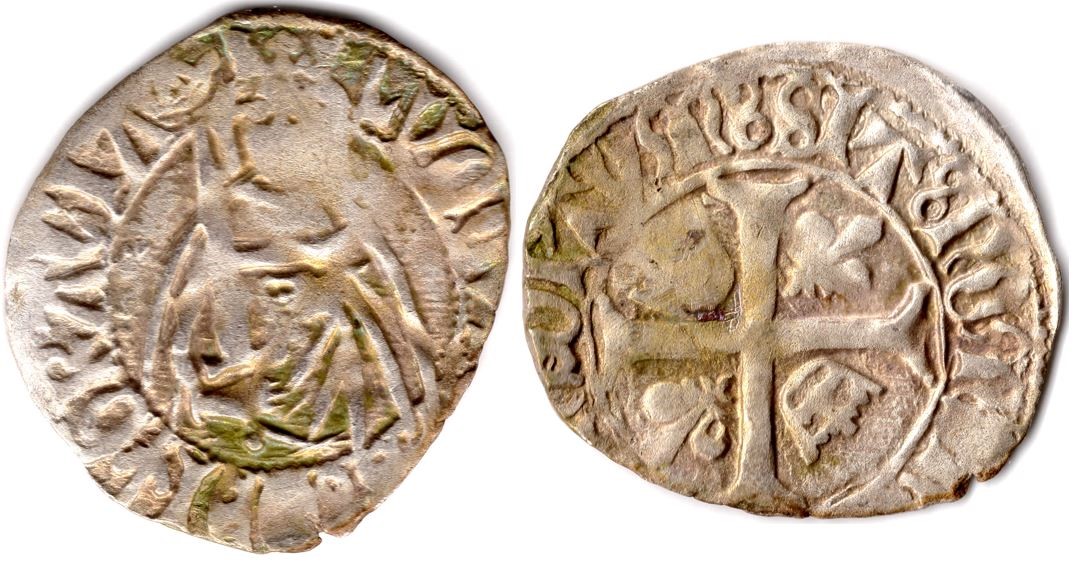 Obverse: LVDOV[ICV]S DEI GRACIA (Louis by Grace of God). The king, facing with finger pointing at sword, crowned. Ship left of crown, mintmark for Bordeaux; fleur-de-lis after DEI (7 o'clock), mintmark for mint master Andre Genys. Reverse: SIT nOmEn[ DnI BE]nEDITVm (Sit Nomen Domini Benedictum / Blessed be the name of the Lord). Cross potent with fleurs-de-lis and crowns. Louis still points to the sword, like his English predecessors did. His successor, Charles VIII, still held the sword but used his left hand to hold a scepter instead. That change was maintained for the rest of the French period. Worth mentioning is that the silver content was lowered successively (like for many other silver coins). The last hardis, minted by Francis I in the early 16th century, were down to 0.193 silver (and weighed 15 % less than those of Louis). The value of 3 deniers tournois was not changed. Another reason to let the Bordeaux townspeople continue minting the coins to which they were since ancient times accustomed - besides the king's benevolence towards his new subjects, perhaps - was the position of the city as an important trade hub. Located in what is still one of the most important wine districts in the world, and with access to the Atlantic, export of wine had for centuries been the main source of revenue for the city and its inhabitants. The hundred years of war with the English had hampered the export, at times severely, and at the time of the French conquest it was down to a fraction of the pre-war numbers. The French king, Charles VII, may have hoped for a renewed boom (that he could tax!), but trade recovered only gradually. One reason for that was the obstacles and restrictions placed on English merchants (England had, naturally, been the most important wine buyer during the English rule): Before entering Bordeaux, they had to stop at another port to acquire an (expensive) safe conduct pass, then they had to stop at different port to surrender any weapons. Once in Bordeaux they had to buy a license, they were only allowed to stay in designated quarters, and they had to wear the English red cross on their clothes when out. They were also subject to a curfew, which prevented them from taking part in whatever evening entertainment the city had to offer. Fortunately for Bordeaux, the desire for Bordeaux wines in England was high enough to make some traders accept the harsh terms of trade. 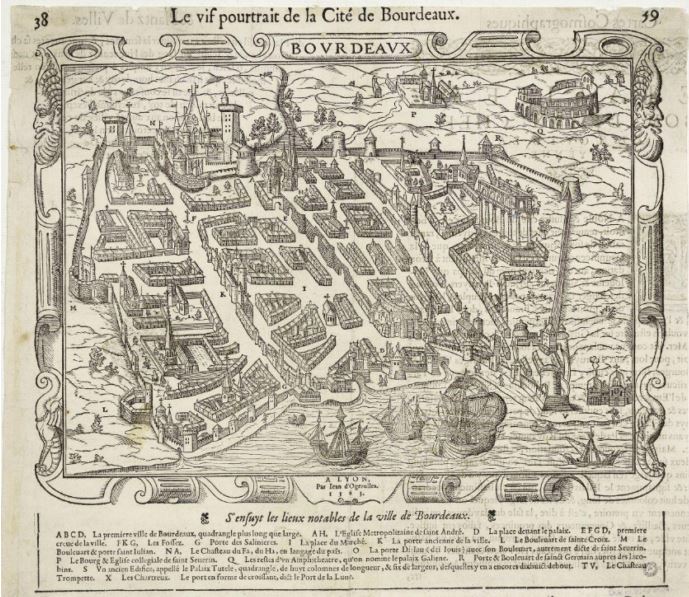 The city of Bordeaux in the 16th century. The city of Bordeaux in the 16th century.
Source: By F. de Belleforest, printed in La Cosmographie Universelle de tout le Monde, Nicolas Chesneau & Michel Sonnius, 1575. WordPress.com.To begin with, French hardis were struck in Aquitaine, but later the area was extended to Brittany and Provence. The last king to strike hardis was Francis I, in Turin in 1538, while fighting with Holy Roman Emperor Charles V over the Duchy of Milan. The ArditIf you look into the small change used in and around the Pyrenees, in the 15th-17th centuries, you will sooner or later come across the "ardit", worth 3 or 2 deniers. And yes, that has its origin in the hardi. A Frenchman will pronounce "hardi" as "ardi", and a Pyrenean farmer speaking Occitan or Catalan would add a "-t", thus the "ardit" has seen the light of day. Bearn, a province in the medieval kingdom of Navarre and located in the west Pyrenees (that is, just south of Gascony), minted liards. In Bearn, the names liard and ardit were used interchangeably, also in official documents. Since the hardi and the liard (at least from the time of the French conquest of Aquitaine) were both valued at 3 deniers, there was no risk for confusion. Catalonia in northern Spain minted ardites from the 1550s to the 1750s. Being close to the Pyrenees, the name was most likely picked up from the hardis/ardits that circulated nearby. Its value is another story: Information that the ardite had a value of 3 dineros, corresponding to the hardi's 3 deniers, can be found in a couple of places, but most sources state a value of 2 dineros, changed to 1 dinero in 1652. So enough said about that. Au revoir, Monsieur HardiWe say goodbye to the hardi here, but not until we have noted some fun facts (using Geneanet's web site): If you live in France today, no one will find it strange if your surname is Hardi. Also not uncommon in Belgium and the Netherlands, as well as in Hungary, for some reason. The same goes for Liard, which is even more common than Hardi. If your surname is Ardit or Ardite, you are most likely from southern France or northern Spain. Next Stop: The TernalisIn the next Chapter, we come closer to the main subject of this thread, the liard. Its predecessor the ternalis was a contemporary of the hardi, its dawn too in the 14th century, but with a brighter future, as we will see. We will also dive into marine zoology and how it was perceived in Medieval times. 
|
|
Moderator
United States
196278 Posts |
Fascinating! |
|
Pillar of the Community
Sweden
2124 Posts |
CHAPTER 3: Before the Liard (or The Age of the Dolphins)
= Late 14th Century =Apparently it was time to introduce a 3 deniers coin in the mid 14th century. Up until then, there had been only deniers and double deniers (at the low value end; larger denominations in silver and gold had been around since the 13th century). The English were early with their hardi, as we saw in Chapter 1, but some 300 miles or so to the East, in the Province of Dauphine, coins of 3 deniers had been around for a couple of decades already (see Note 1). They would eventually be called liards, but in the 1360s they were still called ternales. Let us have a look at one, right away: Ternalis ("liard", 3 deniers viennois), Dauphine 1369-1380, Charles V of France. Billon (0.180). 1.16 g, 20 mm. DupFeod 2472. 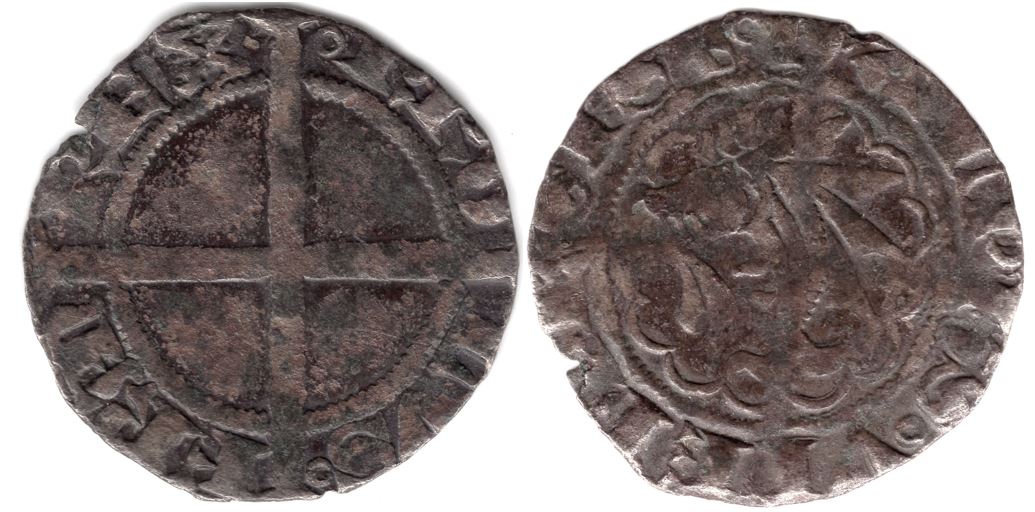 Obverse: KROLVS FRAn REX (Karolus Francorum Rex / Charles King of the Franks). Long cross. Reverse: DALPh'S VIENESIS (Dalphinus Viennensis / Dauphin of Viennois). Dolphin (well . . .) in polylobe. Duplessy calls this a "liard" in his Les Monnaies Françaises Feodales. King Charles himself uses the terms ternaux and ternales (French respectively Latin) in his edict of 1369 specifying weight and fineness for the coin. We will get back to the naming question in the next Chapter and at the end of this one, but there are other matters to look into as well. One thing is that Dauphine was a feudality of the French king, still it is the Frech king himself who issues the coins here. Is Charles V a vassal to himself? I will get back to that at the end of this post. The value of this liard or ternalis is 3 deniers viennois. Dauphine used the Viennois standard for its coins and 1 denier viennois equaled about ½ denier tournois. More about Dauphine minting standards in the next Chapter. Now, the "dolphin". It doesn't look much like a dolphin, more like a fish. Putting a dolphin on a coin is not that original, already the ancient Greeks did that. More original is the reason in this case, namely that the coin is from one of the world's very few Dolphinies ( Dolphiny is the word I will use here, although Dolphinate and Dauphinate are also used). At least that is what the French word Dauphine would translate to, since French dauphin = dolphin (see Note 2). That requires a bit of explanation (if you are not interested in the background, you may well skip the rest of this post - I won't notice ). The DolphinyThere once was a Count Guiges of Albon, residing in Vienne in southeastern France, along the river Rhône. He was the 3rd of his line with that name, and his son was also named Guiges. One day - the year was 1110 - he came up with the idea that his son should be called "the dolphin" (or rather, le dauphin), and he wrote it down in a document (in the document he wrote dalphinus, because like most noblemen of any significance, he was an educated man and wrote in Latin). Where the idea came from is hazy. Some said his wife had an English cousin named Dolfin, of whom she had fond memories. Others said she was Sicilian and had no English cousins at all. There was tale of a dolphin having swum up the Rhône to Vienne, and that must mean something. Some thought the count had gone nuts. What young Guiges thought of it at the time is not known, but when he became Count Guiges IV in 1133, he did put a dolphin on his coat of arms (or maybe that was his grandson, Robert IV, sources disagree). What it looked like is shown below, on the seal of his successor Humbert II. 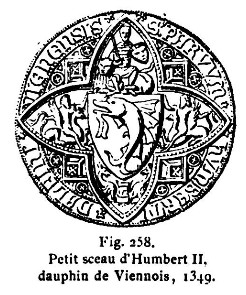 Seal of Humbert II, Dolphin of Viennois. Seal of Humbert II, Dolphin of Viennois.
Source: From Le costume au moyen âge, d'après les sceaux, G. Demay, 1880. Wikipedia, public domain.It is obvious that Guiges (or his grandson) had a very vague idea of what a dolphin looked like. He knew the dolphin swam in the sea, and things swimming in the sea were generally considered as fish. And he knew what a fish looked like, which explains why the dolphin on the liard looks the way it does. It appears the whole dolphin idea appealed to Guiges IV. He decided to call himself Dolphin instead of Count, making it into a noble title. And if a Count had a County, then of course a Dolphin had a Dolphiny. Dolphiny of Viennois, more precisely, Viennois being the region around Vienne, the town were all this started. (I can't help getting this image in my head  : Guiges sitting in his castle, playing the lute and humming ". . . I am the dolphin, goo goo g'joob ..." (see Note 3).) Eventually, around 1250 or so, the dolphin from the coat of arms also turns up on the Viennois coins (deniers, obols, and gros - no liards yet). By that time, also a second dolphiny, Dauphine d'Auvergne, had arisen from a sideline of the Albons (but I will not concern myself further with them; to my knowledge, they never minted any coins - the neighboring County of Auvergne did, but that is another story). So far, so good. The Dolphiny, which was part of the Holy Roman Empire, passed down the generations. Until 1343, at which time the Dauphin is named Humbert II (whose seal is shown above). Humbert is a troubled man and cannot manage the dolphiny's finances. In the end, with no money and no heir, he sees no other way out than to put the dolphiny up for sale. The pope, Benedict XII, (who at this time sits in nearby Avignon) finds the requested price of 120,000 gold florins too expensive, and so does his uncle Robert of Anjou (who, among other things, is count of likewise nearby Provence). But the king of France, Philip VI, agrees. Humbert even manages to throw in a condition: The title of Dauphin shall henceforth be borne by an heir to the throne of France, who would also rule the province. In 1349 the Dauphine de Viennois becomes the French Province of Dauphine, but ruled independently, by the heir who is its Dauphin. The French Province of Dauphine and Who Was the Vassal?The first royal Dauphin of Viennois was Philip's grandson and heir to the throne Charles. (Charles's father was John II, who, you might remember from Chapter 1, was captured by the English at the Battle of Poitiers and ransomed for a huge amount of gold.) He became Dauphin and, in principle, ruled Dauphine from 1349 (in principle, because he was only twelve at the time). In 1364 he became king as Charles V, still without sons, so he continued to rule the province - thus in some sense becoming a vassal to himself. It is his coin that is shown at the top of this post. The dolphiny passed on to his first son (also named Charles) when he was born in 1368. The minting rights, however, did not - more about that in the next Chapter. Before the Liard Became a Liard: The TernalisTo begin with, coins valued at 3 deniers were called ternalis in Latin (plural ternales) and ternal in French (plural ternaux). The word basically means "three of" something. The reason it was used to denote money is perhaps found in the apothecary world. Denier was not only a monetary denomination, it was also a weight unit in the Medieval mark system(s); in the system based on the Troyes mark (= ca 244.8 g), a denier = ca 1.27 g (which, not by coincidence, used to be a typical weight for a Medieval denier coin; as the centuries passed, the coin's weight slowly sank). And a ternal to an apothecary denoted a weight of 3 deniers. Next Time: More About the DolphinyMinting rights, fights, standards, the naming question - some of the subjects treated in the next Chapter! And more coins from Dauphine, of course. Don't forget to show your coins from Dauphine, if you happen to have some! NotesNote 1: When exactly the first 3 denier coin was minted is not known. Numista lists a Dauphine "1/4 Groschen" from 1307-1319 as equivalent to 1/80 livre, but while a gros (or groschen) initially equaled 12 deniers (of some kind) = 1/20 livre, its value was not static. What the value of a Dauphine gros was in 1307 is unknown to me, but in 1340 it was valued at 17 deniers (viennois). Note 2: At the time, it could also be spelled (and probably pronounced) dalphin or daulphin. Note 3: You may be lost here, if you are not a Beatles fan.  A clue in that case: Google "goo goo g'joob"!
Edited by erafjel
04/25/2024 2:50 pm
|
|
Moderator
United States
196278 Posts |
Dauphin is dolphin. I should have known that. I did not know that. Thank you for sharing this most recent chapter. |
|
Pillar of the Community
Sweden
2124 Posts |
|
|
Pillar of the Community
Sweden
2124 Posts |
CHAPTER 4: Another Day in the Dolphiny (and First Mention of Liard)
= Early 15th Century =During the hundred years that followed on the sale of the Dolphiny to the French king, Dauphine became an arena for political intrigue, military endeavors, internal and external conflicts, and not least, competition and friction between king and prince/dauphin. For those interested, there is plenty of info on the net. Suffice it here to say that the status as an independently ruled province ended in 1456, when the dauphin Louis, son of king Charles VI, falls out with his father over how to rule the province. They disagree to such an extent that Charles sends troops to Dauphine and Louis flees to Flanders, only to return as king Louis XI, when his father dies in 1461. From then on, Dauphine is just a regular French province, under direct rule of the Crown. 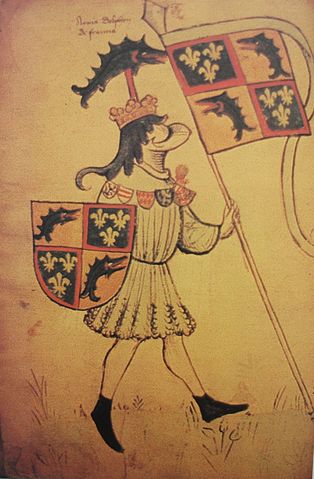 Dauphin Louis, future Louis XI. Dauphin Louis, future Louis XI.
Source: From the German armorial scroll Hyghalmen, ca 1450. Wikipedia, public domain.
Now, about the minting. Firstly, during the whole time as an independently ruled feudality, Dauphine's minting was separate from the French royal minting. Until 1386 the mints continued to use the traditional viennois standard, with sols and deniers viennois. By the late 1300s, 1 denier viennois = ½ denier tournois. In 1386, the royal tournois standard was imposed on the Dauphine mints and from then on, the liards for instance, were valued at 3 deniers tournois. (There is much more to say about the Dauphine minting and its relation to the royal minting, but I will not take up space here for that.) Secondly, the minting rights were not automatically transferred to a new dauphin. That is why the coin I showed in the previous Chapter is minted by the French king, Charles V, and not the dauphin, future Charles VI, to whom the minting rights were not transferred until 1380, when he became king. He in turn did transfer the minting rights to his first son Louis when he was 12 years old (and who died a few years later, never became king), so each ruler had his own principles. The liard below is by Charles VI or by another of his sons, Charles VII (sources disagree on which one). It is any event according to the royal standard and thus tariffed in deniers tournois. Liard, 3 deniers tournois, Dauphine 1404-1408, Charles VI of France or 1422-1440, Charles VII of France, Cremieu. Billon (0.24-0.28). 1.23 g, 20 mm. DupFeod 2482. 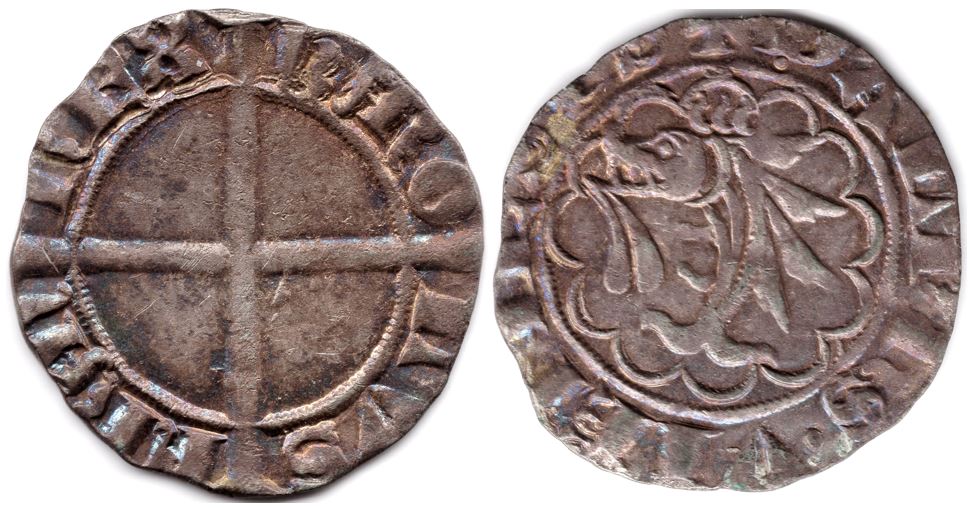 Obverse: KAROLVS FRAn REX (Karolus Francorum Rex / Charles King of the Franks). Long cross. Reverse: DALPh'S VIENESIS (Dalphinus Viennensis / Dauphin of Viennois). Dolphin in polylobe. Annulet below 1st letter ('D'), mintmark for Cremieu. A bit heavier and with almost twice as much silver than the previous liard, it is adapted to the tournois standard, but the design is almost identical. A novelty is the so called "secret point" indicating the mint. It is believed to have been introduced in conjunction with the transfer to the tournois standard in 1386, with a point/annulet below the 1st letter in the inscription for coins minted in Cremieu, and below the 2nd and 3rd letter for the two other Dauphine mints in Romans and Mirabel, respectively. Perhaps it was part of the quality control for the new minting standard? It was apparently successful, because already in 1389 a royal edict mandated use of the system in the entire kingdom, assigning position 4 and upwards to the rest of the royal mints. Origins of "Liard"It is not known where the term "liard" comes from. There are several theories, none of which I find completely convincing. I will just mention one, the one I think may have some truth to it. First known use of the word "liard" is in a royal edict dated November 22, 1382, specifying which coins to mint in Dauphine: "Liardz appelez quartz, . . ., ayans cours pour 3 d. pièce." That is, "liards called quarts, . . ., having a value of 3 deniers a piece." To me the formulation "liards called quarts" indicates that liard was already an established term - the reader was expected to know what that was, just that these particular liards should be called quarts. Since the 1369 edict for the coin shown in the previous Chapter uses the term ternaux/ternales, one can assume that the term liard came into use sometime in between those two dates. That also fits with the theory that the word "liard" is derived from "li hardi", that is, "the hardi" ( li is a Medieval form of French le, meaning "the"). Since the hardi arrived in 1368, it fits the time frame. One problem of course, is that the Aquitaine hardis of the time did not have a value of 3 deniers, but 5 deniers (bourdelois). Besides, it seems odd to name a denomination after a coin used in enemy territory (I don't think the hardis ever circulated in France at this time, if they ever crossed the border, they would need to be exchanged to local money). But I don't have a better theory . . . Next Time: RoyalsEventually the liards (and with them, the dolphins) spread from Dauphine into the rest of France. That is the theme of the next Chapter. I will take a pause over the weekend, the royals will have to wait until Monday. So now is a good time to bring out any hardis or Dauphine liards that you want to show!
|
|
Moderator
United States
196278 Posts |
Very interesting! I like the "li hardi" explanation. Even if the money did not cross the border, the terminology could have been picked up during exchanges. Or perhaps we need to go back further, it is possible that separate people differently adapted the "hard" word for their coins.  |
|
Pillar of the Community
Sweden
2124 Posts |
Quote:
I like the "li hardi" explanation. Even if the money did not cross the border, the terminology could have been picked up during exchanges. That's a theory as good as any, jbuck! Now, Francis and the other 16th century French kings are impatiently rattling their liards out in the hallway, but they will have to wait until tomorrow!  |
|
Moderator
United States
196278 Posts |
Quote:
That's a theory as good as any, jbuck! I get one every now and then. Quote:
Now, Francis and the other 16th century French kings are impatiently rattling their liards out in the hallway, but they will have to wait until tomorrow!  |
| |
Replies: 163 / Views: 7,826 |
To participate in the forum you must log in or register.
Disclaimer: While a tremendous amount of effort goes into ensuring the accuracy of the information contained in this site, Coin Community assumes no liability for errors. Copyright 2005 - 2026 Coin Community Family- all rights reserved worldwide. Use of any images or content on this website without prior written permission of Coin Community or the original lender is strictly prohibited.
Contact Us | Advertise Here | Privacy Policy / Terms of Use
|
| Coin Community Forum |
© 2005 - 2026 Coin Community Forums |
| It took 0.58 seconds to rattle this change. |
 |
|








 First Page


 Posted 04/23/2024 08:24 am


