Coin Community Family of Web Sites Join Thousands of Coin, Bullion, & Money Collectors
Vancouvers #1 Coin and Paper Money Dealer Shop for APMEX Bullion on eBay!Royal Canadian Mint products, Canadian, Polish, American, and world coins and banknotes. 300,000 items to help build your collection! Join Thousands of Coin, Bullion, & Money Collectors Specializing in Modern Numismatics Coin, Banknote and Medal Collectors's Online Mall


Username:
Password:
Save Password
Forgot your Password?


This page may contain links that result in small commissions to keep this free site up and running.

Welcome Guest! Registering and/or logging in will remove the anchor (bottom) ads. It's Free!

The Lovely Lowly Liard

To participate in the forum you must log in or register.
Author Previous TopicReplies: 163 / Views: 7,079Next Topic
Page: of 11
Pillar of the Community
Learn More...
erafjel's Avatar
Sweden
2124 Posts
 Posted 04/20/2024  1:07 pm Show Profile   Bookmark this topic Add erafjel to your friends list Get a Link to this Message Number of Subscribers
The Liard - Lowly or Lovely?

A First Introduction (1/3)


Liards show up here on CCF now and then, mostly in copper, in billon if they are older. Many are well worn and/or badly struck, few are fresh from the mint and nicely struck. Designs range from the simple and mundane to detailed and beautiful. For centuries these small coins from France and the Low Countries were the everyday currency for ordinary people's daily expenses. Valued at three deniers (mostly) respectively two duiten, they belonged to the lowest denomination range.

As lowly as the liard may be, I find them quite lovely too. The well struck and well preserved ones for sure, but also the ones that have been worn down from being passed through countless hands. Holding something in my own hand, which carries traces of use by people who lived hundreds of years ago brings its own special sense of awe.

Before I continue rambling, here is a liard to whet your appetite and illustrate what it is I am talking about:

Liard, France 1492-1498, Charles VIII, Rennes. Billon.

The-Lovely-Lowly-Liard

Despite a bit of double strike, bumps and wear - isn't it lovely, in its own way? This is an early liard, of the dolphin type, common during the medieval and early renaissance periods. I will tell you more about it in a future post in this thread.

Collecting liards has its challenges. Despite the often huge minting numbers, it is many times difficult to find good specimens. Quality was not a central concern when minting these coins; that was more important for the more prestigious gold and large silver coins. Worn dies and bad strikes are commonplace, add to that a lot of wear and tear, and there you have a pretty flat copper disc, with hardly discernible letters and something that was once a portrait of some ruler. Paying 250 € for a rare type that looks like that can make you (or your partner) question your choice of hobby . . .

But I find it an interesting collection area, the more fascinating the more I look into it. Spanning over four and a half centuries from the 14th century to almost 1800, and with more than 40 different issuers, it is enough to keep you busy for quite a while - and, if you like to, learn quite a bit of history along the way!

I will use this thread to show my collection of liards, and tell a bit of history and whatever background to the coins that I am aware of. I like to research my coins: why they were issued, why they look the way they do, what they were used for, etc, and I will share my findings here. My collection is far from complete, but I think I have got a somewhat representative set of coins, from 1368 to 1794, from France royal and feudal and from the different states in the Low Countries. Some look pretty good, some are more unprepossessing.

So, lowly or lovely? A bit of both, I would say. I hope you tag along, then you can judge for yourself.

And yes, you are so welcome to post your own liards! I will be somewhat systematic in how I present my collection, and you can either fit a post in accordance with mine, or you can just post anyway.

But, first a couple more introductory posts to set the scene and provide some general background! First one tomorrow.
Edited by erafjel
04/21/2024 08:34 am
Bedrock of the Community
numismatic student's Avatar
United States
11880 Posts
 Posted 04/20/2024  1:42 pm  Show Profile   Bookmark this reply Add numismatic student to your friends list Get a Link to this Reply
Looking forward to seeing the collection and others' holdings.
IN NECESSARIIS UNITAS - IN DUBIIS LIBERTAS - IN OMNIBUS CARITAS
THE MAN IN THE ARENA, Theodore Roosevelt at the Sorbonne Paris on April 23, 1910: "It is not the critic who counts; not the man who points out how the strong man stumbles or where the doer of deeds could have done better. The credit belongs to the man who is actually in the arena, whose face is marred by dust and sweat and blood, who strives valiantly, who errs and comes up short again and again, because there is no effort without error or shortcoming, but who knows the great enthusiasms, the great devotions, who spends himself in a worthy cause; who, at the best, knows, in the end, the triumph of high achievement, and who, at the worst, if he fails, at least he fails while daring greatly, so that his place shall never be with those cold and timid souls who knew neither victory nor defeat."
My coin website:https://fairfaxcoins.com
Bedrock of the Community
Coinfrog's Avatar
United States
94367 Posts
 Posted 04/20/2024  3:25 pm  Show Profile   Bookmark this reply Add Coinfrog to your friends list Get a Link to this Reply
Standing by!
Edited by Coinfrog
04/20/2024 5:07 pm
Bedrock of the Community
Learn More...
HondoB's Avatar
United States
25102 Posts
 Posted 04/20/2024  3:48 pm  Show Profile   Bookmark this reply Add HondoB to your friends list Get a Link to this Reply
Excellent topic, erafjel! I'm really looking forward to your posts and seeing your coins but even more to learn about them. I have a few liards that mostly fall into your "unprepossessing" category, as I wanted a coin that was possibly handled by my ancestors before they journeyed to the new world.
Inordinately fascinated by bits of metal with strange markings and figures
Pillar of the Community
Russian Federation
5172 Posts
 Posted 04/20/2024  4:45 pm  Show Profile   Bookmark this reply Add january1may to your friends list Get a Link to this Reply
Some of my Louis XIV liards have been strong candidates for my "most worn identifiable coin" category (until I started actively looking for lowball Victorian pennies, which can often have almost only the date showing). Not sure if I have any pics of those - I remember making the pics but might not have preserved them...

Looking forward to the discussion! I think I could have something to contribute in some later sections, but I'm not very confident.

Quote:
Worn dies and bad strikes are commonplace, add to that a lot of wear and tear, and there you have a pretty flat copper disc, with hardly discernible letters and something that was once a portrait of some ruler. Paying 250 € for a rare type that looks like that can make you (or your partner) question your choice of hobby . . .
Back in Russia, I've been fairly actively trying to collect 5th century Roman bronzes, and they sure tend to look pretty much like what you're describing... and when we're talking about AE3 and AE4 types then on top of all those other problems it's also a copper disc hardly a centimeter across, so that even if it's in nominally decent condition you need to squint to see any detail.

I don't think I've been paying 250 euros for any of them, though! But some of the scarcer types did set me back 30-40 euros each and they definitely didn't look like much.
Moderator
Learn More...
Spence's Avatar
United States
34397 Posts
 Posted 04/20/2024  8:33 pm  Show Profile   Bookmark this reply Add Spence to your friends list Get a Link to this Reply

Quote:
I will be somewhat systematic in how I present my collection


Can you please explain your system on how you will be posting? I've definitely got a few to contribute to this thread and would like to follow the same pattern as you.
"If you climb a good tree, you get a push."
-----Ghanaian proverb

"The danger we all now face is distinguishing between what is authentic and what is performed."
-----King Adz
Pillar of the Community
Learn More...
erafjel's Avatar
Sweden
2124 Posts
 Posted 04/21/2024  08:36 am  Show Profile   Bookmark this reply Add erafjel to your friends list Get a Link to this Reply
Thank you all! I hope you will find the thread and the coins in it - mine and others - interesting!


Quote:
I have a few liards that mostly fall into your "unprepossessing" category, as I wanted a coin that was possibly handled by my ancestors before they journeyed to the new world.

I am sure your unprepossessing ones can compete with some of mine, Hondo Boguss. Don't hesitate to show them!

My 9x great-grandfather was born 1595 in Namur (today Belgium, then Spanish Netherlands) and emigrated to Sweden in the 1630s to work in the mining industry. He most certainly must have come across coins like the ones I will show here, which is kind of exciting to think about.


Quote:
I think I could have something to contribute in some later sections

Looking forward to see what you have, january1may!


Quote:
Can you please explain your system on how you will be posting? I've definitely got a few to contribute to this thread and would like to follow the same pattern as you.

I will certainly do that, Spence. The 3rd part of the intro (which I plan to post tomorrow, today it's the 2nd part) will be dedicated to an overview of what I will present and in what order. It will be great to have your contributions here!
Pillar of the Community
Learn More...
erafjel's Avatar
Sweden
2124 Posts
 Posted 04/21/2024  08:47 am  Show Profile   Bookmark this reply Add erafjel to your friends list Get a Link to this Reply
Introduction (2/3): The Liard - What It Is

The liard I showed in my first post is French and so was part of the French denominational system based on the livre: 1 livre divides into 20 sols (or sous), 1 sol/sou divides into 12 deniers (thus 1 livre = 240 deniers). A liard was (for most of the time) equal to 3 deniers, or 1/4 sol, or 1/80 livre. Early on, each French region had its local livre and denier, as we will see, but eventually the livre and hence denier tournois prevailed. Most French liards that I show will thus have a value of 3 deniers tournois (and when it is some other denier, I will tell).

Here is a liard which is not French, but from the neighboring Low Countries, or Spanish Netherlands as they were called then:

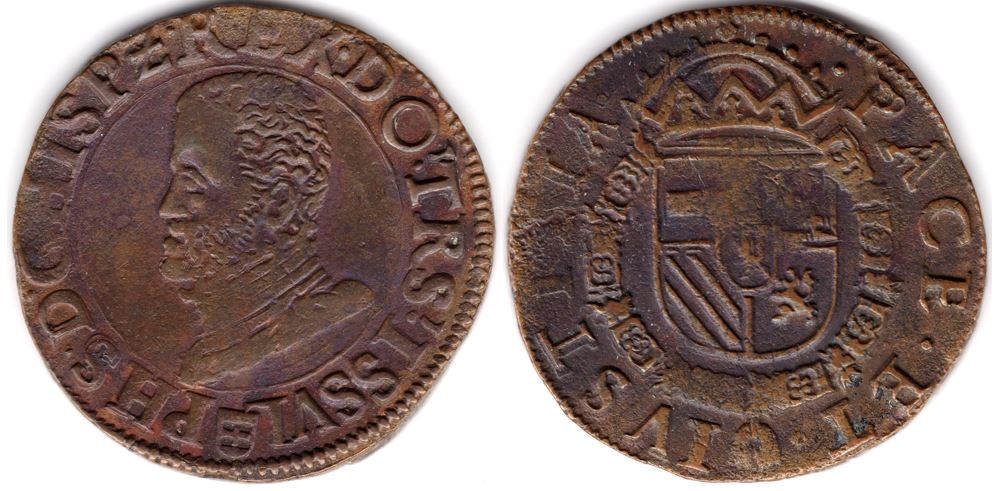
Oord/liard, Overijssel (Spanish Netherlands) 1578-1579, Philip II of Spain, Hasselt. Copper.

The-Lovely-Lowly-Liard

Again, I will say more about this interesting coin, issued during the Dutch Revolt, in a later post. But first thing to note is that it is also called oord. Oord (plural oorden) is Dutch and was the name used for this denomination in Dutch speaking areas, while liard was used in French speaking areas.

The Low Countries' denominational system was different from the French. 1 gulden (or florin) was divided into 20 stuivers, and 1 stuiver equaled 4 oorden. The unit below oord was duit, and there were two duiten on an oord. We can see that there is a certain similarity with the French livre system, and that 1 oord = 1/80 gulden, just like 1 liard = 1/80 livre. Even if the French livre tournois and the gulden were not 1:1, they were for most of the time in the same ballpark.

There is plenty more to say about the monetary system(s) used in the Low Countries and how it developed, but I will just mention that there was also a groot = 2 oorden, and the mite of which there were 12 on one oord. The stuiver was called patard in some regions and the duit was called gigot in some places. Lastly, I have chosen to use the Dutch plural forms oorden and duiten here, rather than the anglicizations "oords" and "duits", which I have seen used in places but do not particularly like. Plural of stuiver is stuivers, though . (To be consistent, I should instead of mite use the Dutch name mijt, with plural mijten, but I feel that this little inconsistency can pass.)

A final remark is that the coin above is of copper, not billon like the French liard I showed in my first post. A shift from billon to copper for small denominations took place 1550-1650 and the Low Countries were first with that for liards/oorden. In my next post, the 3rd and last piece of intro, I will show a French copper liard. The focus of that post, however, is on how I plan to give some structure to the thread, what I will present and in what order.
Pillar of the Community
Learn More...
tdziemia's Avatar
United States
7936 Posts
 Posted 04/21/2024  9:34 pm  Show Profile   Bookmark this reply Add tdziemia to your friends list Get a Link to this Reply
Nice start!

As you say, one interesting feature of this coin is that the first liard of the Low Countries was not a standard royal issue, but, as you say, was struck during the revolt that led to the formation of the Dutch Republic.

The second interesting feature of this coin is the mint. This coin was struck in Hasselt, Netherlands, the mint of the Dutch Province of Overijssel at the time.
At the same time, there was a mint in another city named Hasselt, abouit 150 miles south, striking coins for the Bishopric of Liege.
Edited by tdziemia
04/21/2024 9:59 pm
Moderator
Learn More...
jbuck's Avatar
United States
188130 Posts
Pillar of the Community
Learn More...
erafjel's Avatar
Sweden
2124 Posts
 Posted 04/22/2024  11:47 am  Show Profile   Bookmark this reply Add erafjel to your friends list Get a Link to this Reply

Quote:
This coin was struck in Hasselt, Netherlands, the mint of the Dutch Province of Overijssel at the time.
At the same time, there was a mint in another city named Hasselt, abouit 150 miles south, striking coins for the Bishopric of Liege.

Indeed. I have a liard from that other Hasselt too, will show up in this thread.
Pillar of the Community
Learn More...
erafjel's Avatar
Sweden
2124 Posts
 Posted 04/22/2024  12:09 pm  Show Profile   Bookmark this reply Add erafjel to your friends list Get a Link to this Reply
Introduction (3/3): The Liard - What To Expect


A lot of intro before I get going for real, but I want to limit posts to a reasonable length. It is nearing the end of the beginning, though.

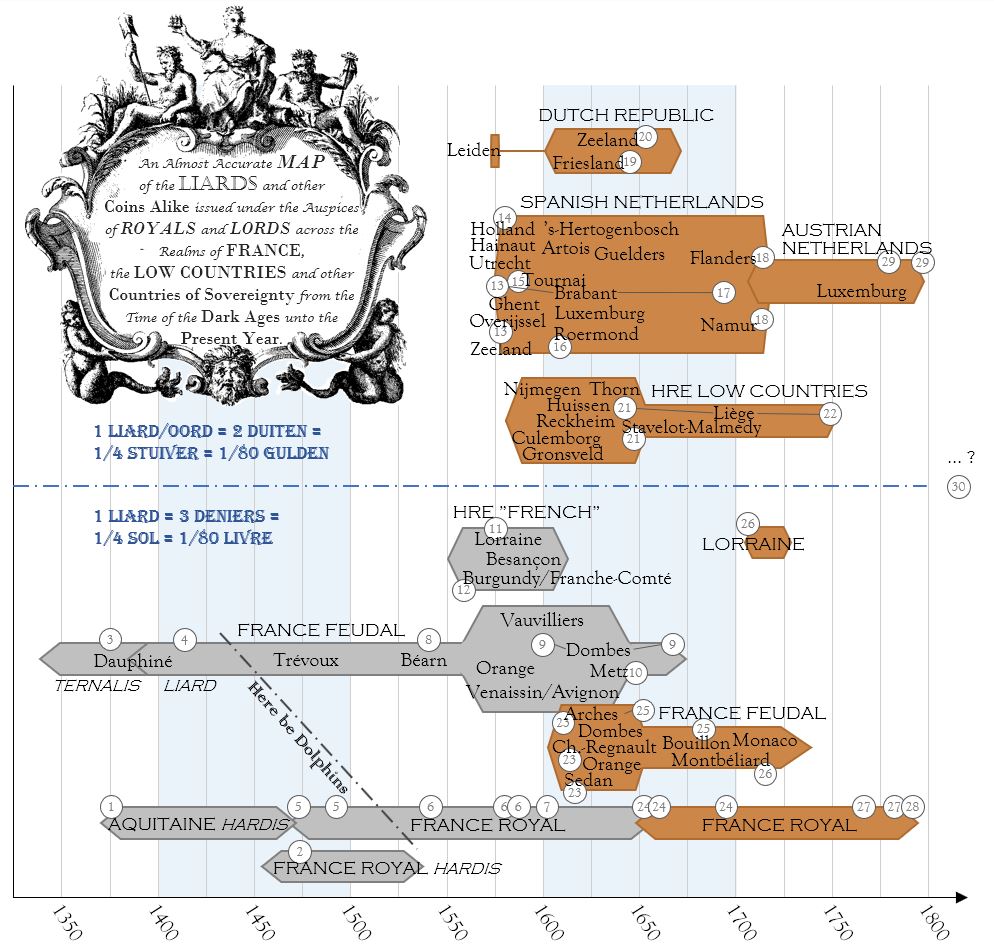
I have more than 40 coins to show, all liards or oorden. They range from 1368 to 1794 and come from 20+ different issuers. I will divide the presentation into 30 posts, called Chapters. One or two coins in most posts, a few with three. It is a rather diverse set of coins, and the timelined "map" below is intended to bring some overview and structure to it all. Billon minting is greyish, copper minting brownish. France and associated feudalities use livre and a liard = 3 deniers, the Low Countries use gulden (or florin) and a liard/oord = 2 duiten. I have entered as many issuers of liards/oorden as I have found - I hope I have placed them correctly (and I have almost certainly missed some). The circles, well, they represent the coins I will show, and the numbers refer to the Chapter they will be presented in.
The-Lovely-Lowly-Liard
Overview map of liards and oorden I will show, with timeline showing year.
Source: The decorative frame around the description is borrowed from a 1754 map by P. Gaultier. Wikipedia, public domain.


Let's go through the Chapters:
1. (Late 14th c.) I will start with the liard's companion, the billon hardi. It originated in Aquitaine in the 14th century, under English rule. The hardi, like the liard, was worth about 3 deniers.
2. (Late 15th c.) The hardis were continued by the French kings when Aquitaine fell to the French.
3. (Late 14th c.) The direct ancestor of the liard was the ternalis, which was minted in Dauphine, a feudality of the Holy Roman Empire. The feudality changed hands to France, to be ruled by the heir apparent to the French throne. Dauphin is French for dolphin, and that animal usually adorned the coins of Dauphine.
4. (Early 15th c.) When Dauphine coinage was adapted to French royal standards, the ternalis changed name to liard.
5. (Late 15th c.) The first French royal liards appeared in the 15th century, like the Dauphine liards made of billon, and like them featuring a dolphin.
6. (16th c.) Eventually, the French royal liards used other designs than the dolphin, although they stayed within a rather narrow design space with initials, crowns and crosses. And billon lives on.
7. (1601) The last regular French royal billon liard will have its own chapter.
8. (Mid 16th c.) French feudalities followed the royals with their billon liards, many with designs remarkably similar to the royals. Bearn was one of the first.
9. (16th-17th c.) Another French feudality, Dombes, was a notorious imitator of royal coins, liards and others.
10. (Mid 17th c.) The city of Metz came under French rule but kept its own minting standards and made its own type of liards.
11. (Late 16th c.) Lorraine belonged to the Holy Roman Empire, but had close ties to France.
12. (Mid 16th c.) Burgundy/Franche-Comte also belonged to the Holy Roman Empire, also with ties to France.
13. (Late 16th c.) The first regular copper liards (statenoorden) were minted by several Spanish Netherlands provinces and towns during the Dutch Revolt in the 1570s.
14. (Late 16th c.) Holland's liards during this period had a style of their own.
15. (Late 16th c.) After the revolt, the southern provinces remained as the Spanish Netherlands and continued minting of copper liards, first under Philip II . . .
16. (Early 17th c.) . . . then Albert and Isabella . . .
17. (Late 17th c.) . . . and Charles II.
18. (1712) The War of the Spanish Succession that followed on the death of Charles II, led to competition for the rule over the Spanish Netherlands and concurrent minting of liards by the claimants.
19. (Mid 17th c.) As soon as the northern provinces formed the Dutch Republic, aka the Seven Provinces, following the Dutch Revolt, they began minting. Copper liards/oorden arrived in the first years of the 17th century. Friesland was one of the provinces minting such.
20. (Mid 17th c.) Zeeland was the other (only two of the Seven Provinces cared to mint oorden).
21. (Mid 17th c.) Liège and other feudalities belonging to the Holy Roman Empire were also early with copper liards/oorden.
22. (1750) A hundred years later, Liège mints the last liards/oorden.
23. (Early 17th c.) French feudalities followed after the Low Countries with copper liards. The early ones are treated here.
24. (Late 17th c.) Eventually France itself caught up and began minting liards in copper in 1654.
25. (Late 17th c.) Later liards from French feudalities, with clear similarities to the French royals.
26. (Early 18th c.) Montbeliard and Lorraine are among the last areas under French influence to mint liards.
27. (Late 18th c.) France keeps minting liards during the 18th century.
28. (Late 18th c.) The French revolution changed a lot, also the looks of the liards.
29. (Late 18th c.) The Spanish Netherlands became the Austrian Netherlands in 1714. Liards were minted until 1794.
30. (19th-20th c.) To Be Disclosed.

The last liard was minted in the Austrian Netherlands in 1794 and it will be presented in the 29th chapter. But there is also a Chapter 30, about how the liard - or at least its memory - lived on in certain 19th century coinage and even continued into the 2nd half of the 20th. (Some of you may know what I am referring to, the rest of you I will keep in suspense. )

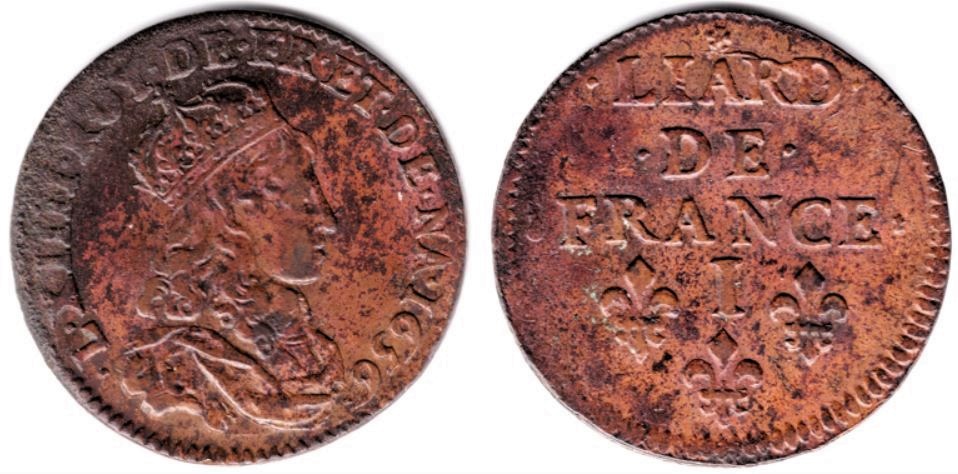
And yes, I promised to show you another liard in this post! Here it is, one of the early French coppers:

Liard, France 1656, Louis XIV, Limoges. Copper.
The-Lovely-Lowly-Liard

You will get to know more about it in Chapter 24!

A Couple of Exclusions

There are at least two additional groups of liards or liard-like coins I have excluded from my presentation here (somehow I feel I will be showing enough ).

Firstly, a few Italian and Swiss city states minted billon liards in the late 16th century, many of which were in essence imitations of French and Burgundian liards. Not without interest, but I will not treat those here (but if you have a coin from them, feel free to post!).

Secondly, ½ groot or 1/4 stuiver coins in silver and later billon were minted by several Low Countries states before the copper era. From 1434, when the groot was standardized, a ½ groot was very close to the French (billon) liard looking at the silver content and it was later equal to the Low Countries liard/oord. I will, however, skip the grooten and their halves here (but again, if you have one, don't hesitate to show it - they seem to be quite uncommon).

Threepence, Trillina, . . .

I limit my exposition to the liards, and coins closely related to the liard. There are other, similar, "triple denominations" that could fit in a broader presentation. The English threepence - 1/80th of a pound - is an obvious candidate (although an English threepence was worth about ten times more than a French liard already in the 1500s, and the discrepancy increased, so it was really a different kind of coin). Then we have the Italian (Milanese mostly) trillina (or trelina/terlina) - worth 3 denari, 1/80th of a lira - which was minted from the mid-15th century and into the 17th century. There was also a Swiss variety, from the Grisons/Graubünden canton. Its trillina was minted for about 60 years around 1500 and was worth 3 half denars, or 1/64th of a testone. Worth mentioning is also the Polish ternar or trzeciak, valued at 3 denars in a system of thalers and grosz (number of denars on a grosz varying over time). There are probably others too.

Sources

A few words about my sources. For French coins I have used mainly the following reference literature (to which I will make references like "Dup 559"):
- Duplessy: Les Monnaies Françaises Royales de Hugues Capet à Louis XVI (987-1793), Volumes I & II, 2nd ed., Maison Platt, 1999. [Dup]
- Duplessy: Les Monnaies Françaises Feodales, Volumes I & II, Maison Platt, 2004 & 2010. [DupFeod]
- Crepin: Liards de France royaux et feodaux (1607-1715), editions les Chevau-Legers, 2008. [C2G]
- Crepin: Les hardis de la Maison de France (1453-1540), CGB Numismatique, 2015. [CHMF]
- Spink: Coins of Scotland, Ireland and the Islands (Jersey, Guernsey, Man & Lundy) Including Anglo-Gallic Coins, 3rd ed., Spink & Son, 2015. [Spink]
- Morin: Numismatique Feodale du Dauphine, Rollin, Paris, 1854.

Low Countries coins are generally not a collection area of mine, so I lack some of the relevant reference works. The great site De Kopergeld Pagina, Numista and the following book is what I have used:
- Vanhoudt: De Munten van de Bourgondische, Spaanse en Oostenrijkse Nederlanden, en van de Franse en Hollandse Periode (1434-1830), 2nd ed., Heverlee, 2019. [Vanhoudt]

I am happy to receive any corrections or additional information about the liard mintage in the Low Countries! (For French coins - my specialty - happy to receive corrections there too; will just pretend I knew all along. )

Now, brace yourselves, 30 posts and 40+ liards are lining up to march into this thread! But don't worry, I will give it a day or so between posts, so you have time to breath.

Moderator
Learn More...
jbuck's Avatar
United States
188130 Posts
 Posted 04/22/2024  1:59 pm  Show Profile   Bookmark this reply Add jbuck to your friends list Get a Link to this Reply
An informative conclusion to the introduction.


Quote:
Now, brace yourselves, 30 posts and 40+ liards are lining up to march into this thread!


Quote:
But don't worry, I will give it a day or so between posts, so you have time to breath.

Moderator
Learn More...
Spence's Avatar
United States
34397 Posts
 Posted 04/22/2024  2:56 pm  Show Profile   Bookmark this reply Add Spence to your friends list Get a Link to this Reply
@era, have you given any thought as to the spacing between chapters? If not, then could you give us a day or two between to absorb and then potentially post any of our own? Hopefully, that doesn't drag things out too far though.

Nevermind--I just read the very last sentence of your latest post.


"If you climb a good tree, you get a push."
-----Ghanaian proverb

"The danger we all now face is distinguishing between what is authentic and what is performed."
-----King Adz
Pillar of the Community
Russian Federation
5172 Posts
 Posted 04/22/2024  3:05 pm  Show Profile   Bookmark this reply Add january1may to your friends list Get a Link to this Reply
If I understand the chapter division correctly, I believe I have coins for chapters 14, 6 (probably), 24 (maybe), and possibly 29 if I bothered to make the pic.
Pillar of the Community
Learn More...
erafjel's Avatar
Sweden
2124 Posts
 Posted 04/22/2024  5:32 pm  Show Profile   Bookmark this reply Add erafjel to your friends list Get a Link to this Reply

Quote:
could you give us a day or two between to absorb and then potentially post any of our own?

I will wait at least a day between posts, two or maybe even three days now and then is probably a good idea. I am in no hurry . I am keen to see the liards/oorden from others, and I will not be picky about when they are inserted into my stream. It is fine to show a Liège liard five posts after I showed mine, for example. There are also some places from which I have no liards, and there it is up to each contributor to find a good time for a post.

Quote:
I believe I have coins for chapters 14, 6 (probably), 24 (maybe), and possibly 29

Looking forward to see your coins, january1may!
  Previous TopicReplies: 163 / Views: 7,079Next Topic
Page: of 11

To participate in the forum you must log in or register.


Disclaimer: While a tremendous amount of effort goes into ensuring the accuracy of the information contained in this site, Coin Community assumes no liability for errors. Copyright 2005 - 2026 Coin Community Family- all rights reserved worldwide. Use of any images or content on this website without prior written permission of Coin Community or the original lender is strictly prohibited.
Contact Us  |  Advertise Here  |  Privacy Policy / Terms of Use

Coin Community Forum © 2005 - 2026 Coin Community Forums
It took 0.63 seconds to rattle this change. Forums