| Author |
 Replies: 163 / Views: 7,831 Replies: 163 / Views: 7,831 |
|
|
|
Pillar of the Community
  Sweden
2124 Posts |
Quote:
Francis and the other 16th century French kings are impatiently rattling their liards out in the hallway, but they will have to wait until tomorrow! I'm running ahead of myself!  Francis et al will have to wait yet another day, until Chapter 6. We have Chapter 5 and the 15th century kings to deal with first! |
|
Pillar of the Community
Sweden
2124 Posts |
CHAPTER 5: First French Royal Liards
= Late 15th Century =
"... considering that in our said land of Daulphine have been most commonly used money of three deniers a piece, and theirs is more common and convenient to use than others ... we wish and order that at our mints in said country of Daulphine and at all others in our Kingdom there should from now on be forged deniers blancs, named liardz de France . . . which shall be current in all of our said Kingdom and in our said land of Daulphine for 3 d. t. a piece."Edict by Louis XI, September 18, 1467. 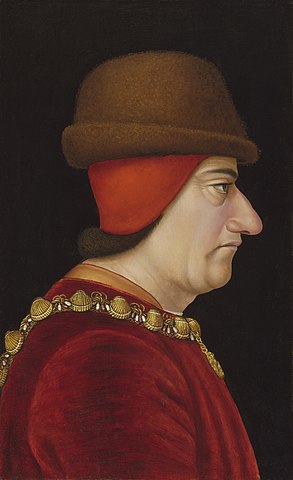 Louis XI, King of France. Louis XI, King of France.
Source: Painting by Jacob de Litemont, ca 1469. Wikipedia. Public domain.Louis XI, the rascal dauphin who fled to Flanders after falling out with his father king Charles VI in Chapter 4, issued the first royal liard in 1467. It looks like this: Liard (3 deniers tournois), France 1467-1483, Louis XI, Troyes. Billon (0.239). 1.03 g, 20 mm. Dup 560. 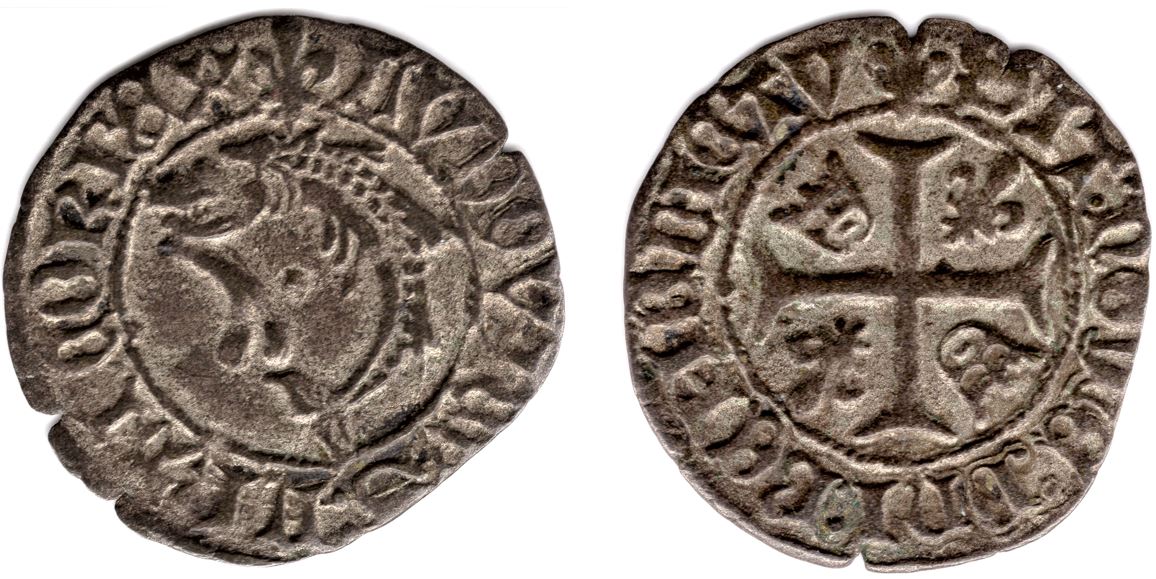 Obverse: LVDOVICVS FRAnCOR REX (Ludovicus Francorum Rex / Louis King of the Franks). Dauphine dolphin. Point under the 14th letter ('C'), mintmark for Troyes. Reverse: SIT nOmE DnI BENEDICTV (Sit Nomen Domini Benedictum / Blessed be the name of the Lord). Cross potent with fleurs-de-lis and crowns. Point under the 14th letter ('E'), mintmark for Troyes. You may compare with the hardi by the same Louis XI in Chapter 2. They are very much alike in style, just that the king has been replaced by a dolphin. That, on the other hand, became the signature for a liard in the royal domain. During Dauphine's independent minting period, dolphins appeared on many denominations (it was, after all, the coat of arms for the province). On the royal coins, a dolphin as the dominating design element was reserved for the liards (with some occasional exception), and conversely, all royal liards had a prominent dolphin (again with some occasional exception). That lasted during three and a half reigns, until the 1540s, when Francis I expanded the repertoire of liard designs. More about that in Chapter 6. Let's have a look at a somewhat later liard, issued by Louis's successor: Liard (3 deniers tournois), France 1492-1498, Charles VIII, Rennes. Billon (0.239). 1.08 g, 19 mm. Dup 602.  Obverse: KAROLVS FRAnCORVm REX (Charles King of the Franks). Dauphine dolphin, in center ermine spot. Reverse: SIT nOmEn DnI BEnEDICTVm (Sit Nomen Domini Benedictum / Blessed be the name of the Lord). Cross potent with fleurs-de-lis and crowns adorned with ermine spots. 'R' in center of cross, mintmark for Rennes. What's with the ermine spots? The explanation is that this is a regional coin for Brittany. Brittany was placed under French rule in 1491 but was granted the right to issue royal coins with a regional mark, the ermine spot from its coat of arms. The dolphin, previously used exclusively on Dauphine coins, has become a denomination mark, which could be used in a completely different region. The Dolphins persistLouis XI effectively disposed of the Dolphiny as a separately ruled entity. Henceforth it was ruled by the king, period. With the Dauphins of Viennois being history, enter the Dauphins of France! (Well, it actually took another 100 years for the title to change. French monarchs were conservative.  ) But the idea of calling the crown prince le dauphin (and, any crown princess, la dauphine) had stuck. The last Dauphin de France was Louis-Antoine de Bourbon, who wore the 19th century dauphin crown shown below at his father's, Charles X, coronation in 1825. 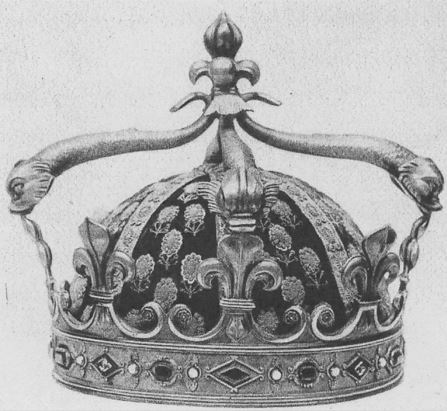 Royal crown of the dauphin. Royal crown of the dauphin.
Source: Photo, 1906. Wikipedia. Public domain.Louis-Antoine was certainly the last of the royal dauphins (so far ), but the term had become synonymous with heir in general. One still sees the term used in France today. The text below is from a 2020 news article about the long-time mayor of Bordeaux, Alain Juppe, supporting his preferred successor, his dauphin, Nicolas Florian. 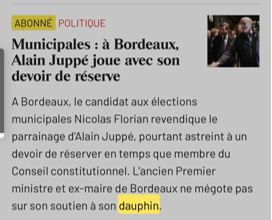 Excerpt from 2020 news article in Le Journal du Dimanche. Excerpt from 2020 news article in Le Journal du Dimanche.
Source: lejdd.fr. Copyright Le Journal du Dimanche.. . . and so does Dauphine (for a While)From 1456, when Dauphine comes under direct rule of the French king, no more coins referring to the Dauphin of Viennois are minted. The last order of Dauphine liards, issued in December 1456, is probably never executed (at least no examples from such an issue have surfaced). However, coins minted at the Dauphine mints continue to have a regional marking - and by now you should be able to guess what . Yes, a dolphin, somehow inserted into the standard "royal" design - it could be replacing a fleur-de-lis with a dolphin, or parting the coat of arms to include both France's three fleurs-de-lis and Dauphine's dolphin, for instance. That custom continued until the early 1700s (not so much for liards, but for higher denominations). More about the HardisAll while the royal dolphin liards were coined, hardis too continued to be issued for some 80 years. Liards and hardis had the same value, weight, and silver content, it was only the design that differed. So why? It is like there would be two different 25 c coins: One called the "quarter" (looking like one many here are familiar with) and then another one with, let's say, the current president holding an assault rifle - maybe called the "toughie"?  Weird as it may seem, that was the situation in France the decades around 1500. In Chapter 2 I cited a royal edict of 1467: "In Guyenne, there is a scarcity of hardiz, which since ancient times our subjects of said country have become accustomed to use . . ." A bit higher up in this post, I cite a similar edict, also in 1467, about Dauphine and its liards. A manifestation of pragmatism, perhaps - don't break what works, and even, mandate that it be used everywhere. Louis XI was nicknamed "the Prudent". Even though the royal hardis and liards were current across the whole kingdom, the use of hardis was concentrated to the Southwest (where Guyenne and Bordeaux are located), the rest of the country using mostly liards. Next time: Back to the FutureWe are done with Medieval France now. In the next Chapter, we land in the middle of the Renaissance, to look at the world from the perspective of the liard!
|
|
Moderator
 United States
196303 Posts |
Very interesting!  Quote:
Francis et al will have to wait yet another day, until Chapter 6. We have Chapter 5 and the 15th century kings to deal with first!   |
|
Pillar of the Community
Sweden
2124 Posts |
CHAPTER 6: French Royal Billon
= 16th Century =The liard had secured its place in the denomination range. There were single and double deniers, still a three denier coin was useful enough to being minted continually. In the 16th century the time was ripe for a new design and the dolphin ridden liard changed appearance under the French kings. (From now on, the liards are all nominally 3 deniers tournois, unless otherwise stated.) Liard, France 1542-1545, Francis I, Marseille. Billon (0.179). 0.93 g, 18 mm. Dup 930. 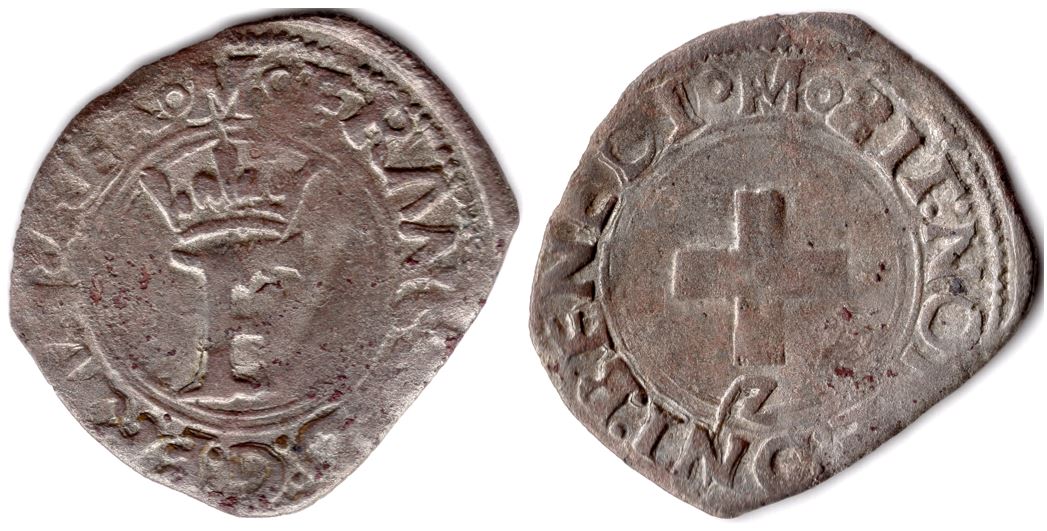 Obverse: FRANC[IS] D G FRAN REX (Franciscus Dei Gratia Francorum Rex / Francis by Grace of God King of the Franks). Crowned F. Ligatured 'AM' at top, mintmark for mint master Andre de Montagut. Reverse: SIT NOME DNI BENEDI (Sit Nomen Domini Benedictum / Blessed be the name of the Lord). Plain cross. 'ft' below cross, mintmark for Marseille. Ligatured 'AM' at top. Up until this one, Francis had held on to the tradition that a liard, it has a fish, sorry, dolphin, on it. Now he breaks the strong tradition of using that symbol to signify that we have a liard, a tradition that had lasted since the first royal liards. Was the king tired of that dolphin creature and wanted something new? Had his protege Leonardo da Vinci told him what a dolphin really looked like, and he found it embarrassing, as an enlightened renaissance prince, to keep pushing out coins with a fish? We don't know. And dolphins didn't disappear completely, they still showed up on liards now and then. Ligatures are always fun and there are two on this coin, for the mintmarks. What looks like 'ft' - or perhaps 'fZ', it looks a little different from coin to coin - is in reality a somewhat artistic form of 'et' (the 't'/'Z' has a horizontal stroke, you may have to squint your eyes a bit to see that on this example). 'et' was the mintmark assigned to Provence - where Marseille was the only active mint at the time - at the mintmark reform of 1540 that assigned letters to all the mints (France had plenty of mints, more than the letters in the alphabet, so a couple of mints had to use other symbols). Later the mintmark developed into just a 'Z' with a stroke (which was already in itself an established short form of Latin et, that is, "and"). The second ligature is what seems to be an ordinary 'M' on top of each side. On this coin it is hard to see, but the left half of the 'M' is actually an 'A'. It is thanks to this mintmark for Andre de Montagut that the time span can be set to 1542-1545, his years as mint master, for this coin type which was minted 1541-1547. The crowned 'F' stands of course for Francis. An initial with a crown might not be the most elaborate of designs, and it is less fanciful than a fish, sorry, dolphin. But it was reused by Francis's successor, Henry II, as well as by his successors Charles IX, Henry III, and Henry IV. The design varied a bit, here is one by Henry III: Liard, France 1578, Henry III, Toulouse. Billon (0.125). 1.28 g, 18 mm. Dup 1145. 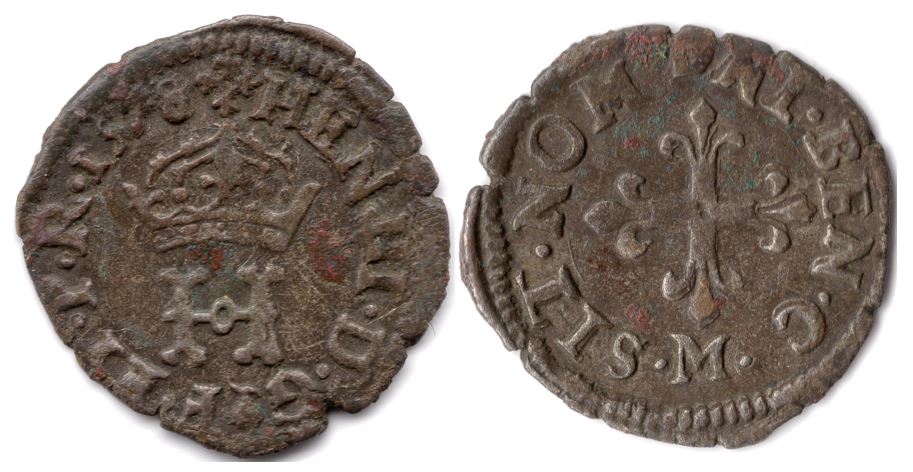 Obverse: HEN III D G F ET P R (Henricus III Dei Gratia Franciae et Poloniae Rex / Henry III by Grace of God King of France and Poland). Crowned H. Tree after 'G', mintmark for master engraver Nicolas Raffin. Reverse: SIT NOM DNI BEN (Sit Nomen Domini Benedictum / Blessed be the name of the Lord). Cross with fleurs-de-lis. 'M' below cross, mintmark for Toulouse; 'C' after BEN, mintmark for mint master Pierre Catellan. This liard is a good illustration to why it is called "black money"! (That, "monnaies noires" in French, was even the official term used in royal edicts, for billon coins with silver content so low that after some use the coin turned black.) Henry III issued several different variants of liards during his 15 years of reign (including ones with dolphins). Here is another one: Liard, France 1585, Henry III, Lyon. Billon (0.125). 0.93 g, 16 mm. Dup 1146. 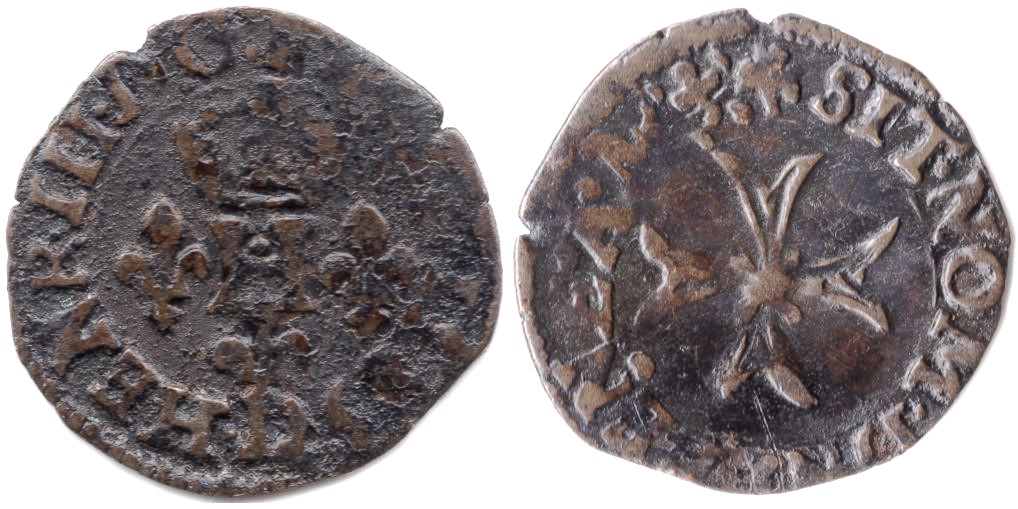 Obverse: HENR III D G F [ET P R] (Henricus III Dei Gratia Franciae et Poloniae Rex / Henry III by Grace of God King of France and Poland). Crowned H and three fleurs-de-lis. 'D' at bottom, mintmark for Lyon. Reverse: SIT NOM DNI BENE (Sit Nomen Domini Benedictum / Blessed be the name of the Lord). Cross of the Order of the Holy Spirit (Saint-Esprit). Trefoil with four dots and point below 12th letter ('N'), both mintmarks for Lyon; 'A M' after BENE, mintmark for mint master Andre Morel. The Knightly Order of the Holy Spirit was founded by Henry III in 1578, with himself as grand master. It was his way of thanking God for making him king of both France and Poland, neither of which he had expected, being only the fourth son of Henry II. (The Poles kicked him off the throne in 1575, after less than two years, since he didn't show up again after his coronation. That did not stop Henry from using the title on coins and everywhere else.) The order was reserved for princes and high-ranking nobles. One would imagine that its cross would adorn the more prestigious coins, but in fact, this liard is the single coin during his reign that features the order's cross. It is not easy to do it justice on a small coin like that, here is what the cross really looks like: 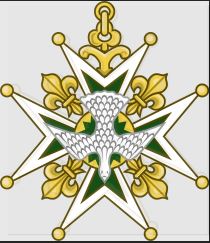 Cross of the Order of the Holy Spirit. Cross of the Order of the Holy Spirit.
Source: Wikimedia Commons. Creative Commons Attribution-Share Alike 3.0 Unported license.Also interesting with this coin is the triple mintmark for Lyon: Letter D, "secret point" below the 12th letter, and a trefoil. Lyon must have been proud of its coins . . . Another Chapter, Another KingNext Chapter will feature a single coin: The last French royal liard made of billon (well, almost). It was Henry IV who decided enough was enough.
|
|
Moderator
United States
196303 Posts |
Fascinating! I am now imagining da Vinci — as portrayed by John Rhys-Davies in Star Trek: Voyager — saying, "That is not a dolphin." |
|
Pillar of the Community
Russian Federation
5186 Posts |
It's mildly hilarious, in retrospect, that my barely identifiable coin is apparently the first non-OP entry in this thread... ...is it, actually? It took way longer than I expected to find the pics. AFAICT it's exactly the Henri III type with the Saint-Esprit cross. I included an extra (blurrier) pic of the reverse because the cross was too well hidden on the other pic. 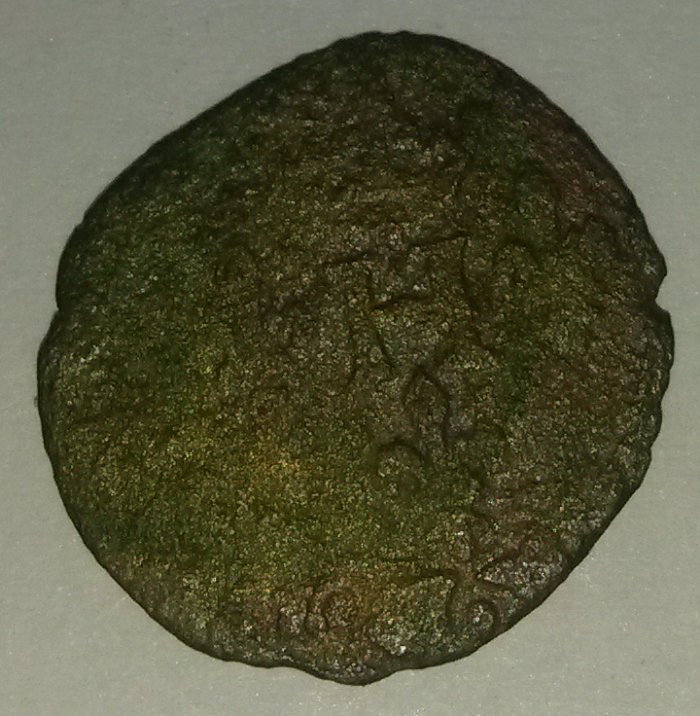 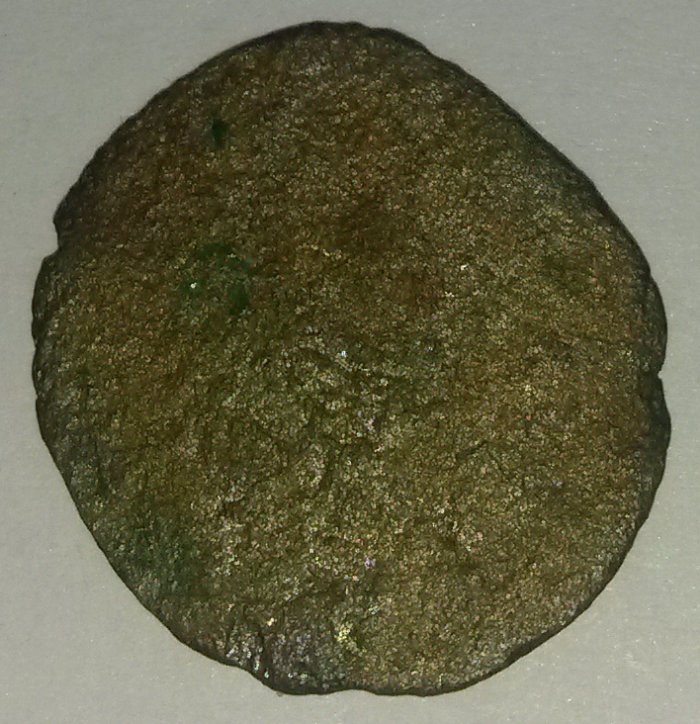 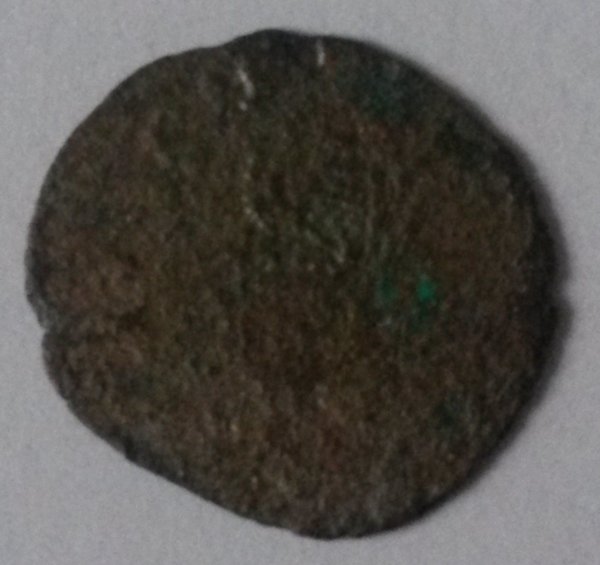 EDIT: while looking at the remnants of the legend and comparing with Numista I found out that it might be a better match to this chapter 9 type. If so, I apologize for posting it out of order... |
|
Moderator
United States
196303 Posts |
Quote:
It's mildly hilarious, in retrospect, that my barely identifiable coin is apparently the first non-OP entry in this thread...   Quote:
AFAICT it's exactly the Henri III type with the Saint-Esprit cross. I Impressive nonetheless. Quote:
EDIT: while looking at the remnants of the legend and comparing with Numista I found out that it might be a better match to this chapter 9 type. If so, I apologize for posting it out of order...  |
|
Pillar of the Community
Sweden
2124 Posts |
Quote:
I am now imagining da Vinci — as portrayed by John Rhys-Davies in Star Trek: Voyager — saying, "That is not a dolphin."  Quote:
It's mildly hilarious, in retrospect, that my barely identifiable coin is apparently the first non-OP entry in this thread... Thanks for helping, january1may!  Quote:
it might be a better match to this chapter 9 type. If so, I apologize for posting it out of order... I can't tell which one it is . . . but no need to apologize, all contributions are welcome, in or out of order. |
|
Pillar of the Community
Russian Federation
5186 Posts |
Quote:
I can't tell which one it is . . . AFAICT the royal type would have a mintmark next to the bottom fleur-de-lis (~5-6h on the coin), and what's in that spot on this coin doesn't look like any kind of right-side-up [i.e. reversed relative to the circular legend] letter. Meanwhile the Dombes coin (at least as depicted on Numista) has R.D upside down (i.e. as part of the circular legend) in this position, which this sure does look like. I originally attributed it (in the thread where I originally mentioned it, without pics) as "[the royal type in question] or similar"; from my memory, I was seeing several very similar royal types on Numista and felt like I couldn't tell them apart. I'm not sure how I missed the Dombes type but perhaps even if I found it I wouldn't have been particularly confident in the attribution (still not, but I also don't have the coin in hand). There's apparently a bunch of further imitative types and it could easily have been one of those. Looking forward to more coins - either from you or (hopefully) from others! |
|
Pillar of the Community
Sweden
2124 Posts |
Quote:
There's apparently a bunch of further imitative types Dombes, Orange, Comtat Venaissin - they all made liards that looked remarkably similar to this type of French liards. When a bit worn, they can be quite difficult to tell apart. |
|
Pillar of the Community
Sweden
2124 Posts |
CHAPTER 7: The Last of the Billons
= 1601 =Billon liards were minted by the French kings until 1601 (but see Note 1). The last regular billon liards were minted 1600-1601 by Henry IV and look like this: Liard, France 1600 (?), Henry IV, Chambery. Billon (0.125). 0.89 g, 17 mm. Dup 1268.  Obverse: HENR IIII D G F ET N REX (Henricus IIII Dei Gratia Franciae et Navarrae Rex / Henry IV by Grace of God King of France and Navarre). Crowned H and three fleurs-de-lis. Reverse: SIT NOM D BENEDICT (Sit Nomen Domini Benedictum / Blessed be the name of the Lord). Indented cross. Star before SIT, mintmark for Chambery; heart after BENEDICT, mintmark for mint master Jacques Trolieur. "Monnaies noires" or "black money" for sure. Henry IV came from a sideline of the French royal family and was king of Navarre (a Pyrenean kingdom that bordered France in the south), until 1589 when he proved to be first in line to the French throne after the death of the childless Henry III. Thus France and Navarre were joined in a personal union with Henry as king of both kingdoms. Including the previous Chapter, we have four different liards, and four different crosses. The Royal Mint did what it could in terms of artistic variety, within the limited framework of crowned initials and crosses. Dolphin liards were still minted, but in diminishing numbers. The last royal dolphin liard was minted by Henry IV in 1594, a regional issue for Dauphine (with no known example). How Much was a Liard?One egg, or a piece of bread, or a glass of wine. That is what you could expect to be able to buy for a single liard in the early 17th century. A normal "minimum wage" for a day laborer was about 10 liards a day. While not worth much, it was still a useful coin with its three deniers of value. One denier and double denier coins were still minted (in copper), but were phased out in the decades to come, making the liard the smallest denomination available. Did the French king ever handle one of his liards? Did he have a notion of its value to ordinary people? In the 19th century, after having kicked out kings and emperors several times, the citizens of the French republic did not think highly of their former kings' understanding of the people's daily concerns. The late 19th century illustration below shows king Henry IV, taking a stroll on the market, researching how costly those "liards" are, that people complain about not having enough of. 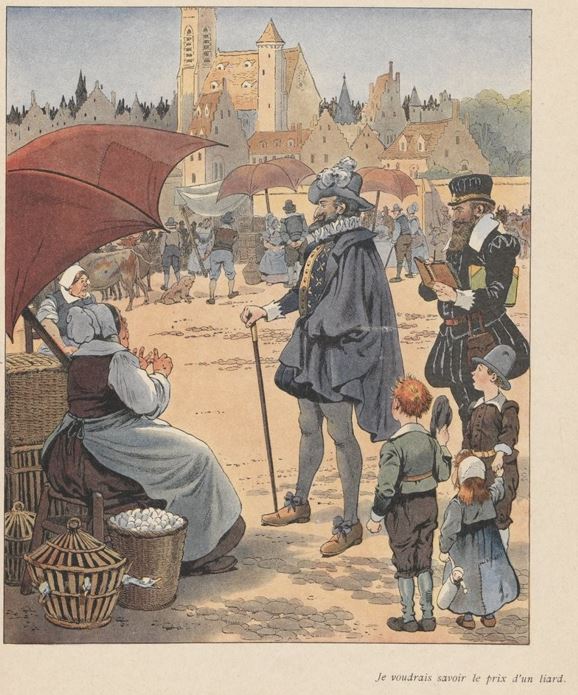 "I would like to know the price of a liard." "I would like to know the price of a liard."
Source: From Les mots historiques du pays de France, 1895. gallica.bnf.fr / BnF. Public domain.What Happened 1602?1601 saw the last regular issue of billon liards. The denomination of 3 deniers was small but useful, as mentioned - still, it took more than a half century until the next issue of liards, in the 1650s (then in copper, we will see those in Chapter 24). Why was that, why didn't the king keep minting those useful liards also in 1602? The main reason was the extensive production of look-alike liards in some of the French feudalities. To an unattentive and/or illiterate eye those looked like a genuine royal liard, only close inspection revealed their identity through differences in details and a different inscription. Since they did not contain the prescribed amount of silver, they were not accepted by merchants and tax collectors. The problem reached such magnitude that the king felt compelled to halt the production of liards. Some of those feudal liards will be shown in the Chapters that follow. Next TimeNow let's leave the Kings of France to mind their own business - until they begin minting copper liards more than half a century later, then we shall return to them! Next Chapter takes the step out of the royal domain and shows what the liards looked like in some of the many French feudalities that still existed at this time. Some of them will look familiar. NotesNote 1: In 1655-1656 there were exceptional - and rare and very expensive - local issues of billon liards for use in Lyon and its environments, which I will not discuss here. Edit: Closer inspection makes me believe it is a 1600 rather than 1601 coin I have, as I first attributed it. Not quite 100 % sure, but the remains of that last digit looks more like a '0' than a '1' under the loupe.
Edited by erafjel
05/02/2024 10:12 am
|
|
Pillar of the Community
Sweden
2124 Posts |
CHAPTER 8: Early French Feudal Billon
= Mid 16th Century =The liard had kind of a slow start in Dauphine, followed by un unremarkable existence in the royal domain and the odd feudality, and then in the late 1500s, everyone wanted one. Bearn, Vauvillers, Venaissin, Metz, Orange, Dombes . . . The list of feudalities minting liards grew constantly. We pick a few to see what was rattling in people's purses! First out, in this Chapter, is Bearn. But first, let's orientate ourselves geographically a bit in 16th-17th century France. In the map below of France, I have marked feudalities with blue, that we have or will come across when talking about billon liards. Navarre-Bearn in the southwest, and then a range of territories in the east, from the bottom and upwards: Dauphine, Dombes, Franche-Comte, Lorraine, and Metz (borders are approximate). 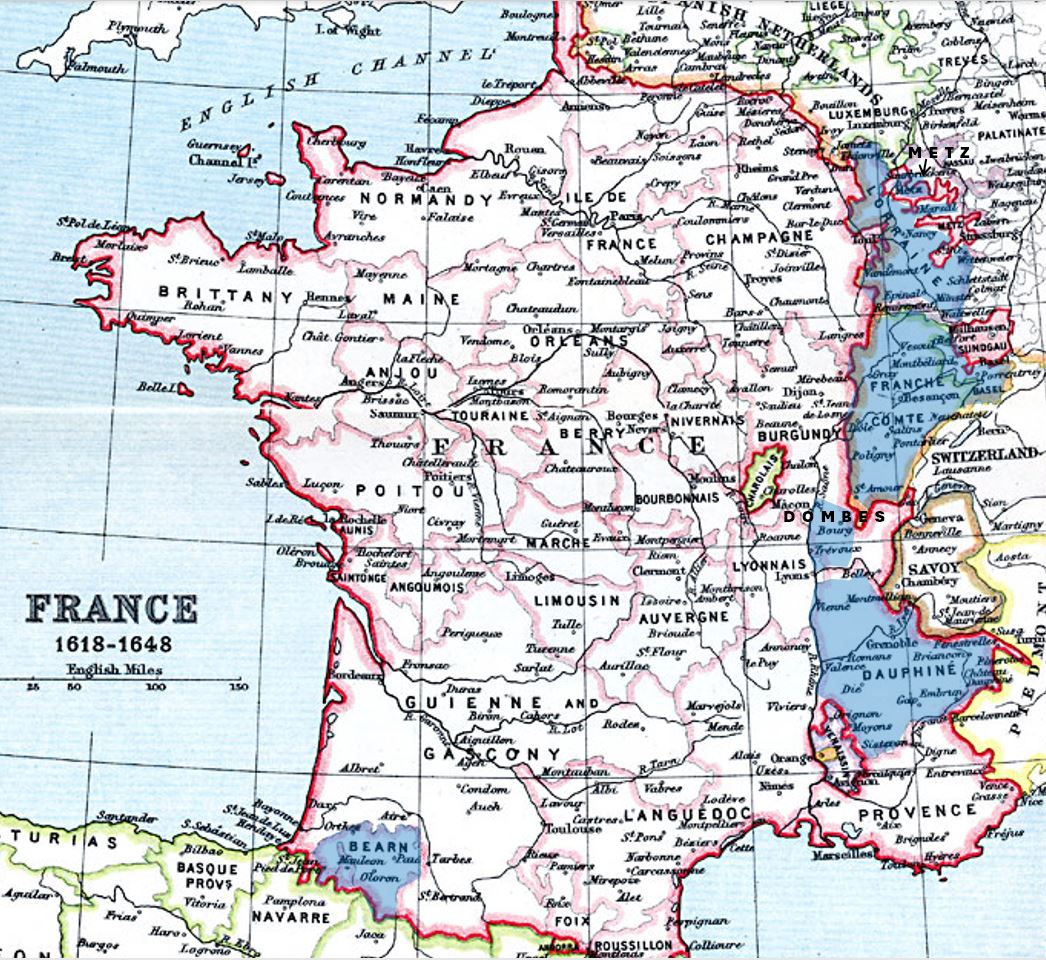 France 1618-1648. Regions of interest marked with blue. France 1618-1648. Regions of interest marked with blue.
Source: From A Literary & Historical Atlas of Europe, 1910. Made available online by Florida Center for Instructional Technology (FCIT), https://etc.usf.edu/maps. Cropped and colored by me.BearnAfter Dauphine, the Lordship of Trevoux (not far from Dauphine) was second to issue liards, in 1456. They are rare and usually in bad condition, so nothing to see from me. Maybe someone else is lucky enough to have one? Next out was the Lordship of Bearn, a province in the Kingdom of Navarre. They minted their own coins (although in the name of the King of Navarre), and from around 1516 they issued liards. This is one: Liard (3 deniers tournois), Bearn 1541-1555, Henry II of Navarre (Henri d'Albret), Morlaas? Billon (0.179?). 1.02 g, 17 mm. DupFeod 1291. 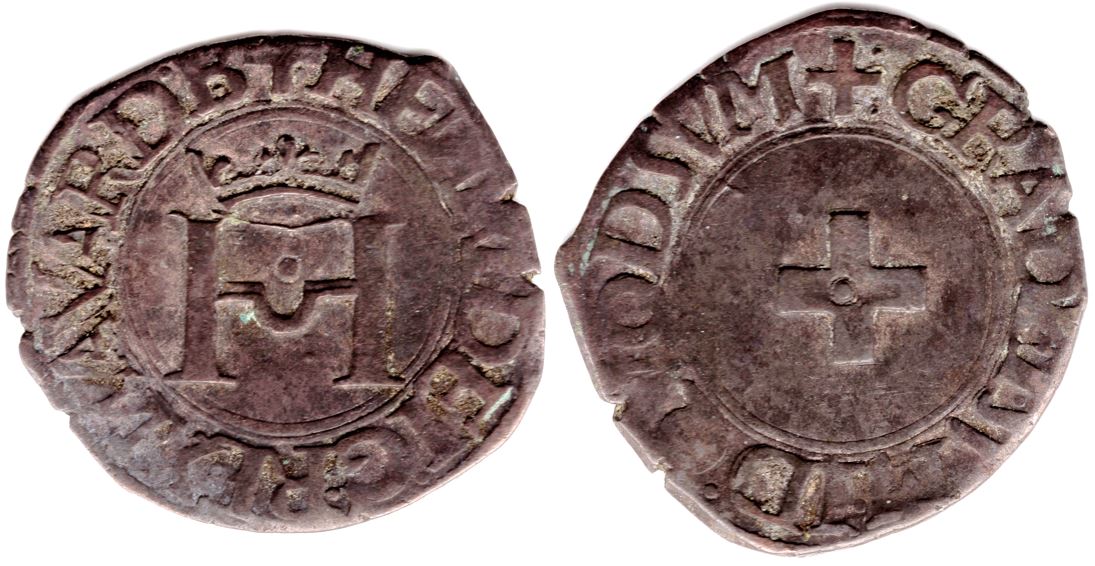 Obverse: HENRY DEI G REX NAVAR D B (Henricus Dei Gratia Rex Navarrae Dominus Bearnie / Henry by Grace of God King of Navarre, Lord of Bearn). Crowned H. Reverse: GRA DEI SVM ID QVOD SVM (Gratia Dei sum id quod sum / By Grace of God I am what I am). Plain cross. Hm. Looks familiar. Could be taken for a French Francis I liard at first sight, like the one I showed two Chapters back, and for comparison shown again here: 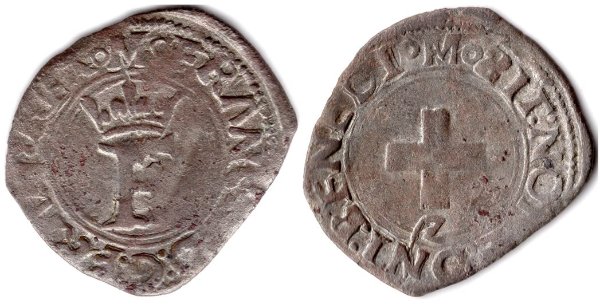 Liard, France 1542-1545, Francis I. For full description, see Chapter 6. Liard, France 1542-1545, Francis I. For full description, see Chapter 6.The common conception is that Bearn copied the liards of its great neighbor and that that was accepted by the French Crown. Since the beginning of the 16th century, Navarre/Bearn and France had harmonized their monetary systems, so Navarre followed the French coinage in terms of weight and fineness and both countries' coins were current in the other country. Which way the copying went can be discussed: Bearn was first - it is believed - with liards having a crowned initial + a cross (albeit a different cross, a cross pattee). And with Bearnaise liards circulating in France in the early 16th century, at the beginning of Francis I's reign, it is not unreasonable that it was an input to a changed design for the French liards. But to differentiate from the Bearnaise liards, France chose a plain cross, which was later in turn copied by Bearn? We don't know for sure what the fineness of the coins was at this time, the dates of different issues, and whether they were minted in Morlaas (more likely) or Pau (less likely). Bearn kept minting records, but for large parts of the 16th century they are lost (which is the reason we don't know for certain when Bearn began its minting of non-dolphin liards). The quality of the Bearnaise/Navarrese coins was not impeccable. There were periods when the French king was dissatisfied with his neighbor's coins, and enacted punishment by deprecating the money or outright forbidding its use in France. Bearnaise liards, for instance, were reduced to a value of only two deniers tournois in France from 1556, following (well founded) suspicions that the Bearn mints had lowered the silver content (which was a worse problem than mirroring the Ns . . .). A couple of more comments: The king, Henri d'Albret, was the 2nd Henri to rule Navarre but the 1st Henri to rule Bearn (as Dominus, Lord). Thus, he is often referred to just as Henri d'Albret in conjunction with the Bearn coinage. The motto, By Grace of God I am what I am, was the motto of the Lords of Bearn. It is from 1 Corinthians 15:10, and was adopted by Gaston de Phaebus in 1350, when Bearn struggled for independence, under pressure from its surrounding powerful kingdoms of Aragon, England, and France.
|
|
Moderator
United States
196303 Posts |
Quote:
CHAPTER 7: The Last of the Billons Very interesting! Quote:
The late 19th century illustration below shows king Henry IV, taking a stroll on the market, researching how costly those "liards" are, that people complain about not having enough of. Reminds me of this scene... Michael: Wow. Lucille: Don't you judge me. You're the selfish one. You're the one who charged his own brother for a Bluth frozen banana. I mean, it's one banana, Michael. What could it cost, ten dollars? Michael: You've never actually set foot in a supermarket, have you? Lucille: I don't have time for this. I've got to get ready for the bachelorette auction. Source: https://arresteddevelopment.fandom....harity_Drive |
|
Moderator
United States
196303 Posts |
Quote:
CHAPTER 8: Early French Feudal Billon You slipped the next chapter in while I was reading an commenting the previous. As before, an interesting read and some nice examples. |
|
Valued Member
Australia
496 Posts |
|
| |
Replies: 163 / Views: 7,831 |
To participate in the forum you must log in or register.
Disclaimer: While a tremendous amount of effort goes into ensuring the accuracy of the information contained in this site, Coin Community assumes no liability for errors. Copyright 2005 - 2026 Coin Community Family- all rights reserved worldwide. Use of any images or content on this website without prior written permission of Coin Community or the original lender is strictly prohibited.
Contact Us | Advertise Here | Privacy Policy / Terms of Use
|
| Coin Community Forum |
© 2005 - 2026 Coin Community Forums |
| It took 0.67 seconds to rattle this change. |
 |
|








 First Page
 Previous Page


 Posted 04/29/2024 2:01 pm


