| Author |
 Replies: 163 / Views: 7,835 Replies: 163 / Views: 7,835 |
|
|
|
Pillar of the Community
  Sweden
2124 Posts |
Thanks, jbuck and kg5. Glad you enjoyed it!  |
|
Pillar of the Community
Sweden
2124 Posts |
CHAPTER 9: More French Feudal Billon
= 16th-17th Centuries =DombesA definite copycat of French coins - liards and others - was the Principality of Dombes. Since 1560 it was ruled by a sideline of the French royal family and its money was current also in France. From start, their coinage had a remarkable similarity with the French ditto. That free ride on the reputation of the royal coins seems to have been accepted by France, probably because of the - at least on occasion - good connections between the rulers of the two states (there were certainly times at which relations were frosty, like for most feudalities). The Dombes coins were tariffed in deniers tournois, but they did not always contain the full amount of silver to be compatible with the royal counterparts. Sometimes, when the duke pilfered too much silver from his coins, the French king enacted a depreciation of the Dombes coins in the kingdom, until the duke behaved again. Here is a liard, contemporary with French king Henry IV: Liard (3 deniers tournois), Dombes 1597, Henry II de Montpensier, Trevoux. Billon (0.125?). 0.95 g, 16.5 mm. DupFeod 2962.  Obverse: H P DOMBAR D MONTISP (Henricus Princeps Dombarum Dux Montispenserii / Henry Prince of Dombes Duke of Montpensier). Crowned H surrounded by three fleurs-de-lis. 'M' after MONTISP, mintmark for the mint master (whose surname presumably began with M). Reverse: DNS ADIVTOR MEVS (Dominus adiutor meus / The Lord is my helper). Cross of the Order of the Holy Spirit. In principle, this liard should be equivalent to a contemporary French 0.125 billon liard, but I doubt that, considering its coppery look. Speaking of which, below is the (French) Henry III liard I showed in Chapter 6. 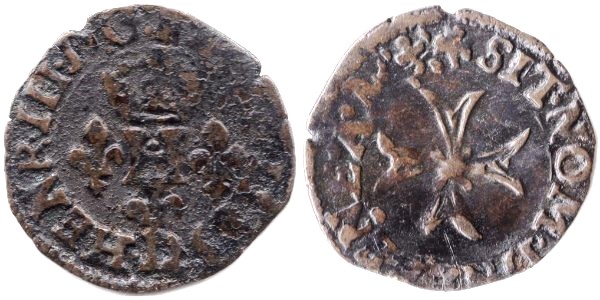 Liard, France 1585, Henry III. For full description, see Chapter 6. Liard, France 1585, Henry III. For full description, see Chapter 6.The duke is named Henry too, so yeah, a crowned H should be ok. Three fleur-de-lis just like on the French coins - well, he is a Bourbon just like the French king, so their coat of arms does fit . . . And he is a knight of the Order of the Holy Spirit, so we can't complain about the cross either. What a coincidence still, that the duke's liards turned out to look just like the king's . . .  From 1650, Dombes was ruled by Princess Anne-Marie-Louise d'Orleans, cousin of French king Louis XIV. She was a very influential person, wealthy and by inheritance princess, duchess, countess, etc of some twenty feudalities all over France (Montpensier mentioned on the coin below being one). Her titles included first princess of the blood of France, which gave her a high rank at the French court but did not carry with it any explicit power. She was also Dauphine of Auvergne, that is, countess of the only other Dolphiny in France besides Dauphine. 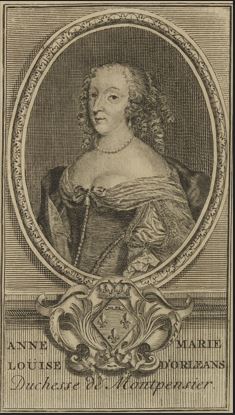 Anne-Marie-Louise d'Orleans, Princess of Dombes. Anne-Marie-Louise d'Orleans, Princess of Dombes.
Source: 17th century engraving. Royal Collection Trust.Here is what a Dombes liard (still) looked like in the late 17th century: Liard (3 deniers tournois), Dombes 1668, Anne-Marie-Louise d'Orleans, Trevoux. Billon (< 0.1). 0.60 g, 14 mm. DupFeod 3014. 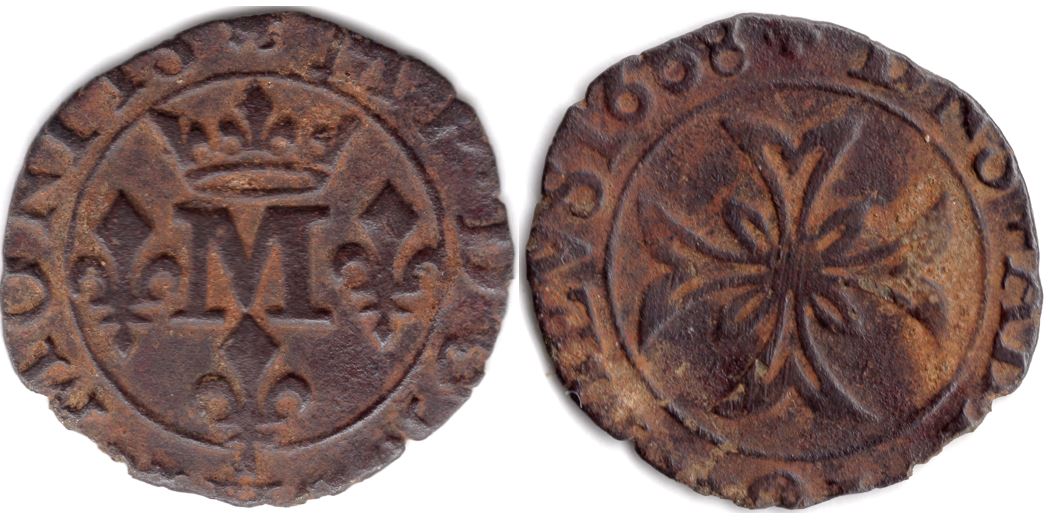 Obverse: M P DOMBAR MONTIS (Maria Principissa Dombarum [Ducissa] Montispenserii / Mary Princess of Dombes [Duchess] of Montpensier). Crowned M surrounded by three fleurs-de-lis. Rose before M P, mintmark for master engraver Gilbert Darmand Lorfelin. Reverse: DNS ADIVTOR MEVS (Dominus adiutor meus / The Lord is my helper). Cross of the Order of the Holy Spirit. Rose before DNS, mintmark for master engraver; trefoil after DNS, mintmark for mint master Mathieu Garnon. The design is still, 70 years later, a direct copy of earlier French liards, and so it has been almost the whole time. Only the initial under the crown has changed, in accordance with the name of the duke/duchess. The three fleurs-de-lis - the coat of arms of France and the Bourbons - are also part of the Princess's arms, but with a label above, as can be seen below her portrait above. The label (signifying a branch of the Bourbon house) is present on many Dombes coins with the three lilies, but not on this one, or other liards. The cross of the Order of the Holy Spirit is there to honor Gaston d'Orleans, deceased husband of Anne-Marie-Louise and knight of the royal order. Rarely do these coins come on a flan large enough to fit the inscription. The silver content is not known; it is easy to see that it is very low in this one, it looks like pure copper. (In fact, it could be a contemporary forgery; these coins were extensively falsified, and I'm not sure how to tell a well made fake from the rather crappy original.  ) Dombes was one of the earliest feudalities to mint liards, possibly because the principality included the town of Trevoux, which as I mentioned earlier, was the first feudality after Dauphine to mint liards, already in 1456. Dombes was also last in France to mint billon liards, up until 1678. By then everyone else had moved to copper. Time for a break, let's pause over the weekend before continuing with Metz, and then Lorraine and Franche-Comte. It's a good time to haul out your own billon liards of all kinds!
|
|
Moderator
 United States
196311 Posts |
Very interesting!  |
|
Bedrock of the Community
United States
12057 Posts |
I'm afraid that most of my Liards are of the Liege variety but this is fascinating and exceptionally written.
I'd expect this to be put into book form and published.
Member ANA - EAC - TNA - SSDC - CCT #890 "Most of the things worth doing in the world had been declared impossible before they were done." -- Louis D. Brandeis |
|
Pillar of the Community
Sweden
2124 Posts |
You are too kind, paralyse, but I'm glad you appreciate it! We will get to Liège eventually - I look forward to seeing your liards! |
|
Pillar of the Community
United States
8056 Posts |
Sorry I have not been present, though I have been trying to keep up with the reading. I am currently engaged in being a part-time caretaker for my three grandchildren (1, 3, 5 years old) while my son and his wife are occupied with both starting new jobs with long commutes (until they move household later this month). As my collecting areas include Lorraine and Low Countries, I eventually will have some things to post. But meanwhile, will comment on some developments 1,000 miles to the east. From Chapter 3: Apparently it was time to introduce a 3 deniers coin in the mid 14th century. Apparently this was also the case in Poland! (though a few years later). Royal Poland struck a ternar (3 denar) coin for the first time in the reign of Wladyslaw Jagiello, probably around 1393, and struck into the first quarter of the 15th century:  (my coin, Kopicki 355, photo courtesy of Warszawskie Centrum Numizmatiyczne) It was a silver based coin (I currently can;t access my copy of Gumowski to know the fineness) of about 0.8 grams. Contemporaneously, if not slightly earlier, Siemowit IV, Duke of Masovia from 1381 also began striking this ternar: https://en.numista.com/catalogue/pieces124203.htmlUnlike France / Low Countries, it does not seem to have been a successful innovation in this part of the world. Wladyslaw's ternar was not repeated by his successors until SIgismund I, 100 years later (1527). Instead, the denar and half-groat dominated the 15th and early 16th century coinage there. Edited by tdziemia
05/05/2024 11:55 am
|
|
Pillar of the Community
Russian Federation
5186 Posts |
Quote:
my coin, Kopicki 355, photo courtesy of Warszawskie Centrum Numizmatiyczne Is anything more precise known about the tenure of Monald of Lucca at the Krakow mint than "1393-94"? It would be hilarious if you manage to get an 1393 coin for the Walking Back thread after all  (presumably it ended partway through 1394 because the next guy was 1394-95, but I'm not sure if any sources name specific months or days; if they do I wasn't able to find anything) |
|
Pillar of the Community
Sweden
2124 Posts |
Quote:
I am currently engaged in being a part-time caretaker for my three grandchildren (1, 3, 5 years old) That's three full time jobs. You are excused! Quote:
As my collecting areas include Lorraine and Low Countries, I eventually will have some things to post. You will have your chance soon. Looking forward to see what you have! Quote:
Royal Poland struck a ternar (3 denar) coin for the first time in the reign of Wladyslaw Jagiello, probably around 1393, and struck into the first quarter of the 15th century Great to see one of those and have some more information! I mentioned the ternar briefly in part 3 of the Intro, but have none myself to show. Thanks for the contribution! |
|
Pillar of the Community
Sweden
2124 Posts |
There must be more billon liards out there among the CCF members, I am sure, but let's move on. You can still show what you have, now, soon, or later!
|
|
Pillar of the Community
Sweden
2124 Posts |
CHAPTER 10: Late French Feudal Billon
= Mid 17th Century =MetzToday the city of Metz is located in northeast France, near the borders to Germany and Luxembourg. Until 1552 it was part of the Holy Roman Empire as a free imperial city and republican state. The Messin Republic, as it was called, would fit much better as part of France, French king Henry II thought. By an agreement - the Treaty of Chambord - with three Protestant princes of the Empire, who were in opposition to the emperor Charles V, the three bishoprics of Verdun, Toul and Metz were handed over to France in exchange for military aid from the French king. No need to ask the inhabitants of the three cities, and Metz (at least) seems to have accepted the fact without too much fuss. Emperor Charles V, on the other hand, certainly did not accept that some of his vassal princes gave out parts of his empire to a foreign ruler. He made a lot of fuss, and laid the city under an unsuccessful siege. Metz (and the two other cities) remained French, in practice. In 1648, as part of the comprehensive peace treaty after the Thirty Years' War, the Holy Roman Emperor too recognized the fact. Speaking of 1648, here is a liard - or quarter sol as it was called - from that year: 1/4 sol (3 deniers messins), Metz 1648. Billon (0.111?). 0.61 g, 15 mm. 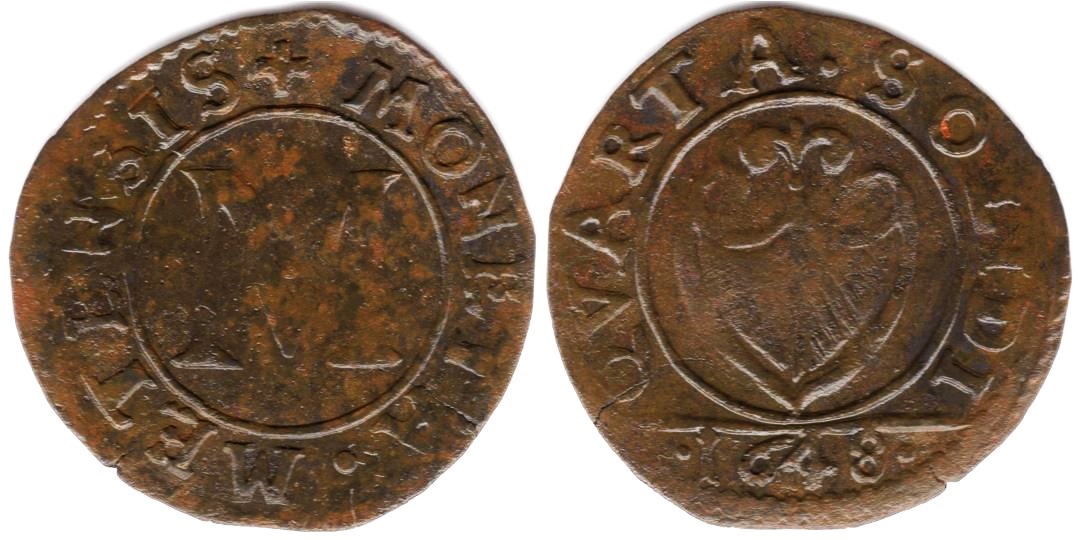 Obverse: MONETA METENSIS (Coin from Metz). Large M for Mettis (Latin for Metz). Reverse: QVARTA SOLIDI (Quarter sol). Coat of arms of the city of Metz. Metz had a long minting tradition, back to at least the 10th century when the Bishop of Metz began minting coins. The city developed a style of its own, and not being a feudality of the French king, its minters did not glance at what his coins looked like. Still, the monetary system was based on a livre-sol-denier division, just like in France, but with their own livre messine (or messaine). The relation to the French livre tournois is not clear, except for that it varied. Judging from silver content, the livre messine should have been worth around 1/5 livre tournois in the 17th century. The liard messin would thus be equal to about 3/5 denier tournois. The Metz liard has no intention of imitating a French liard in any event. Rather, the dominating M on the obverse boasts about it being from Metz. The silver content is not much to boast about, though. Nominally, the coin should contain 0.111 silver, but I doubt that, from the looks of it (see further Note 1). The coat of arms of the city of Metz, shown on the reverse, is a shield with white (left) and black (right) fields (or argent and sable using heraldic color names). It has been in use since at least the 14th century and is believed to represent the town's political independence. A 16th century chanson explains it this way: Qui les couleurs voudra savoir
De nos armes? C'est blanc et noir.
C'est que par blanc: Vitas bonis,
Et par noir: Mors est malis.In translation: Who wants to know the colors
Of our arms? It is white and black.
It's just for white: Life for the good,
And for black: Death for the evils.The Metz city flag and arms still look like this. Beware bad guys, if you visit the city. Next stop: The Holy LandWell, not quite . But The Holy Roman Empire, at least. Not all of it, just Lorraine and Franche-Comte, two states with close ties to France, and - of course - with liards. NotesNote 1. The value 0.111 is what is stated by all, who do state anything about the silver content of these coins. The source is probably Saulcy's Recherches sur les monnaies de la cite de Metz from 1836, where the author states that from 1621 and on, the liards of Metz weighed 12.80 grains and contained 1.42 grains of silver, which gives 0.111 silver. However, he also cites the document of Sept 11, 1621 that specifies the fineness of "liartz" to be "seize grains de fin", that is, 16/24 of a denier, which is 1/12, of fine silver ( grain and denier are here fractions expressing fineness, not weight, which the terms were also used to denote). But 16/24 x 1/12 = 0.056, a figure I could more easily believe to be true.
|
|
Pillar of the Community
United States
8056 Posts |
Quote:
Is anything more precise known about the tenure of Monald of Lucca at the Krakow mint than "1393-94"? It would be hilarious if you manage to get an 1393 coin for the Walking Back thread after all You probably have a better grasp on those sources than I do. I am not aware of any finer dating than 1393-1394 (from auction listings ... I don't have any recent Polish catalogs, only Gumowski). Quote:
Today the city of Metz is located in northeast France, near the borders to Germany and Luxembourg. Until 1552 it was part of the Holy Roman Empire as a free imperial city and republican state. This can been as a chapter just past the midpoint of the 1000+ year history of fighting over this part of Europe. |
|
Pillar of the Community
Sweden
2124 Posts |
Quote:
This can been as a chapter just past the midpoint of the 1000+ year history of fighting over this part of Europe. Being in a place popular with all the neighbors can be troublesome . . . |
|
Pillar of the Community
Sweden
2124 Posts |
CHAPTER 11: Holy Roman Billon (Lorraine)
= Late 16th Century =
France bordered the Holy Roman Empire in the northeast. The Empire consisted of many hundreds of states, ranging in size and importance from large lands to small towns. They were in many respects independent and self-governing, and the border states were under a lot of influence from their neighbors. Such was the situation for the Duchy of Lorraine and the County of Burgundy, or Franche-Comte in daily speech, both with long borders to France and with long-lasting historical ties to that country. One result of the French connection was that the monetary system became a mixture of French and Empire, with francs, livres, sols and deniers from France and gros(chen) and thalers from the Empire. And liards, of course, otherwise I wouldn't bring them up here. Have a look at the map at the beginning of Chapter 8, if you want to see the location of Lorraine and Franche-Comte. LorraineLorraine was an independent duchy in the Holy Roman Empire but with economic, cultural and linguistic ties to France. There were two monetary systems in use: The franc lorrain (or franc barrois, it had its origin in the once independent Duchy of Bar), divided into 12 gros, each divided into 16 deniers lorrains. In parallel, there was the livre lorraine, with the same division as the French livre into 20 sols, each sol with 12 deniers lorrains. (There were coins for gros, sols, and deniers; the franc and livre were moneys of account.) The Lorraine livre was worth around 5/6 of a French livre tournois, and the relation between the denier lorrain and denier tournois was the same. The first liards of Lorraine arrived in the 16th century, inspired by the French liards most likely (without trying to copy them). Liard (3 deniers lorrains), Lorraine 1545-1608, Charles III, Nancy. Billon (0.167). 0.58 g, 14.5 mm. 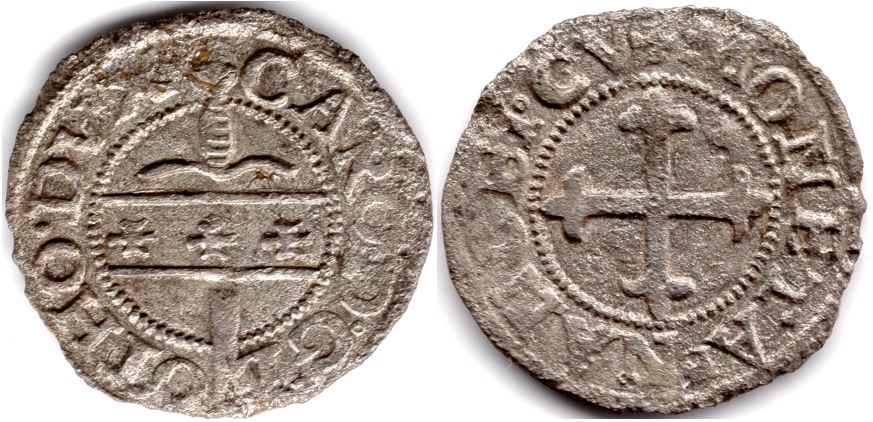 Obverse: CARO D G LOTHO DVX (Carolus Dei Gratia Lothorum Dux / Charles by Grace of God Duke of the Lorrainians). Sword, strip with three alerions (coat of arms of Lorraine). Reverse: MONETA NANCEII CV (Moneta Nanceii Cusa / Money coined in Nancy). Cross with fleurs-de-lis. Charles's long reign was due to him becoming duke at the age of two. There are several varieties of this liard and with more extensive reference material than I have at hand, it is perhaps possible to narrow the time span. The sword and the alerions are classical attributes of Lorraine and its coins. The floriated cross is rare on Lorraine coins and looks very much like the cross on the contemporary liard of Henry III of France that I show in Chapter 6. Liards do not seem to have been a big thing in Lorraine. Numista lists only three types, basically one per century from 1545 to 1729 (the last type will show up in a later post). NextWe move on to Franche-Comte.
|
|
Moderator
United States
196311 Posts |
Thank you for sharing the latest installments. Quote:
There must be more billon liards out there among the CCF members, I am sure, but let's move on. You can still show what you have, now, soon, or later!   |
|
Pillar of the Community
Sweden
2124 Posts |
CHAPTER 12: Holy Roman Billon (Franche-Comte)
= Mid 16th Century =Burgundy/Franche-ComteSome sources say the County of Burgundy got its casual name Franche-Comte from its 12th century Count Renaud III, who refused to pay homage to the Emperor. A bold or "frank count", in French "franc comte", thus would have given rise to the name Franche-Comte, after a couple of centuries and linguistic distortions. Since franche also means "free", a more mundane explanation is that it simply means "free county", which has to do with it developing from a territory with its own ("free") jurisdiction into a self-governing area. The German name Freigrafschaft Burgund translates to exactly that. Whatever the reason, the name stuck and the region, today part of France, still goes under the same name. The monetary system used in Franche-Comte in the 15th-16th centuries is confusing, at least to an external observer many centuries later . At some time at least, it looked like this: 1 franc = 12 gros = 24 carolus = 48 blancs = 144 angrognes = 216 deniers estevenants. The angrogne was a regional Burgundian coin, also known as niquet and worth (at least at this time) 1/3 blanc or 1½ denier estevenant. The denier estevenant was the denier minted in Burgundy's largest town, Besançon, since the 9th century (named after Saint Stevens, who figured on the coins; Besançon, by the way, had its own minting rights and coinage in parallel with that of the County). The carolus, finally, was also a local coin, so named because it had the image of the emperor Charles on it. It was worth two blancs; a double blanc, however, was a double denier, and the denier was, quite logically, called half double ( demi double). Having come that far in my piecing together data from multiple partially contradicting sources, I found that there had also been "strong" and "weak" francs in the 16th century, with different values toward the livre tournois, and in turn divided into "strong" and "weak" gros, etc. Sensing a slight headache, I decided to pretend I hadn't seen that, and halt any further research. So to be honest, I might have missed some aspect of the Burgundian monetization. And, let's not forget that in addition to the County of Burgundy, there was also the Duchy of Burgundy (bordering the County on the west). From 1384 they joined in a personal union, with the same ruler being both duke and count. But, the liards, where are they? Well, that is a good question. They are found in Vanhoudt's book and they are found in Numista. In other places those coins are called demi-blancs, that is, half blancs. Yet other sources call them doubles. Assuming they are ½ blancs, a Burgundian liard would then be the same as 2 and 1/4 denier (estevenant), or 1/96 of a franc. Completely ignoring that this liard thus seems to be neither 3 deniers nor 1/80th of something , here it is: Liard/Half blanc, Burgundy 1555, Charles V of the Holy Roman Empire, Dôle. Billon. 0.73 g, 15 mm. Vanhoudt 243. 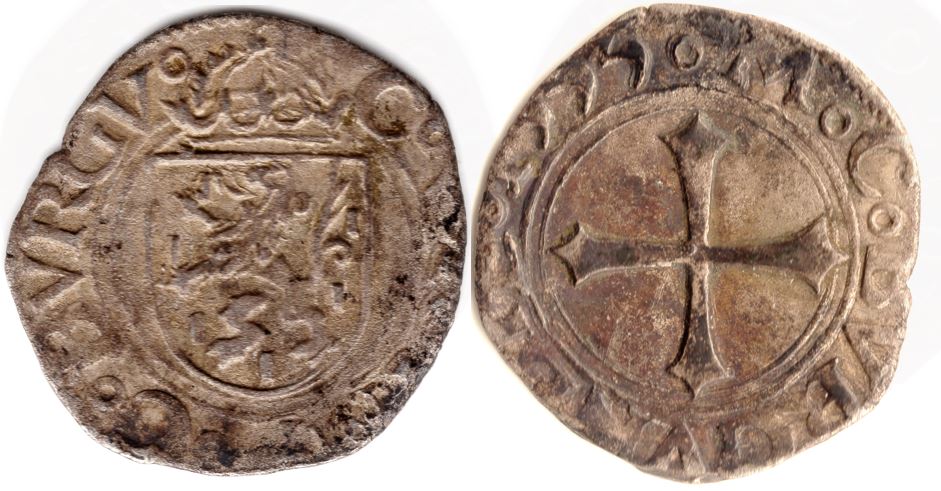 Obverse: C V R IMP C BVRGV (Carolus V Romanorum Imperator Comes Burgundiae / Charles V Emperor of the Romans, Count of Burgundy). Crowned coat of arms for Franche-Comte. Reverse: M C BVRGVNDIE (Moneta Comitatus Burgundiae / Coin from the County of Burgundy). Cross pattee. Minted in fairly large numbers 1550-1559 (last issue posthumous), with a couple of variants in design and inscription, rarely in really good condition. The coat of arms is worth a few words. It shows a crowned lion rampant on a field with bars (a few are visible if you look closely). Originally the coat of arms for the County of Burgundy had an eagle, like so many other states in the Holy Roman Empire (like Lorraine with its three alerions/eagles). Towards the end of the 13th century, count Otto IV decided to change that. He wanted to strengthen the ties with France when marrying the grandniece of King Louis IX of France, and to demonstrate that, he disposed of the imperial eagle. There are no lions in Burgundy, but it's a great symbol for a ruler . The bars, a bit unclear what they symbolize - logs from the Burgundian forests? But what about the ties with France? Emperor Charles V, of the Habsburg house, certainly was no vassal of the French king and in the 16th century relations with France were quite frosty. We have to go back some 80 years to se why. In 1477 future emperor Maximilian I of Habsburg married duchess Mary of Burgundy (after she rejected the French king's proposal to marry his six year old son, future Charles VIII; and yes, Mary was both duchess of the Duchy of Burgundy as well as countess of the County of Burgundy). Hostilities followed, the Duchy was taken over by France and in 1493 the County was taken over by the Habsburgs. Charles V got the title of count in 1506, at the age of six, and held it until his death in 1558. After that, the county went back and forth between France and the Empire a couple of times, before finally being taken over by France in 1678. How much was a Burgundian liard (or whatever it was) compared to a French liard then? Comparing the Burgundian franc with the French livre should give an answer. However, opinions on the relation of those differed. The count figured a 1:1 relationship would be handy. The French king thought that a value of 2/3 livre for a franc could suffice. So in practice, the exchange rate varied over time and with place and depending on who you asked. If we go with the king's opinion, the resulting calculation yields a value of about 5/3 (1 and 2/3) denier tournois for the Burgundian liard. Next time: The Copper Age Copper began to replace low grade billon coins in France and other countries in the 16th century. For liards, the Low Countries were first with copper. We begin with the Spanish Netherlands in the next Chapter! And since that is a quite a leap, from French billon to Low Countries copper, I will wait a couple of days before posting the next Chapter. I hope to see some billon liards from you folks in the mean time!
|
| |
Replies: 163 / Views: 7,835 |
To participate in the forum you must log in or register.
Disclaimer: While a tremendous amount of effort goes into ensuring the accuracy of the information contained in this site, Coin Community assumes no liability for errors. Copyright 2005 - 2026 Coin Community Family- all rights reserved worldwide. Use of any images or content on this website without prior written permission of Coin Community or the original lender is strictly prohibited.
Contact Us | Advertise Here | Privacy Policy / Terms of Use
|
| Coin Community Forum |
© 2005 - 2026 Coin Community Forums |
| It took 0.62 seconds to rattle this change. |
 |
|








 First Page
 Previous Page


 Posted 05/03/2024 10:58 am


