Coin Community Family of Web Sites Join Thousands of Coin, Bullion, & Money Collectors
300,000 items to help build your collection! Royal Canadian Mint products, Canadian, Polish, American, and world coins and banknotes. Specializing in Modern Numismatics Join Thousands of Coin, Bullion, & Money Collectors Royal Estate Auctions - $1 Coin AuctionsVancouvers #1 Coin and Paper Money Dealer Coin, Banknote and Medal Collectors's Online Mall


Username:
Password:
Save Password
Forgot your Password?


This page may contain links that result in small commissions to keep this free site up and running.

Welcome Guest! Registering and/or logging in will remove the anchor (bottom) ads. It's Free!

The Lovely Lowly Liard

To participate in the forum you must log in or register.
Author Previous TopicReplies: 163 / Views: 7,121Next Topic
Page: of 11
Moderator
Learn More...
jbuck's Avatar
United States
189340 Posts
 Posted 05/07/2024  3:42 pm  Show Profile   Bookmark this reply Add jbuck to your friends list Get a Link to this Reply
An interesting read.

I wish I had some examples to share. This is all still new to me.
Pillar of the Community
Learn More...
tdziemia's Avatar
United States
7958 Posts
 Posted 05/09/2024  4:25 pm  Show Profile   Bookmark this reply Add tdziemia to your friends list Get a Link to this Reply
Alas, while I have quite a few 16th and 17th Lorraine coins, I never added a billon liard to my collection .

However ... I did recently add this one to Numista, which I think must be the earliest: https://en.numista.com/catalogue/pieces413782.html

And I'll try to explain the scarcity of types ...
- in the 16th century, practically speaking, there were just two rulers covering an entire century: Antoine (1508-1544) and Charles III (1545-1608). Between them was a Francois who reigned but a year, so we will excuse him for not striking more types. So ... two rulers, two liards (three if we count this one not yet in Numista: https://www.acsearch.info/search.html?id=2753304). More rulers will generate more types (by comparison, France had five rulers between 1498-1589, with long enough reigns to strike coins)
- in the 17th century, the Nancy mint operated fewer than half the years, due to prolonged occupation by the French (1634-1661 and 1670-1697). Despite this, there appear to be three (despite my best efforts to make a complete Lorraine section in Numista, some hard-to-find types are not yet listed):
Henry II (1608-1624) appears to have struck one: https://www.acsearch.info/search.html?id=10955255
Charles and Nicole struck one during their brief joint reign, and Charles struck another during his brief restoration: https://en.numista.com/catalogue/pieces107674.html


Edited by tdziemia
05/09/2024 4:26 pm
Pillar of the Community
Learn More...
erafjel's Avatar
Sweden
2124 Posts
 Posted 05/10/2024  2:18 pm  Show Profile   Bookmark this reply Add erafjel to your friends list Get a Link to this Reply

Quote:
And I'll try to explain the scarcity of types

Excellent, great information tdziemia! So from the three types of liards I was aware of, to seven, if I calculate correctly (with two types for Charles III and including the later one in copper for Leopold).
Pillar of the Community
Learn More...
erafjel's Avatar
Sweden
2124 Posts
 Posted 05/10/2024  2:40 pm  Show Profile   Bookmark this reply Add erafjel to your friends list Get a Link to this Reply
CHAPTER 13: The Early Copper Liards (Oorden) - The Dutch Revolt

= Late 16th Century =


Pure copper coins for the smallest denominations - duiten and double mites (1/3 duit) - turned up in the Low Countries in the early 1500s. The town of Utrecht and the province of Brabant are examples of early adopters. For liards, or oorden in the Dutch speaking areas, there were some early examples of tokens, like the armenpenningen (tokens for the poor) in the town of Delft (1531 and onwards).

The first regular oord for general use was - as far as I know - minted in 1573 by the town of Leiden, Holland, during the revolt against Spain. It precedes the formation of the Dutch Republic and was minted while Leiden was formally under Spanish rule, but it makes no reference to Spain and is usually considered as a Dutch coin, not a Spanish Netherlands coin. It is very rare and I have not tried seriously to find one.

As a reminder: The Low Countries used the gulden (or florin), divided into 20 stuivers, the stuiver in turn divided into 4 oorden. Then there were also the groot = 2 oorden and the duit = ½ oord = 6 mites. The important thing here, though, is that 1 oord = 1/80 gulden, just like 1 liard = 1/80 livre, and the gulden and the livre tournois were similar in value. Consequently, liards and oorden were, more or less, of the same value (and in the literature, oorden are sometimes called liards). (Another reminder: oorden is the Dutch plural for oord and is the form I will use here.)

I will say a bit more about the name "oord" in the next Chapter, but now let's get started! (And if you are not interested in the historical background, just scroll down until you see the coins.)

The Dutch Revolt

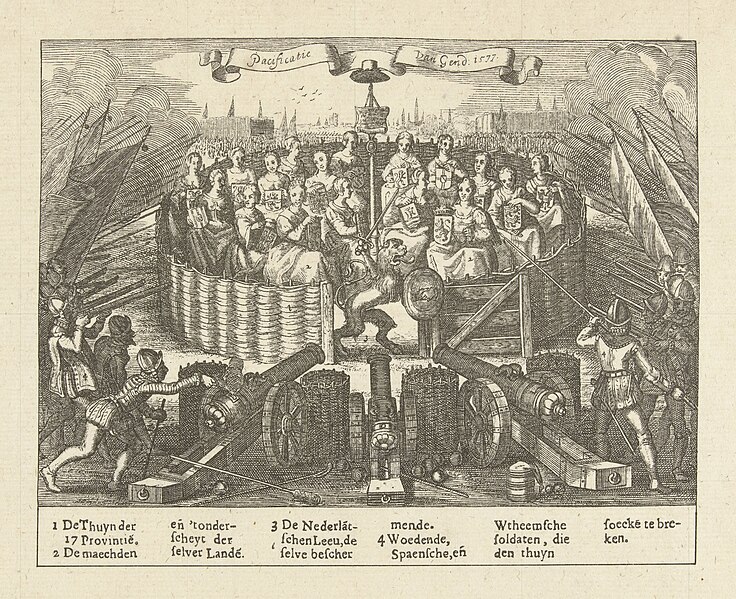
Ghent, Flanders province. November 8, 1576, 10 am. From the town hall balcony, it is proclaimed that an agreement has been reached: The provinces of the Netherlands shall jointly drive out the Spanish troops and "restore the citizens to their rights, privileges, and liberties and their former prosperity".

For years, the Low Countries had rebelled against Spain. Disparate groups in the various provinces had fought the Spanish troops, sometimes in loose alliances, but mostly without consistency and coordination. Over the last year, however, the Spanish troops had begun to mutiny and attack cities just to pillage and ravage (Spain was out of money and could not pay its soldiers). Four days before the balcony proclamation, the city of Antwerp, the financial and cultural center of the Netherlands, had been sacked and thousands killed. In Ghent, representatives from most of the Seventeen Provinces of the Netherlands had already been in session for weeks. Now, with the Pacification of Ghent, they took an important step towards unity, on a path that two years later would lead to the formation of the independent Dutch Republic.
The-Lovely-Lowly-Liard
The Pacification of Ghent in 1576. Allegorical representation with the Netherlands lion protecting the Garden of Holland, with its 17 maidens representing the provinces, from the Spanish troops.
Source: From Nederlandtsche gedenck-clanck, Adriaen van de Venne,1626. Wikipedia, public domain.


Let us go back two decades in time to find the background to all this.

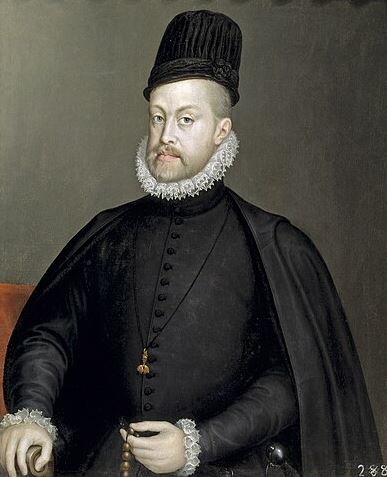
Gout and other health issues plagued Holy Roman Emperor and King of Spain etc Charles V (the guy with the Franche-Comte liard in the previous Chapter) towards the end of his long reign. In 1555, he passed the lordship over the Spanish Netherlands (aka the Habsburg Netherlands aka the Seventeen Provinces) to his son Philip II of Habsburg, who in 1556 also became king of Spain and its possessions. The Spanish Empire encompassed not only Spain and the Low Countries, but also Burgundy, possessions in Italy, huge territories in the Americas, and the West Indies. It was the superpower of its time. One might think that Philip would not pay much attention to the small corner of the empire made up by the Low Countries. Quite the contrary, they were important from both a strategic and economic point of view, positioned in between France, England and the Holy Roman Empire (which had gone to Philip's brother Ferdinand), and being a center for trade and finance. In fact, Philip had his court in the capital Brussels for the first several years of his rule as king of Spain.
The-Lovely-Lowly-Liard
Philip II of Habsburg.
Source: Painting by Sofonisba Anguissola, 1565. Wikipedia, public domain.


Philip worked hard to incorporate his 17 provinces into the rest of his empire, to fit them into the imperial hierarchy and have them contribute to the empire's economy and military endeavors. And, not least, to make its inhabitants stick to the Catholic faith and resist the Protestant heresy that kept spreading. Unfortunately for Philip, his Netherlands subjects did not fully appreciate his efforts. They continued to assert their centuries-old customary privileges and (limited) self-rule they had enjoyed under former rulers. As to faith, they were happy to try the new Calvinism, and wanted to do so without the Spanish Inquisition coming down on them (which it did, without much mercy).

Resistance, insurrection and rebellion began in the mid 1560s. It escalated over the following decade and developed into what became known as the Eighty Years' War. There is no need to go into details here - there is plenty of information elsewhere and whole books have been written about the events. Here I will content myself with what I have said so far and move on to the coins!

As mentioned, copper coins had been used before for the tiniest denominations, smaller than an oord. The province of Holland, which together with Zeeland had been most tenacious in the struggle against Spain, was first to introduce copper coins for oorden, in 1573. It was part of a scheme of issuing over-valued coins (which included also silver coins) and use the surplus to finance the war. The idea appealed to the States General of the Netherlands and in 1577 they instructed the province mints to take similar measures and issue "States coins" (Statenmunten), in all denominations. The Holland coinage we shall look at in the next Chapter, here we look at a couple of coins from other provinces.

The Statenoorden (Liards des etats)

As part of the Statenmunten scheme, copper oorden - statenoorden - were introduced by the provinces Brabant, Flanders, Tournai, Guelders, Overijssel and Zeeland. They shared the same design, only with different mintmarks and the king's titles adapted to each province. (In French speaking parts, such as Tournai, one spoke of liards des etats.) Here are two statenoorden, very similar as you can see.

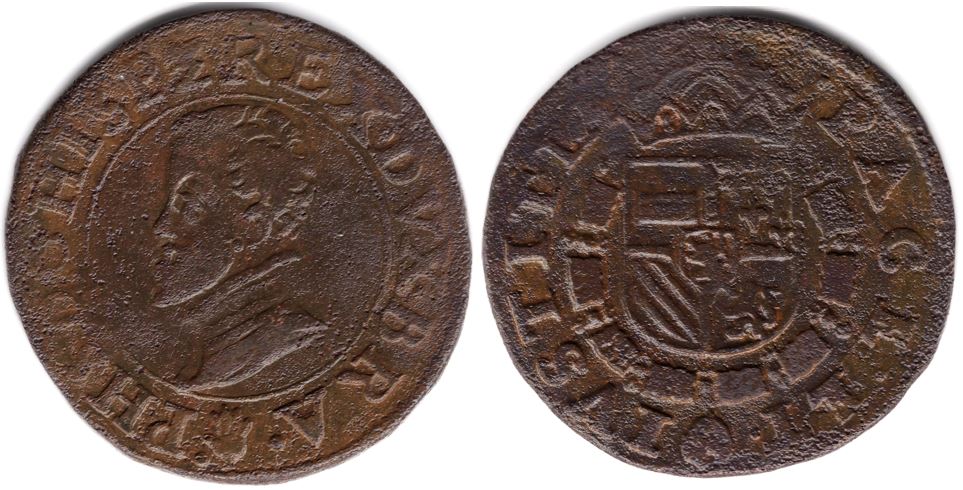
Oord (statenoord), Brabant (Spanish Netherlands) 1578-1580, Philip II of Spain, Antwerp. Copper. 6.65 g, 25.5 mm. Vanhoudt 381.AN.
The-Lovely-Lowly-Liard

Obverse: PHS D G HISP Z REX DVX BRA (Philippus Dei Gratia Hispaniarum et [cetera] Rex, Dux Brabantiae / Philip by Grace of God King of the Spains etc, Duke of Brabant). Bust of Philip II. Hand at bottom, mintmark for Antwerp.
Reverse: PACE ET IVSTITIA (Peace and Justice). Crowned shield with the arms for Philip II as ruler of the Spanish Netherlands, surrounded by collar of the Order of the Golden Fleece.

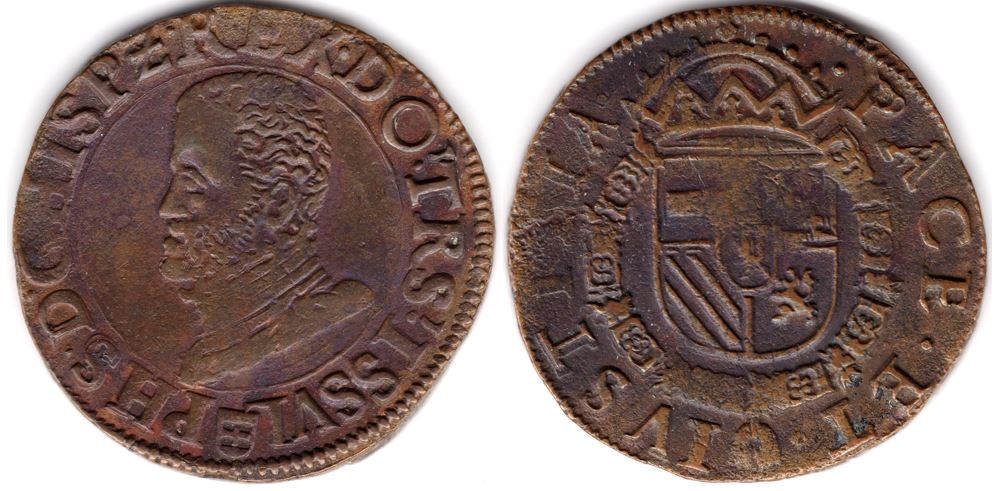
Oord (statenoord), Overijssel (Spanish Netherlands) 1578-1579, Philip II of Spain, Hasselt (Overijssel). Copper. 6.38 g, 25.5 mm. Vanhoudt 381.HS.
The-Lovely-Lowly-Liard

Obverse: PHS D G HISP Z REX DO' TRS' ISSVL (Philippus Dei Gratia Hispaniarum et [cetera] Rex, Dominus Transissulaniae / Philip by Grace of God King of the Spains etc, Lord of Overijssel). Bust of Philip II. Shield with cross (Hasselt city arms) at bottom, mintmark for Hasselt.
Reverse: As previous coin.

Overall, the design is not unlike earlier higher denomination silver coins: Philip II on the obverse, his coat of arms on the reverse. Despite the years of rebellion and now forcing the Spanish troops to leave, Philip is still recognized as ruler. But let us look closer at the reverse.

The first thing to note is that the king's motto, Dominus mihi adiutor (God is my helper), has been replaced by Pace et Iustitia (Peace and Justice). This was done completely arbitrarily by the States General, and was of course meant to send a message to both the population using the coins and to the king: The States General is restoring order, and not with the help of the king's God. Philip did not like the alteration, and even though there was not much he could do about their use in the Netherlands, he persuaded his nephew Rudolf II, emperor of the Holy Roman Empire, to ban use of the coins in his countries (which was more important for the larger statenmunten denominations).

Apart from the replaced motto, the reverse is loyal to the king, with his coat of arms and the Golden Fleece collar. What are those, really?

The coat of arms is a reduced version compared to the full one that Philip would use in Spain and which has some 17 parts (the full coat of arms is used on many coins of the Spanish Netherlands, but especially during this period the reduced version seems popular). Top left we have Austria, top right modern (well, back then at least) Burgundy, bottom left ancient Burgundy, bottom right Brabant's lion. In the center, Flanders's lion. The coat of arms is Philip's personal one and was the same for all coins, regardless of which province they were from. Thus, the arms of Overijssel (another lion, on top of a wavy band) is not shown on the Overijssel coin, all coins show the Brabant and Flanders lions. It follows the principle used earlier for Spanish Netherlands coins, with same type used all over but with localized titles (and mintmark).

The Order of the Golden Fleece was founded in 1430 to defend the Roman Catholic religion. Like his father Charles V, Philip II was grand master of the order. Reserved for Catholics from the highest nobility, the order was the most prestigious and influential order of its time, so it's no wonder that Philip wears it on many of his portraits and has it on some of his coins.

Now back to the obverse. Not much to say about Philip's portrait, it is the same as on earlier coins. But let us pay some attention to the inscriptions, let's analyze the Overijssel coin. The apostrophes in DO' TRS' mark that the words are abbreviated: DO' = Dominus, TRS' = Trans. There are plenty of other abbreviations in the inscription, but presumably those are considered so well known that it is not necessary to point them out. Then we have the Z with a stroke. With or without a stroke, that is a common symbol for Latin "et", that is, "and". I have here interpreted it as "et cetera", since the title "King of the Spains and" really is missing something.

Then we have "the Spains". Spelled out and filling out the "cetera", Philip's title is Philippus Dei Gratia Hispaniarum et Indiarum Rex, that is, Philip by Grace of God King of the Spains and the Indies. (Used to French coins with Francorum Rex - "King of the Franks" - I first read this as "King of the Spaniards and the Indians". "Of the Spaniards" seemed logical, "of the Indians" looked odd. Revisiting Latin grammar, I soon found out that "of the Spaniards" is Hispanorum Rex and Hispaniarum is the plural genitive of Hispania, Spain.) If we take "the Indies" first, that doesn't look too strange, we still talk about the "West Indies" - although here it includes not only the modern West Indies but also large parts of South and North America. But was there more than one Spain? Yes, there was! Castile, León, Aragon, Granada, Navarre, and more - those were once independent kingdoms, later collected under one king, and there we have "the Spains". Over time, it evolved to include Spanish possessions on all continents. The present king, Felipe VI, calls himself "King of Spain". The last monarch to use the term "the Spains" was queen Isabella II, who ruled 1833-1868.

What about Philip's other possessions, Italy and the Low Countries, for instance? Well, he was king of Naples, king of Sicily, king of Jerusalem (at least in his mind), but we don't see that on his Spanish Netherlands coins. As for the Low Countries, he was Lord, not King, of the Seventeen Provinces, where he was Duke of Brabant, Count of Flanders, etc - in principle a separate title for each province (in reality it was a bit more intricate, but no need to go into more details here).

A final remark: As pointed out by tdziemia in one of the first posts in this thread, there are two Hasselts in the Low Countries that have issued coins: One up here in the north, in Overijssel, another further south near Liège. In Chapter 21 I will show a coin from that Hasselt.

Phew, that was a lot. Holland and the rest will have to wait until the next Chapter!

Moderator
Learn More...
jbuck's Avatar
United States
189340 Posts
 Posted 05/10/2024  4:11 pm  Show Profile   Bookmark this reply Add jbuck to your friends list Get a Link to this Reply
Your sharing of the historical context with the coins remains fascinating!
Pillar of the Community
Learn More...
erafjel's Avatar
Sweden
2124 Posts
 Posted 05/11/2024  1:52 pm  Show Profile   Bookmark this reply Add erafjel to your friends list Get a Link to this Reply
Thank you, jbuck. Finding out what history is connected to a coin is an important part of the fun for me.
Pillar of the Community
Learn More...
erafjel's Avatar
Sweden
2124 Posts
 Posted 05/11/2024  1:59 pm  Show Profile   Bookmark this reply Add erafjel to your friends list Get a Link to this Reply
CHAPTER 14: The Early Copper Liards (Oorden) - Holland

= Late 16th Century =


Holland

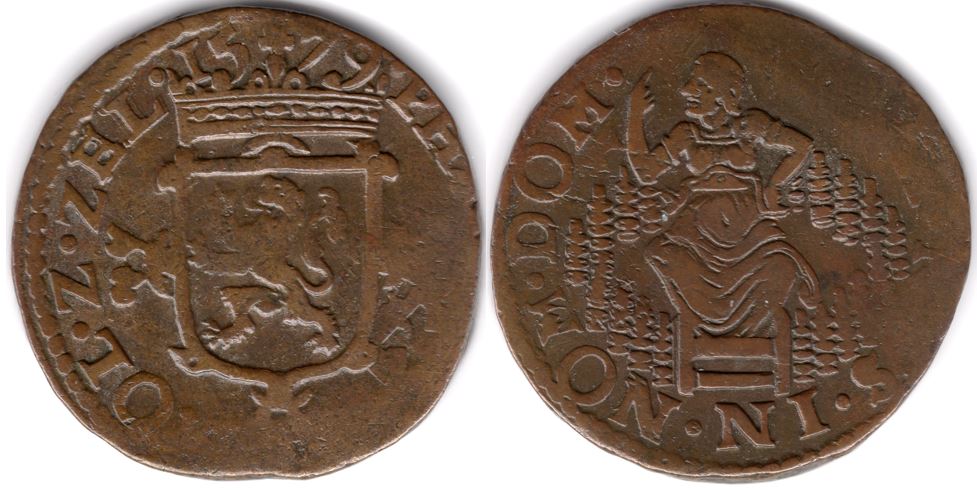
The province of Holland did not issue any statenmunten - after all, they had come up with the concept of overvalued coins and did not need to copy their own idea! Instead, they issued coins of their own design, the best known of which is probably the Leeuwendaalder ("lion thaler") with its prominent rampant lion. The oorden has a maiden instead of a lion (hard to find in good condition, these coins, but I like this one for its clear picture of the maiden):

Oord, Holland (Spanish Netherlands) 1579, Philip II of Spain, Dordrecht. Copper. 6.95 g, 24 mm. Vanhoudt 369.

The-Lovely-Lowly-Liard

Obverse: PH[S D G COM H]OL Z ZEL (Philippus Dei Gratia Comes Hollandiae et Zelandiae / Philip by Grace of God Count of Holland and Zeeland). Crowned coat of arms for Holland, over cross. Flower at top, mintmark for Dordrecht.
Reverse: [AVX NO]S IN NOM DOM (Auxilium nostrum in Nomine Domini / Our Help is in the Name of the Lord). The Dutch Maiden seated in the Garden of Holland.

Not long after one of its towns, Leiden, minted its 1573 copper oord, Holland as a province followed. Already in 1574 was the first provincial copper "rebellion" oord minted. Despite the rebellion, this coin from 1579 still recognizes Philip as the province's ruler. His portrait has had to give way for the province's coat of arms, even though that too strictly speaking refers to Philip, crowned with his (open) countal crown as it is (in comparison, the statenmunten have coats of arms with a (closed) royal crown, since they refer to Philip as king). A remark: The count of Holland was also count of Zeeland, a fact that is pointed out on some of Holland's coins.

The reverse is very different from anything we have seen so far. The Dutch Maiden would, following the revolt, become a symbol of the Dutch Republic and eventually the personification of the modern Netherlands, but here she is still a symbol of freedom for the province of Holland. She sits in the Garden of Holland, with its protective fences that symbolizes the impregnability of the province, and with its gate through which no one is let in without permission. This too later became part of the repertoire of symbols of the Dutch Republic (as seen on the picture near the top of the previous Chapter).

The inscription - "Our Help is in the Name of the Lord" - is from the New Testament (Psalms 124:8) and refers to how trust in God's strong name will help Holland. (It is, I guess, not a coincidence that there is a similarity with Philip's motto "God is my helper"; Holland trusts the Heavenly Powers to be on their side.) To underline the message, the maiden points to heaven. (My first impression was that this maiden, rather steady and with a folksy appearance, made another gesture, directed at Philip perhaps . But looking closely and counting fingers, I now have faith in that she is on the pious side. )
Before leaving the years of the revolt, we may note that the copper coins of this period are comparatively heavy: 6-7 grams. Later liards/oorden are of lighter constitution. Maybe it was a way to install trust in these new coins, made of copper instead of silver.

Why Copper and why "Oord"?

Pure copper was not new for small denominations by the 1570s, but for the first time it was used for general circulation liards/oorden. The war activities caused strain on the finances of Holland, and one way to alleviate that was to issue over-valued coins. For higher denominations, the Leeuwendaalder with 0.750 fineness instead of the usual 0.833, and for oorden pure copper instead of billon as in the earlier ½ grooten. That lower denominations in pure copper had worked earlier was probably also a factor.

Then we have the name "oord". Google translates it with "resort" (!), "place", "spot", "location", and that is its meaning in modern Dutch. An older meaning was "corner", and one explanation I have seen is that taking a quarter ("corner") of a stuiver, a coin that often had a cross (sometimes a long cross), yielded the value of an oord. But I think other coins had crosses too, so I don't know . . . A completely different explanation is that it is derived from the Roman gold coin aureus.

Next Time: Back to The Spanish Netherlands

The northern provinces, seven of them, broke away from the Spanish Netherlands and formed the Dutch Republic in 1579. More about them in Chapters 19 and 20! The southern provinces reverted back to the Spanish Crown. It is them I will talk about in the next Chapter.
Pillar of the Community
Russian Federation
5177 Posts
 Posted 05/11/2024  5:19 pm  Show Profile   Bookmark this reply Add january1may to your friends list Get a Link to this Reply
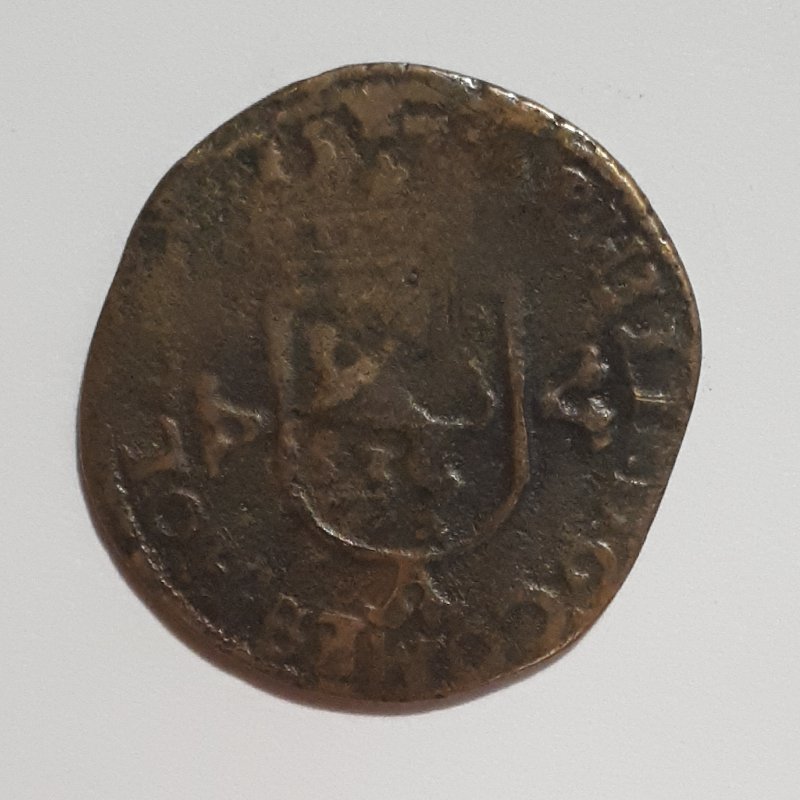
This is the chapter that I do have a coin for!

The-Lovely-Lowly-Liard The-Lovely-Lowly-Liard

Not the best photos though...

AFAICT this is one of the subtypes that don't specifically mention Zeeland. I date it to 1575 because a listing of legend types only had this variant for that year (and this also matches my best guess from the remnants of the date), but in any case it's from the 1570s.
Pillar of the Community
Learn More...
tdziemia's Avatar
United States
7958 Posts
 Posted 05/11/2024  11:21 pm  Show Profile   Bookmark this reply Add tdziemia to your friends list Get a Link to this Reply
Quite a nice example of that coin from what I can find.

Maybe we discussed it before, but the Van Gelder & Hoc catalog only mention two legend variants, both starting with PHS. But yours and this one clearly start with PHILI(P): https://www.acsearch.info/search.html?id=1576601

Edited by tdziemia
05/12/2024 10:36 am
Pillar of the Community
Learn More...
erafjel's Avatar
Sweden
2124 Posts
 Posted 05/12/2024  03:43 am  Show Profile   Bookmark this reply Add erafjel to your friends list Get a Link to this Reply
Nice, january1may, and an unusual variety too, it seems!
Pillar of the Community
Learn More...
erafjel's Avatar
Sweden
2124 Posts
 Posted 05/12/2024  5:28 pm  Show Profile   Bookmark this reply Add erafjel to your friends list Get a Link to this Reply
CHAPTER 15: Liards and Oorden of The Spanish Netherlands

= Late 16th Century =


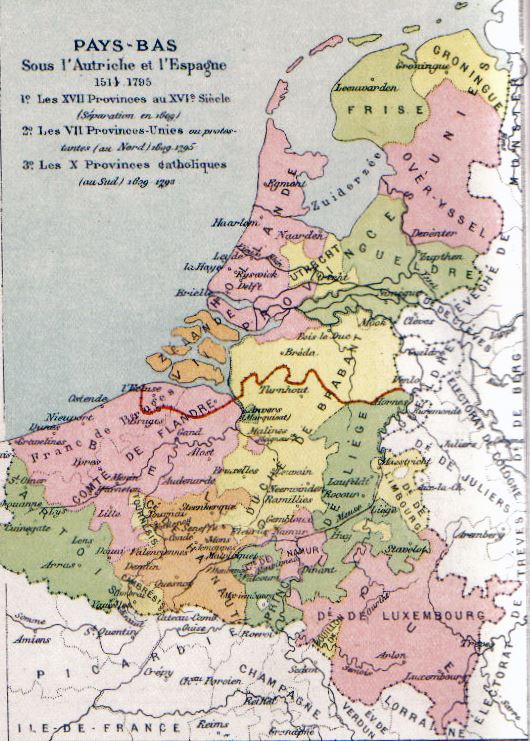
The southern provinces remained under Spain. Hostilities with the Dutch Republic continued, with alternating success and defeat for both sides, but I will not go into that here. The map below is of a somewhat later date, but shows the different provinces and the (later) border between the Spanish possessions and the Dutch Republic (The Seven Provinces).

The-Lovely-Lowly-Liard
Map of the Habsburg (Spanish, later Austrian) Netherlands and the Dutch Republic, divided by the red border line. Note that Liège was its own Prince-Bishopric, not part of the Habsburg Netherlands. (For some reason, the map maker has omitted Amsterdam. It is located just to the right of 'N' in HOLLANDE.)
Source: from Atlas de geographie physique, politique et historique à l'usage de l'enseignement primaire et de l'enseignement moyen, ca 1878. Wikimedia. Public domain.


Coinage in (what remained of) the Spanish Netherlands continued much as before the revolt, but with copper coins as a new element. In the next few posts, I show liards/oorden from different districts and different rulers, spanning over 130 years, in this and the next three Chapters.

Tournai - Philip II

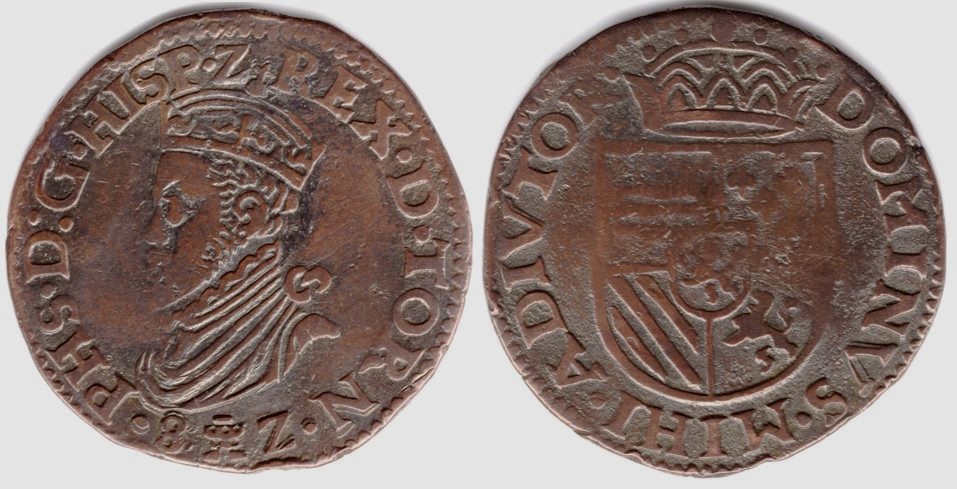
Liard, Tournai (Spanish Netherlands) 1582, Philip II of Spain, Tournai. Copper. 4.75 g, 26 mm. Vanhoudt 321.TO.

The-Lovely-Lowly-Liard

Obverse: PHS D G HISP Z REX D TORN (Philippus Dei Gratia Hispaniarum et [cetera] Rex, Dominus Tornacensis / Philip by Grace of God King of the Spains etc, Lord of Tournai). Crowned and armored bust of Philip II. Tower at bottom, mintmark for Tournai.
Reverse: DOMINVS MIHI ADIVTOR (God is my helper). Crowned shield with the arms for Philip II as ruler of the Spanish Netherlands.

Not too much to say about this coin, but a few remarks are in order. Firstly, Tournai was not a province, it was a town with surroundings, and with its own minting rights. Secondly, Tournai was mainly French-speaking, so this was called a liard rather than an oord. Thirdly, it is a bit lighter than earlier liards (des etats) - time to save on the copper? Four, Philip has to do without the Golden Fleece collar on this one (I don't know if that has any significance, or if it is just work rationalization for the die cutter). On the other hand, he is presented with a crown. And five, Philip has got his motto back, things are back in order!
Pillar of the Community
Learn More...
tdziemia's Avatar
United States
7958 Posts
 Posted 05/12/2024  10:33 pm  Show Profile   Bookmark this reply Add tdziemia to your friends list Get a Link to this Reply
What an amazing collection of early Low Countries liards you have! Really a pleasure to follow (I've only got a few later very common ones for the later chapters).

On the map ... I think think the red line is the modern Belgium-Netherlands border. But at that time the "Spanish Netherlands" extended well to the north of it. Brabant (the large yellow bit) had about one third of its territory north of the line, including the mint at Bois-le-Duc (today the Dutch city called 's-Hertogenbosch ... still the Duke's forest no matter how it's called!)

Edited by tdziemia
05/12/2024 10:35 pm
Moderator
Learn More...
jbuck's Avatar
United States
189340 Posts
 Posted 05/13/2024  10:52 am  Show Profile   Bookmark this reply Add jbuck to your friends list Get a Link to this Reply
Great read and wonderful examples!


Quote:
This is the chapter that I do have a coin for!
Excellent!
Pillar of the Community
Learn More...
erafjel's Avatar
Sweden
2124 Posts
 Posted 05/13/2024  5:10 pm  Show Profile   Bookmark this reply Add erafjel to your friends list Get a Link to this Reply
Thank you, tdziemia and jbuck!

Quote:
On the map ... I think think the red line is the modern Belgium-Netherlands border. But at that time the "Spanish Netherlands" extended well to the north of it.

Yes, you are right. The red line is the border as defined in the 1648 Peace of Westphalia, which is still the Belgium-Netherlands border. So it is later than the 1582 coin I showed, at that time northern Brabant was still part of the Spanish Netherlands (but for most of the time occupied by the Dutch Republic, from what I understand - the 1648 Treaty established what was already a fact).

Looking forward to see your later liards!
Pillar of the Community
Learn More...
erafjel's Avatar
Sweden
2124 Posts
 Posted 05/13/2024  5:17 pm  Show Profile   Bookmark this reply Add erafjel to your friends list Get a Link to this Reply
CHAPTER 16: Liards and Oorden of The Spanish Netherlands

= Early 17th Century =


Philip II died in 1598. He left Spain to his son Philip III but the Netherlands went to his daughter Isabella and her husband Albert. He was Governor General of the Habsburg Netherlands, and also a relative to Philip. Albert had been quite successful in the ongoing war against the Dutch Republic, until Spain's 1596 bankruptcy (the fourth under Philip) and the problems of paying the troops that followed. The war continued for another 13 years, with ups and downs for Albert, until the Twelve Years' Truce of 1609 provided some respite.

Roermond (Guelders) - Albert and Isabella

Albert and Isabella ruled jointly and both have their names on the coins. Here is an oord, from one of the first peaceful years. (Technically, the Eighty Years' War was still going on, but of course the - for the moment peaceful - belligerents didn't know that.)

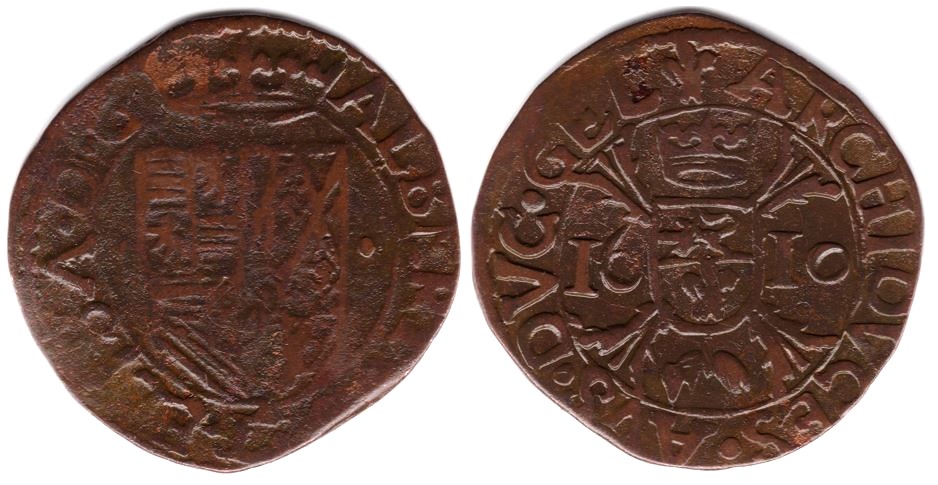
Oord, Roermond (Guelders, Spanish Netherlands) 1610, Albert and Isabella, Roermond. Copper. 4.11 g, 25 mm. Vanhoudt 606.

The-Lovely-Lowly-Liard

Obverse: ALBERTVS ET ELISA D G (Albertus et Elisabet Dei Gratia / Albert and Isabella by Grace of God . . .). Crowned coat of arms for Albert and Isabella.
Reverse: ARCHIDVCES AVS DVC GEL (Archiduces Austriae Duces Gelriae / . . . Archdukes of Austria, Dukes of Guelders). Crowned coat of arms for Roermond on top of Burgundian cross and with Golden Fleece order lamb hanging below. Fleur-de-lis on top, mintmark for mint masters Johan (Jacob) & Matthijs van Nederhoven.

This is a local coin for the town of Roermond. The province Guelders (or Gelderland) to which it belonged, consisted of disjoint territories and had been split between the Spanish Netherlands and the Dutch Republic. Roermond, in the south, remained under Spain. (Today it is located in the province of Limburg in the Netherlands. On the map in the previous Chapter, it is seen east of the red border, between the words "GUELDRE" and "ELECTORAT".)

The coat of arms for Roermond on the reverse shows the Guelders lion and the van Wachtendonck lily. The city of Roermond still has the same arms. (The van Wachtendoncks had been "Guardians" - Voogden in Dutch - of the town since early days. Exactly what a "Guardian" did is a bit fuzzy, but they were influential - and the hereditary title, although today completely ceremonial, is still carried by some families.) The cross on top of which the town's arms rest, is a Burgundian cross. The lamb looks familiar maybe, and yes, it is the Golden Fleece lamb that hangs along here too. Albert was a knight of the order.

I began with the reverse instead of the obverse this time, but variety pleases . The obverse shows the coat of arms for Albert and Isabella. It is actually somewhat simplified and unfortunately a bit too worn to make out clearly on this coin, but the coin in the next Chapter - by Charles II - has a much clearer coat of arms and I will go through that in detail instead. The only major difference to Charles's arms is the upper left quadrant, which here shows the quartered arms for Bohemia and Hungary, kingdoms of Albert's father Maximilian II.

Not much more to say, I think, except a minor remark: Albert and Isabella carry the title "Archdukes of Austria", despite that the ruling archduke at the time was Albert's brother Matthias. But if you were born a Habsburg (which both Albert and Isabella were), there were perks like having some "honorary" titles to flash. Albert did become ruling archduke in 1619, as Albert VII, but he abdicated after only a few months.
  Previous TopicReplies: 163 / Views: 7,121Next Topic
Page: of 11

To participate in the forum you must log in or register.


Disclaimer: While a tremendous amount of effort goes into ensuring the accuracy of the information contained in this site, Coin Community assumes no liability for errors. Copyright 2005 - 2026 Coin Community Family- all rights reserved worldwide. Use of any images or content on this website without prior written permission of Coin Community or the original lender is strictly prohibited.
Contact Us  |  Advertise Here  |  Privacy Policy / Terms of Use

Coin Community Forum © 2005 - 2026 Coin Community Forums
It took 0.56 seconds to rattle this change. Forums