Coin Community Family of Web Sites Join Thousands of Coin, Bullion, & Money Collectors
Coin, Banknote and Medal Collectors's Online Mall 300,000 items to help build your collection! Join Thousands of Coin, Bullion, & Money Collectors Vancouvers #1 Coin and Paper Money Dealer Specializing in Modern Numismatics Royal Canadian Mint products, Canadian, Polish, American, and world coins and banknotes. Royal Estate Auctions - $1 Coin Auctions


Username:
Password:
Save Password
Forgot your Password?


This page may contain links that result in small commissions to keep this free site up and running.

Welcome Guest! Registering and/or logging in will remove the anchor (bottom) ads. It's Free!

The Lovely Lowly Liard

To participate in the forum you must log in or register.
Author Previous TopicReplies: 163 / Views: 7,129Next Topic
Page: of 11
Pillar of the Community
Learn More...
NumisEd's Avatar
United States
5192 Posts
 Posted 05/25/2024  8:40 pm  Show Profile   Bookmark this reply Add NumisEd to your friends list Get a Link to this Reply
Utrecht (Spanish Netherlands) also struck Oorden. Maybe you missed those?
Edited by NumisEd
05/25/2024 8:40 pm
Pillar of the Community
Learn More...
erafjel's Avatar
Sweden
2124 Posts
 Posted 05/26/2024  08:11 am  Show Profile   Bookmark this reply Add erafjel to your friends list Get a Link to this Reply

Quote:
Utrecht (Spanish Netherlands) also struck Oorden. Maybe you missed those?

No, I am aware of those: 1578-1579 under Philip II. Utrecht is just one of the issuers I don't show coins from or talk much about, but I do have it in my "map" in part 3 of the Introduction. It would be wonderful to see one here!
Moderator
Learn More...
jbuck's Avatar
United States
189462 Posts
 Posted 05/26/2024  3:53 pm  Show Profile   Bookmark this reply Add jbuck to your friends list Get a Link to this Reply
The copper king, long did he reign! Thank you for sharing the history and your fine examples!
Pillar of the Community
Learn More...
erafjel's Avatar
Sweden
2124 Posts
 Posted 05/26/2024  5:13 pm  Show Profile   Bookmark this reply Add erafjel to your friends list Get a Link to this Reply
Thank you, jbuck! Next up, some copper princes!
Moderator
Learn More...
jbuck's Avatar
United States
189462 Posts
Pillar of the Community
Learn More...
erafjel's Avatar
Sweden
2124 Posts
 Posted 05/26/2024  5:36 pm  Show Profile   Bookmark this reply Add erafjel to your friends list Get a Link to this Reply
CHAPTER 25: The Princes Strike Back - More Non-Royal Liards

= Late 17th Century =

The "foreign princes", as French king Louis XIV called them, were the first to strike copper liards that were French in the sense that they were made by vassals of the French king. We saw some of those in Chapter 23. It took decades until France itself introduced liards of copper (previous Chapter). Once that happened, the "princely" liards tended to take on the characteristics of the royal ones - the mostly tiny principalities saw no problems with opening up a much wider market for their liards, bringing in vastly more seigniorage from minting than if they would cover only the needs of the few inhabitants of the principality. The French king had another view on that. He did not want to subsidize his vassals on his own expense. In addition, since the foreign liards were not valid in France, merchants, tax collectors, and others who received them from the common people would not accept them as payment. That caused a lot of annoyance and complaints, and the king had enough of that for other reasons.

Let us see what he had to complain about!

It was the Principality of Dombes that used to cause the most monetary headaches for the French king (we saw their copycat activities back in Chapter 9). With the advent of copper, I think we have a new champion:

Arches-Charleville

This small principality on the northern border of France has figured before. It was one of the early adopters of copper liards and we saw a rather nice one from 1609 in Chapter 23. That one was minted by Charles I Gonzaga, now nearly 50 years later, it is his grandson Charles II Gonzaga who is at it.

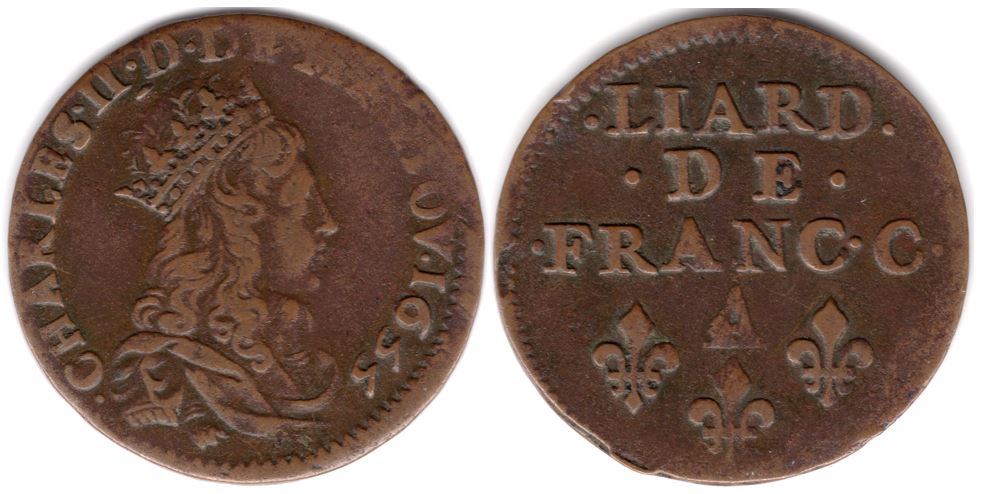
Liard (3 deniers tournois?), Arches-Charleville 1655, Charles II Gonzaga, Charleville. Copper. 3.06 g, 22 mm. C2G 288.

The-Lovely-Lowly-Liard

Obverse: CHARLES II D DE MANTOV (Charles II Duc de Mantou / Charles II Duke of Mantua). Crowned, draped and armored bust of Charles Gonzaga.
Reverse: LIARD DE FRANC C. Mintmark 'A'.

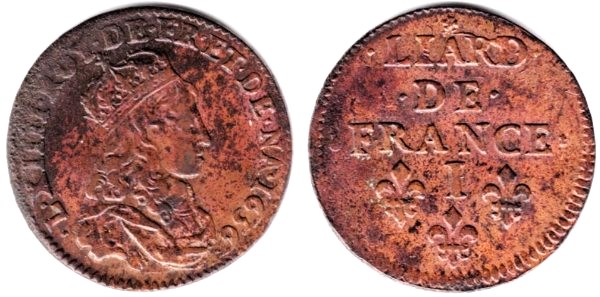
Well. Below is the French royal liard from the same time. It is quite obvious where Charles found his inspiration.

The-Lovely-Lowly-Liard
French royal liard, 1656. See Chapter 24 for full details.

If we begin with the reverse: The mintmark 'A' really doesn't mean anything. It is not the mintmark for Charleville (which was the only mint anyway, so a mintmark was superfluous). But it looks good, right there, just like the 'A' for Paris/Corbeil does on the French liards . Then LIARD DE FRANC C - a very benevolent interpretation is that the trailing 'C' stands for Charleville, a more fitting (but unintentional of course) that it stands for Copy .

The obverse is worth a few comments. Here, the inscription is correct - good for those who could read! Like his grandfather Charles I, Charles II is Prince of Arches, but foremost he is Duke of Mantua, the family duchy in northern Italy. It passed to his branch of the family in 1627, and that is the title he displays on this coin. The portrait - well, in those days and those wigs, one prince looked much like another, and Charles could argue that it is pure coincidence that he happens to look much like the French king, in this particular portrait.

The crown is actually different from the king's: It may be hard to see, but there are palm leaves inserted in the crown, and on top of it there is a small altar. The altar, according to tradition placed on Greek Mount Olympos, is an old symbol used by the Gonzagas (the meaning of which is unclear). It was important enough for Charles I to rename a hill in his town of Charleville to "Mont Olympe" (still in existence today, made into a park). The direct reason behind the palm leaves is equally unclear. They are general symbols of victory and, with the ancient Olympic athletes being rewarded with palm leaves, there is a connection to the Olympos altar.

If the intentions of the family symbols are unclear, Charles's intentions with the liards were more transparent. He was in dire need of money, and if you have the right to mint your own, you should do the most of it, right? His expenditures constantly exceeded his incomes, and in 1659 he sold the duchies of Nevers and Rethel (from which Arches had been spun off) to Cardinal Mazarin, prime minister of France. The small Principality of Arches-Charleville was kept, but was annexed by France in 1708. The title of Prince was transferred to relatives in the French nobility and is still today a hereditary title. It is now held by Stephane, 10th Duke of the Belgian House of Ursel (but the title is not recognized by the Belgian state, neither does the Republic of France acknowledge the Ursels' sovereignty over the French town of Charleville-Mezières!).

As a final remark, the nominal value of 3 deniers tournois did perhaps apply within the principality. Charles wanted that to apply also in France - and it probably passed for it in many cases - but the French authorities did not accept it for any value.

Bouillon

"Bouillon, Bouillon . . .?" - those of you with a good memory might recognize that name from previous posts, but before you scroll back to find the Bouillon coin, hold on! There isn't one (until now). But the Duchy of Bouillon, a not so small duchy in what is today southern Belgium, has figured here before. In Chapter 21 (where there is also a map), Ferdinand of Bavaria, bishop of Liège etc, claimed to be Duke of Bouillon on his 1641 liard, and so did his successor Johann Theodor in 1750 (Chapter 22). Both held the title on paper only, actual control was since long with dukes named La Tour d'Auvergne. The Duchy of Bouillon bordered the Principality of Sedan, and on the 1615 liard from Sedan in Chapter 23, Henri de La Tour d'Auvergne, Prince of Sedan, chooses to use his title Duke of Bouillon instead.

So, finally, a coin that actually is from this popular duchy:

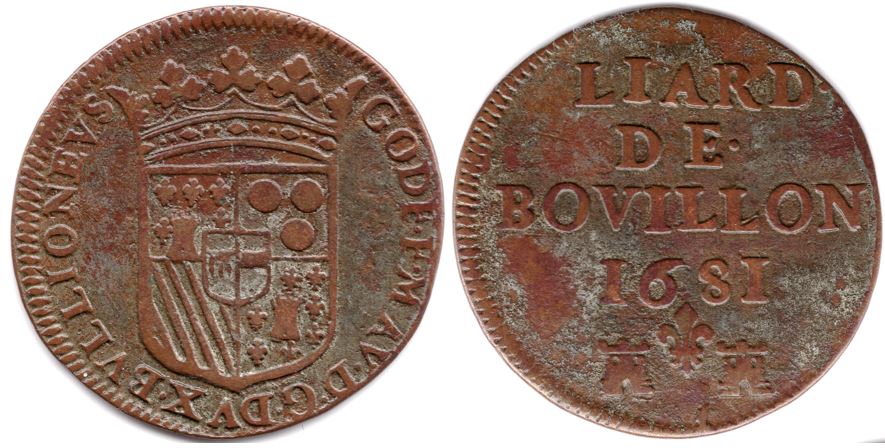
Liard (3 deniers tournois?), Bouillon 1681, Godfrey-Maurice de La Tour d'Auvergne, Bouillon. Copper. 2.89 g, 24 mm. C2G 332.

The-Lovely-Lowly-Liard

Obverse: GODF F MAV D G DVX BVLLIONEVS (Godfridus Fridericus Mauritius Dei Gratia Dux Bullioneus / Godfrey Frederic Maurice by Grace of God Duke of Bouillon). Crowned coat of arms for the House of La Tour d'Auvergne.
Reverse: LIARD DE BOVILLON. Two towers and a fleur-de-lis.

No copying here, but clearly French inspiration at the reverse.

Let's talk about the denomination first. Bouillon used the French system with livre/franc-sous-deniers as well as the Liège system with florin-patards-liards. The ducal edict for the 1681 coinage states that a douzain has the value of a sou or a patard, and that there are four liards on a patard. A douzain/sou is 12 deniers, which gives the value of 3 deniers to the liard. However, at this time the French liard was worth only two deniers (by decree of the French king). Quite soon (1683), Godfrey adapted and issued instead "Double de Bouillon", lighter and smaller than the liards. It is a bit unclear what the liards were actually worth.

The coat of arms is not too complex (compared to some others in this thread). The towers and fleurs-de-lis in the top left and bottom right quadrants are for La Tour (= tower) d'Auvergne; we have that on the reverse as well. Top right quadrant is for Boulogne, bottom left for Turenne, both feudalities that had become family possessions. In the middle a heart shield parted with the arms for Auvergne and for Bouillon itself.

The period of Bouillon coinage was brief. 1681 and 1683 are the only years coins were minted. There was a mint in the town of Bouillon before, but it minted (and only occasionally) for the bishopric of Liège. The dukes did not spend much time in their duchy (they preferred to reside in Paris), and the short monetary activity was more an attempt to make some money from seigniorage than to introduce local coins. Bouillon ceased being a duchy in 1794, after the French revolution, but the ducal title remains and is today held by the Austrian family Rohan.

Next Up: Two Frenchifieds

Next Chapter deals with Montbeliard and Lorraine. Whether they are feudalities of France or not can be argued, but certainly under French influence and they made liards, so here they are placed in this thread.
Pillar of the Community
Learn More...
erafjel's Avatar
Sweden
2124 Posts
 Posted 05/26/2024  5:42 pm  Show Profile   Bookmark this reply Add erafjel to your friends list Get a Link to this Reply
Lots of copper in three days, and I am sure there are more of these liards out there among other CCF members. Don't be shy, show us what you have!

It's anyhow time for a wee break in the flow of copper, so I will pause for a couple of days before continuing with the next Chapter.
Moderator
Learn More...
jbuck's Avatar
United States
189462 Posts
 Posted 05/28/2024  08:51 am  Show Profile   Bookmark this reply Add jbuck to your friends list Get a Link to this Reply
Another interesting chapter and lovely examples. Good to see the Bouillon coin make its debut.
Pillar of the Community
Learn More...
erafjel's Avatar
Sweden
2124 Posts
 Posted 05/29/2024  1:02 pm  Show Profile   Bookmark this reply Add erafjel to your friends list Get a Link to this Reply
Thank you, jbuck! It is time to move on . . .
Pillar of the Community
Learn More...
erafjel's Avatar
Sweden
2124 Posts
 Posted 05/29/2024  1:22 pm  Show Profile   Bookmark this reply Add erafjel to your friends list Get a Link to this Reply
CHAPTER 26: Life and Liards on the Borderline

= Early 18th Century =


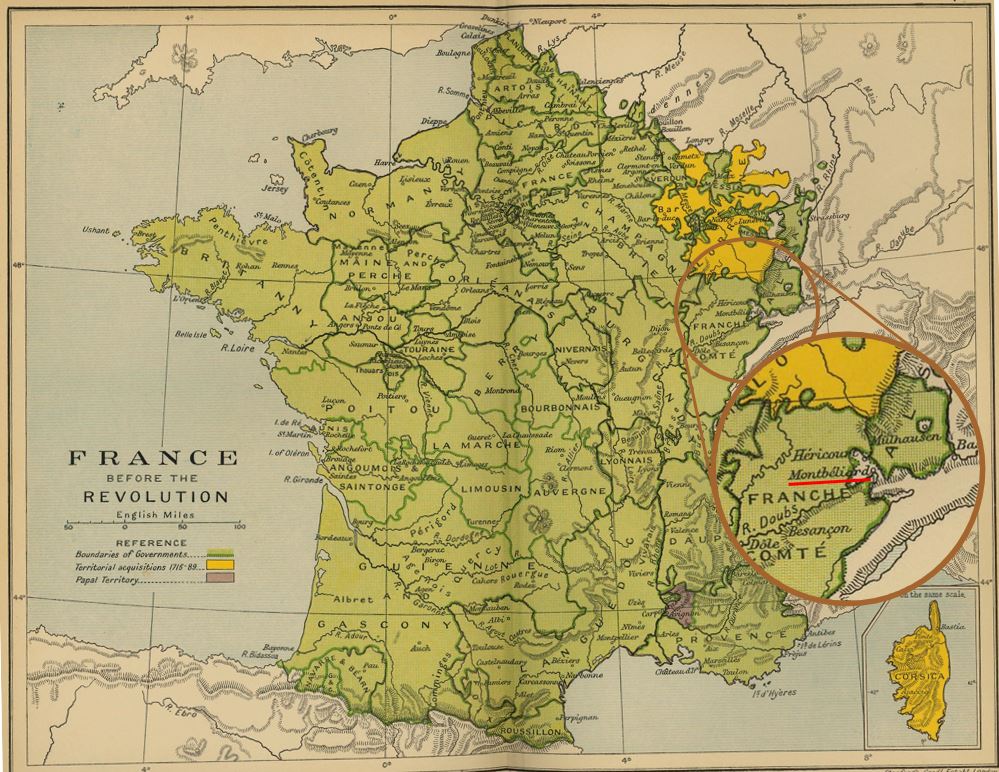
Being squeezed between the ambitious Holy Roman Empire and an expansionist France must have been a pressured existence. That was the case in the early 1700s for the small County of Montbeliard and the large Duchy of Lorraine. Let's have a look at where they are located, before moving on. The map below shows France in the 18th century, with the area containing Montbeliard enlarged and its location underlined. It is not a big place. Neighboring Lorraine, in yellow, is much larger.
The-Lovely-Lowly-Liard
France in the 1700s. Montbeliard underlined with red. Lorraine in yellow.
Source: From The Cambridge Modern History Atlas, 1912. Made available online by Emerson Kent.com. Edited by me.


Montbeliard is in numismatic literature often grouped with French feudalities, while Lorraine often is not. Both were formally part of the Holy Roman Empire since centuries, but pressure from France increased all the time. The French king - like many other kings - wanted to expand his domains. Lorraine, with many of its inhabitants speaking (a variant of) French and under French cultural influence, was an obvious target. Montbeliard was surrounded by Franche-Comte, and when that was taken over by France in 1678, Montbeliard in practice became a French dependency.

Montbeliard

Montbeliard formally belonged to the Holy Roman Empire and was ruled by the Duke of Württemberg, whose boss was indeed the Emperor. But, in the early 18th century, he was also completely dependent on the French king, since Montbeliard was in practice under French control and at the mercy of French troops in the surrounding Franche-Comte.

Montbeliard was a County but ruled by a Duke who was also a German Prince, so County of Montbeliard, Duchy of M., Principality of M., Princely County of M. are designations that all occur.

Squeezed in between Franche-Comte, the Holy Roman Empire, and Switzerland, and with influences from France and the city of Besançon, plus using its own local money, the monetary situation was complex with elements of chaos, at least seemingly so to an external observer. According to a document from 1578, the following relations applied: 1 livre = 1.25 franc (faible) = 12 batzen = 15 gros = 20 sols = 60 vierer = 30 grands blancs = 120 rappen = 240 deniers. In addition, 1 batzen = 4 kreuzer = 2-3 sols tournois, 1 thaler = 20 groschen = 60 kreuzer, and 1 gros fort = 4 blancs forts = 12 niquets!

The need for a liard on top of all this is perhaps not obvious, but here it is:

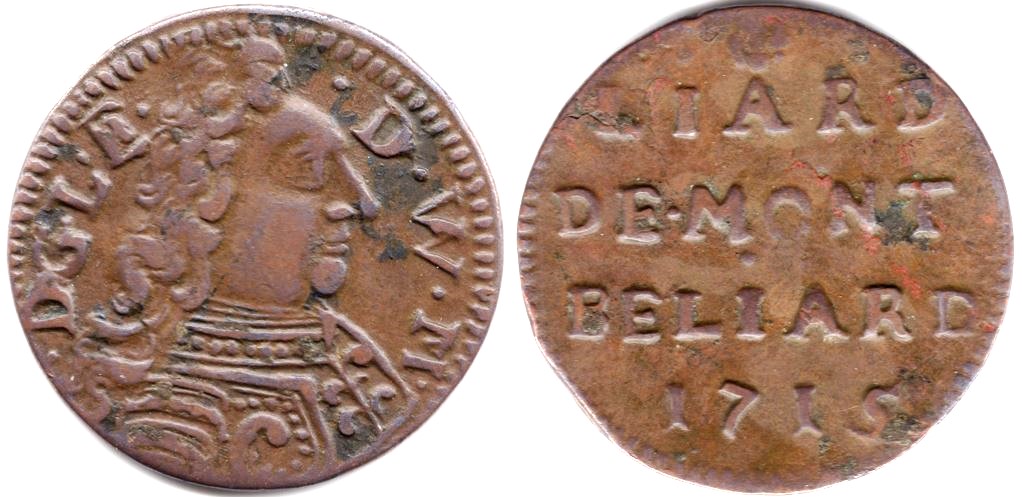
Liard (3 deniers tournois / ½ kreuzer), Montbeliard 1715, Leopold Eberhard of Württemberg-Montbeliard, Montbeliard. Copper. 3.30 g, 21 mm. DupFeod 3107.
The-Lovely-Lowly-Liard

Obverse: D G L E D W M (Dei Gratia Leopoldus Eberhardus Dux Wirtembergensis [et] Montisbelligardensis / By Grace of God Leopold Eberhard Duke of Württemberg and Montbeliard). Cuirassed bust of Leopold Eberhard.
Reverse: LIARD DE MONTBELIARD.

I generally have three criteria for a coin to make it into my collection: It should have some (preferably interesting) history associated with it, it should if possible be of XF or better quality, and, last but not least, it should possess a certain amount of beauty. As you have seen in previous Chapters here, I have had to compromise on quality in many cases when it comes to liards, some simply do not come in anything near XF, unless you are prepared to wait half a lifetime for that one survivor to hit the market. For the history part, I think all coins shown here meet that criterion. This one certainly does too, and its quality is ok for its type. But for beauty . . . I do wish old Leopold had engaged a more skilled die cutter . . .

The obverse inscription may win the prize, if not for most proportional and artistic performance, at least for most concise (or cryptic). Not much to say about the reverse. This is the way a liard is expected to look like at this point in time, apparently (but someone should have introduced the die cutter to the idea of using a punch for the letters). It is of course a bit funny that LIARD appears twice (it was one reason I could overlook the artistic shortcomings ).

The name Montbeliard intrigued me. I haven't been able to locate a Mount Beliard in the modern city surroundings. The name is believed to be derived from Latin Mons Biliardae, which means "log mountain" or "tree mountain". The Castle Montbeliard is located in the center of the city, on a hilltop which can hardly be called a mountain. The German name is Mömpelgard, which can mean either "mountain garden" or "mountain guard" (I have no source for that, apart from that Mömpel is most likely derived from Mons, and gard or gart - both forms are used in old texts - is old German for both garden and guard/soldier).

Montbeliard was definitely taken over by France in 1796 and the duke renounced all rights to it, and that was the end of the title of Count of Montbeliard.

Lorraine

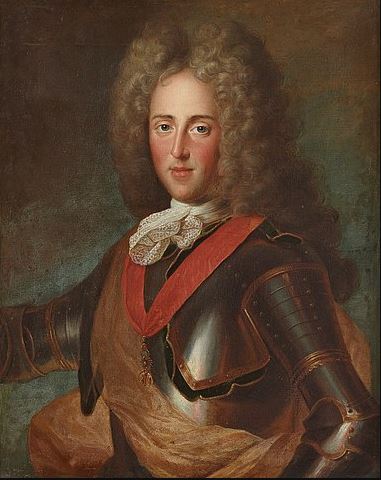
In Chapter 11 I showed a billon liard from Lorraine which I could only date to the wide span of 1545-1608. Like everyone else, Lorraine moved to copper, and my next coin is clearly dated 1706. During the hundred years in between the two, Lorraine was torn between its two surrounding superpowers, France and the Holy Roman Empire. France occupied the duchy for a good deal of the 17th century, forcing the duke into exile. The Thirty Years' War 1618-1648, with armies marching back and forth and leaving devastation behind them, didn't make things better either. Eventually, the French troops left in 1697 and Leopold I was installed as Duke. He was great-great-grandson of Charles III (the long-reigning duke with the billon liard) and half nephew and godson of the Holy Roman Emperor and Archduke of Austria (whose name was also Leopold I; Leopold was a popular name those days . . .). Married to the niece of French king Louis XIV, he was well connected, to say the least. When his two mighty benefactors clashed in the War of the Spanish Succession in 1701, Leopold could, however, do little other than watch while French troops marched into Lorraine to "protect" it from Austrian aggression. The occupation was fairly peaceful, though, and Leopold could continue his rule.
The-Lovely-Lowly-Liard
Duke Leopold I of Lorraine.
Source: Painting by Pierre Gobert. Wikimedia Commons. Public domain.


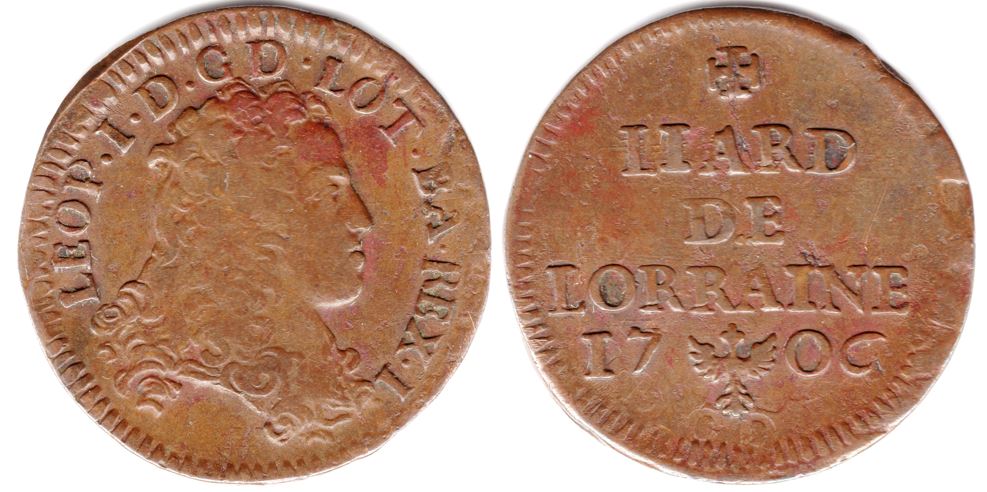
Liard (3 deniers tournois), Lorraine 1706, Leopold I, Nancy. Copper. 3.28 g, 22 mm.
The-Lovely-Lowly-Liard

Obverse: LEOP I D G D LOT BA REX I (Leopoldus I Dei Gratia Dux Lotharingiae [et] Barri Rex Ierusalem / Leopold I by Grace of God Duke of Lorraine and Bar, King of Jerusalem). Draped bust of Leopold I.
Reverse: LIARD DE LORRAINE. Cross potent above, alerion (eagle) below.

With the tight connections with France, Lorraine's monetary system was in principle aligned with the livre tournois (although at times the French king was dissatisfied with the quality of the duchy's coins). The design of the liard is perfectly in line with French liards, without being a copy. Interestingly, despite large mintages, it is hard to find these in good shape. One finds plenty of them on ebay at any given time, but I had to look for quite some time before I found one as nice as this one.

Bar, which Leopold points out he is duke of on the coin, was an old duchy, later incorporated into the duchy of Lorraine. (It was, by the way, for some time in the hands of the House of Montbeliard - the threads of European history are intertwined in intricate ways.) The title King of Jerusalem may raise an eyebrow, or two. The Kingdom of Jerusalem was founded in 1099 by leaders of the First Crusade and was dissolved in 1291. The title continued to be used by descendants, real and imagined, and was also traded to add to the confusion. Leopold was fond of the idea of being able to style himself as king, so he made use of the family's old claim to the title. The Jerusalem cross - a cross potent with four small crosses in its quadrants - or its simplified form of just a cross potent, occurs on many of Leopold's coins. Here it is found at the top on the reverse.

Lorraine was incorporated into France in 1766. Its existence as a duchy was over, but, like many other landless titles, the title of Duke of Lorraine has survived to the present day. Its present holder is Karl von Habsburg-Lothringen, who is a descendant of Leopold I. As a Habsburg, he has a list of titles more than a page long, and it still ends with "etc". Being king of Jerusalem is one of them, passed down from Leopold, but he does not put it on his business card (see Note 1). Present king Philip VI of Spain also carries the title King of Jerusalem, and he actually engages in the problems of the region (although of course he has no formal power).

The-Lovely-Lowly-Liard
Karl von Habsburg-Lothringen, current duke of Lorraine.
Source: Wikimedia Commons. Creative Commons Attribution-Share Alike 4.0 International license.


Turbulent Years to Come

The last decades of the 18th century were an eventful time in France. In 1789, the people rose up in a bloody revolution. As usual, we will have a look at what the liards looked like, before and after that turbulent event.

Notes

Note 1. The Habsburgs have renounced all claims to the thrones of Austria and Hungary, and it is illegal for them in those countries to make any use of their ancestral titles.

Moderator
Learn More...
jbuck's Avatar
United States
189462 Posts
 Posted 05/29/2024  2:15 pm  Show Profile   Bookmark this reply Add jbuck to your friends list Get a Link to this Reply
An fascinating chapter. Thank you again for sharing it and your examples.

I find it interesting that we still have some of these centuries old titles still being held.
Valued Member
Paul St Louis's Avatar
United States
127 Posts
 Posted 05/29/2024  4:00 pm  Show Profile   Bookmark this reply Add Paul St Louis to your friends list Get a Link to this Reply
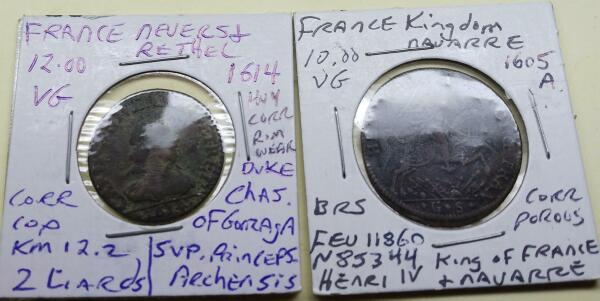
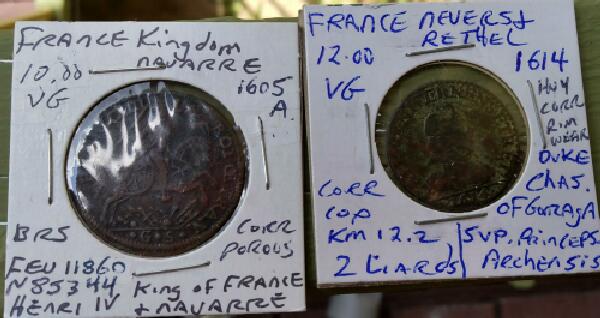
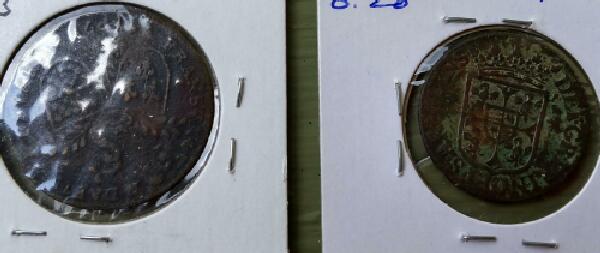
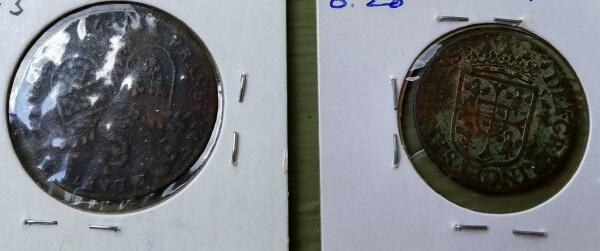
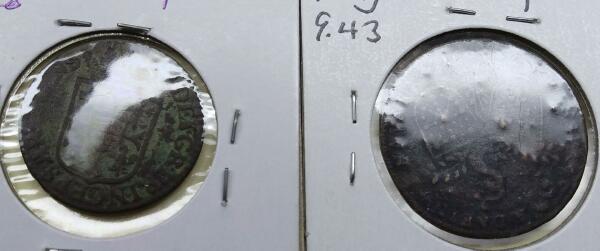
I have these that may be of interest, and also attached is one coin I am unable to identify. There is another one somewhere in my pile of unidentifiable coins that may be French 16th century, but am unable to locate it.

The-Lovely-Lowly-Liard
Pillar of the Community
Learn More...
erafjel's Avatar
Sweden
2124 Posts
 Posted 05/29/2024  6:22 pm  Show Profile   Bookmark this reply Add erafjel to your friends list Get a Link to this Reply
Thank you for contributing, Paul St Louis!

The "France 1605" is not a coin but a token of some kind, similar to this one: https://en.numista.com/catalogue/ex...ia32400.html

The last one (the unidentified one?) could be this trillina: https://en.numista.com/catalogue/pieces376591.html
Pillar of the Community
Learn More...
erafjel's Avatar
Sweden
2124 Posts
 Posted 05/29/2024  6:29 pm  Show Profile   Bookmark this reply Add erafjel to your friends list Get a Link to this Reply
Thank you, jbuck!

Quote:
I find it interesting that we still have some of these centuries old titles still being held.

Oh yes. Old duchies die hard.
Pillar of the Community
Russian Federation
5177 Posts
 Posted 05/29/2024  6:34 pm  Show Profile   Bookmark this reply Add january1may to your friends list Get a Link to this Reply

Quote:
The last one (the unidentified one?) could be this trillina
Yes, that's almost surely it. More definite image at the bottom of this page: https://www.forumancientcoins.com/m...lan_pt05.htm

Ironically enough, a trillina is a 3 denari coin, so kind of topical, I guess
[EDIT: I see it's been mentioned in the 3rd part of the introduction.]
Edited by january1may
05/29/2024 6:35 pm
  Previous TopicReplies: 163 / Views: 7,129Next Topic
Page: of 11

To participate in the forum you must log in or register.


Disclaimer: While a tremendous amount of effort goes into ensuring the accuracy of the information contained in this site, Coin Community assumes no liability for errors. Copyright 2005 - 2026 Coin Community Family- all rights reserved worldwide. Use of any images or content on this website without prior written permission of Coin Community or the original lender is strictly prohibited.
Contact Us  |  Advertise Here  |  Privacy Policy / Terms of Use

Coin Community Forum © 2005 - 2026 Coin Community Forums
It took 0.55 seconds to rattle this change. Forums