| Author |
 Replies: 163 / Views: 7,841 Replies: 163 / Views: 7,841 |
|
|
|
Moderator
 United States
196320 Posts |
Quote:
Thank you, I will! I am going to "time travel" 45 years back in time and meet with my fellow high school graduates. I hope you had a great time! I have yet to attend any high school reunion. 37 years on and zero desire. I see those people on FB and remember why I prefer to decline invitation.  Nice example, tdziemia!  Quote:
I grinned at the "altitude" on the screen: - 6 feet.  Quote:
You know, I think we can stretch the scope to include liard multiples, without risking overloading the thread with posts . I have noticed that they are often nicer looking than the single liards. So please do show us what Philip V looked like!  |
|
Pillar of the Community
  Sweden
2124 Posts |
Yes, jbuck, I had a good weekend back in my home town, meeting with old friends again (it wasn't the first reunion of this kind, and they are always a fun experience).
While hoping to soon see tdziemia's double liard, let's continue with some other Low Countries! Next Chapter coming up!
|
|
Moderator
United States
196320 Posts |
Quote:
While hoping to soon see tdziemia's double liard, let's continue with some other Low Countries! Next Chapter coming up!  |
|
Pillar of the Community
Sweden
2124 Posts |
CHAPTER 21: Holy Roman Copper
= Mid 17th Century =Well, we had holy billon in the 1500s (Chapters 11- 12), now in the 1600s it is the more modern holy copper.  Joking aside, while the southern Low Countries remained as the Spanish Netherlands and the northern dittos were now the Dutch Republic, there were also a number of Low Countries that did not belong to either. The County of Gronsveld, the Duchy of Cleves, the Prince-Bishopric of Liège, the County of Reckheim, the Princely Abbey of Stavelot-Malmedy, the Principality of Thorn, the County of Culemborg, and several others, were directly under the Holy Roman Emperor. They had never been part of the Habsburg Netherlands and for most their status did not change as a result of the Dutch Revolt (although they could be affected by the hostilities during the revolt). A few were eventually absorbed by the Dutch Republic, but most remained until the 1790s, when they fell under the expansionist France. (In the Duchy of Cleves, it was the town of Huissen that issued local coins. In addition, the former free imperial city of Nijmegen, since 1543 belonging to the Spanish Netherlands, used its ancient minting rights to issue local coins during the Dutch Revolt). The lands I listed above are those that issued liards or oorden. Most of the early ones - late 16th and early 17th century - are hard to find in decent condition, so I will show only two later examples, from two of the lands. If you have any liards/oorden from any of these Holy Roman lands, please do show!A Different LiardThe two lands I show liards from here are Liège and Stavelot-Malmedy. Both used the Liège liard, or liard liegeois (see Note 1), and before going into the details of the specific coins, the denomination itself is worthy of a few words. Before 1600, the florin liegeois was used. It was divided into 20 patards or aidants or liards (liegeois). At the same time, the exchange rate to the Brabant florin was four florins liegeois to one Brabant florin. In 1600, the standard florin was changed to be the Brabant florin, but to point out that it was a Liège denomination, it was called florin Brabant-Liège. It was divided into 20 patards Brabant-Liège, with each patard divided into four aidants/liards liegeois. Thus the old liards were kept in the new system and with the 1:4 exchange rate for Brabant to Liège florins, resulting in 1 florin (Brabant-Liège) = 80 liards. Not too confusing, right? Then just let me point out that in addition to this, there was also a sol liegeois (or soz, different spellings abound), of which there were 24 on a liard. Yes, the Liège liard was subdivided into Liège sols, not the other way around. And, 20 sols liegeois equaled 1 livre liegeoise, which means that the liard was worth more than the livre! Fortunately, we can completely ignore that curiosity in the discussion here. (And I haven't even mentioned the gigots, mites, deniers, copes, and brûles which were also part of the system . . .) "Aidant"?One thing puzzles me: Why were the Liège liards called "aidants"? In contemporary texts the name is used as a synonym for patard and liard, as if self-evident and without explanation. It translates to "helping" or "helper", but that doesn't help . I have spent several hours searching, without finding a conclusive answer (see Note 2). I also let ChatGPT have a shot at it, which was somewhat amusing (Note 3). If anyone knows the origin for the term "aidant", please share your knowledge!LiègeThe Prince-Bishopric of Liège was a large enclave in the Spanish Netherlands (see map). It was an ecclesiastical principality of the Holy Roman Empire, with its prince-bishop being a full voting member of the Imperial Diet, an important imperial institution which we need not go into what it was here. Since 1583 it was the Archbishop of Cologne who had the seat of Prince-Bishop. 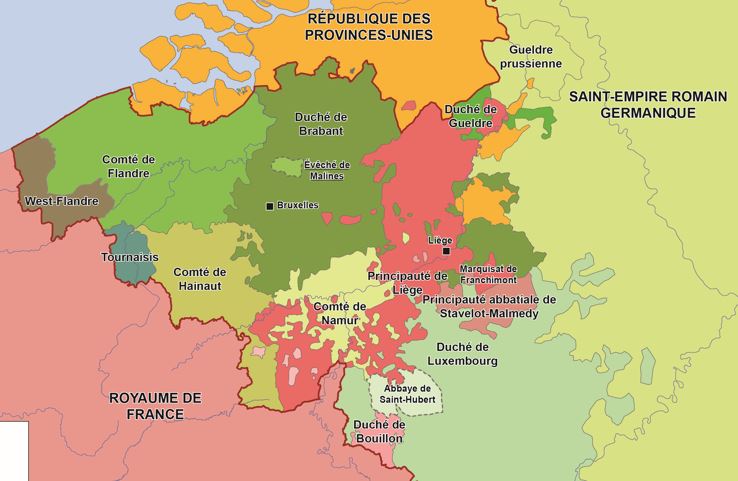 Principality of Liège (in pink), Stavelot-Malmedy and Bouillon (pale pink), in 1789. Principality of Liège (in pink), Stavelot-Malmedy and Bouillon (pale pink), in 1789.
Source: SEGEFA-Ulg & Institut Destree, connaitrelawallonie.wallonie.be (cropped).As mentioned above, Liège had its own monetary system, and it had a fairly rich coinage with denominations from tiny copper fractions to gold florins. Liards were minted more or less continually. Here is one from 1643: Liard "aidant", Liège 1643, Ferdinand of Bavaria, Hasselt (Loon). Copper. 3.02 g, 24.5 mm. 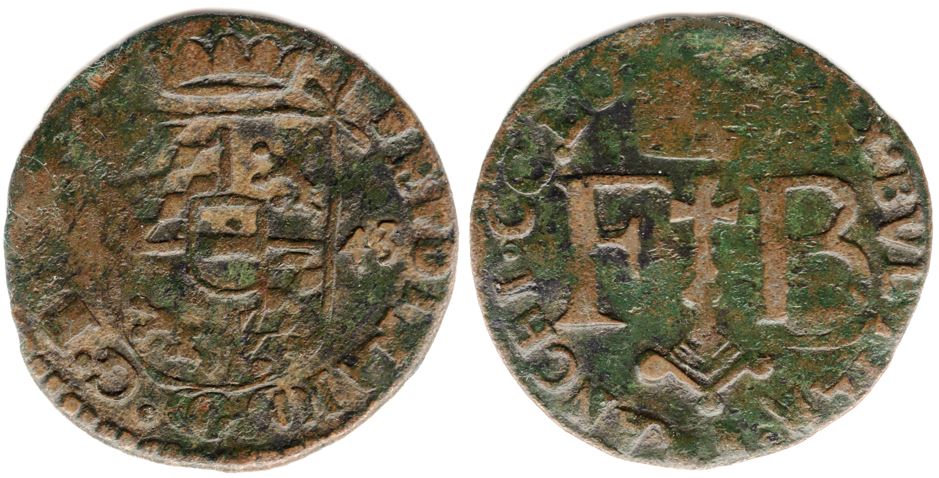 Obverse: FERDINAND D G E[P LEO] (Ferdinandus Dei Gratia Episcopus Leodiensis / Ferdinand by Grace of God Bishop of Liège). Coat of arms of Bavaria-Palatinate, heart shield with arms of the Duchy of Bouillon, crowned with electoral hat. Reverse: [DV]X BVL MAR FRANCHI CO LO (Dux Bulloniensis Marchionus Franchimontis Comes Lossensis / Duke of Bouillon, Marquis of Franchimont, Count of Loon). F B in field (Ferdinandus Bavariensis / Ferdinand of Bavaria). Electoral hat and perron of Liège. This coin is minted in the "other" Hasselt (the "first" being the Hasselt in Overijssel, where one of the oorden in Chapter 13 was minted). This Hasselt was located in the County of Loon, north of Liège and subordinated to its bishop (who was, in fact, Count of Loon himself, as the inscription points out). Ferdinand minted liards of this type in Hasselt, Liège, and Maaseik, and the way to tell them apart is by the presence or absence of bullets and rosettes and minor differences in the inscription. Parts of the inscription are gone, but the "F B" for Ferdinand of Bavaria has been pretty resistant to wear. Before saying more about him, let's spend a moment with that perron between the two big letters. At least I had to look up what a perron is (in Swedish it means train platform, and that's definitely not it!). There is a Wikipedia article about "Perron (columnar monument)", which is precisely what it is. It is apparently a (province of) Liège thing, with roots in Medieval times, symbolizing freedom and autonomy of the town where it was erected. Only the "Good Cities" (French Bonnes Villes, Dutch Goede Steden), towns important enough to be represented in the States of Liège, were allowed to have a perron. There were 23 such towns in 1651, including Hasselt and Maaseik, and Liège, of course. The perron shown on these coins looks very similar regardless of mint, and it is thought to always be the perron of Liège that is shown. A symbol of great significance, important enough to still be on Liège's city arms as well as being stylized in its official logo: 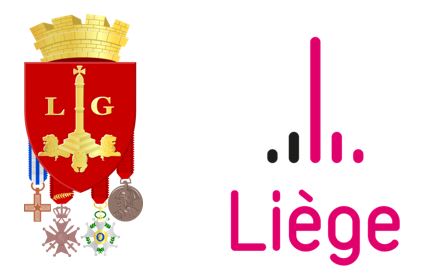 Liège city modern coat of arms and official logo. Liège city modern coat of arms and official logo.
Source: Wikimedia commons. Creative Commons Attribution-Share Alike 3.0 Unported license (coat of arms) respectively Public domain (logo).And it still stands - rebuilt after having been knocked over by a violent storm in 1693 - at the Place du Marche: 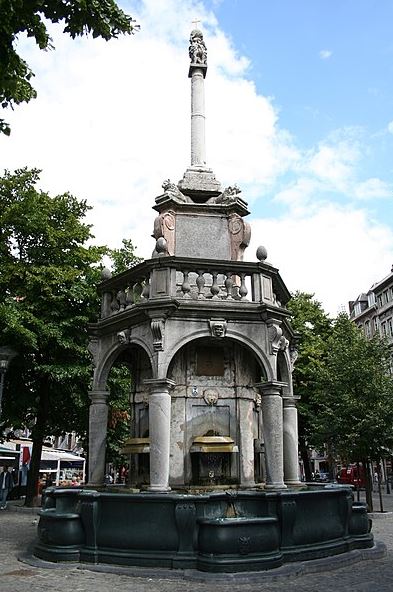 The Liège perron today. The Liège perron today.
Source: Wikimedia commons, photo by Jean-Pol Grandmont. Creative Commons Attribution-Share Alike 3.0 Unported license.
Now over to Ferdie! Born into the House of Wittelsbach, with plenty of royal blood in his veins, he had a life filled with titular duties: Archbishop-Elector of Cologne, Prince-Bishop of Liège, Hildesheim, Münster and Paderborn, Prince-Provost of Berchtesgaden, Prince-Abbot of Stavelot and Malmedy, Archchancellor of Italy, Duke of Westphalia, Marquis of Franchimont, Count of Logne, of Loon and of Horne, and a few others. He used the title Duke of Bavaria as well, although that belonged to his brother Maximilian. Duke of Bouillon was a hereditary claim, since technically the duchy was subject to the Principality of Liège, but in 1492 the title had been claimed by Robert de la Marck, brother of Liège bishop erard de la Marck. When Ferdinand became "Duke of Bouillon" in 1612, the duchy was held by Duke Henry de La Tour d'Auvergne (a liard of his will show up in Chapter 23). Elector was one of the highest positions in the Empire; there were only seven appointed, and their role was to elect a new emperor, when needed. As shown on both sides of the coin, that required a special hat! One can see better what it looks like in the picture below. 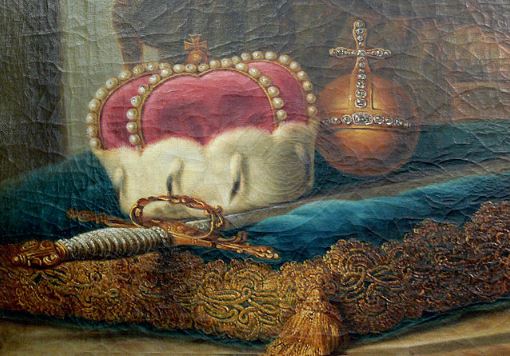 Electoral hat from the 18th century. Electoral hat from the 18th century.
Source: Detail of a 1781 painting by Brandt of Charles Theodore, Elector of Bavaria. Wikimedia Commons. Public domain.Despite the many ecclesiastical titles, Ferdinand was never ordained, and he appointed auxiliary bishops to carry out the religious duties. As for being the abbot of the Stavelot and Malmedy monasteries, he was one in a series of absent abbots, and it is unknown whether he ever visited his "workplace". 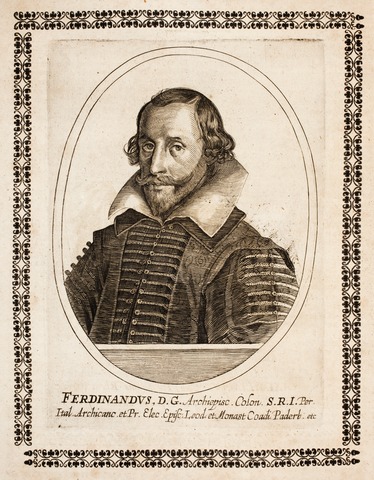 Ferdinand of Bavaria. Copperplate engraving, 1642. Ferdinand of Bavaria. Copperplate engraving, 1642.
Source: Wikimedia Commons. Public domain.You may, by the way, remember the name Wittelsbach from Chapter 18, where there was a Maximilian II Emanuel of the House of Wittelsbach. He was the grandson of Ferdinand's brother Maximilian I. Stavelot-MalmedyThe Princely Abbey of Stavelot-Malmedy, founded in the 7th century and bordering the much larger Prince-Bishopric of Liège, was also an ecclesiastical principality of the Holy Roman Empire. It had the same imperial status as its "big brother" Liège and was, although remembered by few today, not an unimportant entity in its time. Not a bad advancement in the 1,000 years since the establishment of a monastery in the Ardennes Forest, at "a place of horror and solitary isolation which abounds with wild beasts" according to contemporary sources. The abbey's coinage was not very extensive, but liards were minted 1643-1650. Liard "aidant", Stavelot-Malmedy 1643-1650, Ferdinand of Bavaria, Louveigne? Copper. 4.50 g, 24 mm. 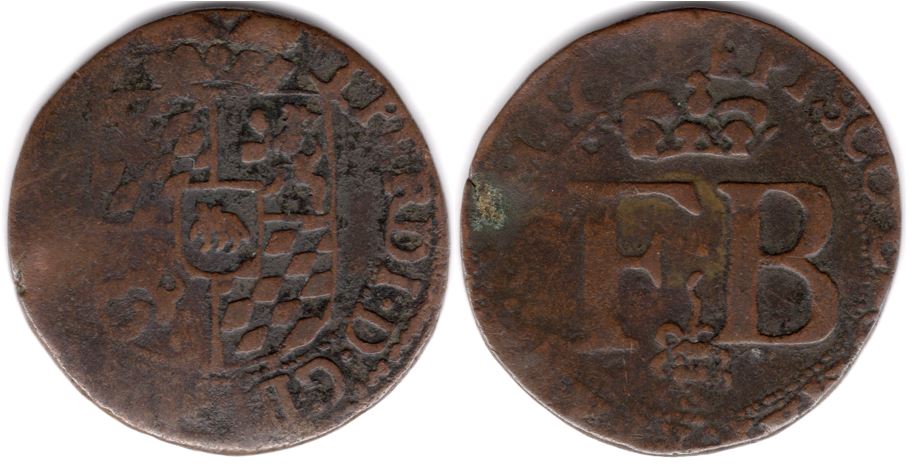 Obverse: FERDI D G E[LEC COL PRI STA] (Ferdinandus Dei Gratia Elector Coloniensis Princeps Stabulensis / Ferdinand by Grace of God Elector of Cologne, Prince of Stavelot). Coat of arms of Bavaria-Palatinate, heart shield with arms of Stavelot (wolf), crowned with electoral hat. Reverse: EPISCO L[EO MAR FRANC CO]M LO[N] (Episcopus Leodiensis Marchionis Franchimontis Comes Longianus / Bishop of Liège, Marquis of Franchimont, Count of Logne). F B in field (Ferdinandus Bavariensis / Ferdinand of Bavaria). Electoral hat and Medusa head (symbol for the County of Logne, mintmark for Louveigne?). It has had a rough life, this liard, with some hard hits along the way (literally, as it looks). The bishop of Liège was by default also abbot of Stavelot-Malmedy, so again we find Ferdinand's name and selected titles on this coin (which also looks almost identical to its Liège counterpart). The Stavelot-Malmedy coin production was distinctly intermittent. The need for coinage was likely covered by using the coins of Liège, which looked very similar and had the same denominations. When Ferdinand acceded to his posts in 1612, a range of somewhat larger denominations were issued for Stavelot-Malmedy, in small numbers. After that, no more coins were issued until the liards of 1643. They, on the other hand, were minted in large numbers (yet, they are difficult to find in anything but lousy condition). An additional mint was opened in Louveigne, besides the "regular" one in the town of Stavelot. Besides the liards featuring the Medusa head, there are others with a perron. It is a theory that the Medusa head is a mintmark for Louveigne (situated in the County of Logne, which has the Medusa head as a symbol) and the perron is a mintmark for Stavelot (where there is a perron, albeit not looking like the one on the coins, that one looks more like the perron of Liège). Next time: More from LiègeWe are not quite done with the Holy Roman Low Countries. One more coin to show, also from the Bishopric of Liège, but a 100 years later. It is in fact one of the last coins minted there. NotesNote 1. Liege, Liege, or Liège? The use of an accent in Liège has changed over time and may cause confusion when looking at documents from different time periods. Before the 18th century, the normal spelling was Liege (no accent). Then the spelling Liege (acute accent) began to be used and in 1880 it became the official spelling. In 1946 that was changed to Liège (grave accent), which remains the modern spelling. Liegeois(e) ("from Liège", ends with -e for things of feminine gender) is a different matter, there the accent is acute, never grave (and in older texts often absent). I will consistently write Liège and liegeois(e) in this text, even if that strictly speaking leads to some anachronisms. Note 2. I tried many combinations of Internet search terms and found lots of interesting information, but not the answer I was looking for. I found good works about the numismatics of Liège by Frère from the 1960s and by de Chestret from the 19th century, I found an online version of a Traite Historique et Methodique . . . des Anciennes Monnoies by a notary of Liège from 1758 (the Internet is fantastic!). They all use the term "aidant" but none tries to explain it. The work by de Chestret quotes original edicts about coinage from the 16th century, in which the term was used as if self-evident already then. I reached out to CCF, but no one (at that time) seemed to have an idea. But I got the suggestion to contact the experts at the Belgian auction firm Jean Elsen, who specializes in Low Countries coinage, and I did, but their kind reply was that they unfortunately had no information about the origin of the term. Note 3. I asked ChatGPT why patards/liards were also called "aidants" in 16th century Liège, to see if it knew anything about the subject. I got a speculative answer about the liards probably being called "helpers", since small change like that helped facilitate daily transactions. Perhaps there is some truth to it, in that this small denomination was what helped the poor through their day. But then why wasn't the even smaller brûle called "aidant"? When asking in French - thinking any documents concerning the subject and which ChatGPT has been trained on, would likely be in French - I got a more interesting, if not so truthful, "answer" (translated from French): In the 16th century, the term "aidant" was used to refer to the patard or liard in Liège because of its role in the art of pyrotechnics. The liard in Liège was used as a primer to ignite gunpowder. The fact that it "helped" light the gunpowder probably led to its nickname "helper".
|
|
Moderator
United States
196320 Posts |
A rich and informative chapter! I took a long pause at mention of the Duchy of Cleves, pondering the fourth wife of Henry VIII... divorced, beheaded, died, divorced, beheaded, survived. But I digress...  I appears Ferdinand wore many hats, but it was interesting to see the literal hat as depicted on your nice example coin. As for my opinion on aidant, I will accept the ChatGPT answer as plausible, even if it has a whiff of urban legend to it. |
|
Pillar of the Community
Sweden
2124 Posts |
Thanks jbuck! Yes, it was a rather long post, next chapter will be more brief.
|
|
Pillar of the Community
Sweden
2124 Posts |
CHAPTER 22: More Copper From Liège
= 1750 =Moving forward a 100 years from the Liège coin in the previous Chapter. Liège is still a Principality, with a Prince-Bishop, still from the House of Wittelsbach. His name is Johann Theodor (of Bavaria), and he is the son of Maximilian II Emanuel (who had a Namur liard in Chapter 18), whose father's uncle was Ferdinand of Bavaria (who had the Liège liard in the previous Chapter). Johann is not Archbishop of Cologne, though, that post went to his brother Clemens. All kept in the family. Generally, the 18th century is better than the 17th for Liège. Uncle Ferdinand had to deal with the Thirty Years' War, from which the principality did not go unscathed although it was spared the worst atrocities. The second half of the century saw more war, tensions, and revolts, but we shall not go further into that here. The 18th century was, in comparison at least, a time of peace and prosperity. Things got better. Not least on the minting side, as my next liard illustrates. It looks so much better than the earlier ones; the technological advancements with milling and improved presses certainly show. Liard, Liège 1750, Johann Theodor of Bavaria, Liège. Copper. 3.61 g, 23 mm. 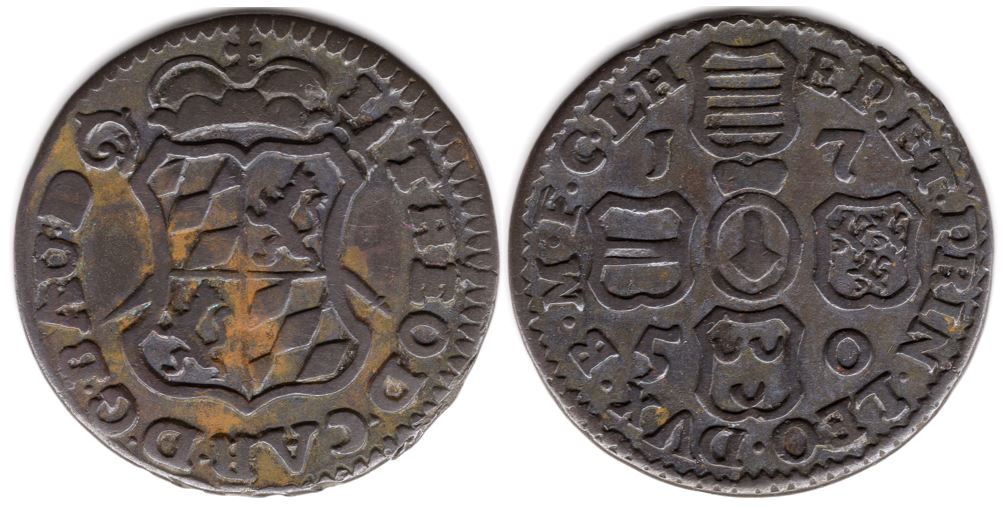 Obverse: I THEOD CAR D G BAU D (Iohannes Theodorus Cardinalis Dei Gratia Bavaria Dux / Cardinal Johann Theodor by Grace of God Duke of Bavaria). Coat of arms of Bavaria-Palatinate over crossed sword and bishop's staff and crowned with electoral hat. Reverse: EP ET PRIN LEO DUX B M F C L H (Episcopus et Princeps Leodiensis Dux Bulloniensis Marchionus Franchimontis Comes Lossensis Hornensis / Prince-Bishop of Liège, Duke of Bouillon, Marquis of Franchimont, Count of Loon and Horne). Arms for Loon (top), Bouillon (left), Liège (center, below electoral hat), Franchimont (right), Horne (bottom). Somewhere on the way it seems the name "aidant" has faded away and become (I think) purely a money of account. Otherwise, there is not that much to say about this liard. We can note that the Liège perron is still present, tiny but visible on the Liège arms at the center of the reverse. We can also note that Johann liberally makes use of titles, some of which belong to his relatives rather than himself. As usual among the Wittelsbachs, he styles himself Duke of Bavaria, although it is his nephew who has that title. The electoral hat that sits on his coins, he would have loved to have on his head, but it sat on the head of his brother, the Archbishop of Cologne. (He did apply for the post when his brother Clemens died in 1761, but was rejected by the Pope, who had doubts about Johann's moral conduct.) Although Johnny's coins looked nice, they tended to be underweight and of lower fineness than prescribed (we are talking higher denominations here). Minted in large numbers they spread into the Dutch Republic and the Austrian Netherlands, which led to protests. In the end, the Aulic Council in Vienna (the supreme court of the Holy Roman Empire that dealt with feudal affairs) ordered Johann to cease minting, in 1754. There are Liège coins of later date, but only with tiny mintage figures, and intended for ceremonial purposes. Next time: Back to the French FeudalitiesAfter having spent quite some time in the Low Countries, it is time to return to the French feudal states, where copper reached before it reached France itself. With this Chapter, I leave the Low Countries for a while, not to return until Chapter 29 and the Austrian Netherlands. Until then, we shall spend time in France and nearby lands. But before going there, let's take a break, a day or two. Do post your own liards and oorden, or multiples thereof!
|
|
Moderator
United States
196320 Posts |
Brief indeed, but still interesting and a nice example. |
|
Pillar of the Community
United States
8056 Posts |
First, here is the 2 liard coin of 1709 from the County of Namur (Spanish Netherlands) with a portrait of Philip V which I mentioned earlier. To me an example of a copper coin where a bit of green corrosion does not really detract from the aesthetics of the coin (because it is evenly distributed): 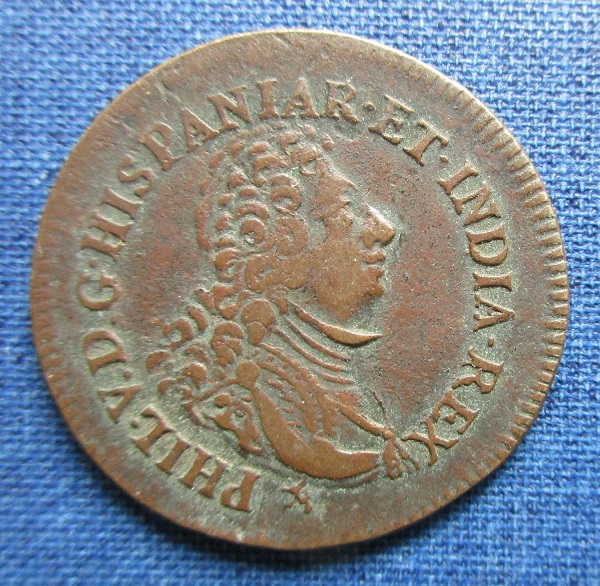 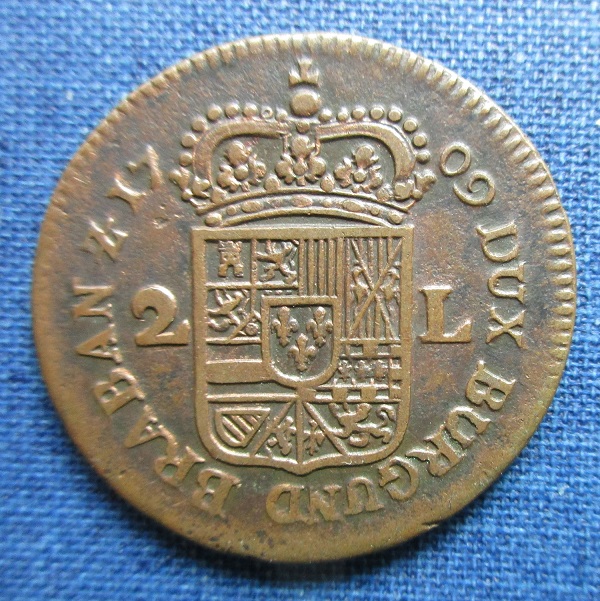 Next, on Liege and its "perron," I recall from contributions to the medieval part of Numista's Liege section, that the perron has appeared on Liege coins since at least the late 1100s: https://en.numista.com/catalogue/pieces307780.htmlAs always, wonderful to read, AND very nice coins, in particular the 17th century Liege for which attractive examples are hard to find (I guess most of them helped too much at whatever they were helping with . Finally ... There are probably more elegant contributions from Liege to the culinary world, but as we enter this year's garden vegetable season I will sing the praises of the Salade Liegeoise, a warm salad made from potatoes, green beans, sauteed shallots or onions, and bacon or (my choice) smoked ham, with a light vinaigrette. For most of July and August I have green beans from my garden in the fridge as the starting point (if the deer don;t get them first as they did last year), so if there are some leftover boiled potatoes hanging around, this will likely be my lunch the next day. https://belgianfoodie.com/salade-li...s-and-bacon/Edited by tdziemia
05/24/2024 07:49 am
|
|
Moderator
United States
196320 Posts |
Quote:
First, here is the 2 liard coin of 1709 from the County of Namur (Spanish Netherlands) with a portrait of Philip V which I mentioned earlier. Very nice! |
|
Pillar of the Community
Sweden
2124 Posts |
A super lovely coin, some Liège history, and a salad! What a diverse and excellent contribution, @tdziemia, thank you! That coin has a nice patina, I agree. A luxury to have green beans from one's own garden! I have only herbs in mine, the oregano thrives (I could use oregano in everything I cook without running out of it). I will definitely try that salade liègoise, now that the new potatoes are available, it looks delicious (maybe spice it up with a bit of oregano . . .  ). |
|
Pillar of the Community
Sweden
2124 Posts |
CHAPTER 23: First French Coppers
= Early 17th Century =The Low Countries were first with pure copper coins for the small denominations, in its corner of Europe. The very smallest ( duiten and double mites) came already in the beginning of the 16th century, and liards/oorden in the 1570s. In the French area, it was the Principality of Dombes that was first with copper: its deniers and double deniers saw the light of day in 1576. France itself followed the year after with the same denominations. For liards, the French feudality Arches-Charleville was first, in 1607, and soon after followed Sedan and Château-Regnault. All three were close to, or bordering, Liège and the Spanish Netherlands, and were no doubt inspired by the coinage from those countries. I show a liard from each of these three. Arches-CharlevilleThe Principality of Arches was created in beginning of the 17th century, around its newly established capital Charleville. It was a "spin-off" from the larger Duchy of Rethel and was ruled by the same duke, Charles I Gonzaga. A mint was built in the new town, and almost immediately Charles began to mint coins of all denominations, from deniers to gold ecus. The mint used modern equipment with milling and mechanical presses ( balanciers), so the quality of the coins was good. The first engraver's artistic skill, however, had obvious limitations (you can see an example of his work here). He was soon replaced by Nicolas Briot, who was also employed as royal engraver in Paris, and then the duke's portrait left nothing to be desired. Just have a look at this lovely liard: Liard (3 deniers tournois), Arches-Charleville 1609, Charles I Gonzaga, Charleville. Copper. 4.03 g, 25 mm. C2G 280. 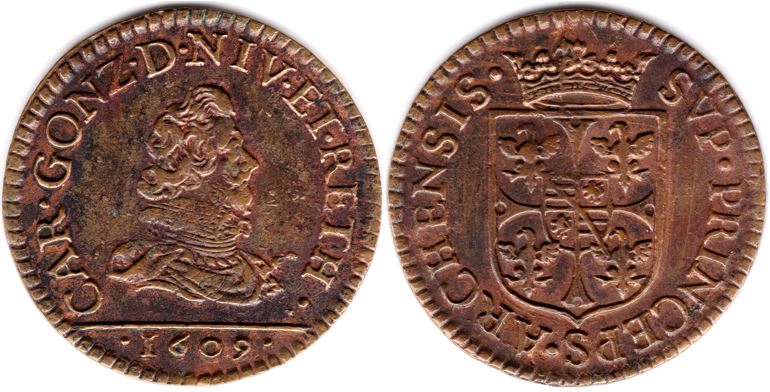 Obverse: CAR GONZ D NIV ET RETH (Carolus Gonzaga Dux Niver et Rethel / Charles Gonzaga Duke of Nevers and Rethel). Armored bust of Charles Gonzaga. Reverse: SVP PRINCEPS ARCHENSIS (Supremus Princeps Archensis / Supreme Prince of Arches). Crowned coat of arms of Charles Gonzaga. The main arms is for the Duchy of Mantua (where the Gonzagas were dukes; the title was held by Charles's cousin Vincenzo at this time): Four eagles parted by a Mantuan cross (or cross pattee). The heart shield in the middle shows the ancient and new arms for Gonzaga. Charles had good connections with the French royalty. He was a relative of French king Henry IV, was born in Paris by wealthy parents, and received an excellent education. He seems to have been a fan of laces, judging from his coin portrait and even more from this one: 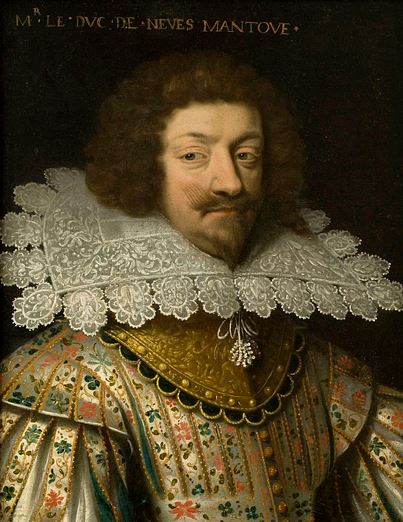 Charles I Gonzaga. Charles I Gonzaga.
Source: Painting by Daniel Dumonstier, ca 1620. Wikimedia Commons. Public domain.Coining money was a new thing for the duke, so he had to look for inspiration. It is close at hand to think he glanced at the liards from the neighboring Spanish Netherlands and at small coppers from France. The Tournai liard and the French double denier (which does not belong in this thread, but France hadn't started with copper liards yet) show the similarities in design. 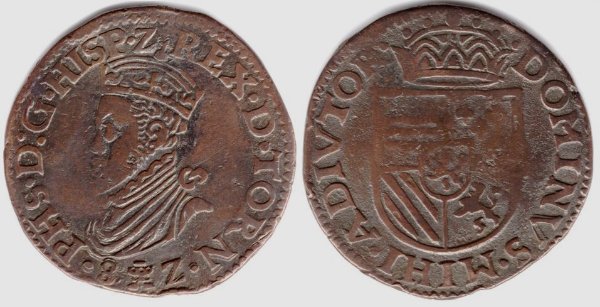 Liard, Tournai, Philip II. For full description, see Chapter 15. Liard, Tournai, Philip II. For full description, see Chapter 15.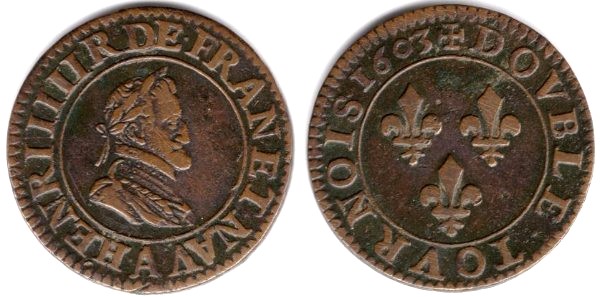 Double denier, France 1603, Henry IV.Château-Regnault Double denier, France 1603, Henry IV.Château-RegnaultAn hours bike ride north of Charleville lies Château-Regnault. The time on horseback in the early 1600s may have been something similar. With the horse stabled, you would then enter the castle on top of the hill in the river bend. The Lord of the Castle, François de Bourbon-Conti, bids you welcome and offers you to share his evening meal, before showing you his collection of liards from the nearby feudalities and Spanish provinces. 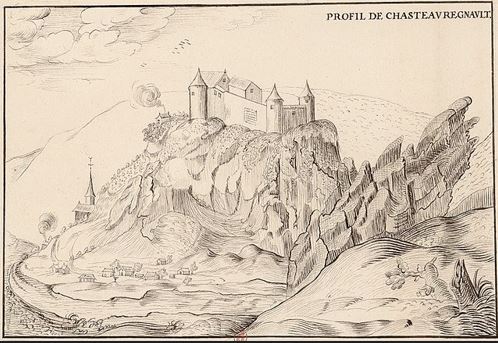 Château-Regnault 1640. Château-Regnault 1640.
Source: From Description du royaume de France by Gaston d'Orleans. Wikimedia Commons. Creative Commons Attribution-Share Alike 4.0 International license.If you arrive by bike 400 years later, not many traces remain of the castle. It was torn down towards the end of the 17th century and today there is a grassy field on the hill top. Here is what the lord's own liards look like: Liard (3 deniers tournois), Château-Regnault 1614, François de Bourbon, Château-Regnault. Copper. 4.34 g, 25 mm. C2G 294. 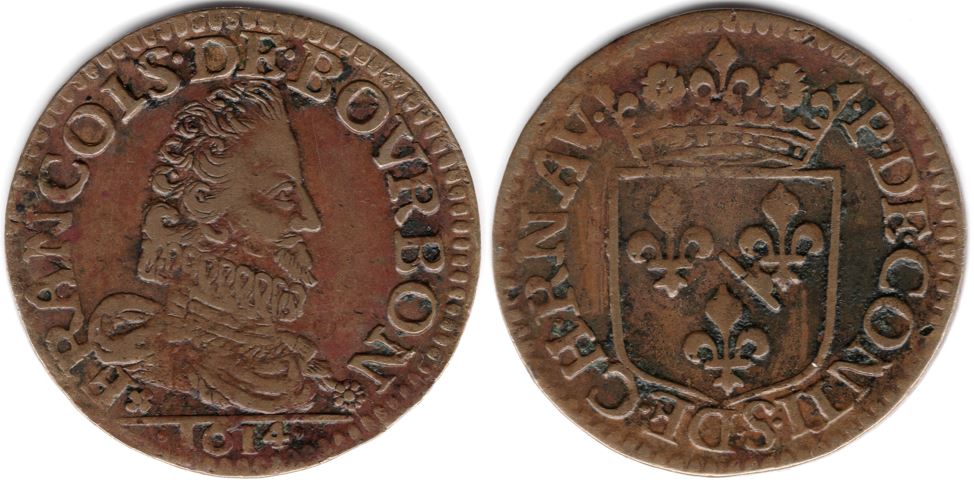 Obverse: FRANCOIS DE BOVRBON. Draped and cuirassed bust of François de Bourbon. Reverse: P DE CONTI S DE CH RNAV (Prince de Conti Souverain de Château Renaud / Prince of Conti, Sovereign of Château Regnault). Crowned coat of arms of François de Bourbon. François is a Bourbon prince, so just like the Bourbon kings, he uses three fleurs-de-lis in his coat of arms. The slanted bar signifies cadency, that is, he does not belong to the main line of Bourbons. The coin does look a lot like the Arches-Charleville liard. That is not just inspiration, it is also made by the same engraver, Nicolas Briot (who keeps himself busy these days). A final remark: On the coin, the castle is named "R(e)nau", and spellings like Renaud or Renault occur, not least in descriptions of coins from the feudality. The official spelling today is Regnault, and it is useful to be aware that there are a number of other castles all over France named Château Renaud (none of which has minted). SedanIf you instead go eastwards from Charleville, one hour by bike - or horse - brings you to the Principality of Sedan. In the beginning of the 17th century, it was ruled by Prince Henri de La Tour d'Auvergne (he also ruled the nearby Duchy of Bouillon and a couple of other small lands). He too minted liards with his portrait and coat of arms, confusingly similar to those of Arches-Charleville and Château-Regnault (and yes, it was Nicolas Briot who cut the dies here too). However nice looking they are, I think this one is more interesting: Liard (3 deniers tournois), Sedan 1615, Henri de La Tour d'Auvergne, Sedan. Copper. 3.12 g, 24 mm. C2G 326. 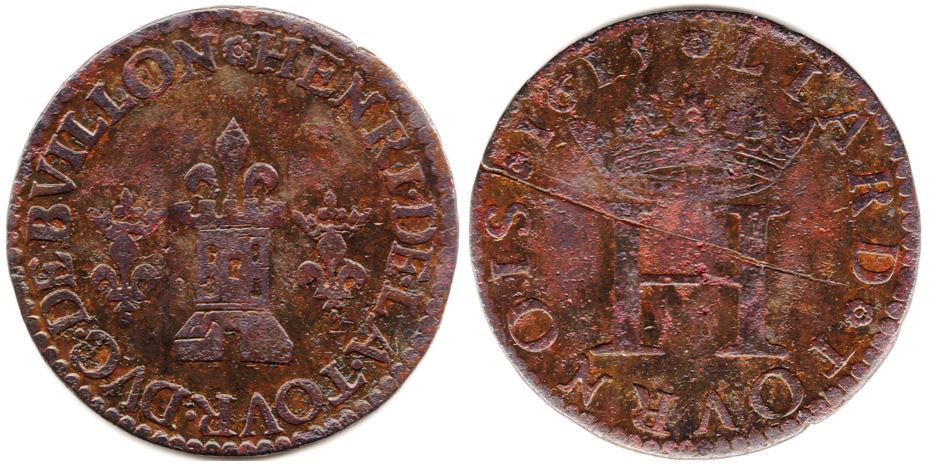 Obverse: HENRI DE LA TOVR DVC DE BVILLON (Henri de La Tour Duc de Buillon / Henri de La Tour Duke of Bouillon). Tower and two crowned fleurs-de-lis. Rose on top, mintmark for mint master Didier Briot. Reverse: LIARD TOVRNOIS. Crowned H for Henri. The tower and fleurs-de-lis are part of Henri de La Tour's (= tower) coat of arms. The interesting thing about this liard is that it is the first coin, anywhere as far as I know, that has the name "LIARD" on it. The reason for the radical design change was that French king Louis XIII had grown tired of the recurring low quality copies (and outright forgeries) that emanated from Sedan and the other feudalities, so in 1614 he forbade their use in France. This was mainly aimed at the higher denominations, for which all three feudalities mentioned here were involved in forging underweight silver and gold coins, but the liards and deniers were affected too. Following the design change, the liards were allowed in France again, but apparently without much success, as they were minted only during 1615. Finally, to get an idea of the size of these small principalities on the northern edge of France, here is a contemporary map. I have added (approximate) distance scales for miles and kilometers and underlined the towns of Sedan (in the center) and Charleville (top left). Sedan was not a big domain. 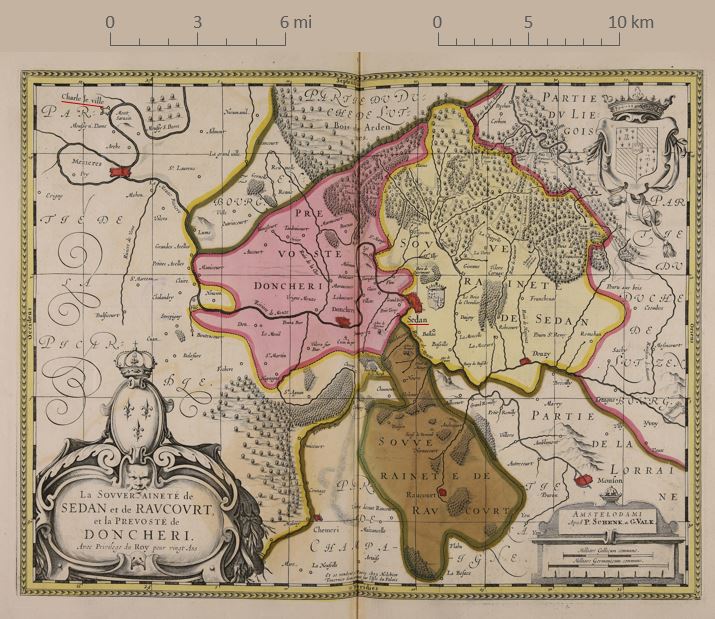 Map of the Principality of Sedan, etc, in the 1630s. Map of the Principality of Sedan, etc, in the 1630s.
Source: From a 1636 map by Jan Jansson, Amsterdam (with additions by me). Wikimedia Commons. Public domain.
Next Chapter: Vive Le Roi!There will be more liards from the French feudalities in Chapter 25, but first, we make a detour to France proper to see how they catch up on the copper trend.
|
|
Moderator
United States
196320 Posts |
Very fascinating! Tell me I am not the only one whose wandering brain conjured images of a Renault sedan. It is nice to see LIARD appear on an actual coin. |
|
Pillar of the Community
Sweden
2124 Posts |
Quote:
Tell me I am not the only one whose wandering brain conjured images of a Renault sedan. |
|
Pillar of the Community
Sweden
2124 Posts |
CHAPTER 24: The Sun King's Coppers
= Late 17th Century =
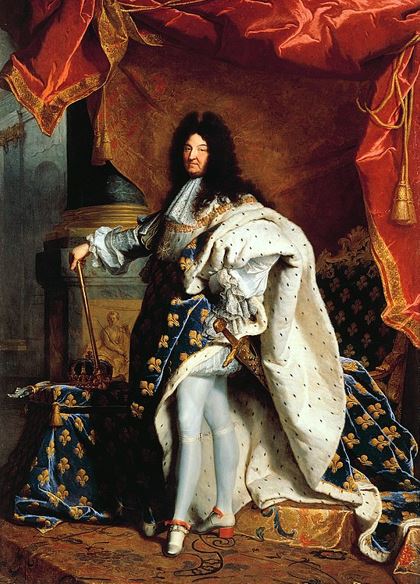
King Louis XIV of France in 1700.
Source: Painting by Hyacinthe Rigaud. Wikimedia Commons. Public domain.Louis XIV became king of France in 1643, at the age of 4, when his father, Louis XIII, died from illness only 42 years old. He would sit on the throne of France for 72 years, until 1715. A long reign that I will not try to summarize. Of interest here is that he introduced the copper liard, a fact that is often overshadowed by other deeds, like building the Versailles castle and such. While not remembered as the Copper King, that is how he will be portrayed in this post, literally. The last regular billon liard in France was minted in 1601 (see Note 1). You find it in Chapter 7, if you want to have a look at it. Testing the Market, The First Royal Copper Liard"Louis by the grace of God, king of France and of Navarre, to all who will see these letters, greetings. The kings, our predecessors having made for the convenience of commerce pieces of liards of billon . . . this manufacturing having been recognized as dangerous, as a consequence of the easiness there is to alter their fineness, and which our neighbors counterfeit and bring to France those that are nothing but whitened copper, and by these means make a great gain on aforesaid pieces. . . . this piece finds itself so useful for the small commerce and for giving alms, so that in the largest part of the provinces in our kingdom, our subjects receive and use daily those that are brought by the foreign princes while not having any more of those made at our Mints, those having in part been melted to take their silver, and in part lost due to the smallness of the piece, giving an opportunity to masters of those foreign mints to manufacture them again and bring them to France, which is an abuse that must no longer be tolerated.
. . . we have hereby signed by our hand, and having said and ordered, we say and order, it is our wish and such is our pleasure that there shall be manufactured at the workshops of our Mints or other places more convenient as needed, pieces of liards of pure copper and without blend with silver . . . and having a value in our kingdom, countries, lands and lordships of our obedience of three deniers tournois . . ."From the decree issued by Louis XIV, in 1649. Not bad for a 10 year old. He summarizes the situation and need for new coins well, albeit in a somewhat convoluted language. While useful for the daily small commerce and alms-giving, minting of billon liards ceased because they were drawn from the market into the melting pots of "foreign princes". Keeping the silver, they minted lookalike liards of the remaining copper and passed them on to unsuspecting, or at least illiterate, good Frenchmen. The Dombes liards in Chapter 9 are good examples of the coins the king was referring to. Any liards not meeting that fate, were easily lost due their tininess (the 1600 liard in Chapter 7 weighs less than a gram and fits on a fingernail). The making of a larger piece, out of pure copper, was the remedy. A number of pattern coins were made, but here is the first result that reached the public. Liard "with crowned L" (3 deniers tournois), France 1654, Louis XIV, Corbeil. Copper. 3.78 g, 22 mm. Dup 1587, C2G 14.  Obverse: LOVIS XIIII ROY DE FRAN ET NA (Louis XIIII Roi de France et Navarre / Louis XIV King of France and Navarre). Louis XIV, crowned, draped and cuirassed. Reverse: LIARD DE FRANCE. Crowned L between two fleurs-de-lis. 'A' at bottom, mintmark for Corbeil. This is actually a pattern coin too, but with a mintage of around 4,000-5,000 and apparently put into circulation. It was probably a test to see how it would be received by the public. With a nominal weight of 4.1 g and a diameter of 22 mm it is considerably heavier and larger than the billon liard from 1600, so not so easily lost. The design has similarities to the 1600 liard, that one having a crowned H surrounded by fleurs-de-lis. A portrait of the king is a novelty for liards, but for the single and double deniers that has been the rule for long by this time. The name LIARD now appears for the first time on a coin minted by the French king. Some of the preceding patterns had the denomination "3 deniers" stated on the coin, but as we shall see soon, omitting the actual value turned out to be useful. The mintmark 'A' usually stands for Paris. There was however unrest in the capital, caused by the Fronde, the civil wars that followed after the Thirty Years' War ended in 1648, so the mint had been moved to Corbeil a bit south of Paris. A Definite Young LouisIt seems strange that copper liards had not been introduced earlier, considering that deniers and double deniers in copper had been around for long. Also, as we saw in the previous Chapter, the northern principalities had already, more or less, shown what they could look like. My guess is that up until the 1640s, the need for small denominations was covered by the deniers and double deniers, even though the next higher (readily available) denominations were 12 and 15 deniers. A certain lack of copper for minting - copper was needed for the many wars France participated in, not least the Thirty Years' War, in which France took part 1635-1648 - may have played a part. In the 1640s, deniers and doubles were being phased out, as their value was becoming too small to be useful. The last denier was minted in 1649. A three denier coin would be the smallest useful denomination, and it could not be made of billon due to the problems with copying and falsification mentioned above. So, the need for a three denier copper coin became more urgent. Once that decision was taken - and the unrest caused by the Fronde was out of the way - an ambitious program was launched. Some ten new mints were set up across the country to mint only the new liards (the existing mints would continue to mint the higher denominations). They were sometimes located in small places that had not previously had a mint, like Corbeil and Vimy. French mints had a letter as mintmark ('A' for Paris, 'D' for Lyon, for example), but the new mints did not get their own letter, instead they used the letter of the nearest regular mint. Thus Corbeil, near Paris, used 'A', and Vimy, near Lyon, used 'D'. The definite type had the same portrait as the pattern but a different reverse: Liard "with juvenile bust" (3 deniers tournois), France 1656, Louis XIV, Limoges. Copper. 4.38 g, 22 mm. Dup 1588, C2G 114. 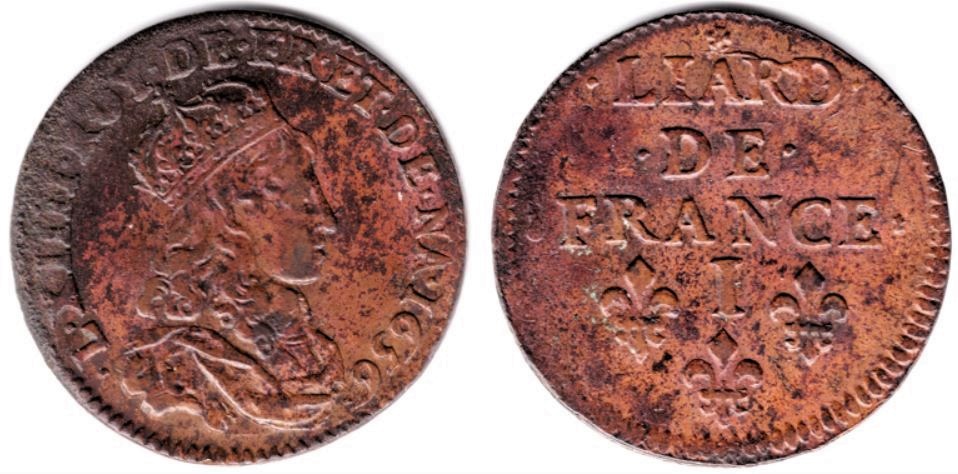 Obverse: L XIIII ROY DE FRAN ET DE NA (Louis XIIII Roi de France et Navarre / Louis XIV King of France and Navarre). Louis XIV, crowned, draped and cuirassed. Reverse: LIARD DE FRANCE. Three fleurs-de-lis. 'I' below center, mintmark for Limoges. Flower on top, unknown mintmark; drop before 'FRANCE', unknown mintmark; ermine spot after 'FRANCE', mintmark for unofficial mint master Pierre Pagnon. The coin was minted in Limoges, but not in the ordinary mint workshop. The specially set up liard mint did not have a regularly appointed (by the king) mint master, but the person in charge (here Pierre Pagnon) put a mark on "his" coins. Two other mintmarks (flower and drop) are of unknown significance; probably one of them is the engraver's mark. About 600 million liards were minted 1655-1658. The copper needed was in part supplied by melting existing copper coins (deniers, doubles, and foreign coins). The material cost was 1-1½ denier per liard, and labor was cheap those days, which made the whole business a profitable one. That opened up another golden opportunity for those "foreign princes", who quickly realized that minting lookalike copper liards was as profitable as the old billon copying business. Very soon France had an influx of similar-looking liards from neighboring principalities, often underweight. Below is one blatant example from Arches-Charleville, which I will describe in more detail in the next Chapter. It would easily pass as a genuine French one to an unsuspecting and illiterate eye. But when trying to use it to buy something from a merchant better at letters, or trying to pay the tax collector, it was rejected. This of course caused lots of grievance, and much of it was directed at the authorities and their new coins rather than at the counterfeiters. 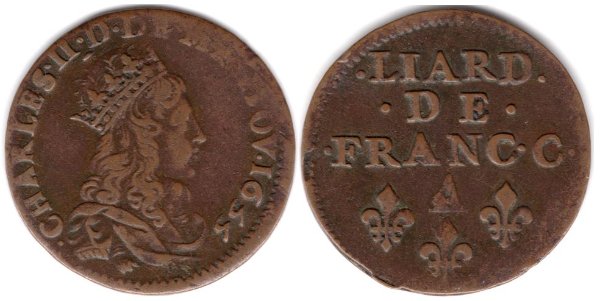 Copycat liard from Arches-Charleville. Full details in Chapter 25. Copycat liard from Arches-Charleville. Full details in Chapter 25.The plan to stop fakes by removing the silver had failed. Something had to be done. Soon rumors flourished that the value of the liards would be reduced to just two deniers, to make falsification less attractive. A royal edict of May 25, 1658, strongly denied any such plans and pointed out that anyone requesting a discount to accept liards - an immediate consequence of the rumors - would be severely punished. The edict that did reduce the value to two deniers then followed June 20. No immediate effect was seen, and soon new rumors about yet a reduction to one denier started. The edict strongly denying that came July 4, and the edict implementing said reduction July 20. By now, the people's trust in their king (not being exceedingly high to begin with) had also been severely reduced. Louis (or his advisors) realized that it was a miscalculation to think the people would rejoice at seeing their hard-earned liards lose 2/3 of their value. August 3, another edict restored the value to two deniers, and at that it would remain until the 1690s. The above somewhat haphazard sequence of events can be interpreted in two ways. Either the royal administration cleverly implemented a scheme by which they got three deniers for every liard that left the mint, but when it was time for people to use them, they only got two deniers back. Reducing the value to one denier for a short time only served to quell the people's indignation by soon "restoring" the value to two deniers. Or, the royal administration simply was ill prepared and improvised when things didn't work out as planned. I know what I think . . . A Definitely Older LouisFrance had around 20 million inhabitants, so 600 million liards meant 30 pieces per person (plus an unknown number of fakes). The somewhat tumultuous aftermath of the first series of liards did not encourage the king to repeat the exercise. The liards (effectively double deniers after the immediate devaluation) had to last. So they did, while the king waged wars, built Versailles, established colonies (not least Louisiana, named after the king), and tightened his personal control of country, administration, aristocracy, and the military. The absolute monarchy came into being, with Louis at the center, like the Sun, bringing light and life to everything and everyone . . . (see Note 2). Now it is 1693. The king has aged, he is 54 years old. The liards from his youth have aged too, they are becoming hard to recognize due to wear and tear - those that have not, for one reason or another, been melted down to make use of the copper for something worth more than two deniers, that is. Liards are becoming scarce, and finding coins for small change is becoming difficult. In addition to that, the state treasury needs a refill, so some seigniorage from minting is welcome. There, two good reasons to create a new series of liards! Liard "with aged bust" (3 deniers tournois), France 1695, Louis XIV, La Rochelle. Copper. 3.50 g, 21.5 mm. Dup 1589, C2G 188. 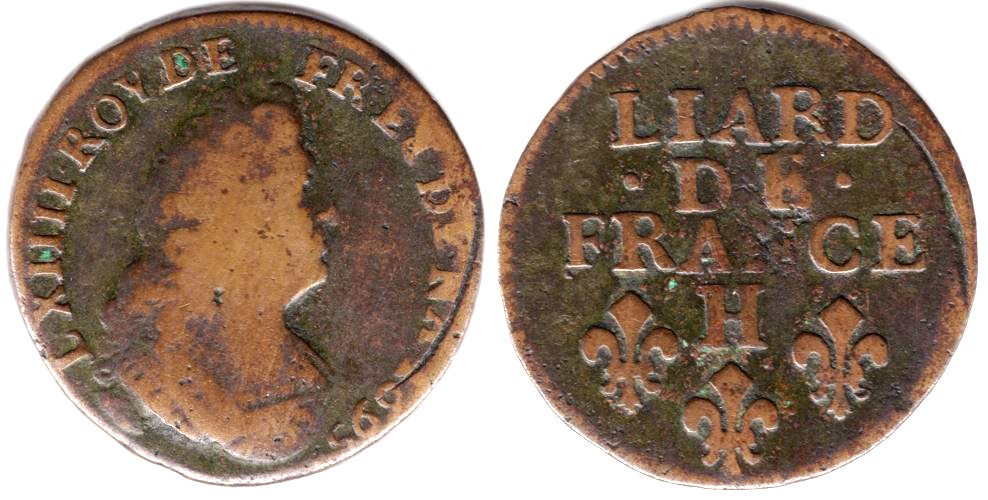 Obverse: L XIIII ROY DE FR ET DE NA (Louis XIIII Roi de France et Navarre / Louis XIV King of France and Navarre). Louis XIV, armored. Reverse: LIARD DE FRANCE. Three fleurs-de-lis. 'H' below center, mintmark for La Rochelle. The new liards come with a revaluation to three deniers. This time it is the regular mints that are entrusted with the minting. The volume and intensity are also lower, 80 million coins in total, over a period of ten years. The copper is sourced from old liards (and any other copper coins around) but also from scrapped bronze cannons. Most of those were located in the coastal town of Rochefort. Nearest mints were in La Rochelle and Nantes, and the liard above is in all probability made out of cannon bronze. Louis XIV passed away in 1715, at the age of 76 and after having reigned for 72 years (making him the longest reigning monarch ever; Elizabeth II comes in second, with 70 years). He minted many more coins of different sizes and looks before that, but no more liards. Next timeLouis XIV's successor, Louis XV, made his own liards and those we shall look at in Chapter 27. In the Chapter following this one, however, we go back to the feudalities and have a look at what those "foreign princes" came up with when the royal liards started to show up. NotesNote 1: In 1655-1656 there was an attempt to drive out foreign billon liards (of low quality) in the Avignon-Lyon area by minting three different types of royal billon liards for local use. It was not too successful and they were soon replaced by the new copper liards anyway. They are rare and expensive today. Note 2: Louis XIV took the Sun as his emblem, not because it like him was in the center of "everything", but because Louis identified himself with the god Apollo. Apollo, the bringer of peace and light, protector of arts and knowledge, was traditionally seen as a personification of the Sun. (The heliocentric view, with Earth and the planets revolving around the Sun, gained ground in the 17th century but was firmly rejected by the church. Louis was certainly aware of the cosmological developments and ideas of the time. But as the protector of the Catholic Church and faith, and like his predecessors on the French throne holder of the title "Most Christian King", he could hardly make use of the analogy.)
|
| |
Replies: 163 / Views: 7,841 |
To participate in the forum you must log in or register.
Disclaimer: While a tremendous amount of effort goes into ensuring the accuracy of the information contained in this site, Coin Community assumes no liability for errors. Copyright 2005 - 2026 Coin Community Family- all rights reserved worldwide. Use of any images or content on this website without prior written permission of Coin Community or the original lender is strictly prohibited.
Contact Us | Advertise Here | Privacy Policy / Terms of Use
|
| Coin Community Forum |
© 2005 - 2026 Coin Community Forums |
| It took 0.66 seconds to rattle this change. |
 |
|








 First Page
 Previous Page


 Posted 05/20/2024 5:01 pm


