| Author |
 Replies: 17 / Views: 6,803 Replies: 17 / Views: 6,803 |
|
New Member
Germany
1 Posts |
Hello All, I'm collecting large silver coins like Reichsthalers, pieces-of-eight or related coins. Recently I got interested in American and British trade coins, 1 yuan pieces and 1 yen pieces. From what I read in the forum, all these coins are heavily faked. I'm considering being this coin shown below. Size is 38.3 mm, weight 27.0 g. Could I ask your opinion on whether the coin looks genuine?  |
|
|
|
Moderator
 United States
194816 Posts |
 to the Community! Your reply was split into its own topic for the proper attention.  |
|
Bedrock of the Community
United States
94367 Posts |
 to the CCF! |
|
Pillar of the Community
United States
1915 Posts |
I've replied the same way a number of other times about the value of looking genuine.
I can post coins that are known fake but yet I doubt anyone could identify them from the photos.
If there is something obvious to notice then that is better.
Finding a blatant flub or flaw is more helpful, but sometimes they are not so seen.
At first glance, I'd saythe coin looks pretty good.
But as stated, I have others that are not genuine that look even better.
Allowing for small error, the measures are close to being correct.
Edited by Albert
04/25/2024 12:41 am
|
|
Valued Member
United States
136 Posts |
Your coin is an 1892 1 yen of the more common variety (the last flame overlaps 3 spines on the tail). It is in my opinion certainly genuine and looks to be a good AU. It also doesn't seem to suffer from some of the hairlines that many of this type tend to have that can put them in the details grade. However there is one thing that looks a little suspicious to me which is the slightly weird toning of the reverse. The color is quite strange and I have never really seen it exactly that way, it is also missing in the field so it may have been wiped or very lightly cleaned. I would have to look at it in hand to properly assess that . There is also a scratch there which wouldn't be enough by itself to put it in details but again would have to look at it. Overall, I would suggest this was sent for grading and potential conservation as the discoloration on the reverse might be some kind of residue which someone like NCS could probably deal with As for value an AU 55 1892 of the common variety is probably worth around 150 USD as a bid from a coin dealer though you could probably sell it for more on an auction site or ebay but that would be for a coin that is problem free and not a detail grade. Just for your information, an 1892 where the flame overlaps 4 spines will be worth over 1000 in strong AU. So good luck ... be careful bidding in terms of value (remember grading it and conserving is likely to cost a bit and also it could still be cleaned) but you can rest assured that is a genuine coin at least in my opinion - for guidance I have every single 1 yen in every variety and I have maybe 10 different 1892s (I shoudl probably sell some!)... |
|
Valued Member
United States
136 Posts |
Albert I do agree with you for many coins but with the meiji 1 yens I have never seen a copy of the common varieties that could possibly pass muster even from photos. I have seen fakes that might not be identifiable from pictures for the 1870,74,75, and even 78,79 but never for any of the common dates. They are just too hard to fake for the value. Of course one should never say never, but I would put decent money on this one being genuine.
|
|
New Member
Japan
34 Posts |
To me, there's nothing suspicious about the toning of this coin in my opinion. Many of the Japanese silver one yen coins that end up outside of Japan tend to be pretty nice shiny coins. However, Japan is a country that is very hot and humid in summer time and if you search around for silver coins in Japan, they often have some dull brown toning like that coin. There's a lot of quite well worn coins around as well. They have "regular" toning but other types as well: This one looks like it's been in sweaty hands, where the open flat areas away from the detail have contacted and toned a bit darker: 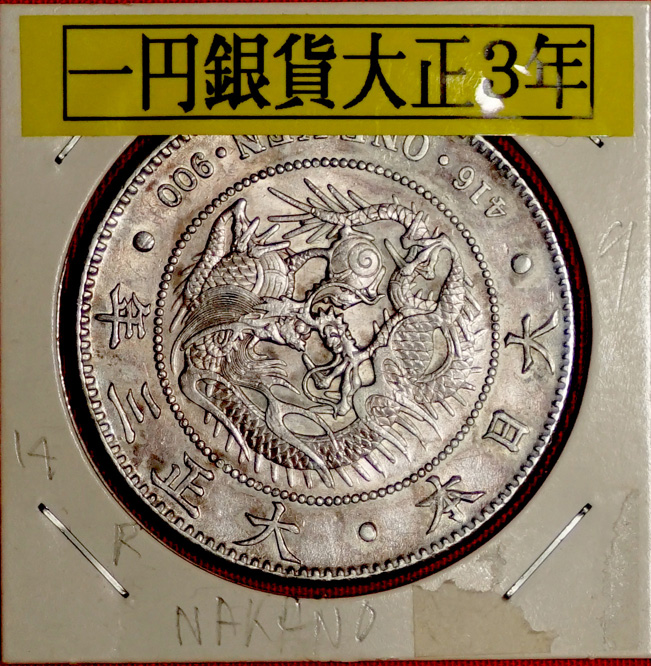 This one looks like it's gotten a more even brown tone over time, but on the open flat areas away from the detail, some of the tone has rubbed off to a lighter color. You can also see a chop mark.  This one has suffered some water by the looks of things, and has toned very dark and blotchy. It was cheap because it was so black, so I decided to immerse it in hot water and sodium bicarbonate. This process removed a lot of the very black blotchy toning to reveal the colors. It may look ok here but it's still an unattractive coin. I don't normally clean coins but this was so cheap (about $40) and very blotchy black. In Japan, they don't like toned coins, so this must have been hard to sell to Japanese buyers. The condition is AU, with very little wear. 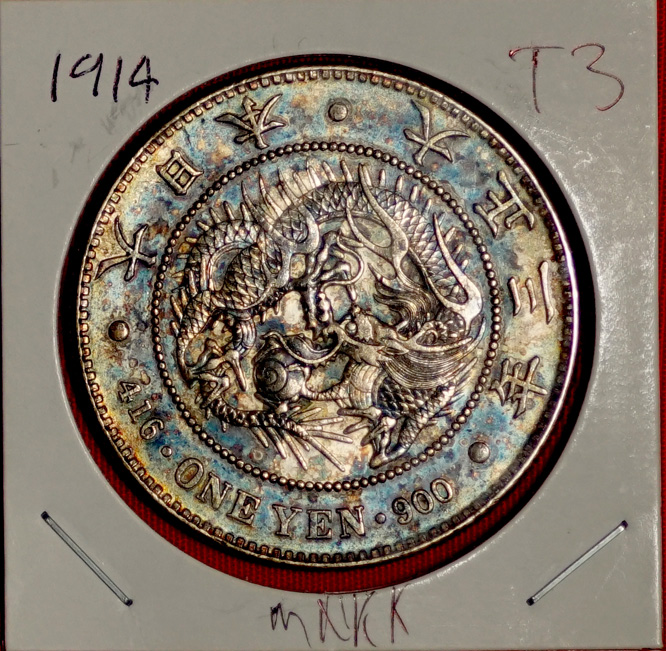 I lived in Japan for 16 years so I accumulated around 80 one yen coins, with only a few missing dates/varieties. It's actually fun to search out these less than perfect looking coins, some of which can be AU or better but a little unattractive due to brown toning. |
|
Moderator
United States
15867 Posts |
to the CCF |
|
Valued Member
Italy
290 Posts |
Since this thread started out pretty generic, may we use it as an "aggregator" to ask opinions on authenticity for this particular coin?  Thank you very much!  |
|
Valued Member
Italy
290 Posts |
As an example I'd love to know what you all think about this specimen slabbed by PCGS. As far as I know PCGS did slab some fake Silver Yens before and even wrote about it. What do you all think about this one? Would love to know Dnas and manosgerms and Albert and all's opinions! Thank you very much!  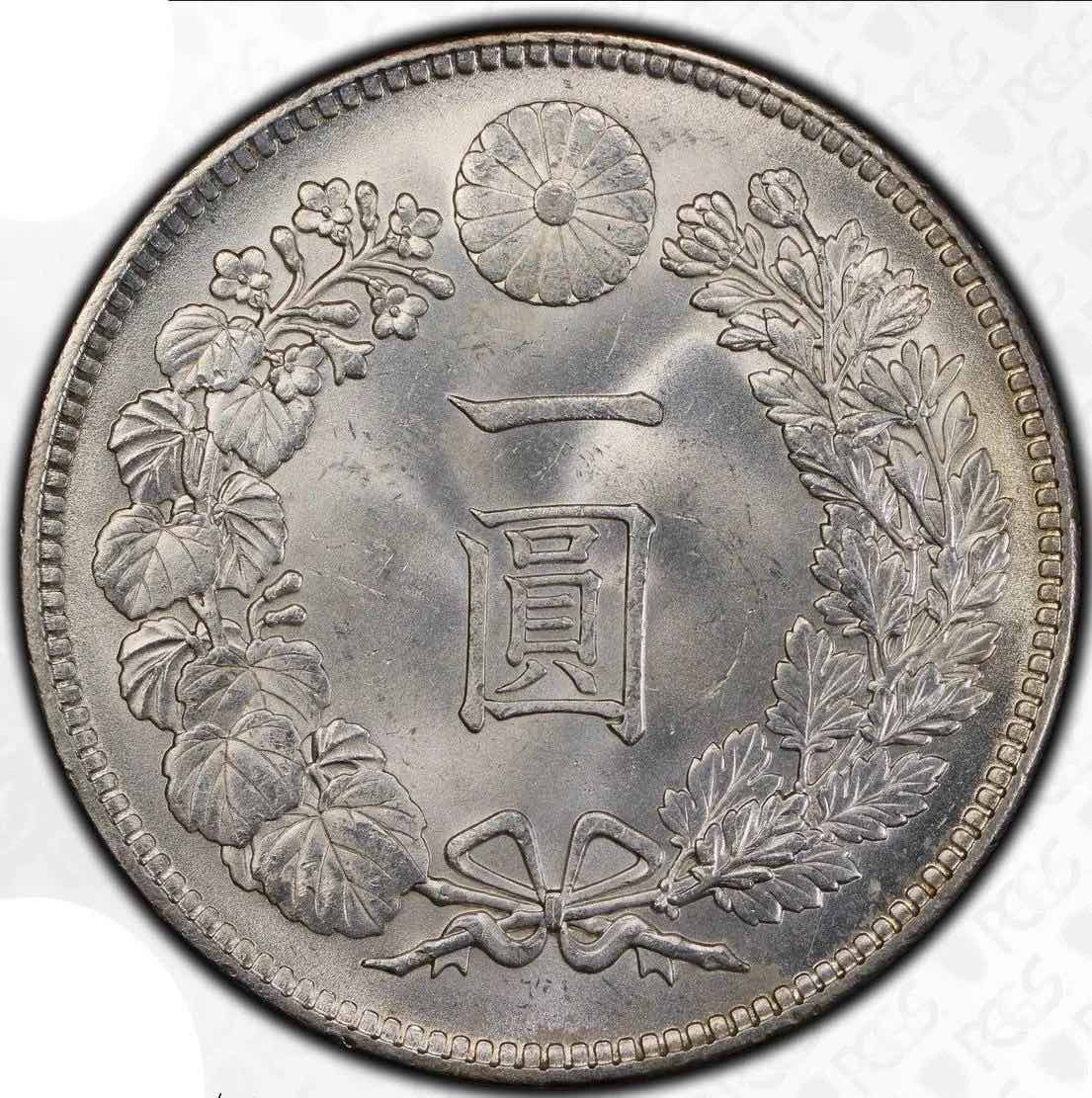 |
|
Valued Member
United States
136 Posts |
As far as I can tell it looks totally legit to me
The 1914 is very common and is only conditionally rare, and so this one could be just an awesome fake trying to get MS65 or better which would make it worth having a struck coin made out of silver but the problem with that is that there are some rim dings and also the ball the dragon is holding is badly scuffed which is actually very rare on these coins and hence bad.
Also the coin looks as if it may have been wiped but is in otherwise great shape.
NGC wrote that some of the better fakers are beginning to use actual dies taken from genuine coins for fakes that are not the traditionally faked expensive 1 yens (1870, 1874, 1875, 1878, 1879) and I recently saw a bunch of 1891 1 yens all sold together that looked as if they might be fakes with the gin mark also done very well (this used to be a telltale sign of a fake for the varieites which had an 1897 mint chopmark )
However, I do think that the one you sent is indeed a genuine coin from year 3 of the Taisho era.
|
|
Valued Member
Italy
290 Posts |
Thank you very much manosgerms! Much appreciated all the info provided  This is a 64. How much would you comfortable pay for it if I may ask? Thanks again!  |
|
Valued Member
United States
136 Posts |
Personally I have a 63+ that is at least as good but that's just an opinion... as I say the scuffs on the ball for me are a no no. At this point I am only looking for a 66 as I have a 65 already which I found actually on ebay and had graded. My 63+ cost around 400 bucks when I bought it if I recall but it was long ago when these were rather cheaper. Some 64's have recently traded around 800-900 bucks (with auction premium) and there is one on HA right now looking for bids with the auction ending on June 21st. I would expect you could sell the thing on ebay for the price that trades at HA minus auction premium minus around 10% because you are not HA. |
|
Valued Member
Italy
290 Posts |
Thanks manosgerms for the further guidance! I realize my message was ambiguous -- I am not looking to sell but was looking to buy the coin!! The coin was in an auction: https://www.pcgs.com/cert/47363189 ...I was able to grab it for $620 all in   Edited by joe_77
05/26/2024 09:09 am
|
|
Valued Member
United States
136 Posts |
So 0.9*(850 /1.2 ) = 637.5 and you got it for 620. :) That's pretty much exactly right. I think you got a good deal at 620 especially if you think the ball ding is less important (because the rest of the coin is gem ) So nice one well done:)     |
|
Valued Member
Italy
290 Posts |
Thank you for doing the math manosgerms! This is an interesting discussion! I thought I got a nice deal as I normally look at the price of the coin "all in". Is this the wrong way of looking at it? Another way of seeing this is that it is about 2/3 of what three similar coins are for sale at Ginza now (which is known to be a bit expensive though). Is it common practice when buying from individuals to remove the fees of auction houses? Like if you wanted to sell a coin which just sold for x at HA, wouldn't you say "If you wanted this you would have to dish out x so give me x?" (all discussion here applies to slabbed coins where theoretically authenticity should not be a question so risk *should* be zero on the matter of "a professional dealer vetted this" vs the opposite) Cheers Edited by joe_77
05/27/2024 07:23 am
|
| |
Replies: 17 / Views: 6,803 |







 Posted 04/24/2024 7:13 pm





