| Author |
 Replies: 11 / Views: 1,256 Replies: 11 / Views: 1,256 |
|
|
Pillar of the Community
United States
6967 Posts |
I bought this coin on ebay without really being sure of MS vs. PF. An acetone soak removed what was probably secondhand smoke and revealed a much more mellow gold toning. There are a lot of rainbow hints. Also a few specks of what might be verdigris beginning. Case for PF: The super sharp steps. Even on gem MS Full Steps 1942 nickels, you don't see steps that deep, straight, and perfectly uniform. This is 6FS, far beyond the requirement of 5FS for Full Steps. Under magnification, the reverse lettering is also super thin in a way that does not match circulation strikes in the PCGS catalog. Finally, the thick rims with multiple concentric grooves or fins is common on 1942 proof strikes, presumably from higher strike pressure. Also absent is the Die Deterioration typical of 1942 circulation strikes (both cupronickel and 35% silver). The fields are quite flat and clear of die scratches, gouges, polishing lines, and other imperfections. Case for MS: If this were a proof strike, the bust does not seem super deep. Also, I could only find the spidery thin lettering on a single 1941 proof. Most of the proofs had thicker letters, although nowhere near as thick as MS coins, especially after Die Deterioration. It was only sold as a 1942 nickel, which means it wasn't pulled out of a proof set. The obverse lettering seems fairly typical, in contrast to the reverse lettering. What say you, o' masters of coin? PCGS 1942 nickel PF
PCGS 1942 nickel MS FS  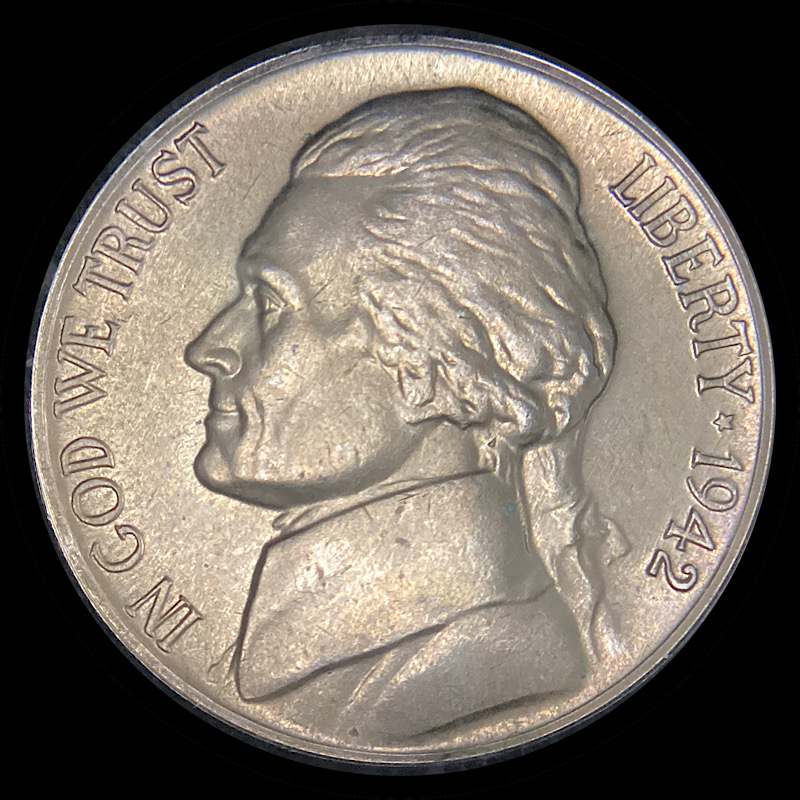     |
|
|
|
Bedrock of the Community
United States
94367 Posts |
I'll say MS-64, probably FS. Doesn't look like a proof.
|
|
Moderator
 United States
110186 Posts |
I say not a proof as well.
|
|
Pillar of the Community
 United States
6967 Posts |
That's two seasoned votes for circulation strike. My gut still leans towards proof. Those slender letters, crisp steps, and well-defined side steps easily found on many Type 2 proofs. With only 27,600 produced of each proof nickel type in 1942, it had to be a very limited number of dies. I also found several examples with that over-polished B in Pluribus. https://www.pcgs.com/coinfacts/coin...-type-2/4180Let's root for circulation strike, though. There are only five examples of 6FS in the NGC census. Edited by Brandmeister
09/14/2024 10:54 pm
|
|
Bedrock of the Community
United States
10601 Posts |
Those step steps seem too darn perfect and crisp for a business strike. Maybe a slightly impaired proof?
Edited by Marv65
09/15/2024 12:44 am
|
|
Pillar of the Community
United States
2023 Posts |
I'm leaning MS. The details on the roof of the memorial (especially the windows above the center/front door) are too soft for proof.
|
|
Pillar of the Community
United States
3535 Posts |
A really nice business strike I think..get 'er graded!
|
|
Bedrock of the Community
United States
10601 Posts |
Quote:
..get 'er graded! That's for sure - Those steps are fantastic. |
|
Pillar of the Community
United States
6967 Posts |
Upon consideration, I'm not sure this one meets the criteria for grading. According to the price guides, a graded 1942 cupronickel 5¢ mid-MS Full Steps sells for about $50. A mid-PF proof sells for maybe $60. That doesn't even clear the grading cost.
In order for grading to be worth it at all, the coin would have to get the MS 6FS designation at NGC.
|
|
Moderator
United States
198004 Posts |
Look at the rims, not the strike. The rims do not look squared.
|
|
Pillar of the Community
United States
6967 Posts |
Jbuck, I know that is true of 1950-2024. Is that also uniformly true of 1938-1942? Not arguing that point, I am just trying to expand my knowledge.
|
|
Moderator
United States
198004 Posts |
I believe—and I am welcome to be proven incorrect—that proof coins have squared rims because of the minting process: the proof strike uses a much higher pressure and lasts a longer time; proof coins are often struck twice as well. This forces the metal to more completely fill the void. While blank and die preparation methods have changed, this "high and long" process dates back to the earliest examples of US Mint proofs.
|
| |
Replies: 11 / Views: 1,256 |
|







 Posted 09/14/2024 8:03 pm


 Uncirculated American Silver Eagles


