| Author |
 Replies: 16 / Views: 4,497 Replies: 16 / Views: 4,497 |
|
Moderator
 Australia
16991 Posts |
At the recent coin show, I picked up a puzzling little piece. The 2x2 it came in said the following: "A76 Zanzibar Molt.4 1299 copper beaten". Another number, "1050", is on the back. If they're catalogue references, I have no idea which books they refer to. The writing's not too clear; some of the letters and numbers might be wrong. The 2x2 was self-adhesive, so it can't have been re-used from another coin. Now, when I bought it, I knew I'd never heard of any coins from Zanzibar that were this size - it's only 11 to 13mm diameter, and quite thick, quite unlike the large, thin coins of Zanzibar I own and had seen elsewhere. I'm almost certain the ID is wrong, but I'm at a complete loss as to where it might be from. It's certainly not from the AH1299 Zanzibar coin series shown in the Krause catalogue. The side I've decided to call the "obverse" has three clear, distinct horse legs. The creature seems to be walking to the left, though I have no idea where it's head has gone. There's also a nice sharp exergue line the horse is standing on; very Classical-looking. 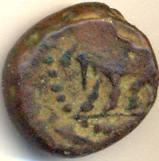 The reverse is depicted more or less at coin rotation to the obverse pic - I have no idea if this is the "right way up", since I can't see enough of the script to ID it. 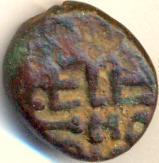 I've tried: - ancient Greek - I don't know what script it is on the reverse, but it don't look Greek to me. - Indian States - I haven't seen anything in the Krauses or elsewhere with a horse or horse-like creature. The closest I've found are the "elephant coins" of Mysore, but this animal definitely has horse-like legs. - Islamic - if you turn the legs upside-down, it kind-of resembles Arabic script, but that wouldn't match the chunky script on the other side. Besides, I'm sure it really is legs on an an exergue line, not script with some kind of die crack. "A76" might have been a reference to the Album catalogue of Islamic... but it's not. - East Africa - on the possibility that "Zanzibar" was where it was found, rather than where it was made. I'm at a loss. Before I consign it to the Folder of Perpetual Mysteries, does anyone have any ideas, either on what the coin is, or what the cryptic code on the 2x2 might mean?  Don't say "infinitely" when you mean "very"; otherwise, you'll have no word left when you want to talk about something really infinite. - C. S. Lewis
|
|
|
|
Moderator
 United States
6563 Posts |
|
|
Moderator
United States
6563 Posts |
No but with all seriousness aside. I have no idea on ancients and the like. If there is anyone that can come along and ID this sucker for you then...  |
|
Pillar of the Community
United States
645 Posts |
|
|
Pillar of the Community
Spain
1361 Posts |
Quote:
The side I've decided to call the "obverse" has three clear, distinct horse legs. For me I think it is more of an elephant than a horse. |
|
Moderator
United States
23731 Posts |
Well this one has me stumped also. I checked my ancient text resources and haven't found anything even close. This might be one to post on the ancient coin forum.
Edited by echizento
05/26/2009 12:48 am
|
|
New Member
Australia
14 Posts |
|
|
Moderator
 Australia
16991 Posts |
Quote:
For me I think it is more of an elephant than a horse. I thought it might be an elephant, too, but the legs are very, very horse-like, with pointy hooves and calf-balls. I think DCH's idea of a bull is possible, too, and those Narwar coins do indeed come closer than anything else I've managed to find. It's given me a time and place to try to investigate closer, anyhow. Don't say "infinitely" when you mean "very"; otherwise, you'll have no word left when you want to talk about something really infinite. - C. S. Lewis
|
|
Pillar of the Community
United Kingdom
1077 Posts |
I see a trunk and tusk. Plus Elephants have very knobbly knees and ankles like that. My vote is for Elephant.
Obviously that doesn't help identify the coin though. Sorry!
|
|
Valued Member
Netherlands
376 Posts |
Glad that you cannot know about it all, have you tried the Ghaznavids tribe yet?
|
|
Moderator
Australia
16991 Posts |
Yes, actually I did think of them from the first - I have a Ghaznavid jital with chunky Arabic writing on the reverse that looks very similar to the reverse on this. Except, on all the Ghaznavid coins I could reference, the horses are so stylized you can barely tell that they're animals; Those are clearly legs.
Don't say "infinitely" when you mean "very"; otherwise, you'll have no word left when you want to talk about something really infinite. - C. S. Lewis
|
|
Valued Member
Netherlands
376 Posts |
If I stumble on info in future, I'll let you know... no guarantees
|
|
Moderator
Australia
16991 Posts |
 Well, it's now been six years since I've posted this, and I haven't really found anything closer than the near-matches linked to above. Certainly nothing definitive enough to lock it down as. We've got a whole swag of new ancient/mediaeval experts who might not have trawled through the deep archives to find this thread. So... any new ideas out there? Don't say "infinitely" when you mean "very"; otherwise, you'll have no word left when you want to talk about something really infinite. - C. S. Lewis
|
|
Moderator
United States
23731 Posts |
It's probably from one of the Eastern empires, almost looks a bit Kushan but that's only a guess. I wish that Pankaj Tandon from Coin India was a member, I bet he would know.
|
|
Valued Member
Jordan
78 Posts |
|
|
Pillar of the Community
United States
8904 Posts |
 with Mass. There are a few similarities here, style-wise. Maybe this helps narrow it down? http://coinindia.com/MNI0963-437.37.jpgDevaloy Devaraja (1731-61), regent for Immadi Krishna Raja Wodeyar II (1734-66) Copper kasu, Elephant type, with crescent Weight: 2.83 gm. Diameter: 11-13 mm Die axis: n.a. Elephant left, crescent-like shape above, all within ruled and dotted borders Criss-cross lines, with circles in the empty squares Reference: MNI 963, KM 153 |
| |
Replies: 16 / Views: 4,497 |






 Posted 05/25/2009 10:40 pm





