I am attaching a link to my paper below.
A STUDY OF FEEDER MECHANISM DIE DAMAGE PATTERNS
Focusing on Examples on Lincoln Cents
SUMMARY
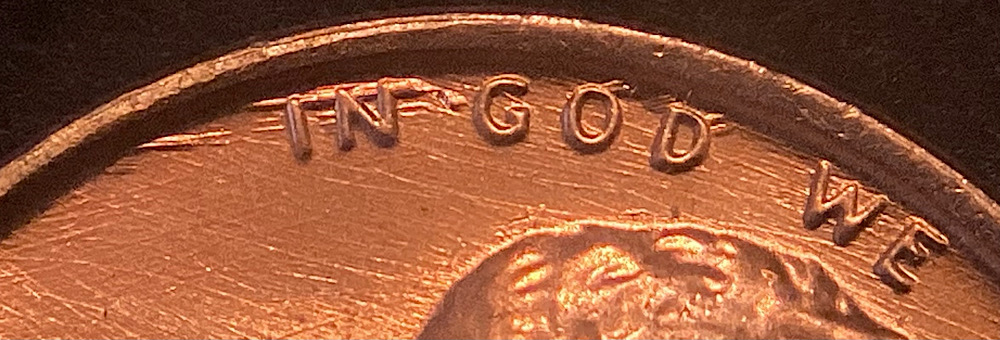
The most likely perpetrator of the feeder mechanism die damage commonly seen on Wheat Cents is the Feeder Mechanism designed by Oberlin Smith, President of the Ferracute Company. A patent for this design was issued in 1896. Some of the presses at the mint were Ferracute Presses. Most of the damage examples are most likely die dents from a Feeder Finger from this mechanism being struck into the die, although a die scratch example is known.
In the patent schematic of 1896, a Feeder Bar is shown with Finger Arms in place, along with an image of a single Finger Arm. The two-pronged downward bend at the end of the arm is the Feeder Finger. The length of the Feeder Arm is no larger than about 3" and the inside length of the Feeder Finger is no longer than one-half the diameter of the die over which it passes in delivering the blank to the striking chamber.
This configuration matches with die damage patterns we normally see on Wheat Cents, where the die damage extends over no more than approximately half the coin. I think this suggests that the damage patterns are die dents from one of these Feeder Fingers being struck into the die, rather than die scrapes. In addition, the features do not show any characteristics of scrapes, such as striations, ragged edges, and irregular widths.
From 1945, when a Conversion Unit for Coining Presses was invented at the San Francisco Mint and installed in all mint presses, until the 1990s, few examples of feeder mechanism die damage have been presented (do you have a photo of one?). During that period the mint went through a succession of press and feeder mechanism types.
For most Memorial Cents after 1990, the feeder damage patterns are likely caused by a Pusher Feeding device on a Schuler horizontal stroke press.
During this period, Bliss Presses were being converted to a new Dial Feed System described by the US Mint as a Colony Dial Feed Assembly. Also, during this period, the Mint was converting from vertical stroke Bliss Presses (anvil die = reverse die) to horizontal stroke Schuler Presses (anvil die = obverse die = Inverted Die Installation). In both press styles, the anvil die is the stationary die.
The characteristics of these die scrapes do not exhibit significant variations in their patterns during this time, which, while not diagnostic, is certainly suggestive that they originate with a single press/mechanism type. Their characteristics are roughly straight scrapes of varying widths and lengths, with ragged and uneven edges. An example with a die scrape showing a slight arc would suggest that a Bliss Press with a Dial feeder was the cause.
For most Shield Cents after around early 2018, the feeder die damage patterns are most likely caused by a Dial Feeding device on a Schuler horizontal stroke press.
This style pattern exhibits characteristics of low to high density, thin die scrapes, with less ragged edges and more uniform width, and appears on either or both sides of the coin. The die scrapes are oriented in the same direction on both dies (For Cents: NW/SE on the obverse and SW/NE on the reverse). Feeder-applied struck-through features are frequently found along with the scrapes or independent from them. This pattern began appearing coincidentally with the estimated time of installation of dial feeders on horizontal Schuler Presses.
Prior to the Schuler dial feeder/horizontal stroke press, it was not so common for the hammer die to exhibit feeder mechanism damage except in the form of feeder-applied struck-through. With the dial feeder/horizontal stroke press, feeder die scrapes with similar style pattern characteristics are found on both hammer and anvil dies.
All evidence I have seen indicates that the Dial Feeder Mechanism on the horizontal Schuler press began production at the US Mint in 2018. I remain open to examine any evidence anyone can produce which indicates an earlier date.
As new information comes forward, the conclusions I have reached may very well be modified!
https://www.coincommunity.com/pdf/S...erns.5.1.pdf










 Posted 06/04/2025 3:30 pm


 I'll get my examples up you asked for later today or in the morning. In the meantime, I have put up several links that may help.