With funding for the US Space Program - and its possible return to the moon - in the news of late, it seemed like a reasonable time to explore another commemorative coin proposal regarding the highly-successful Apollo program.There's no doubt that the Apollo missions were a milestone achievement in human space flight, so it's little wonder that Congress has entertained commemorative proposals marking the program for decades.
Most recently, the US issued a multi-coin commemorative program in 2019 to mark the 50th Anniversary of Apollo 11. There have been previous attempts to authorize coins to mark the seminal event - dating all the way back to 1969!
I've discussed a few here:
-
What If? 1969 Apollo 11 - Part I -
What If? 1969 Apollo 11 - Part II-
What If? 1971 Apollo 11 / Lunar Landing Trust Fund-
What If? 1973 Apollo Lunar LandingAnd, of course, there is the 1971-78
Eisenhower dollar series (non-Bicentennial) that features a rendition of the Apollo 11 mission emblem on its reverse.
Apollo 11 Mission Emblem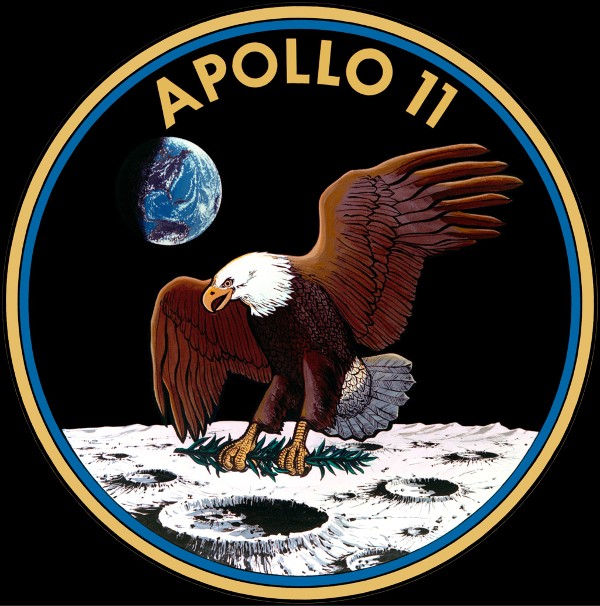
Another coin proposal was introduced in the House of Representatives ("House") by John Cooksey (R-LA) in February 2001 (during the 107th Congress) that called for a two-coin program consisting of up to 100,000 Gold Half Eagles ($5) and up to 500,000 Silver Dollars. The bill sought "coins in commemoration of Project Apollo."
Upon its introduction, the bill was referred to the House Committee on Financial Services, with a further referral to its Subcommittee on Domestic Monetary Policy, Technology and Economic Growth.
Cooksey's bill included a "Findings" section to provide background and context for the proposed coin program:
Congress finds the following:
(1) Project Apollo in general, and the flight of Apollo 11 in particular, were milestones in the history of our Nation.
(2) When referring to Project Apollo, historian Arthur Schlesinger, Jr., observed, "The one thing for which this century will be remembered 500 years from now was: This was the century when we began the exploration of space.''
(3) Project Apollo helped demonstrate the technological and economic strength of the United States at the height of the cold war.
(4) Project Apollo was an engineering triumph that successfully achieved the policy goals set by President Kennedy.
(5) In only 9 years, Project Apollo advanced rocket technology from the 28-foot Redstone rocket which produced 78,000 pounds of thrust to the 363-foot Saturn V which produced 7.7 million pounds of thrust, which is comparable to building a modern commercial aircraft 9 years after the Wright brothers built their first airplane.
(6) The Apollo flights are among the high points of our human achievement and allowed the entire world to view the planet Earth in a new way.As was typical for coin bills of the time, its wording included only generic guidance regarding thr designs for the coins, stating only that they be "emblematic of the 35th anniversary of the Apollo 11 lunar landing." The Secretary of the Treasury was to select the designs in consultation with the Commission of Fine Arts, after receiving review comments from the Citizens Commemorative Coin Advisory Committee (CCCAC). (The CCCAC was the forerunner of the Citizens Coin Advisory Committee (CCAC); the CCAC replaced the CCCAC in 2003.)
The coins were to be dated "2004" and issued only during calendar year 2004. The bill specified that the coins were to be struck in Proof and Uncirculated versions, with a single Mint facility being limited to the striking of "any particular quality of the coins." This guaranteed at least two Mint facilities would have been used to strike the program's coins.
The Issue Price of each coin was to include a surcharge:
- $35 for the Gold Half Eagle
- $10 for the Silver Dollar
Collected surcharge funds were to be paid to the National Air and Space Museum of the Smithsonian Institution for "for the purposes of:
(A) collecting, exhibiting, and caring for objects related to Project Apollo; and
(B) documenting and researching the mission of Project Apollo (including a collective outreach to the workers associated with Project Apollo for the contribution of their memories regarding Project Apollo)."
The bill did not progress past Committee, however, and so, the 35th Anniversary of the Apollo 11 Lunar Landing passed without US commemorative coins. (Australia, however, issued a Silver Dollar - with a lenticular lens - in 2004 to mark the 35th Anniversary of the Apollo 11 Moon Walk.)
Just speculation on my part, but if the 35th Anniversary of Apollo 11 coin proposal had been successful, it likely would have been a significant obstacle to getting the 2019 50th Anniversary coin program approved. Also, the 2004 coins would likely have been "regular" coins vs. domed/curved. (I'll leave it to others to decide whether that would have been a "good" or "bad" thing!)
For other of my posts about commemorative coins and medals, including other What If? stories, see:
Commems Collection. 






 Posted 07/14/2025 3:20 pm


 It really is!


