| Author |
 Replies: 12 / Views: 1,214 Replies: 12 / Views: 1,214 |
|
|
Bedrock of the Community
United States
11954 Posts |
Most people don't know that the policy of the United States from 1792 to 1873 was that anyone could walk into a U.S. Mint, drop your gold or silver bullion or unrefined metal on a counter, and the Mint would turn your gold or silver into standardized U.S. gold or silver legal tender coins for free, at taxpayer expense. The Coinage Act of 1873 ended free coinage of silver which was then known by opponents of this policy as the "Crime of '73." Free coinage of gold continued but ended in 1933 when Roosevelt ended private ownership of gold. His administration confiscated gold coins and bullion from the public during the Depression by issuing Executive Order 6102. This Order was made permanent in the Gold Reserve Act of 1934. Roosevelt's ban was lifted when Ford signed Pub. L. 93-373 as a rider to the International Development Association Appropriations Act of 1975. Private ownership of gold became legal again in the United States when the law went into effect on December 31, 1974. This also coincided with the opening of U.S. gold futures markets. Ford restored private ownership of gold but not the free coinage policy that prevailed up to 1933. Imagine walking into a U.S. Mint with your silverware, foreign silver coins, gold jewelry, bars, and being able to walk out with shiny newly minted coins or silver and gold certificates that could be redeemed in gold or silver coin at any bank later without any loss through fees of any kind. It is a coin collector's dream. I think we are far enough away from 1933 to know anyone who experienced free coinage, but old-timers here might remember parents, grandparents, other family members and friends who experienced this service firsthand. It is fading from people's memories these days. Ann Arbor Courier July 29, 1896. 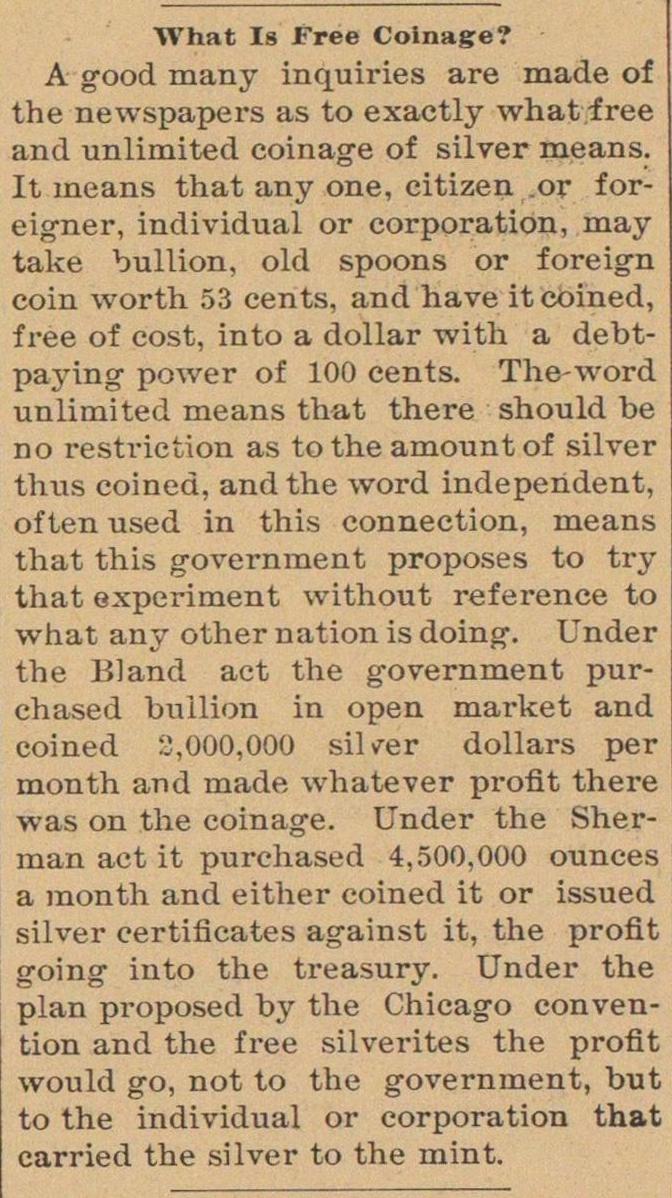 IN NECESSARIIS UNITAS - IN DUBIIS LIBERTAS - IN OMNIBUS CARITAS THE MAN IN THE ARENA, Theodore Roosevelt at the Sorbonne Paris on April 23, 1910: " It is not the critic who counts; not the man who points out how the strong man stumbles or where the doer of deeds could have done better. The credit belongs to the man who is actually in the arena, whose face is marred by dust and sweat and blood, who strives valiantly, who errs and comes up short again and again, because there is no effort without error or shortcoming, but who knows the great enthusiasms, the great devotions, who spends himself in a worthy cause; who, at the best, knows, in the end, the triumph of high achievement, and who, at the worst, if he fails, at least he fails while daring greatly, so that his place shall never be with those cold and timid souls who knew neither victory nor defeat." My coin website: https://fairfaxcoins.com |
|
|
|
Moderator
 United States
34531 Posts |
Fascinating! Quote:
I think we are far enough away from 1933 to know anyone who experienced free coinage I don't even remember gold being illegal to own!  "If you climb a good tree, you get a push."
-----Ghanaian proverb
"The danger we all now face is distinguishing between what is authentic and what is performed."
-----King Adz
|
|
Bedrock of the Community
 United States
11954 Posts |
The 1933 ban on gold ownership in the United States had several exceptions, including gold needed for industrial, professional, or artistic use, up to $100 in gold coins per person, and gold coins with a "recognized special value" to collectors. Gold held for foreign governments or legal transactions was also exempt. The ban was later lifted, and private ownership is now legal.
Key exceptions to the 1933 ban
Industrial, professional, or artistic use: Gold required for legitimate use in industry, a profession, or art was exempt.
Collector coins: Gold coins that had a "recognized special value" to collectors of rare and unusual coins were exempt.
Small amount: An aggregate amount of up to $100 in gold coins and certificates was exempt per person.
Foreign and legal transactions: Gold being held for a foreign government or being used in legal transactions was also exempted.
Penalties: Violating the order could result in fines of up to $10,000 or imprisonment for up to 10 years.
IN NECESSARIIS UNITAS - IN DUBIIS LIBERTAS - IN OMNIBUS CARITAS THE MAN IN THE ARENA, Theodore Roosevelt at the Sorbonne Paris on April 23, 1910: " It is not the critic who counts; not the man who points out how the strong man stumbles or where the doer of deeds could have done better. The credit belongs to the man who is actually in the arena, whose face is marred by dust and sweat and blood, who strives valiantly, who errs and comes up short again and again, because there is no effort without error or shortcoming, but who knows the great enthusiasms, the great devotions, who spends himself in a worthy cause; who, at the best, knows, in the end, the triumph of high achievement, and who, at the worst, if he fails, at least he fails while daring greatly, so that his place shall never be with those cold and timid souls who knew neither victory nor defeat." My coin website: https://fairfaxcoins.com |
|
Bedrock of the Community
United States
11954 Posts |
Not sure why the article says that you could deposit 53 cents in bullion and have it coined into a dollar. If true, you could almost double your money at the Mint every time you went with gold or silver, and would have been promptly overrun with people seeking that free money. Maybe the proof readers at the Ann Arbor Courier were half asleep, shaking off a hangover as that story went to print.
IN NECESSARIIS UNITAS - IN DUBIIS LIBERTAS - IN OMNIBUS CARITAS THE MAN IN THE ARENA, Theodore Roosevelt at the Sorbonne Paris on April 23, 1910: " It is not the critic who counts; not the man who points out how the strong man stumbles or where the doer of deeds could have done better. The credit belongs to the man who is actually in the arena, whose face is marred by dust and sweat and blood, who strives valiantly, who errs and comes up short again and again, because there is no effort without error or shortcoming, but who knows the great enthusiasms, the great devotions, who spends himself in a worthy cause; who, at the best, knows, in the end, the triumph of high achievement, and who, at the worst, if he fails, at least he fails while daring greatly, so that his place shall never be with those cold and timid souls who knew neither victory nor defeat." My coin website: https://fairfaxcoins.com |
|
Bedrock of the Community
United States
11954 Posts |
Coinage Act of April 2, 1792
Establishing a mint and regulating the coins of the United States.
SEC. 14. And be it further enacted, That it shall be lawful for any person or persons to bring to the said mint gold and silver bullion, in order to their being coined; and that the bullion so brought shall be there assayed and coined as speedily as may be after the re-ceipt thereof, and that free of expense to the person or persons by whom the said bullion shall be been coined, the person or persons by whom the same shall have been delivered, shall upon demand receive in lieu thereof coins of the same species of bullion which gold or pure silver therein contained: Provided nevertheless, bringing such bullion, and of the direction of the said mint, to make an immediate exchange of coins for standard bullion with a deduction of one half per cent. from the weight of the pure gold, or pure silver contained in the said bullion, as an indemnification to the mint for the time which will necessarily be required for coining the said bullion, and for the advance which shall have been so made in coins. And it shall be the duty of the Secretary of the Treasury to furnish the said mint from time to time whenever the state of the Treasury will admit thereof, with such sums as may be necessary for effecting the said exchanges, to be replaced as speedily as may be out of the coins which shall have been made of the bullion for which the monies so furnished shall have been exchanged; and the said deduction of one half per cent shall constitute a fund towards defraying the expenses of the said mint.
IN NECESSARIIS UNITAS - IN DUBIIS LIBERTAS - IN OMNIBUS CARITAS THE MAN IN THE ARENA, Theodore Roosevelt at the Sorbonne Paris on April 23, 1910: " It is not the critic who counts; not the man who points out how the strong man stumbles or where the doer of deeds could have done better. The credit belongs to the man who is actually in the arena, whose face is marred by dust and sweat and blood, who strives valiantly, who errs and comes up short again and again, because there is no effort without error or shortcoming, but who knows the great enthusiasms, the great devotions, who spends himself in a worthy cause; who, at the best, knows, in the end, the triumph of high achievement, and who, at the worst, if he fails, at least he fails while daring greatly, so that his place shall never be with those cold and timid souls who knew neither victory nor defeat." My coin website: https://fairfaxcoins.com |
|
Moderator
Australia
16961 Posts |
Quote:
Not sure why the article says that you could deposit 53 cents in bullion and have it coined into a dollar. Because, at the time the article was written, one silver dollar contained 53 cents worth of silver. Which is, of course, precisely why the "free silver" advocates wished to reinstate the policy. Back when "free coinage" was available, the silver price was much closer to face value. In January 1890, the price of silver was $1.16 per ounce. This collapsed by the end of 1890 to $0.69, and it had slipped even further by 1896. This in turn had caused the Panic of 1893, and resultant collapse of the banking sector. It also causes the suspension of silver coinage manufacture (resulting in the super-low mintages of silver coins in that time period) and the closure of the Carson City mint. Don't say "infinitely" when you mean "very"; otherwise, you'll have no word left when you want to talk about something really infinite. - C. S. Lewis
|
|
Bedrock of the Community
United States
11954 Posts |
You are correct. The price of silver in 1896 was $0.68 per troy ounce. A silver dollar contains 0.7734 troy ounces of silver so a silver dollar contained $0.525912 worth of silver which rounds up to $0.53 or 53 cents. This is the opposite of what happens today when the value of silver is greater than than the face value of coins. Silver coinage is hoarded, pulled from circulation and not spent. If the value of silver is much less than the face value of coins containing silver, people would want to spend the coins at face value and not hold silver dollars which were intrinsically worth less than face value. That is how banks and the Treasury ended up with hundreds of millions in Morgan dollars that no one wanted in their vaults. Gold didn't have this issue in 1896 as a troy ounce was pegged in the US at $20.67 per troy ounce. In London, gold traded at £4.25 per troy ounce. The U.S. dollar was £0.2053, so the London price of gold in dollars was $20.70 per troy ounce. Gold could therefore be coined reasonably for equivalent value and free coinage could continue through 1933. IN NECESSARIIS UNITAS - IN DUBIIS LIBERTAS - IN OMNIBUS CARITAS THE MAN IN THE ARENA, Theodore Roosevelt at the Sorbonne Paris on April 23, 1910: " It is not the critic who counts; not the man who points out how the strong man stumbles or where the doer of deeds could have done better. The credit belongs to the man who is actually in the arena, whose face is marred by dust and sweat and blood, who strives valiantly, who errs and comes up short again and again, because there is no effort without error or shortcoming, but who knows the great enthusiasms, the great devotions, who spends himself in a worthy cause; who, at the best, knows, in the end, the triumph of high achievement, and who, at the worst, if he fails, at least he fails while daring greatly, so that his place shall never be with those cold and timid souls who knew neither victory nor defeat." My coin website: https://fairfaxcoins.com |
|
Moderator
United States
194485 Posts |
Very interesting topic and thank you for sharing!  |
|
Valued Member
United States
450 Posts |
Cool history lesson and excellent commentary, I've always been a silver bug.
|
|
Bedrock of the Community
United States
11954 Posts |
Thank you for your kind comments.  IN NECESSARIIS UNITAS - IN DUBIIS LIBERTAS - IN OMNIBUS CARITAS THE MAN IN THE ARENA, Theodore Roosevelt at the Sorbonne Paris on April 23, 1910: " It is not the critic who counts; not the man who points out how the strong man stumbles or where the doer of deeds could have done better. The credit belongs to the man who is actually in the arena, whose face is marred by dust and sweat and blood, who strives valiantly, who errs and comes up short again and again, because there is no effort without error or shortcoming, but who knows the great enthusiasms, the great devotions, who spends himself in a worthy cause; who, at the best, knows, in the end, the triumph of high achievement, and who, at the worst, if he fails, at least he fails while daring greatly, so that his place shall never be with those cold and timid souls who knew neither victory nor defeat." My coin website: https://fairfaxcoins.com |
|
Bedrock of the Community
United States
17884 Posts |
The article was wrong. Free coinage of silver actually ended with the Act of 1853. After that Act was passed you could bring your silver to the Mint and they would purchase it at the current rate and then THEY would coin it into silver coin, but the profit went to the Government not the depositor of the silver. Before the Act the silver coins contained very close to the full value in metal, but the act made the silver coins subsidiary and there was profit to be made from converting bullion to coins, and the Government claimed that profit. With the Act of 1873 free coinage of silver DID return to a limited extent. Depositors could bring silver to the Mint and have it coined for free, but only into Trade dollars, and after 1876 you had to attest that the coins would be exported. Many depositors stated they would export the coins but then put them into circulation in the US. As the value of silver fell it was becoming quite profitable for the depositors, but not so much for the people stuck using them because the Trade dollars had only limited legal tender status. And after 1876 they lost all legal tender status, but coin production continued. Edited by Conder101
11/30/2025 08:48 am
|
|
Moderator
United States
194485 Posts |
Thank you for the addendum. |
|
Moderator
United States
105133 Posts |
This is a great topic, never knew that it was illegal to own gold at one point. It reminds me of the Mel Gibson movie 'Lethal Weapon' and all the "illegal" gold krugerrand coins they found in the trunk of a car..
|
| |
Replies: 12 / Views: 1,214 |
|
To participate in the forum you must log in or register.
Disclaimer: While a tremendous amount of effort goes into ensuring the accuracy of the information contained in this site, Coin Community assumes no liability for errors. Copyright 2005 - 2026 Coin Community Family- all rights reserved worldwide. Use of any images or content on this website without prior written permission of Coin Community or the original lender is strictly prohibited.
Contact Us | Advertise Here | Privacy Policy / Terms of Use
|
| Coin Community Forum |
© 2005 - 2026 Coin Community Forums |
| It took 0.52 seconds to rattle this change. |
 |
|










 Posted 10/10/2025 9:31 pm


