











 Posted 11/07/2025 10:32 pm


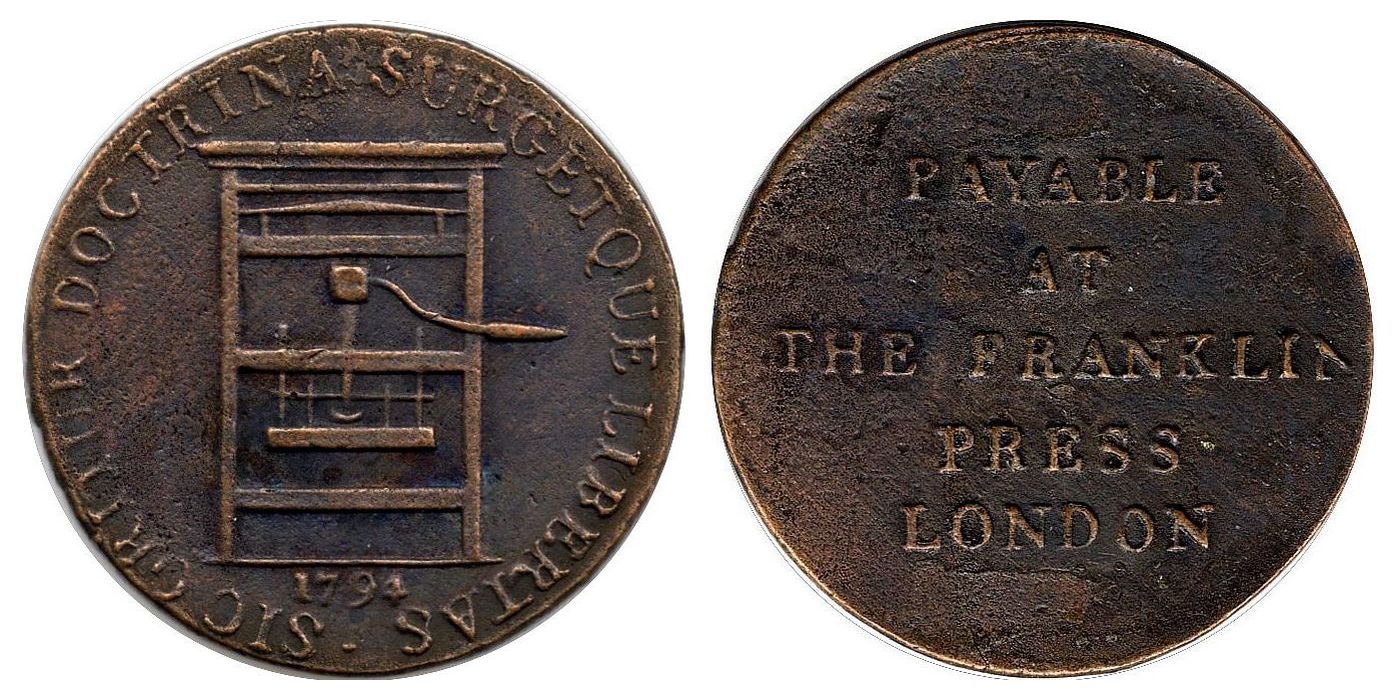
Cast Franklin Press tokens emerged in the late 18th century as a direct response to Britain's chronic shortage of small coinage. Merchants and tradesmen issued struck copper tokens to meet everyday needs, but counterfeiters quickly realized they could profit by producing imitations. Casting was a cheaper, simpler process than striking, requiring only a mold taken from a genuine piece and molten copper alloy. The result was a token that looked convincing enough to pass in circulation, even if the details were softer and the surfaces riddled with pinholes from trapped gases.
These counterfeits circulated widely because communities were desperate for usable change. Even flawed pieces were accepted in local economies, as the alternative was no coinage at all. The Franklin Press design, with its motto linking learning and liberty, carried cultural weight and recognition, making it an ideal candidate for imitation. In this way, counterfeiters tapped into both the symbolic appeal and the practical utility of the token, ensuring their cast versions blended into daily commerce despite their imperfections.
Today, cast Franklin Press tokens are valued not for their monetary worth but for the story they tell about economic necessity and ingenuity. Their porosity, seam lines, and softened lettering are diagnostic features that distinguish them from struck originals, but these flaws are precisely what make them historically significant. They remind us that counterfeit tokens were not simply "fakes" in the modern sense, but artifacts of survival—evidence of how ordinary people adapted to scarcity and kept trade moving in a time of monetary crisis. John Lorenzo.
These counterfeits circulated widely because communities were desperate for usable change. Even flawed pieces were accepted in local economies, as the alternative was no coinage at all. The Franklin Press design, with its motto linking learning and liberty, carried cultural weight and recognition, making it an ideal candidate for imitation. In this way, counterfeiters tapped into both the symbolic appeal and the practical utility of the token, ensuring their cast versions blended into daily commerce despite their imperfections.
Today, cast Franklin Press tokens are valued not for their monetary worth but for the story they tell about economic necessity and ingenuity. Their porosity, seam lines, and softened lettering are diagnostic features that distinguish them from struck originals, but these flaws are precisely what make them historically significant. They remind us that counterfeit tokens were not simply "fakes" in the modern sense, but artifacts of survival—evidence of how ordinary people adapted to scarcity and kept trade moving in a time of monetary crisis. John Lorenzo.


