| Author |
 Replies: 26 / Views: 1,897 Replies: 26 / Views: 1,897 |
|
Pillar of the Community
United States
1210 Posts |
There has been a lot of topic discussed recently on here I feel regarding Shield nickels... Most of it from me I believe. Lol. Since I'm quite inclined to be interested in nickels, given that this is the majority of the coins that I collect, I've wandered into Shield nickel territory somewhat. I might even argue that after V nickels, the Shield nickel is my favorite designed nickel. However, I've noticed, and even from doing some research about the topic online, that Shield nickels aren't really particularly popular. A member on here posted a thread recently involving their proof Shield collection, which was absolutely stunning IMO. A lot of people seem to think the design is just plain old ugly. I, however, feel they are unique and can be very beautiful, especially in nicer grades. There is also the old adage of being difficult to store due to their oddball size, being slightly smaller than a modern nickel. I was lucky enough to find a Dansco album for them recently for a good price. But, outside of that, I can't imagine that the 2x2 method appeals to everyone. They are also somewhat difficult to find in nicer examples, even for non-slabbed coins. However, it can be done. So, any thoughts? The few common variations, "with rays" and without. Interestingly enough, there also seems to be a 1866 version with rays as well? A lot more rare than the 1867 though I believe. 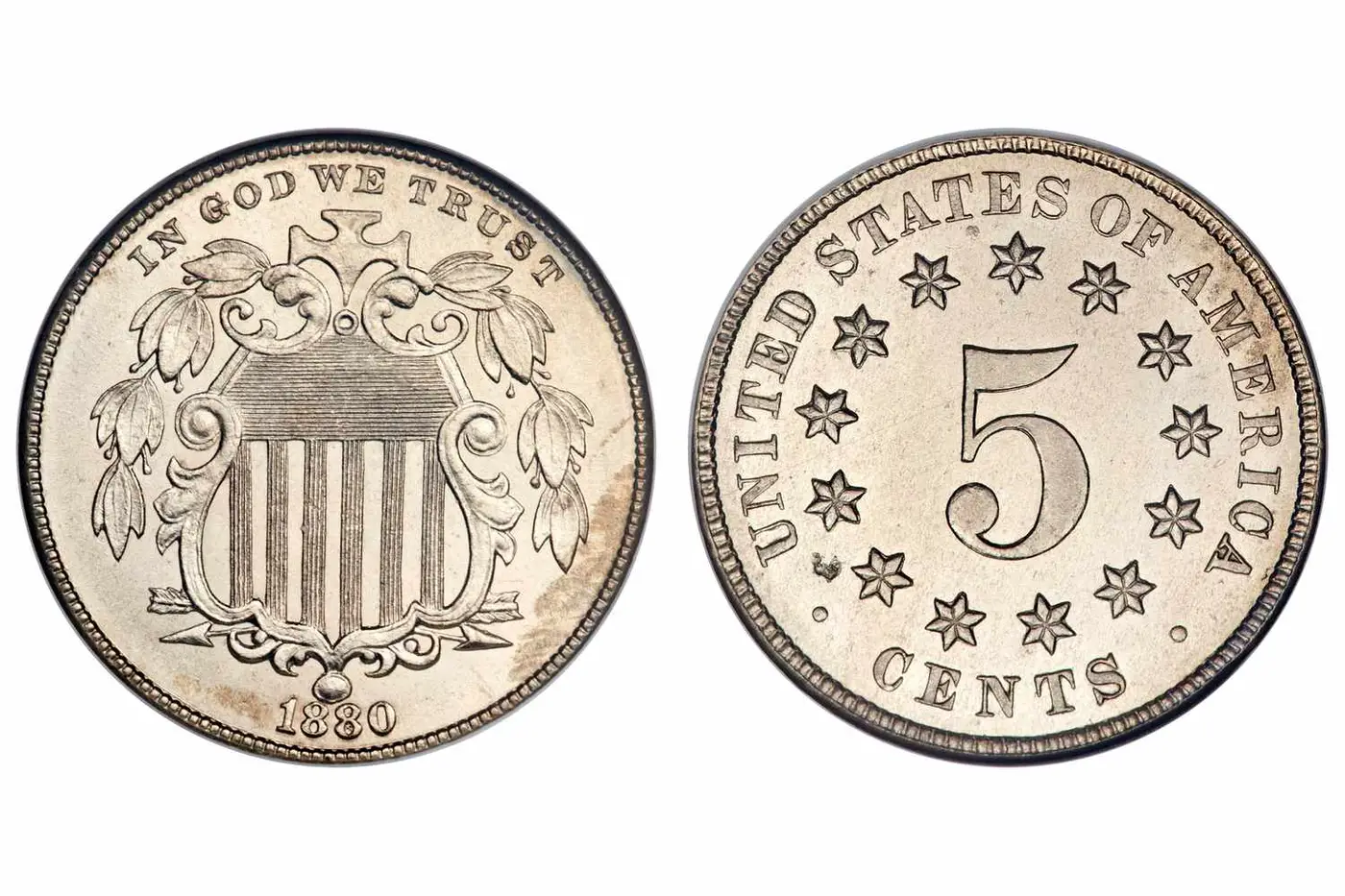 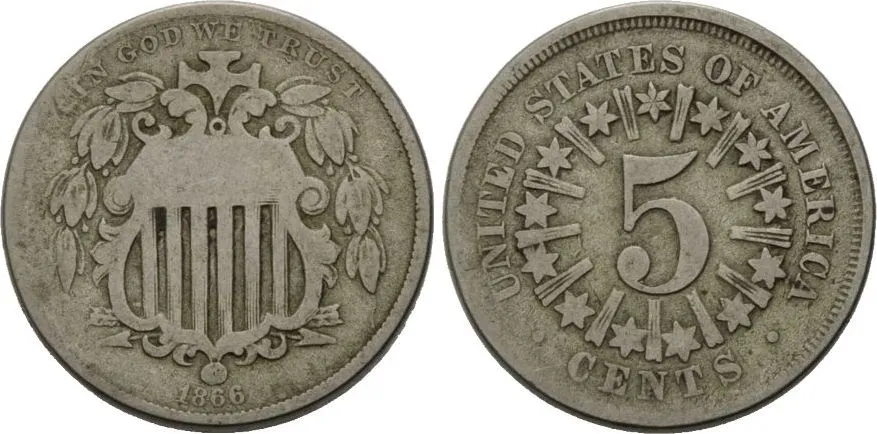 Edited by Humanist1287
02/05/2026 05:54 am
|
|
|
|
Moderator
 United States
15997 Posts |
I agree the Shield nickel is a handsome coin. A visually related coin is the US Two Cent Piece. Minted from 1864 to 1873, they circulated together with the Shield nickel (1866-1883). 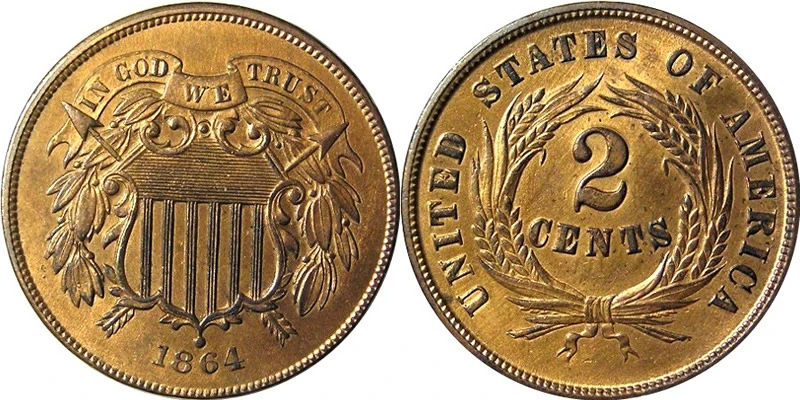 Both coins are generally less popular with modern collectors, and handsome circulated examples can be purchased at reasonable prices. Perhaps you should consider adding a two-cent piece to your collection as a visual 'cousin' to your Shield nickel.  |
|
Moderator
United States
109455 Posts |
Not entirely sure they are not more popular, but they are a very nice design for a nickel (especially with rays)
|
|
Bedrock of the Community
United States
27514 Posts |
Shield nickels are really cool! It's an interesting design, especially with rays. I think that many people are not attracted to them because they're not particularly inexpensive in nice condition and they went downhill really quickly when circulated. Quote:
there also seems to be a 1866 version with rays as well? A lot more rare than the 1867 though I believe. The 1867 with rays had a much lower mintage than 1866, otherwise I wouldn't have one. It's a beater but it was cheap. US 5 Cents 1866 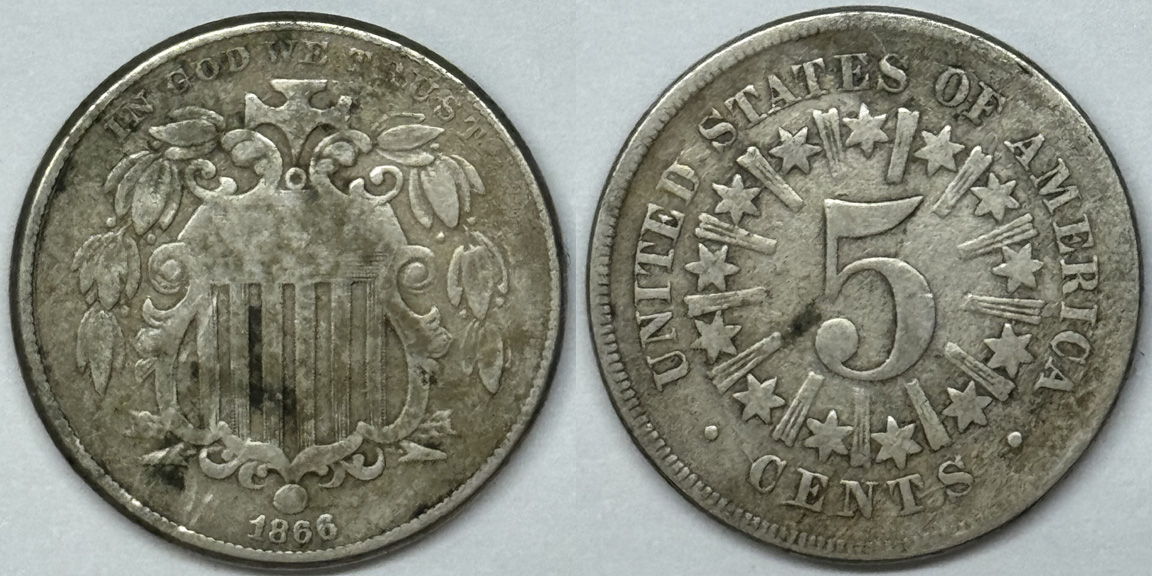
Inordinately fascinated by bits of metal with strange markings and figures
|
|
Pillar of the Community
 United States
1210 Posts |
HondoB, I agree. Beautiful coin! It makes sense now. In 1866, "with rays" was basically the standard design. Going forward, at some point in 1867, they removed them, leading to both "with rays" and "no rays" coins. From what I've seen on ebay, with coins under 1866 sometimes being listed as "with rays" somewhat confused me, as there is nothing different from the standard design for 1866 and coins with rays, from what I gather. |
|
Moderator
United States
197600 Posts |
I like them enough to like the two I have in my 7070. Maybe one day I will tackle a set. Or a subset minus the keys. An even dozen.  |
|
Pillar of the Community
United States
1210 Posts |
Honestly, I'm not really even sure what the "main set" consists of. If you go by the Dansco album, there's 22 holes. As far as I know, you can already eliminate the 1877 and 1878 coins, as these are proof only issues and cost thousands. Even if someone did own these coins, I would most definitely NOT recommend putting them into the album and keeping them slabbed. As far as I can tell, 1879, 1880 and 1881 are the normal, non-proof keys. 1871 is also pretty low mintage. So, I mean, minus those 5 coins, you are only talking about 17 coins honestly. I am thinking the rest can probably be obtained fairly easy. You just might have to hunt around for nice ones, which might cost a bit more. I wouldn't think that it would cost anymore than 100 dollars for SUPER nice examples of non low mintage years. I've seen pretty nice examples go around on ebay for 20-50 dollars. Edited by Humanist1287
02/05/2026 11:19 am
|
|
Moderator
United States
197600 Posts |
Something to ponder.  |
|
Pillar of the Community
United States
1210 Posts |
|
|
Pillar of the Community
United States
6955 Posts |
Cost is certainly a factor. I think the 2 and 3 cent coins have more draw as unusual denominations.
I personally prefer coins with a bust over heraldry.
|
|
Bedrock of the Community
United States
27514 Posts |
If I were in the market for a nice one (well, I somewhat am), I'd look at a coin show first. Dealers are very willing to haggle on slow-movers, which Shield nickels are. One of my clubs has a show on 2/13 and 2/14 - I may look at a few. Inordinately fascinated by bits of metal with strange markings and figures
|
|
Valued Member
United States
256 Posts |
I love Shield nickels for the plethora of varieties it holds. From RPD, DDO, DDR to missing leaf, they hold many surprises! Although die cracks are the norm in this series, finding an example with strong clashing is a challenge! Edited by Finn70
02/05/2026 2:55 pm
|
|
Bedrock of the Community
United States
10601 Posts |
Shield nickels just scream "Classis Coin" with that design. I really like them but the prices are pretty high for alot of people (YNs) just getting into the hobby .
|
|
Moderator
Australia
17023 Posts |
A factor to consider in terms of "popularity" is collector sentiment. Buffalo nickels and even Liberty nickels are "popular" because lots of old-timer collectors alive today remember getting them in change as young'uns, an obsolete coin which may even have sparked their collecting desire. The Shield nickels, not so much as they were pretty much already gone from circulation by the 1960s (especially if they tended not to work in vending machines due to their different specifications). Thus, the two more-modern-yet-still-obsolete designs have a broader base of collectors interested in them. Don't say "infinitely" when you mean "very"; otherwise, you'll have no word left when you want to talk about something really infinite. - C. S. Lewis
|
|
Pillar of the Community
United States
6955 Posts |
Untestable prediction: in 250 years—or however long it takes to make nickels obselete—people will still hold Buffalo nickels in higher regard than any other five cent American coin. No kid has ever exclaimed with delight, "Oooo boy! That's a Thomas Jefferson's house nickel!" |
|
Pillar of the Community
United States
3747 Posts |
Quote:A factor to consider in terms of "popularity" is collector sentiment. Buffalo nickels and even Liberty nickels are "popular" because lots of old-timer collectors alive today remember getting them in change as young'uns, an obsolete coin which may even have sparked their collecting desire. This. I very well remember getting them in change, and that's exactly what started my collections. Many people collect Shield nickels as type coins, but for all the reasons already noted don't tackle the complete sets. When the silver Three Cent and Half Dime were replaced with the cupro-nickel coinage, the Philadelphia mint had a huge learning curve. The metal is hard, the coining presses were old, and the required striking pressure destroyed dies. For the Shield nickel, another issue was the cluttered design. The result was a lot of cracked dies, poorly struck coins, and frustration. For Philadelphia, however, it was a learning experience. The Liberty nickel was a much lower relief design, easier to strike, and wore much more evenly in circulation. Philadelphia also made all of the dies, and could replace dies easily. Philadelphia also had the lion's share of funding as the main mint, and upgraded its equipment. Fast forward to 1912. Denver and San Francisco were tasked for the first time with striking cupro-nickel coinage with the Liberty nickel. The relative ease of striking that design was deceptive. The following year, the change to the much higher relief and much more cluttered and poorly-wearing Buffalo nickel overwhelmed the branch mints. They hated the design and experienced all the problems Philadelphia had worked through almost a half century earlier with the Shield nickel, but without the benefit of enough working dies, good striking presses, or adequate funding for upgrades. That's a key reason why the Philadelphia Buffalo nickels are much better struck than the Denver and San Francisco Buffalos. That, in turn, led to the less cluttered and slightly lower relief and much better-wearing Jefferson nickel designs. So treat the Shield nickel as Philadelphia's high school metal shop learning curve project that paved the way for the designs that followed. |
| |
Replies: 26 / Views: 1,897 |







 Posted 02/05/2026 08:13 am


 Uncirculated American Silver Eagles


