| Author |
 Replies: 17 / Views: 6,072 Replies: 17 / Views: 6,072 |
|
New Member
Israel
25 Posts |
Hello everyone, My Questions are about a very special silver medal that believed to be from the 18th century. The topic of the medal is, as I understand, the victory of Christianity over Judaism. The medal is very detailed and most likely to be made by a great artist/maker. OBV: 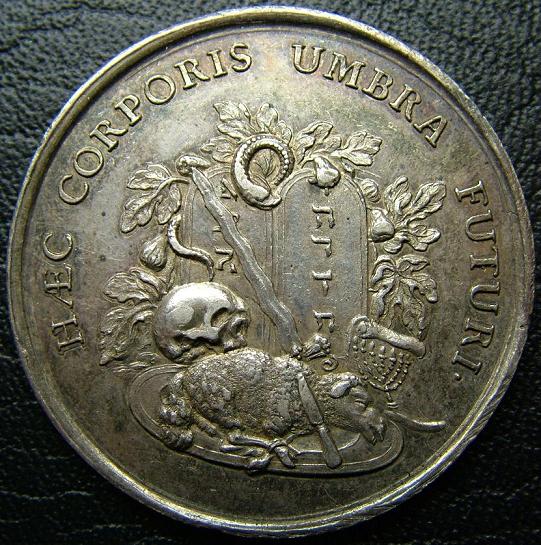 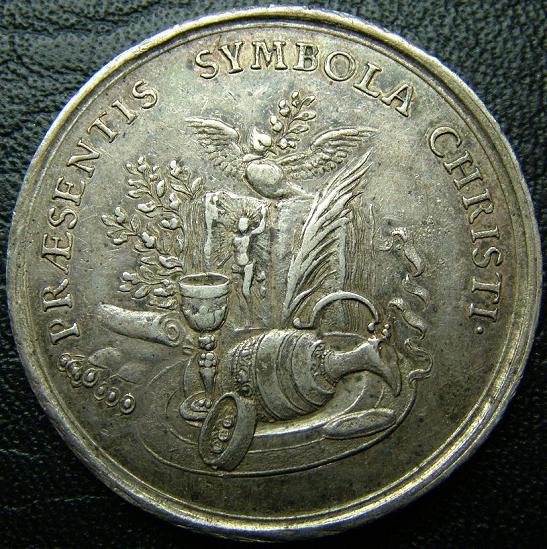 H'EC CORPORIS UMBRA FUTURI REV: PR(A)ESENTIS SYMBOLA CHRISTI The free translation of the medal is something like: The shadow of the past changed into the symbols of christianity. The inscrition is in Latin or Italian. The medal has a satirical aroma/flavor. Medal is 40 mm (Millimeter) in diameter and weight 21.10 Grams. Medal is not listed in Friedenberg as Anti-Semitic medal and I can't find any info' on it on my other Catalogs and books. Medal is not signed. So my Questions are: A)Does anyone know who made this medal? B)when it was made (A year will be grait)? C)Is it Italian as I think? D)Does anyone saw this medal in any book? Any referance? Please help me to identify it. P L E A S E. Thank you very much, C. Eliyahu. |
|
|
|
Moderator
 United States
23731 Posts |
 , to the community, Very nice medal, lots of symbolism, haven't been able to locate any information on it though. Are there any marks along the edge? |
|
Pillar of the Community
United States
1429 Posts |
Eliyahu,
I dont know much about it except the Hebrew writing and the fabulous design. Great addition to your collection.
Regards,
Zohar
|
|
Valued Member
United States
245 Posts |
Futuri Latin for Future
UMBR Latin for shade; ghost; shadow
CORPORIS substantial/material/concrete object/body; particle/atom; corporation| guild
|
|
New Member
 Israel
25 Posts |
Thank you for your replies. Unfortunately, there are no marks along the edge.
As to the meaning of the medal and inscription: As Figman did, so am I. I translated the inscription word by word and find it a mix of Latin and Italian (?), that what makes me think it's Italian in origin. In the end I came to free translate as I proposed: The shadow of the past (In the side of the Hebrew symbols) and something like: Changed into the symbols of Christianity.
But all the Questions still stands. I will post another silver medal out of my private collection which I can't identified of waterloo battle(?).
Many thanks for the responses,
C. Eliyahu.
|
|
Valued Member
United States
245 Posts |
The Figman sees Figs & Fig leafs, my kind of coin.
Also looks like a Minora too.
|
|
Valued Member
Netherlands
376 Posts |
I believe this is an Antwerp medal of round and about 1750- 1850 which has something to do with a church or monastery. The vanitas skull and dove of peace tells me so. Latin text is catholic-minded. Never the less, the absence of makersname tells me that it is something clerical. Lettering suggest early belgian, maybe G. Braemt.
Edited by valutarick
06/21/2009 11:54 am
|
|
New Member
Israel
25 Posts |
Thank you very much, any info' helps. The fact that it doesn't have maker name does't necessarily means that it's clerical to me, because when an artist believe that it's work will scream his name, he sometimes not sign/mark it.
Thanks again,
C. Eliyahu.
|
|
New Member
United States
32 Posts |
It is a beatiful coin, Id love to hear more about it
|
|
Moderator
Australia
16974 Posts |
I don't think there's anything specifically anti-Semitic about it. The two motifs seem to me to be based on 2 Corinthians 3:6 - "The Law kills, but the Spirit gives life". Of course, that doesn't mean that the makers of this medal weren't the kind of people that would use this verse (and others) to justify anti-Semitism.
Don't say "infinitely" when you mean "very"; otherwise, you'll have no word left when you want to talk about something really infinite. - C. S. Lewis
|
|
New Member
Israel
25 Posts |
I think that's the point of the artist/maker who made this medal Sap. The artist/maker convey his message mostly by art.
Look at the side that describe the Judaism, the way I see it the medal describe the Judaism and The Old Testimony as religion of war, cruelty and death : Skull, snake wrapped around the Ten commandments, on the plate a sheep with knife on his neck perhaps as symbol to Jewish slaughter ritual, the leafs are pointing downwards. This side of the medal gives a gloomy feeling.
In contrast, the Christian religion/The New Testimony described as the successful religion: A figure -perhaps Jesus- raising his hand upwards and this time on the plate we find pieces that perhaps symbolize the richness and prosperity of Christianity. Also, the leaf are pointing upwards ext' ext' ext'.
Now, add the discription that clearly state that the Judaism is Umbra (Shadow). So, the medal is not saying "I hate Jews" or something like that but it has something to do with that indirectly.
Thank you for your reply,
C. Eliyahu.
|
|
Valued Member
Netherlands
376 Posts |
Antwerp in Belgium has a large percentage inhabitants of Jewish origin, as did Amsterdam in Holland. remember diamonds are forever...grinn. In Holland we call these kind of medaltokens pieces of History. Looking by the way it has been struck it is the firm belief that it is a Belgian origin. The rim tells me so. Go to Antwerp and look for churches and synagoges, there you may find your answer.
|
|
New Member
Israel
25 Posts |
I will try to do that Valutarick.
Thank you very much again,
C. Eliyahu.
|
|
New Member
Israel
25 Posts |
As to now, no new information was found about this medal, in spite of my best effort. If anyone know by whom it was made or definite country in which it was made in, in what year ext' will much apprecaite it.
I'm sure it wasn't done by Jewish maker and the meaning of the medal is known (More or less, see the correspondence above). All other information is still bleary.
C. Eliyahu.
|
|
Valued Member
Israel
84 Posts |
A great coin for the collection.
I found this: Italy(?): religious/ Church medal in white metal/ silver(?), ND (mid 18th Century); not maker-marked; size: 39mm; weight: 21.15g. Obverse: images associated with Judaism; Latin legend "HÆC CORPORIS UMBRA FUTURI" ('The Body Shadow'). Reverse: images of wine and literature; Latin legend above "PRÆSENTIS SYMBOLA CHRISTI" ('Feast of the Christ'). A known but unidentified medal (Sally Rosenberg 1932 #1308; "Numophylacii Ampachiani" cat. 1830 pt 2 #8987): per Rosenberg the artist is Martin Omeis; per Antoine-Feill (1908) it's "EF" (which Bernhard, "Medaillen und Plaketten" p.213, renders as Carl Enhörning).
|
|
Valued Member
United States
172 Posts |
What a beautiful old medal. Regarding interpretation, I think it's a Christian medal representing the Holy Communion (aka Eucharist or Lord's Supper) involving the symbolic consumption of the body and blood of Christ. The dead Jewish lamb represents the body of Christ (Christ is often called the Lamb of God), and the chalice, presumably with wine, represents the blood of Christ. I don't see anything anti-Semitic about it.
|
| |
Replies: 17 / Views: 6,072 |










 Posted 06/20/2009 12:32 pm


