Quote:
Of course this makes the assumption that coins are going to be used in the future.
Agreed; it would be much easier to implement the switch to a unified currency once physical money is obsolete and all transactions are electronic. After all, if your money's just electrons in a computer, it won't matter whether those electrons are called dollars, euros, credits, or whatever. However, most of the world is nowhere near ready to make this switch.
Quote:
I didn't find any thoughts like how it would be workable in such a large scale. For example same interest rate in fast growing countries and in low growing countries? This is one thing which could go wrong in Eurozone too, because there are such a different types of economies in same currency zone. Do they have any deeper thoughts about these "boring basic things"?
The euro as it now stands is a voluntary unified currency. First, countries have to volunteer to join the EU, then commit to reforming their economy to bring it up to Eurozone standard before joining the euro. If a country (like Switzerland) doesn't want to be a part of either, they don't have to be. And presumably, if a country goes rogue and decides to stop supporting euro-friendly policies, the EU will kick them out again. So far, most countries in Europe are choosing to join, and those that join are choosing to stay.
But most of the rest of the world does not share Europe's warm fuzzy let's-all-get-togetherness. Many countries in Asia, Africa and Latin America hate each other's guts - the ones that aren't tearing themselves apart in civil wars, that is. There's no way any but a small minority would voluntarily hand over control of their economies in the way a unified currency would require - not without some sort of "carrot" to encourage them. In Europe, the "carrot" is EU membership - which allows overpopulated and underdeveloped countries to both export their surplus unemployed population and attract wealth and interest from the wealtheir member-states. But I can't see any kind of world-wide political union analogous to the EU forming, voluntarily, anytime soon. The UN simply isn't designed for that role.
Of course, some evil dictator could always go around conquering everybody again. It's happened before - Hitler made the reichsmark a defacto European currency and before him, Napoleon brought quite a good deal of the world into the French economic sphere, and several of those countries kept the French economic system in place, even after the French left. But nobody's powerful enough to conquer everywhere at the moment - not even the Americans.
Rather than forming all at once, I believe currency unification will most likely be a gradual thing. The Eurozone will continue to expand, probably to include some of the better-off nations in Asia, Africa and South America. Other currency unions native to those places will form and the ones currently in existence there (such as the CFA franc in Africa) will expand, until you eventually have a dozen or so currency blocs: the monetary unions, and the few national currencies big enough to compete with the blocs on their own (US$, yen, RMB yuan, perhaps some others). These blocs may eventually merge, but it will be a long and gradual process - several generations away from now, at least.
All of this, of course, requires no further major world wars, disasters or other disruptions to break out. Any such conflict would destroy all efforts at monetary unification, just as the French-backed Latin Monetary Union was killed off by World War I. Humans being what they are, I'm not optimistic of the world's chances of avoiding another world war for several more generations. In the aftermath of such a war, currency reunification efforts would have to restart all over again.
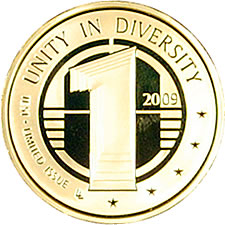
As for this particular coin: crackpot idealists have been producing "prototype world currencies" for decades now; the Krause "Unusual World Coins" book has pages full of them. This "coin" is no different.
Don't say "infinitely" when you mean "very"; otherwise, you'll have no word left when you want to talk about something really infinite. - C. S. Lewis









 Posted 07/21/2009 8:43 pm





 A nice PR gag though.


