Quote:
Bullnuke...huntsman53 will take your advice and not attempt to clean. Do you really think it is worth sending to NCS?
Kie
Kie,
First off, I would contact someone at Coneca...possibly Mike Diamond at
http://www.conecaonline.org0 or Ken Potter at
http://koinpro.tripod.com/ to have the coin looked at. As far as I know and of this date, there has been only one other 1992-P "
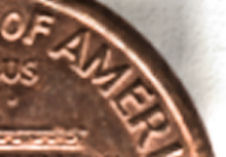
Close AM"
Lincoln Cent (the Discovery specimen) found so far and your's is several grades higher in condition. So, yes! Once Coneca or Ken Potter verifies that it is a genuine 1992-P "
Close AM"
Lincoln Cent, it would be worth the cost of having it conserved before grading, certification and attribution. Off course, if Coneca or Ken Potter puts their' seal of approval on the coin, then you could just submit it for grading, certification and attribution, then sell it and let the buyer worry about the corrosion (possibly getting worse). However, by having it conserved then graded, certified and attributed, the coin might fetch more at auction but then again it may not!
For more information about this Variety, go to the link below. I have also copied and pasted the article from Coneca's website and have highlighted the important parts in bold print.
Good luck...Frank
http://hermes.csd.net/~coneca/November 23, 2008 -- CONECA Member, Joe Thompson reports finding a 1998 '
Wide AM'
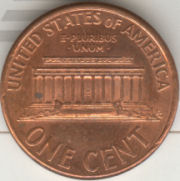
Lincoln Cent in his pocket change. In the image of the uppermost coin you can see the normal '
Close AM' variety, which sports an M of AMERICA that is shifted close left to A of AMERICA and far from the E. The lower image is of the '
Wide AM variety, which exhibits an M that is well centered between the A and E of AMERICA.
Frank Gasparro's designer initials, FG, are found further from the lower right side of the Memorial building on the '
Close AM' variety than on the
Wide AM where they are, of course, closer.
The '
Wide AM' variety was created when the Mint inadvertently processed dies intended for proof coinage as business strike dies. The same error occurred again in 1999 and 2000. Conversely, some 1998-S and 1999-S proof cents can be found mated with a reverse die bearing the '
Close AM' business strike reverse processed as proof dies.
Additionally, somehow just before the transition in 1993 after the new ' Close AM' dies were prepared at least one ' Close AM' die (for each Mint) was used to produce a very small quantity of 1992 and 1992-D cents with the Close AM design (everything prior to 1993 should have been ' Wide AM'). These are presumed by some to be test-strikes minted at the end of 1992 to make sure the dies were compatible for striking with the obverse designs. Both 1992 and 1992-D ' Close AM' varieties are very rare in any grade. Another more minor reverse design style transitional variety is known for the 1988 cent. You can learn more it here: Design Varieties
http://www.varietyvista.com/Design%20Varieties.htm.







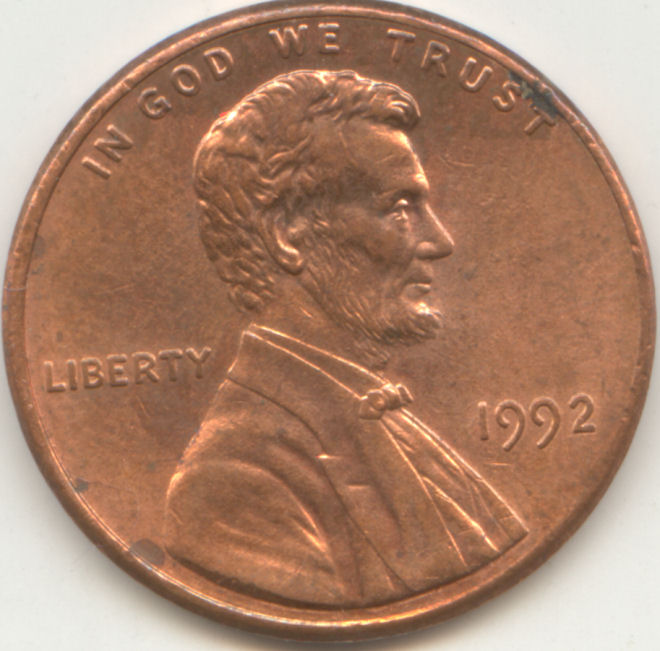
 . Looked like someone had returned the rolls to the bank after searching based on the date groupings in each roll. Then on the 99th roll 3/4 of the way through I found what I am sure is a 92
  . Made all those other rolls worth the search

 .
.


 Posted 07/24/2009 5:42 pm


 )
)