| Author |
 Replies: 28 / Views: 6,381 Replies: 28 / Views: 6,381 |
|
Pillar of the Community
United States
1415 Posts |
This doesn't look too bad. or does it? Where's SwamperBob? I be catchin up to you!!  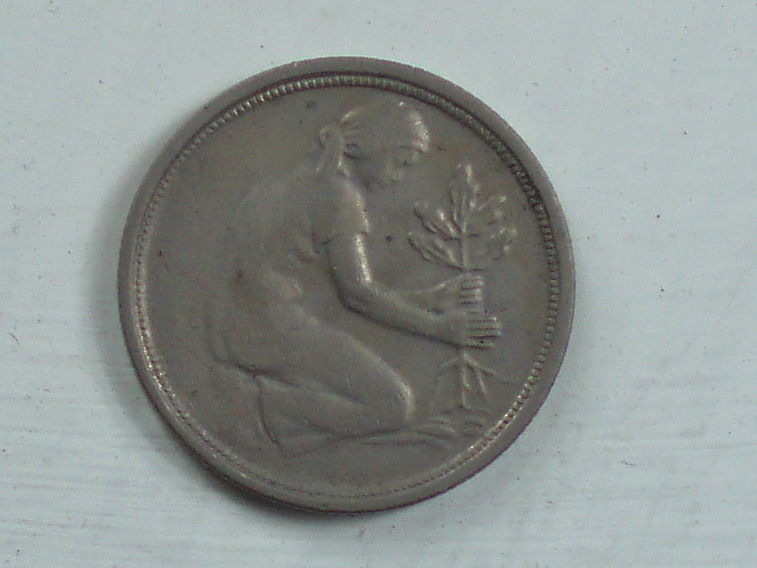 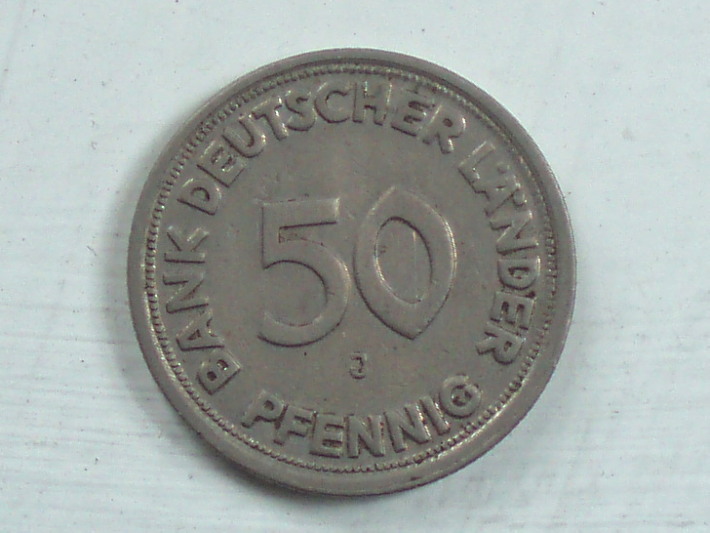 |
|
|
|
Pillar of the Community
United States
3098 Posts |
*ahem* I THINK IT'S FAKE!  The strike quality looks cast... would there actually have been people making fake 50pfs? And sorry I'm not swamperbob. |
|
Pillar of the Community
Thailand
1509 Posts |
Krause has the BANK DEUTSCHER LANDER as KM#104 but only lists 1950G and then as an unauthorized restrike.
The 1950J issue (KM#109.1) should be BUNDESREPUBLIK DEUTSCHLAND. Is the date readable below the kneeling figure?
|
|
Pillar of the Community
United States
5362 Posts |
My specialty is Mexican Republican, but from what I know about German issues post WWII, the coin does not look all that bad. I would not be overly suspicious of it being a forgery. The coin was Copper-nickel (hard to strike) and the die with the woman kneeling looks like it has very soft details. Those factors combined with a recovering ecconomy and high mintages and you have a scenario where extending die life would be an objective. That means lower striking pressure and a loss of detial. I have seen several dates of this particular type with a similar weak look. There are no other obvious signs of forgery that I can see.
|
|
Pillar of the Community
Thailand
1509 Posts |
If, as swamperbob says, it looks kosher then it would be an unlisted km#104? Still can't make out any detail of the date from the picture.
|
|
Pillar of the Community
 United States
1415 Posts |
thai-vic,
Nope no date - not even a trace.
|
|
Pillar of the Community
Thailand
1509 Posts |
If there is no trace and it's completely worn then it could only be a 1949. This is the only year with the J mintmark for #104.
|
|
Pillar of the Community
Germany
1238 Posts |
Must be a 1949 piece. Hamburg (J) did not make any "Bank deutscher Länder" pieces with the 1950 date. Karlsruhe (G) did, but those are not really "unauthorized restrikes". Right, the mints were not supposed to make them - the Federal Republic of Germany was founded in May 1949, and some time later the country's name was to appear on the pieces instead. Karlsruhe accidentally made some 1950 BdL pieces, and the government then decided that it was OK to issue them.
Quite a few of those 50 Pfennig 1949 "Bank deutscher Länder" coins have partly "missing" years. Problem is that the year on the 50 Pf coins is small - and if you have dirty or worn dies, well ... Such coins with a completely missing date are not common, but not expensive rarities either.
Christian
Edited by chrisild
07/25/2009 06:08 am
|
|
Pillar of the Community
United States
1415 Posts |
Still a curiosity to me. There is no trace of a date. I would think that something would have been there even if grease filled. That is one reason I picked this up. Second was for this one to have a mate. 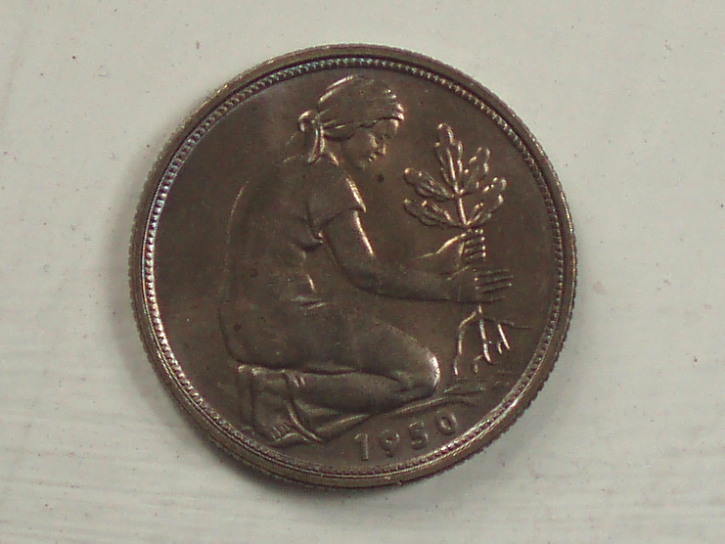 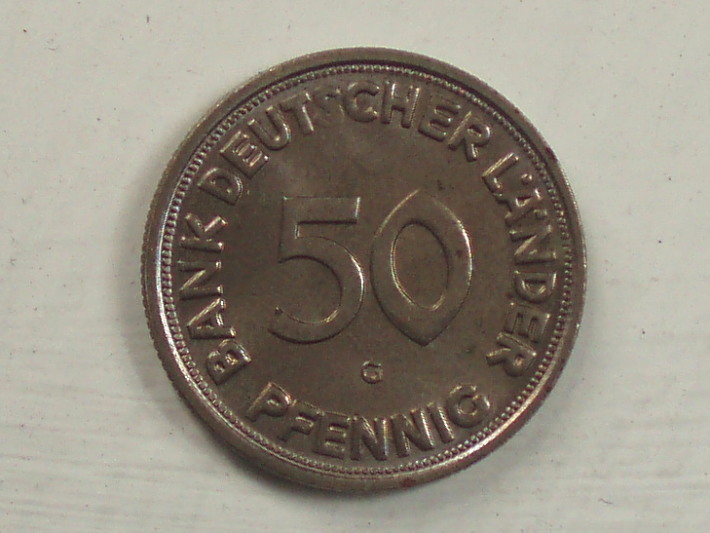 |
|
Pillar of the Community
United States
5362 Posts |
When a die fills with "grease" it can totally obliterate any die feature. Grease is a term that is quite misleading. The grease that fills a die and stays there is actually a mixture of lubricating grease, dirt and metal dust from the mechanism. It is VERY hard - approaching the strength of the die itself - otherwise the strike pressure would push the grease out of the way. It is not soft by any means. If you check large numbers of mint rolls/bags, as I have, you will find pieces of this material from time to time on individual coins and in the bags. It is HARD. I once found a 1996 US Quarter with a large "grease spot" that crossed part of the eagle. Part of the eagle was obviously missing because some of the grease had pulled away. I put the coin in acetone (which as it turned out was a big mistake). The grease dissolved and more of the eagle was missing. The dealer I worked for at the time said it would have been worth more if I left the grease in place. I think this kind of error stretches the point a bit. It is a curio - part of everyday life in the coining environment. I didn't see it as a "numismatic collectible". In fact if the "grease" fill that clogs one number is dislodged intact and stays on the die surface you can actually get a coin with an impression of the grease letter driven into the coin. I have seen a Lincoln Cent with a second D produced in just this way. Some stray "clash marks" and some random "strike through" coins are made this way. One last comment, I also notice that the woman's feet are nearly gone as well. Could be die wear could be grease either way it is one of those common "die state" situations that can be informative and curious while not being super valuable. Edited by swamperbob
07/25/2009 1:39 pm
|
|
Pillar of the Community
Germany
1238 Posts |
Quote:
Second was for this one to have a mate. Now this one is not only rare but also a beauty indeed. But maybe she should stay single.  Christian |
|
Pillar of the Community
Canada
1248 Posts |
Hello, there is an expert for these in Germany. he is well known his name is Guy Franquinett http://www.franquinet.dehere are 3 50 PF. all supposed to be 1950G ?  careful..... there are chinese forgeries around..., a lot of them.. Guy would be able to say with certainty what this one is..... good luck HHB |
|
Valued Member
Australia
432 Posts |
I agree with hbb - Guy is the place to go for a definitive yes/no... If this is indeed a 1950J BdL, it will be worth a fortune (as there are NO records of this die combination ever being struck)... If its a 1950G BdL, do a search on this forum for 'Karlsruher Münzskandal', I remember writing a post about the 1950G BdL and the Münzskandal; a Genuine 1950G is worth hanging onto as well...
Now, from your pictures, I cant make out any outline of a date (perhaps that is just the picture?) and the 'softness' of the reverse features seems to contrast with the obverse features is unusual (again tho, could simply be the picture?). If the pictures you have posted DO the coin Justice, I would be somewhat suspicious and getting the coin looked at by some ppl who know their German stuff. Then, if you're feeling good about it, get it to Guy... As I said, a 1950J BdL is NOT mentioned in any of the Mint Records, Bundesgesetzblatt or BdL/Bundesbank records I have!
|
|
Pillar of the Community
United States
1415 Posts |
Zaggy, Glad to see that you are still around. As for the 'J' not sure what is up with it. I probably should not have indicated the year(1950). There is absolutely no marks whatsoever where the date should be. It looks like it was never on the dies? Also the composition of the coin is entirely different than the 1950G. The 'J' does not appear to be cast. Looks like a really 'soft' strike. With the different composition, soft strike and no date, I was thinking maybe a 'pattern' or test coin? All ideas to be accepted.  |
|
Pillar of the Community
Philippines
1156 Posts |
I have a 1949F 50 pfennig, is it as rare as the 1950 pfennig or just common? thanks
|
|
Pillar of the Community
Germany
1238 Posts |
The 1949 coin is actually pretty common. An F (Stuttgart) piece would cost about €50 in unc.condition, but that type is usually somewhat (or very) worn, thus less than €1. These "Bank deutscher Länder" coins were designed before the Federal Republic of Germany was founded on 23 May 1949. The later pieces, as from 1950, have the country name (Bundesrepublik Deutschland). Only the "1949" and "BdL" combination is rare ...
Christian
|
| |
Replies: 28 / Views: 6,381 |










 Posted 07/24/2009 11:29 pm


