| Author |
 Replies: 9 / Views: 3,534 Replies: 9 / Views: 3,534 |
|
|
New Member
United States
13 Posts |
OK, I'm still new to collecting, but I found this guy roll searching the other day. I think it's a double clipped planchet, can you guys that know what you're talking about verify this for me, and if so, how do I determine the value if I wish to ebay it? 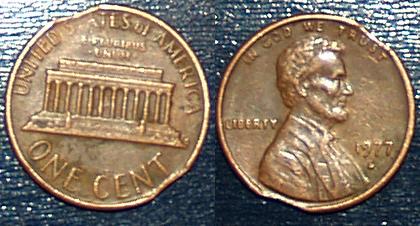 |
|
|
|
Bedrock of the Community
United States
62064 Posts |
Closer images of the clipped areas would help. You should note a weakening of the rim gradually and the devices weakening near the clip. The location of the clips are very close to how the coin strip would punch them. See if this image helps? 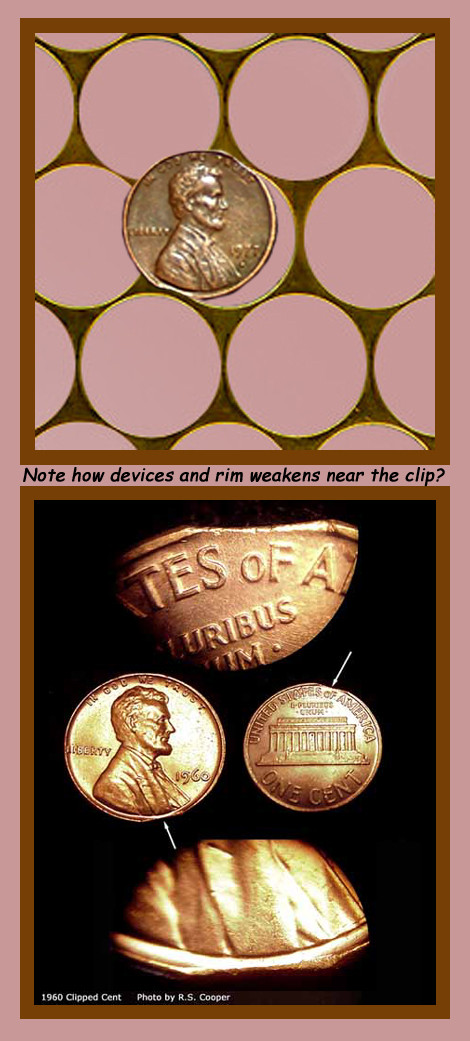 |
|
New Member
 United States
13 Posts |
I'm not sure what you mean by "weakening". Also, these are about the best pics I can get. Took 8 tries just to get this quality.
|
|
Bedrock of the Community
United States
62064 Posts |
On a coin that was clipped outside of the mint, the area where the rim and the fields would be flattened, the rim would be sharp instead of weakening gradually like the example of the 1960 I posted. You might be able to tell with the images provided. sorry I don't have an example of a faked one to show, just the real thing.
|
|
Pillar of the Community
United States
7629 Posts |
The 1977D cent posted in the original thread is a genuine double curved clip. It's worth up to around $5.
That's really all it took, eh Coop? Remember that some people who post here don't understand a bunch of numismatic jabber, and don't really need the stuff explained in great detail. They just want an answer without having to solve a riddle to get it.
|
|
Pillar of the Community
United States
1807 Posts |
With all due respect coppercoins, I like the jabber. And thanks to the both of you this site is very educational.
|
|
Pillar of the Community
United States
7629 Posts |
I understand, but sometimes, especially with novice collectors, trying to explain all the whats, whys, and hows just confuses them more than it answers their questions. A simple what it is and what its value is would suffice in this case. If follow-up questions are asked, then it's time for the jabber. I'm not against the education at all...but only so much of it is helpful - and at the right time.
|
|
New Member
United States
13 Posts |
Actually, I was looking for the answer, (thanks copper), AND the reason why. (thanks coop).  I think I understand now how to tell if it's genuine or not, but determining the value is now confusing me. Looking at the '09 North America Red Book, on page 101 it lists values for different types of clips. the one I think my coin fits into is row I-C-6 saying a coin with this type values:$10up. So why is mine only worth $5? the condition? Edited by morgantime
08/04/2009 1:20 pm
|
|
Pillar of the Community
United States
7629 Posts |
Because $5 is a good starting point for something like this. Not only does the condition come into play, but the depth of the clips, and whether or not something like this is common or scarce for that particular date. You could get anywhere from $5-$25 for the coin depending on where you sell it, how you sell it, and who buys it. I wouldn't want to say it's worth $25 and have you out there trying to sell it for that because it probably wouldn't sell. If you start it at an auction at $5, it will probably sell for that and then some, especially if you expose it to a number of clip collectors who have a chance to bid-war for it.
No matter what 'price guide' you find for errors, each and every coin is unique unto itself, so the idea of an exact value for any error is an abstract idea with as many answers as people answering. It's not nearly as exact as values for non-error coins. Bottom line, though, is that these are not very common, but they are not scarce either. A value of a few dollars is the starting point, and if you get more than that, great!
|
|
Pillar of the Community
United States
7629 Posts |
BTW, my records indicate a sale of a 1969S cent in in 2002 grading MS64RD with a triple rim clip for $22.50 if that helps any. Triple clips are far less common than double clips, and uncirculated red cent errors sell far better than circulated examples.
|
| |
Replies: 9 / Views: 3,534 |
|






 Posted 08/03/2009 5:58 pm





