| Author |
 Replies: 14 / Views: 1,266 Replies: 14 / Views: 1,266 |
|
|
Valued Member
United States
273 Posts |
|
|
|
|
Bedrock of the Community
United States
14454 Posts |
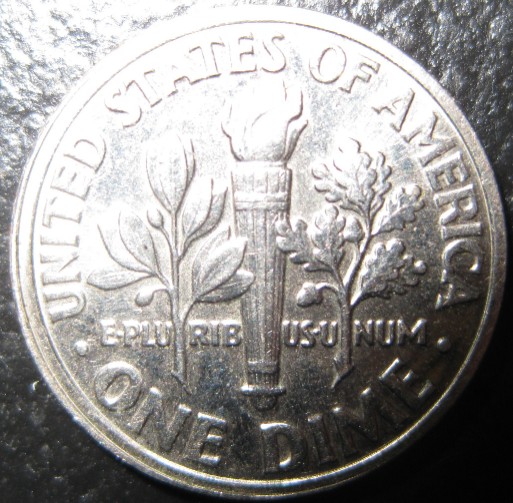
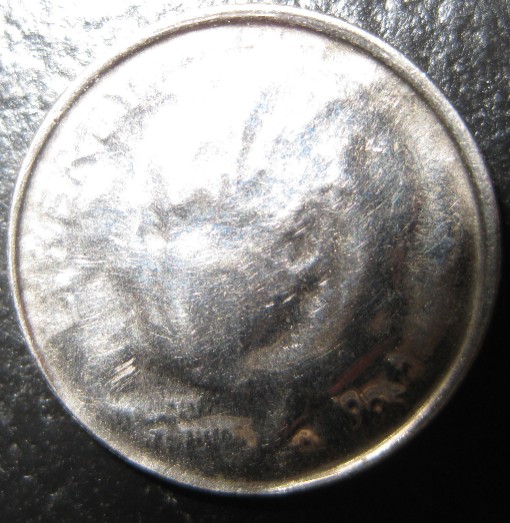
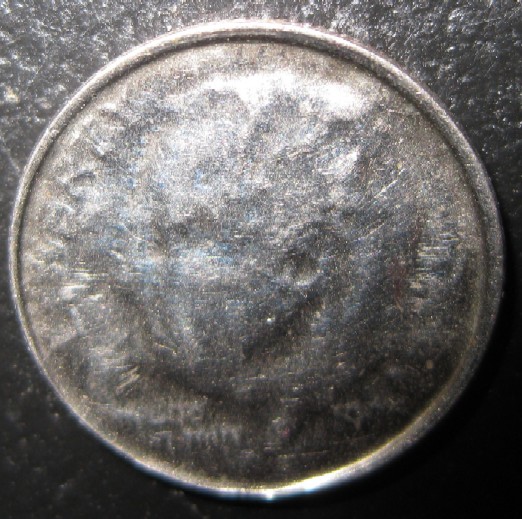
looks like a capped die to me, its done where another coin is stuck to the obverse die and that coin was struck with with the obverse die capped with the other coin, or that is the coin that was stuck on the die. I am not an error expert but thats what it looks like to me
|
|
Bedrock of the Community
United States
62064 Posts |
Late die stage capped die. Worth hanging onto and not put back into circulation. Nice find.
|
|
Pillar of the Community
United States
2752 Posts |
It's a generic capped die strike. Struck by a late-stage die cap.
Error coin writer and researcher.
Edited by mikediamond
08/17/2009 09:50 am
|
|
Bedrock of the Community
United States
14454 Posts |
woohoo I finally got a error correct  |
|
Valued Member
 United States
273 Posts |
Thanks for the help on the id. I had read something about capped die errors in an earlier post and suspected thats what it was, but I'm mostly a bill collector so I wanted to be sure. However what do you mean by late stage and how can you tell that difference between an early, mid, or late stage. Thanks again for the help.
|
|
Pillar of the Community
United States
3640 Posts |
The die stages refer to the age/use of that particular
die. When the die is new it would be Early Stage (EDS)
As more coins are minted from that die the die would start to wear
then approach Middle Stage (MDS) then eventually Late Stage (LDS)
As the die wears the coins devices are not as crisp etc. You have to look at many coins to compare and get to know the slight differences.
There are many resources online to show you also. Your particular coin
would have to be verified by someone who has seen many of these in various die stages. Such as the people who responded to this post.
|
|
Valued Member
United States
265 Posts |
Nice find! I would love to have a pocket change find like that!
|
|
Valued Member
United States
273 Posts |
Thanks for the info Indian. I guess I will have to look some picture up online so I can tell the differences myself. I'm also assuming that an early stage would be more desirable than a late one. Again thanks for the help.
|
|
Valued Member
United States
321 Posts |
I got a quarter that looks like that. hmmm
|
|
Pillar of the Community
United States
3507 Posts |
Hi,
Indian1 did a nice job of explaining Die Stages in general.
It is a little different when we talk about capped die strikes.
An Early stage is when the "Cap" is newly stuck to the die (Usually the hammer die). If the die "cap" is a coin and not a planchet, the first few coins struck while the die is capped will be "brockages" . The coin that is stuck to the die will act as a die itself and impart details to the coin being struck.
As the die cap progresses to a Mid stage, the details imparted by the die cap become distorted as each strike causes the coin that is stuck to the die to thin out. So a Mid-stage die cap will have a distorted but still somewhat identifiable image of the details imparted to it by the die cap.
A coin struck by a late stage die cap, such as the one above, is essentially struck through a thin layer of metal that is the die cap after it has been flattened to a point where the details from the coin that was stuck to the die are pretty much obliterated.
Being struck through that very thin layer of metal will cause the effect as seen on the coin at the beginning of this thread.
It may sound confusing, but with die caps, the stages depend on the condition of the coin that is stuck to the die.
Thanks,
Bill
Edited by foundinrolls
08/19/2009 4:08 pm
|
|
Valued Member
United States
273 Posts |
Lets see if I understand what you are saying. Planchet gets struck and then stuck, usually to the hammer die. New planchet is put in place and struck with capped die. The first few planchets struck in this manner will have a reversed image on one side. After a few coins have been struck the cap becomes thinner and the reverse image becomes weaker. Eventually the cap is almost nothing so the image from the die starts to get through again like on the coin I found. Is that essentially what you are saying. Thank you for the explanation it make the coin that much cooler to me  . |
|
Bedrock of the Community
United States
62064 Posts |
Edited by coop
08/19/2009 7:37 pm
|
|
Pillar of the Community
United States
2752 Posts |
Actually, the middle coin -- the one with the brockage on the reverse face -- is probably not a die cap. I know they're always labeled as such. But these coins are the mate of a double-struck reverse die cap. The evidence that such coins are struck only once is as follows:
1. A smooth transition between floor and wall.
2. A crisp incuse outline of Lincoln's bust on the reverse. If this had been struck more than once (the second time against another planchet), the brockage would have been obliterated or nearly so.
3. The expansion of the brockage is equivalent to the expansion seen in two-strike reverse die caps (the mate of such a coin).
4. 99% of broadstruck coins with full, first strike brockages show cupping of this magnitude. If the cupping required more than one strike, we would expect to see coins with little or no cupping and the latter coins would predominate in the market. But such coins hardly exist, and most of these are probably the result of abnormally low striking pressure.
5. If these coins were die caps, there would be an even greater number of coins with counterbrockages. But I've only seen six in ten years.
6. In these coins there is relatively even expansion of the brockage from edge to center. If these were die caps there would be far greater expansion in the center. While the center may be somewhat more expanded than the periphery, this is more likely due to the fact that the center of the coin receives the full brunt of the strike while the perimeter squeezes out between the dies, escaping the full impact.
7. Cup-and-saucer mated pairs that feature a 2-strike reverse die cap (the vast majority), feature a "cup" that looks just like this. The top coin must be struck only once.
Error coin writer and researcher.
|
|
Valued Member
United States
273 Posts |
I don't don't think I was clear enough in my last post. What I mean to say was this: Planchet gets struck and then stuck, usually to the hammer die. New planchet is put in place and struck with capped die. The first few planchets struck in this manner will have a reversed image on one side. 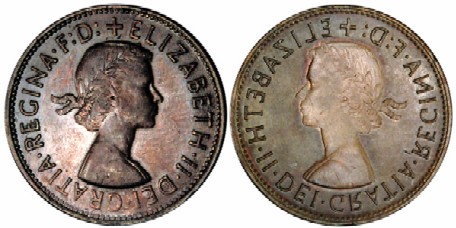 After a few coins have been struck the cap becomes thinner and the reverse image on struck planchets becomes weaker. 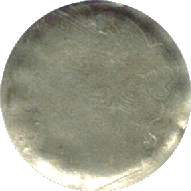 Eventually the cap is almost nothing so the image from the die starts to get through again on struck planchets like on the coin I found. I hope this is a little clearer and that I am getting the idea right. |
| |
Replies: 14 / Views: 1,266 |
|









 Posted 08/17/2009 02:54 am





