| Author |
 Replies: 11 / Views: 4,134 Replies: 11 / Views: 4,134 |
|
|
Pillar of the Community
United States
2335 Posts |
I went to an estate sale this weekend & this is one of the items I picked up. I am assuimg this is a fake or replica of some sort, but the estate had a lot of really high end items(oil paintings, antiques, silver, etc) & it was pretty cheap so I bought it. This thing weighs 14.4 grams & is 33mm in diameter. The hole in it is silver colored all the way through. Any idea what it is, or is supposed to be? I've heard that one of the companies that salvages shipwrecks takes silver bars & mints replicas. Could this be one of those? 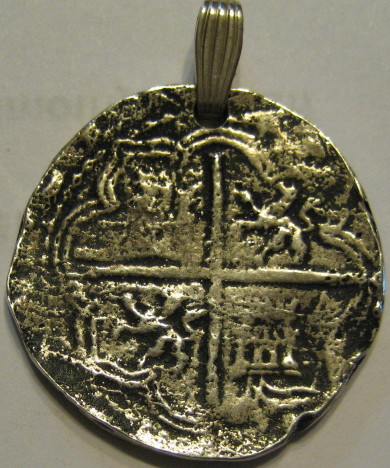 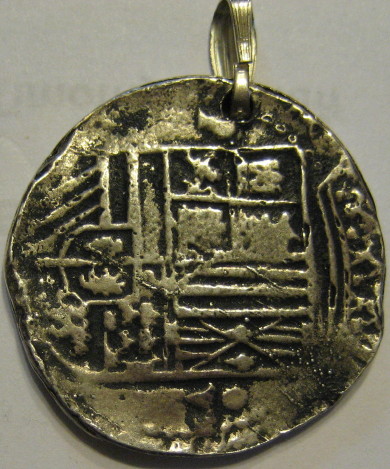 Identified - moved to World Coin forum - Sap Identified - moved to World Coin forum - Sap |
|
|
|
Pillar of the Community
Belgium
651 Posts |
This seems me to be a replica of a Spanish cob, possibly a 4 reales.
|
|
Moderator
 Australia
16982 Posts |
It could be a genuine shipwreck coin that's simply been very badly treated (first corroded by seawater, then harshly cleaned, then turned into jewellery), but I'm leaning more towards replica made for jewellery purposes; parts of the design just look too sloppy to be genuine. The die rotation on this coin is 90 degrees, not the usual zero or 180 - I don't think the Spanish mints would have been that sloppy, but an expert in the series like swamperbob might be able to confirm or deny this.
At 33mm diameter, it's supposed to be a 4 reales; the book weight for those is 13.5 grams, but the loop will throw your weight out. If it's solid silver, then it frankly doesn't make too much difference whether it's a real coin or not, in that condition. Take it to a jeweller to test it.
Don't say "infinitely" when you mean "very"; otherwise, you'll have no word left when you want to talk about something really infinite. - C. S. Lewis
|
|
Pillar of the Community
United States
3357 Posts |
It looks reale enough to me and very piratey. The assayer's mark is obliterated by what looks like seawater corrosion. I'd judge it to be from Potosi ca 1600-1620 and worth $50. If it were an old corroded hole it would probably be worth a little more, but this hole looks fresh.
"Two minutes ago I would have sold my chances for a tired dime." Fred Astaire
|
|
Pillar of the Community
 United States
2335 Posts |
This coin was priced at $5. I probably wouldn't have bought it except I was buying over 70 troy ounces of sterling silver(flatware & bowls) for a good bit less than melt. Even though I suspected it was a fake/replica I knew I would make more than enough on the silver to cover it.
Hopefully swamperbob will chime in with an expert opinion.
|
|
Pillar of the Community
United States
3357 Posts |
$5 sounds pretty good - right around melt if it's real. Silver content in these was supposed to be above sterling - 93.7%, if I remember right. $50 would be fair retail. The guy who could tell you whether it's a common fake is Daniel Sedwick. You might want to look around his sedwickcoins site to see comparables for sale and from previous auctions. You'll find by comparison that this cob is not desirable numismatically.
So what the heck. Put in your pocket and pretend you're a pirate for the afternoon.
"Two minutes ago I would have sold my chances for a tired dime." Fred Astaire
|
|
Pillar of the Community
United States
5362 Posts |
trdhrdr007 Looking at the coin - I believe it is a jewelery style reproduction. I say this for several reasons: 1. The weight is too high for a heavily corroded 4R and the coin is too light for an 8R to have any detail remaining. 2. There are numerous round casting lumps raised on the surface typical of metal upwelling on the cast surface. 3. There are some parallel raised lines that looks like mold issues that are clearly associated with a cast copy (several generations from the original) 4. I believe I see traces of an edge seam in two spots 5. I believe I may own a matching copy someplace in my non-catalogued cob copies. 6. I agree with Sap on the rotation issue the hammer die is held by hand and unless the "holder" rotates the die 90 degrees between strikes it is difficult to imagine such a rotation. Small rotations are COMMON - 90 degrees is no too common at all. Here is a diagram of the most serious problems I see: 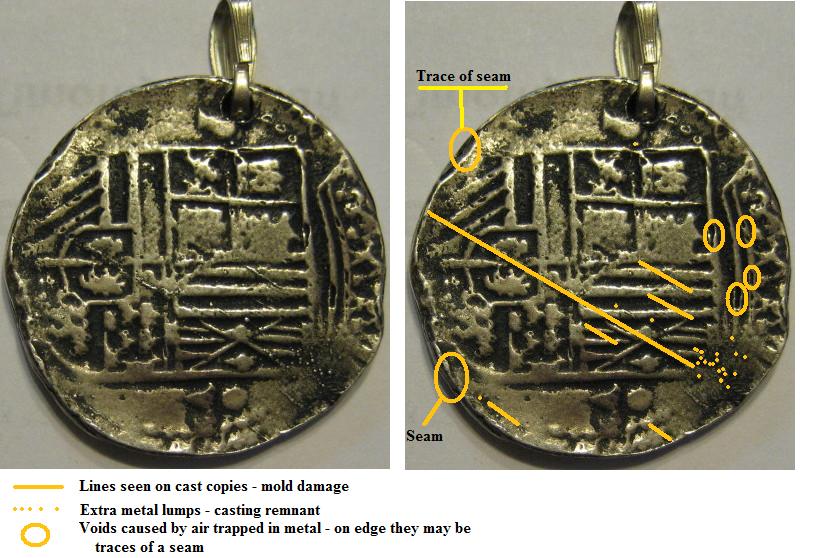 I agree salt water at times can do some funny things to a coin surface but this looks all wrong to me.
|
|
Pillar of the Community
United States
5362 Posts |
Just noticed I did not clearly ID the possible edge seams that I think I see. Edited by swamperbob
08/21/2009 5:21 pm
|
|
Pillar of the Community
United States
2335 Posts |
I knew if we could get swamperbob to chime in on this one we'd get a lot of detailed information. A couple of the things that I noticed & was suspicious of were the raised dots & the possibility of a seam on the edge. I guess I should have posted a good shot of the edge.
|
|
Pillar of the Community
Spain
1361 Posts |
this is real silver! I mean the loop  |
|
Pillar of the Community
United States
2335 Posts |
Even though this is a replica the weight, size & in hand "feel" of the coins make me believe it's silver.
|
|
Pillar of the Community
United States
5362 Posts |
Specific gravity should be able to tell quickly. Coins smaller than 2R are tough but a coin of this size is usually easy.
It already has a suspension hole so a small thread even removes the need for making a hangar correction.
|
| |
Replies: 11 / Views: 4,134 |
|








 Posted 08/20/2009 10:34 am


