| Author |
 Replies: 8 / Views: 2,229 Replies: 8 / Views: 2,229 |
|
|
New Member
Australia
34 Posts |
Hello, I'm still going through my collection that was given to me and can not work out which note this is in the renniks book. The serial number and signitures dont match according to the book. There are so many variations that I dont know which one is which. Please help me. Its the bottom note that I'm talking about. If people can advise on the other notes please feel free to comment and share info or even gradings if they dare. Cheers Damo 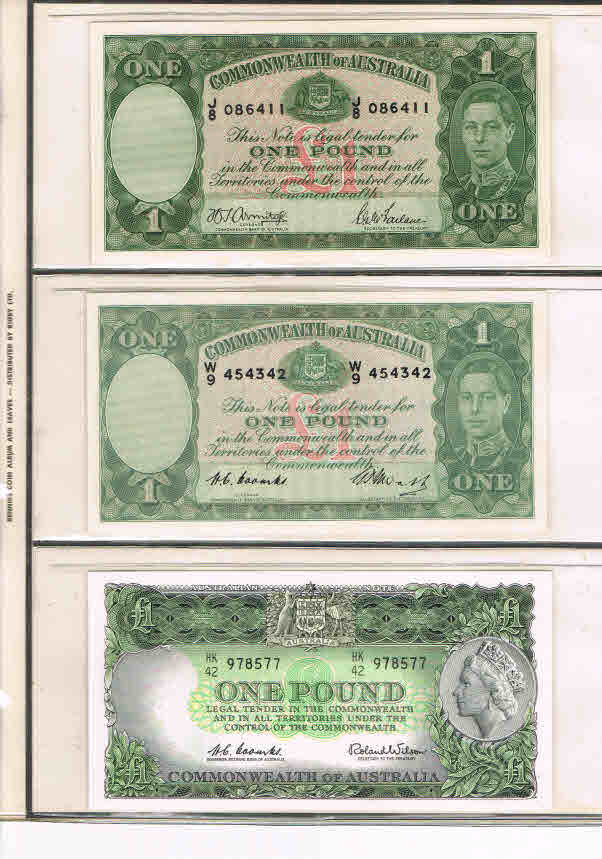 |
|
|
|
Moderator
 Australia
16982 Posts |
The bottom note is a regular Coombs-Wilson Reserve Bank issue. You'll see in the Renniks that, somewhere in between HF66 and HK68, they switched ink colours on the back from "dark green" (R34a, Mc51) to "emerald green" (R34b, Mc52). The experts apparently don't know exactly were the transition point is.
If you're having difficulty telling whether it's "emerald green" or "dark green", you're probably not alone. You probably need to see the two colours side-by-side with yours to know for sure; I'd suggest taking it to a dealer or an IBNS meeting and see if they can spot the colour for you.
If it means anything, I only have two £1 notes: HJ87 and HK60. To my eyes, they look the same colour, and HK60 is definitely "emerald" class, so on balance of probabilities, yours (which lies in between my two numbers) also is "emerald green".
Don't say "infinitely" when you mean "very"; otherwise, you'll have no word left when you want to talk about something really infinite. - C. S. Lewis
|
|
Pillar of the Community
Australia
2830 Posts |
quote: "If you're having difficulty telling whether it's "emerald green" or "dark green", you're probably not alone."
- I agree
quote: "You probably need to see the two colours side-by-side with yours to know for sure"
- that's the only way I can do it.
In the end, I decided that this "variety" was too trivial to concern myself with.
Peter in Darwin
|
|
New Member
 Australia
34 Posts |
Hey guys, thank you for your replys. After a few hours of actually pulling out the notes from there folders and having a look at them, most of my notes are defenitly UNC, I can not believe it, they dont even have a centre fold on most of the notes. Anyway, I have both, light green and dark green, 1 of each, serial numbers for light green are hk42 978577 (i can tell by the pound symbol on the front of the note, not on the back as you say) and for the dark green (by the pound symbol on the front, noticably darker, mind you these notes have not seen day light for 30 odd years) its hj88 995323, both are REALLY REALLY crisp with no folds or marks or bent corners. Would you class these as UNC?
|
|
New Member
Australia
34 Posts |
If someone could actually tell me how to make them smaller I would show you all of them. They are in JPEG format, from between 1.3mg to 700kb, if could make them smaller I will post them straight away.
Thank you
|
|
Pillar of the Community
Australia
1040 Posts |
You can download a program like Irfanview (do a google search) which is a picture editing program. It allows you to re-size, crop, etc. |
|
New Member
Australia
34 Posts |
Cheers Latman, I've scanned them up using a program I got, just want to put the notes in the proper area of this forum, which area do I do that?
|
|
Pillar of the Community
Australia
1040 Posts |
If they are Australian notes, start a new thread in this section of the Aussie forum. If there are a lot of notes, you may want to start a few different threads. If you have world notes as well, they should go in the world banknote section further up the main page.
|
|
Valued Member
Australia
363 Posts |
In regards to the original notes, the top one was issued in 1942 with signatures Armitage & Macfarlane, again dark green print. The middle note was issued in 1949 with signatures Coombs Watt. Cheers Simon.
|
| |
Replies: 8 / Views: 2,229 |
|









 Posted 12/24/2009 07:23 am


