| Author |
 Replies: 17 / Views: 2,963 Replies: 17 / Views: 2,963 |
|
Pillar of the Community
United States
1283 Posts |
I got them from Bank of America. I felt a little selfconscious at first because I thought the lady would look at me weird for asking for 2500 pennies. So I deposited some money and said, "Oh, and I would like 25 buck cash back. Do you mind if I get that in pennies?" She acted like it was a perfectly normal request and said, "Sure, I just have to get them from the back." And so it it went. The only thing is the box says "Inspected by #XXX." I hope the little rat didn't cherry pick my Lincolns! In any event I took a picture of the box. As far as varieties go, what are the major dates and mint marks I should separate to inspect later? 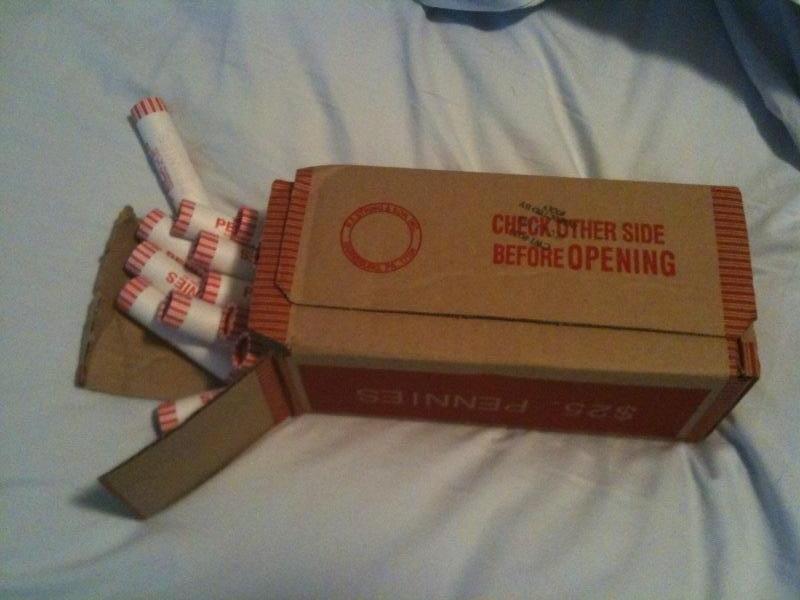 |
|
|
|
Valued Member
United States
57 Posts |
search for wheat backed coins first
|
|
Valued Member
United States
271 Posts |
Although a far from complete method....I like to first set them back in these piles.
-any wheat backs
-1970
-1983
-1984
-1998
-1999
-2000
All of them get a once over with a magnifying glass, however those dated in the list get tossed into a pile for looking over later. I look over those dates more closely. Of course there is some preference, for instance I only focus on 1970 S cents. The other mint marks much less so. And with the 98/99/2000, I only focus on the P mint cents.
|
|
Pillar of the Community
United States
2669 Posts |
Coppercoins has a separation technique that goes faster than usual. I think you separate by last digit then by decade digit (pretty sure that's how he outlined it.. I can't find that post but I'll keep looking for it). After that, if you inspect all one year at a time, you can spot anomalies faster. Look for doubling, anything else out of the ordinary. Small dates (1960 and 1970-S, I think, may be others). Repunched mint marks. There are way too many to list! As a starting point, when you're ready to peek at a certain year, you could look at coppercoins.com and see what's already attributed and decide how granular you want to be when searching. Keep in mind there are more varieties out there that have not yet been identified. Good luck and keep us posted.. of course we'll be wanting pictures  |
|
Pillar of the Community
United States
514 Posts |
It's been a while since I've searched cents. This was my routine: 1. Pre- or Post- 1982. The reason for this is the intrinsic value of the metal. The thought is to stockpile a large enough amount that you can sell it for scrap metal value. If you don't think it's worth it, by all means don't do it.  2. Separate pile for 1982s. When enough accumulated, weigh with a digital (or balance) scale. Also check for all of the varieties produced that year. 3. 1998, 1999, 2000: When enough accumulated, check for Wide-AM variety. 4. 1992: Set aside and check for Close-AM variety. If I were to start again, I would add: 5. 1983: Set aside and check for doubled-die reverse. Of course, you'll find the occasional wheatie and even rarer indian. I keep the wheaties separate even though the common ones aren't worth more than the 1959-1982 coppers. I also bought several folders, and pick through the piles of pre and post 1982s for nice examples to fill the slots. The question is: How will you return the ones you don't want? -wheatiefan |
|
Valued Member
United States
335 Posts |
When we search a box, my son is just looking for dates he doesn't have--which means 2009 LP3-D and LP4-D and wheat cents. Actually, we save all the 2009s. We never really bother looking for varieties.
I collect Canadian cents, so I check those, too. I collect the Canadians because after I introduced Simon to coin collecting, he wanted me to have something to look for, too. Living in Michigan, we get lots of Canadian change.
We also save the box to take back the re-rolled cents. We usually get a mix of different denominations, instead of just cents.
|
|
New Member
United States
16 Posts |
Good Luck with your box Paratrooper. The more I search cents the more I find there is to search for. I've only been at it for 2 years, but I enjoy it tremendously. By the way I was a member of the 101st. Airborne in Vietnam. Take care and good luck.
|
|
Moderator
 United States
16014 Posts |
No advice on what to look for .... just this .... enjoy.  David |
|
Valued Member
United States
258 Posts |
Break it down as follows 1. All 1981 and before coins seperated into wheats and memorial. 2. 1982 (seperate zinc and copper later) 3. 1983 (for errors) 4. 1992 p and d (for narrow am) 5. 1998 p, 1999 p and 2000 p (for Wide AM) 6. All bu coins with strong details in zinc. 7. Foreign coins (usually Canadian) 8. 2009 pennies 9. Any with S mintmark Keep all the coins you like and want and throw the rest back! Sincerely, John Leckrone Edited by 925dealer
01/05/2010 10:03 pm
|
|
Pillar of the Community
 United States
1283 Posts |
A quick spot report: I just went through half the box with my seven year old daughter and all we looked for were wheats. I'm starting there so she can be involved and I'm going to do the more tedious sorting and inspection later. Just thumbing for wheaties our finds haven't been stellar, but at least we haven't gone empty handed. Halfway through we found 1 55-D in VF 3 2009 Cents, all are P's and all are different. A Childhood, an Indiana and an Illinois. 5 Canadian pennies. 1 2003 Bermuda "Elizabeth II" Cent in BU red. No idea about this one as I only know US coins. 1 1985-P in stunning, spot-free BU red. |
|
Valued Member
United States
258 Posts |
The 1983-1986 zinc pennies are hard to find in bu condition so you are now well on your way to discovering the joys of "treasure hunting" in boxes of coins. May you continue to find some real treasures! Sincerely, John Leckrone
|
|
Valued Member
United States
429 Posts |
What is the final goal? Fill holes? Find Wheat's? When I search I do a couple of things: 1. Have a list of all the major coins you will need to look at (Double dates, Wide AM, etc.0 2. I then have containers for the different things I want to keep and look at later. 3. I save all the BU's I can find and put them into rolls of their own. 4. Put aside any that my kids may need for their collection. I use to save the older coppers but I was getting too many and I wanted newer ones to search through. If you want these as well, save them, if not just throw them back in and trade for more. |
|
Pillar of the Community
United States
2600 Posts |
USAP, welcome to the addiction.  Jim |
|
Valued Member
United States
53 Posts |
I think the "inspected by" just means that it was checked (weight) to make sure that there was 50 per roll.
|
|
Bedrock of the Community
United States
20069 Posts |
Quote:Break it down as follows 1. All 1981 and before coins seperated into wheats and memorial. 2. 1982 (seperate zinc and copper later) 3. 1983 (for errors) 4. 1992 p and d (for narrow am) 5. 1998 p, 1999 p and 2000 p (for Wide AM) 6. All bu coins with strong details in zinc. 7. Foreign coins (usually Canadian) 8. 2009 pennies 9. Any with S mintmark Keep all the coins you like and want and throw the rest back! Sincerely, John Leckrone That's exactly what I do! But I add 1972 DDO, 1995 DDO and 1984 doubled ear. I don't bother with the MM varieties, it's just too time consuming for me. Lincoln Cent Lover!VERDI-CARE™ INVENTOR https://verdi.care/
|
|
Pillar of the Community
United States
2600 Posts |
I agree with Thad. I have found a number of 72 DDOs including die#. I am also keeping all extremely nice 1960-D small dates. They seem to be disappearing. Have never found a 60-P small date in circulation.
Jim
|
| |
Replies: 17 / Views: 2,963 |







 Posted 01/05/2010 5:37 pm


