| Author |
 Replies: 49 / Views: 19,455 Replies: 49 / Views: 19,455 |
|
Pillar of the Community
United Kingdom
2838 Posts |
Having collected for about 20 years I've been lucky enough to have never had this until now - to be honest I didn't even know what it was until a couple of weeks ago. Below is a picture of an Antoninus Pius sestertius coin that I cleaned using electrolysis - not something I normally advise but it was unidentifiable even after a 2 year soak in olive oil and all other cleaning attempts. It worked quite well and I was happy with the results. About a month ago I noticed a couple of light green patches on it but just assumed it was verdigris. 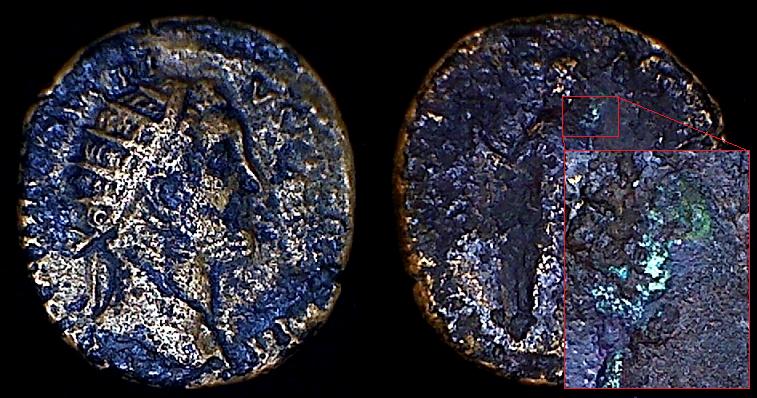 About two weeks ago I happened to notice that the coin next to it in my case also had some green discolouring - see below a Trajan sestertius. The A surface still looked OK just with a very dark green tinge on some of the legend. 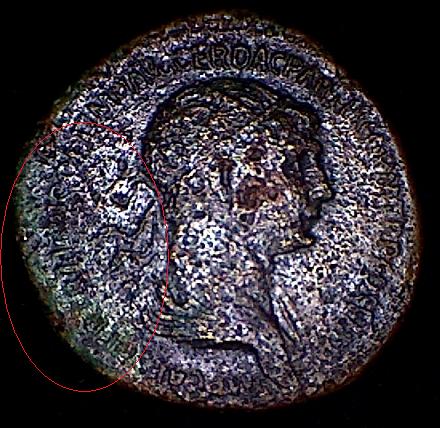 The rim of the coin however was worse and showed some light green areas. 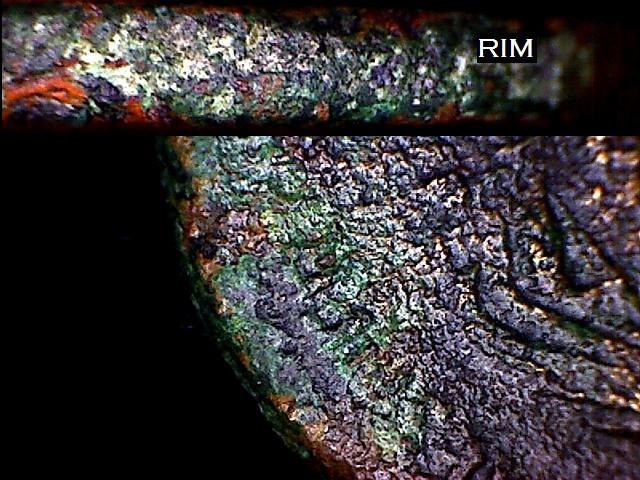 After a bit of searching on the internet I found out about bronze disease - What amazed me was that it had spread from coin-to-coin even though they are not in contact with each other. I was also amazed with how much the Trajan coin had been affected in just a couple of weeks having been stable for about 15 years! To make matters worse the below dupondius coin arrived around the same time from ebay and I spotted the same issue on it straight away - It seems to have been 'tarted up' for sale but the crater on it shows its suffered quite badly in the past. 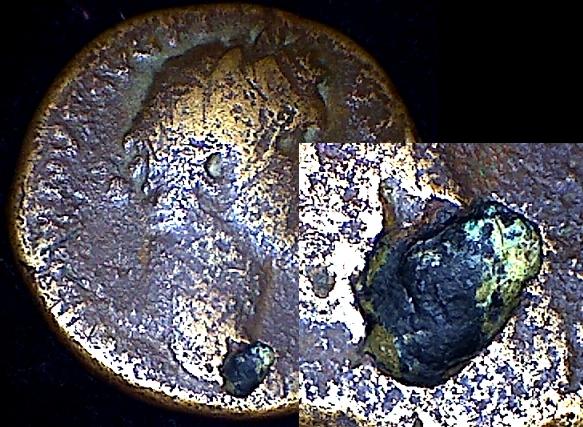 I know this problem isn't restricted to ancients hence posting in the main forum. None of these coins are worth a fortune but the Trajan is worth a bit and has a lot of sentimental value. I have researched BD on the net but the treatments seem very long winded and all say it can come back years down the line. Has anyone got any advice or even better have they had it, treated it and had long term success? For starters I have removed the 3 infected coins and I'm hoping none of my others are infected. I think I need to do something quick as its seems pretty virulent. I have also put some 'slugs' in with the infected coins and a couple of those also now seem to have the same problems. I'm hoping to use these to experiment on. I was surprised that there were no commercial products to treat this as I think there could be some money to be made. Worried that I could loose a couple of Ks worth of coins means I and I bet others would not worry about the price if someone had a proven long term solution. Any advice welcome but as stated above would really like to hear from people who have had it and beaten it long term. Edited by bobbyhelmet
03/11/2010 11:34 am
|
|
|
|
Moderator
 Australia
16982 Posts |
Bronze disease is "contagious", but can't actually jump across from coin to coin without those two coins either touching or being jostled around to make flakes of the green stuff break off and land on other coins. However, if there's latent corrosion on both the coins, putting them both in similar BD-forming conditions can result in BD forming independently on both coins at the same time. In any event, BD is almost always a pale powdery green-blue colour; dark green patina is usually stable and shouldn't be spreading. I would assume that in this case, the green spots were always there, you just never had cause to notice them before. For myself, I've tried treating just two objects that had a bad case of contagious verdigris: my atrocious Tasmanian copper token and a Claudius quadrans that somehow managed to turn pale green and powdery while sealed up inside a 2x2. I'm pleased enough with the results of my token, but I'm reluctant to use ammonia on an ancient copper coin, since I'm worried it would completely strip away everything non-metal from the coin. Don't say "infinitely" when you mean "very"; otherwise, you'll have no word left when you want to talk about something really infinite. - C. S. Lewis
|
|
Moderator
United States
23731 Posts |
One of the causes of BD is moisture getting into the the structure of the metal. In your cause it could have been caused when you used electrolysis to clean the coin. One method that I have used to stop the problem from spreading is the place the coin in a 250 degree oven for 20 minutes or so. This will dry out any moisture present in the coin. Once removed from the oven the coin is placed on a piece of granite slab and covered with a bell jar (or anything that will form a seal) so that as the coin cools it doesn't draw moisture back in. This works very well for me.
|
|
Pillar of the Community
 United Kingdom
2838 Posts |
Thanks guys - just the sort of responses I was looking for. Saps treatment thread is better than most websites about BD! Having a bit of trouble getting some 25% ammonia - It seems they dont trust us with it in the UK as its all watered down to about 8%. Hoping to get some tomorrow from a friend who has a barbers shop. The heating and then cooling in a vacuum is a very good bit of advice. I often heat coins to get the moisture out but never thought of cooling them in this way. Even though I'd be wary to treat a whole coin my 3 can be done local to the outbreaks so will give it a go over the weekend and post the results. Quote:
dark green patina is usually stable and shouldn't be spreading. I would assume that in this case, the green spots were always there, you just never had cause to notice them before This is possible - I will just treat the rim of this coin which is the only area with light green deposits. This is a very odd coin to be honest. I cleaned them in hot water yesterday before sealing them in a tub of distilled water. The coin went purple in the hot water before fading back to dark brown! Never seen anything like that before - I'll take a picture if it happens again. |
|
Bedrock of the Community
United States
20038 Posts |
BD is nothing more than an advanced stage of verdigris. When I get home, I'll post the draft section from my upcoming book.
The bottomline, treat it pretty much like any other verdigris. Soak in distilled or deionized water, neutralize with a very weak solution of sodium bicarbonate (baking soda), soak in acetone and put it in an airtite holder.
If you prevent the feed materials from getting to the coin, the verdigris will essentially halt.
Lincoln Cent Lover!VERDI-CARE™ INVENTOR https://verdi.care/
|
|
Bedrock of the Community
United States
20038 Posts |
I think this will be messed up since I copied from Word, but you'll get the idea. Quote:
ACID REACTIONS a.k.a. "BRONZE DISEASE"
Another aspect of verdigris known by collectors of ancient coinage is something called "Bronze Disease". Personally, I don't consider it a "disease" and some of the science behind explanations I've read is questionable. It is simply another way to describe the formation of verdigris. It is no different from what has been discussed thus far. It is simply severe verdigris at an extremely advanced state perpetuated by air and water exposure. Laymen call it a "disease" because they see it as a process that cannot be stopped. As you will see by the time you finish reading this book, it can certainly be slowed to a crawl or completely stopped.
The solid part of bronze disease science is the chemical reactions involved. In the presence of water, the following "reverse" verdigris reactions occur to a modest extent because of chemical equilibrium. The first step is the formation of hydrochloric acid:
Copper Chloride + Water #61664; Hydrochloric Acid + Copper Oxide
Next, the hydrochloric acid attacks the copper metal:
Hydrochloric Acid + Copper #61664; Copper Chloride + Hydrogen (gas)
This reverse reaction will occur with all the verdigris salts, for example copper sulfate forms sulfuric acid:
Copper Sulfate + Water #61664; Sulfuric Acid + Copper Oxide
The sulfuric acid then attacks the copper metal:
Sulfuric Acid + Copper #61664; Copper Sulfate + Hydrogen (gas)
With respect to coins, under stable temperatures and in the absence of water, these reactions would be quite minuscule because of the activation energy needed. Copper complexed with chloride or sulfate is quite happy and it would require energy to decompose them.
On a micro-electronic scale, the surface of a coin has charged areas. There are regions of slightly positive and slightly negative charge. This is a general scientific property of all metals. The micro-charge areas are enough to drive the reactions to the smallest extent.
On a larger scale, oxidizers such as air or hydrogen peroxide (H2O2), acidic conditions or direct electric current would certainly drive the reaction. The oxygen catalyzed reaction is the most interesting and likely:
Copper Chloride + Water + Oxygen #61664; Copper Chloride•Copper Hydroxide Complex+ Hydrochloric Acid
As shown above, the free hydrochloric acid then attacks the copper surface to form more copper chloride. I believe this is but one small part of very complicated chemical equilibriums occurring within verdigris.
|
|
New Member
United States
36 Posts |
I have very little experience with ancient bronze coins; however, I've seen references to heating the coins at about 240 Degrees F for 20-30 minutes. I'm assuming this is drive away any residual moisture which would then reduce/stop the bronze disease. Good luck with this problem.
Wayne
|
|
Pillar of the Community
 United States
1551 Posts |
If you have a friend that makes jewelry they all tend to have a Vacuum to draw stabilizing agents into rocks and loss wax castings. They also tend to have very nice heat boxes to melt out wax from the investment.
If you have a local jewelry maker, they may place your coin in the heating box and then the vacuum to fully dry your coin out. My brother has a very nice set up for loss wax casting's and it works.
|
|
Pillar of the Community
United States
2669 Posts |
After getting all the possible moisture out, many people then coat the coin in a protective wax to keep out any future humidity. A lot use Renaissance Wax, although I hear regular furniture Min Wax will also seal it fine. Might want to get some other opinions on the Min Wax, but Ren Wax is what the British Museum uses, so I would hope that one would be on the "ok to use" list.
|
|
Pillar of the Community
United States
2669 Posts |
Forgot to include that since the wax effectively seals the coin away from the air, it stops the chemical reaction that causes BD. Just make sure to get it in every nook and cranny and check it occasionally to make sure it stays covered  Edited for clarity  Edited by xshift
03/19/2010 12:33 am
|
|
Bedrock of the Community
United States
20753 Posts |
One of the problemes with almost any sure cure for such reactions with Bronze is actually the materials that make up Bronze. Note that Bronze and Brass are basically composed of Copper.
Normally Brass is Copper, 1% Tin, 30% Zinc approxiamately.
Bronze, however, although is also primarily Copper, it also contains Tin and varieous other substances such as Manganese, Aluminum, Phosphorus, even silicon and many, many other substances to make it appear as the users prefer.
In most, not all, instances where anything containing Copper turns Green, it is usually due to a reaction with a Sulfurous type of Acid.
In many areas where Sulfur rich coal is burned, power stations and many factories with boilers, the emissions are SO or SO2. This mixes with the moisture in the air in the form of H OH, otherwise noted as H2O, producing the mild type of H2SO3 or H2SO4 in the air.
In such areas people find their Copper pipes, Copper grounding systems, Copper Fenials on top of buildings turning Green from this what is normally called Acid Rain. In some areas it is so bad major comapanies have gone to insulated grounding systmes or even Lead covered Copper wiring. In the Illinois area ComEd Electric has gone to almost all coated wiring for grounding systems and in many places have replaced Copper Ground Rods with Stainless Steel due to the amount of Acid Rain in that area.
The point is possibly in your area such air contaminates are present and not much in the way of removing moisture from the coins will be that much benificial. I would actually try to soak those coins in very warm distilled water for a while, then blow dry them with a warm hair dryer. After that do anything you can to stop any air from getting to those or any Copper type of coins. Many such containers on the market for just that purpose.
|
|
New Member
United States
36 Posts |
Hmmmmm...Carl, I believe there are two issues going on here. Moisture in the air along with a sulfur contaminate of some kind. Plastic coin holders do a wonderful job of protecting coins but they are not 100% effective in keeping outside air from reaching the coin. There are thousands of slabbed Indian Head cents that have gone from Red to Red Brown to Brown while sitting in their plastic holders. I have little experience with ancient bronze coins but I have read where many people do use Ren-Wax to coat their bronze coins---this does provide a seal against environmental exposure; however, chemical reactions within the interior of the coin can still occur resulting in damage and destruction of the bronze coin. Bronze disease is not easy to treat and involves several steps that may take weeks of treatment. The following website describes some of the procedures that might be useful: http://www.collector-antiquities.com/89/ |
|
Bedrock of the Community
United States
20753 Posts |
Quote:Posted Today 4 Hrs 49 Min ago -------------------------------------------------------------------------------- Hmmmmm...Carl, I believe there are two issues going on here. Moisture in the air along with a sulfur contaminate of some kind. Plastic coin holders do a wonderful job of protecting coins but they are not 100% effective in keeping outside air from reaching the coin. There are thousands of slabbed Indian Head cents that have gone from Red to Red Brown to Brown while sitting in their plastic holders. I have little experience with ancient bronze coins but I have read where many people do use Ren-Wax to coat their bronze coins---this does provide a seal against environmental exposure; however, chemical reactions within the interior of the coin can still occur resulting in damage and destruction of the bronze coin. Agreed that most containers such as slabs, plastic flips, cardboard flips, etc are not air tight. Many years ago I did the simple test on a 2x2 and simply blew into one side and noticed my breath went right through. Since then I now seal all openable sides with clear tape. Since then there is no possible way that air can get to the coin unless there is a slight cut or hole in the plastic itself. Those are tights advertise also are sealable with a bead of almost anything in the way of a sealant but should not be necessary. I am rather confused though as to the chemical reactions INSIDE a coin. Exactly how does that occur? IF your referring to the electrical charges created by the dissimilar metals touching within a Bronze coin, note there is non unless there is a change in temperature. Or is there some other internal reactions going on? |
|
New Member
United States
36 Posts |
By chemical reactions inside the coin, I'm referring to what I've read about bronze conservation of antiquities from experts in this field. I am a retired chemist, have zero experience in ancient artifact conservation, but do recall reading that this bronze disease can continue even though an effort has been made to seal the coin's surface. I think some of the confusion might be that at the microscopic level it is extremely difficult to completely isolate a coin from the surrounding environment...even with the clear tape you mentioned molecules of air and other gaseous contaminants can still get through. In order to be more specific I would have to do a little research on the chemistry of the bronze disease to refresh my memory on what is happening to the internal structure of the coin. However, I do recall that the science and chemistry regarding this continuing degradation inside a presumably sealed coin seemed consistent with basic chemistry reactions.
|
|
Bedrock of the Community
United States
20753 Posts |
As usual Google is loaded with BD situations and solutions. Mostly based on Chloride attacks on Bronze coins. A little plagerism here but to repeat what sounds logical this is what was listed on one of those: Quote:
BENZOTRIAZOLE (BTA):
This is a professional way to stop it, used by restorators and museum preservers.
Dissolve the (solid) Benzotriazole in Ethanole. Ethanole roughens the patina slightly after some hours of soaking, but that effect is very minor.
The preservers of the roman Museum of Carnuntum in Austria use the Benzotriazole since 1987 with much success. They use a 6-7% solution and soak the affected coin about 1 hour - 2 days.
Prepare the coin before the chemical process ?
There is no need to remove the light-green powdery stuff. But it is better to remove most of the disease with a pin or a plastic stick or something similar. The solution penetrates better into the affected areas.
How to use the BENZOTRIAZOLE - ETHANOLE solution?
If your coin is suffering from minor bronze disease, soak it a few hours.
If your coin is suffering major bronze disease, soak it in the solution for at least 5 hours. There is no formula nor do I have long-term experience.
What to do afterwards ?
Rinse the coin in water and wipe it off with a rag to remove excessed benzotriazole. If you discover new bronze disease after some time simply repeat the benzotriazole process.
However and interesting bit of information on almost all of those is that the actual so called Bronze diseace is actually a protective coating and stops further problems. So actually there is no INTERNAL chemical reactions occuring and the removal of the outer corrosion does more harm than good. Of course that would mean so many of us would have to have all Green coins.  |
|
New Member
United States
36 Posts |
Well, I really think the bronze disease is not a protective coating, it describes a process that actually destroys bronze artifacts. You may be thinking of a patina, which is normally a coating of a copper sulfide compound that does offer protection for the coin. However, it must be emphasized that a copper patina is not the same as what some refer to as bronze disease. While benzotriazole might be very effective in treating bronze disease, it is also entirely likely that this substance might have a deleterious effect on the protective coating or patina...again, which is different than what I'm referring to as bronze disease. I've had no experience with benzotriazole or bronze disease and whatever one does it would certainly be my recommendation to experiment on less costly coins first. Also, benzotriazole is a hazardous and harmful chemical that needs to be handled in a careful manner---I've got to believe there is a less hazardous manner to treat this bronze disease problem. In any event, here is a link for the MSDS on this chemical: http://www.jtbaker.com/msds/englishhtml/B1692.htm Quite frankly, if it were me I'd seriously consider sending the coin(s) to the conservation service provided by NGC coins, particularly if dealing with expensive bronze coins. I've used their service in the past and have been very pleased with the results...and I am in no way affiliated with NGC in any way shape or form. |
| |
Replies: 49 / Views: 19,455 |










 Posted 03/11/2010 10:37 pm


