| Author |
 Replies: 17 / Views: 7,970 Replies: 17 / Views: 7,970 |
|
Valued Member
United States
67 Posts |
I'm feeling kind of sick at my stomach when I look at this Morgan. Are those cloudy spots on the obverse the dreaded PVC damage? What about the dark spot at the bottom on the reverse? 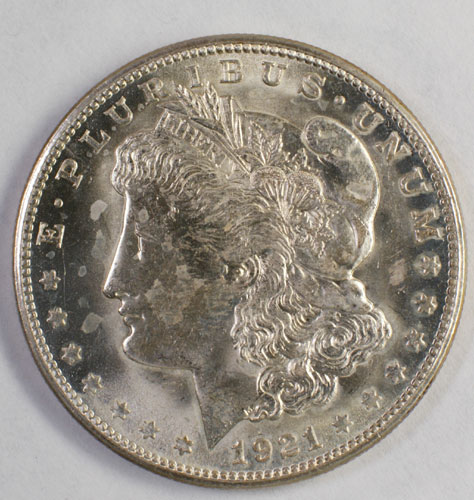 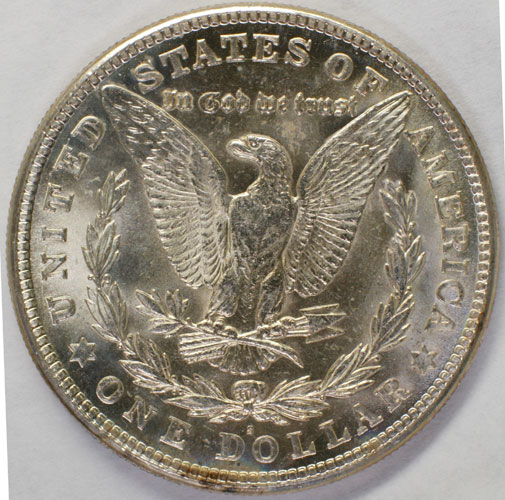 Is there any help for this coin? |
|
|
|
Pillar of the Community
United States
1703 Posts |
Diane,
My guess it someone tried to dip it or clean it in some way on the obverse. The area around the stars on the right and on the cheek looks like some kind of chemical reaction. I could be wrong.It could be pvc damage. The dark spot on the reverse is just toning.Morgan Fred would know more.It's really not a bad coin,Diane
Edited by TLS5933
07/06/2006 8:21 pm
|
|
Bedrock of the Community
United States
14454 Posts |
I have to agree, PVC would be black and that looks like a chemical reaction like TLS5933 said. You can try to use 100% acetone with a q-tip and massage it and see if you can get it off but if it was from being dipped it probably has eaten into the metal. If it was dipped what caused that was they didnt thoroughly rince the coin afterwards and it will make spots like that
|
|
Pillar of the Community
United States
7123 Posts |
Hi Diane
Where and How was this coin stored ?
I dont think you can hurt the coin by soaking it in pure acetone for a day or two,,
If its something that will come off, it will either be gone or you will see improvement, if not the coin is what it is .
Rick
|
|
Moderator
 United States
23522 Posts |
The good news is, it probably isn't PVC, and if it is, it's early enough to make it go away completely. The bad news is, depending on what the spots actually are, you might not be able to help them too much.
Before I say anything, I must emphasize that any use of acetone is a extremely flammable process which endangers the area - ensure good ventilation. I do it in the small bathroom with the exhaust fan on.
They might be dip residue spots, likely since most clean-looking Morgans have been dipped at one time or another. You can likely make them go away, but you may not be happy with the result. Try acetone first, although results are unlikely because acetone can only act on organic compounds. The next possibility is a quick dip in E-Zest, but remember that this is an acidic compound which works by removing actual metal. From that point onward, the coin will be considered to have been "cleaned" if anyone but NCS does it.
Milk spots are another possibility. Early in the minting process, older coin planchets were washed in an acidic solution of cream of tartar. Different compounds are used today, but the process is the same. Occasionally, they were insufficiently rinsed. As a result, the coin was struck with some of the original mint wash stuck to the planchet; the resulting spots, called milk spots, are extremely difficult to remove because they're struck-through and practically part of the surface of the metal. Some believe that they're from contamination after the wash but before the strike; I lean towards the first explanation because milk spots tend to look the same on any coins minted of the same materials.
An acetone wash might help. Not likely, but some post-strike wash residue will come off this way. The best I'm aware of is a soak in a 25% solution of MS70, a coin cleaning agent available online (Google it up). The normal application method of MS70 is to rub it in with a Q-tip - MS70 is a soap, not a solvent - but some are leery about using a Q-tip near a proof coin, for instance. Dipping will do it, but only if you destroy the coin doing it.
Sometimes, even if you can remove them, you're left with a spot of a different color beneath, anyways.
Here's what I'd do if it were my coin. Acetone dip first - give it a day to soak. Pull it and immediately rinse in warm running water, alternating sides every few seconds so that each side gets at least 30 seconds' rinse total. If you're beyond paranoid, finish with an ethanol rinse - that stuff will remove any minute residue left and evaporates so quickly that spotting is unlikely.
If that doesn't do it, I'd dip it in MS70 to get the whole surface wet, and then "scrub" it with a Q-tip already wetted with MS70. Then an immediate warm water rinse, as above.
Last resort: E-Zest. You'll need rubber tongs for this dip, to allow the compound to evenly hit the coin. Hold it by the edge with the tongs, and give it no more than 1-2 seconds in the dip. Do that once and once only. Immediately rinse the living snot out of it with everything you can find to rinse with. Real fanatics use distilled water; I settle for warm tap water, then acetone, then water again.
If that doesn't do it, it's not going to get done.
If your coin has any significant value, ignore everything I've said and send it in to NCS. I don't recognize any of the real value-added VAMs in your 1921-S; for that coin, they're all visible to the eye in photos as good as the ones you're taking.
My guess is the coin would grade MS63-64-ish. At MS65, a 1921-S is at the level of getting NCS involved.
|
|
Pillar of the Community
United States
7123 Posts |
Diane
Should you decide to follow daves Very well written cleaning proceedures, I would like to add one word of caution,, the time between the E-Zest and the rinse counts toward the 2 or 3 second dip time .
In other words if you dip the coin for 2 seconds and it takes 3 seconds to start the rinse, that is 5 seconds in the dip .
Rick
|
|
Valued Member
 United States
67 Posts |
Thanks to Metalman, SuperDave, Bryan, and TLS5923 for all the helpful suggestions. I'm going to pick up some acetone tomorrow and try that first. Metalman asked: quote:
Where and How was this coin stored ?
All my Morgans belonged to my father, who collected them (along with other coins) for 70 years. He had them in cardboard boxes and filing cabinets in his home, which was at various times in California, Illinois, Hawaii, Texas, and Iowa, never temperature or humidity controlled. But most of them seem to be in good condition. Only a few have this filmy look, and I don't know whether they were that way when he got them. His coins are in brown paper coin envelopes (with some transparent material inside), in plastic or paper rolls, or in 2x2s. The coins that are more valuable, like this one, are in the 2x2s. (I can pick the best coins by pulling out the cardboard holders.) I don't know whether the transparent windows in the holders are PVC or not, which worries me a lot. I've ordered some Airtights, but they haven't arrived yet. When they do I'll start replacing the holders on the more valuable coins first. Thanks again for the helpful advice! |
|
Valued Member
United States
157 Posts |
Maybe milk spots, maybe the result of a dip gone bad. I'd suggest a quick bath in acetone followed by rinsing in distilled water.
|
|
Rest in Peace
United States
2684 Posts |
Diane, I can't find anything to argue about with TLS, Bryan, Dave, and Rick's comments. I also don't think its PVC damage. Looks like the Morgan was near someone who was cleaning something else and it splattered on it. One guess: carbon tetrachloride could have been used to clean a manual typewriter's key faces, a common (and dangerous) usage of the now generally banned chemical into the late 1960's and the nearby Morgan got splattered in the process. If it's carbon tet damage, it's there to stay unless it's cleaned (i.e., surface metal removed).
It's almost a judgement call on whether or not to use E-Zest which would, as Dave stated, revert the coin to "cleaned" status. However, the coin doesn't have a whole lot of value in its present condition and even if the spots were removed without cleaning or weren't there to begin with, still wouldn't be particularly valuable (maybe $175 if graded and slabbed as MS-64; ungraded [raw] without the spots maybe $85). Acetone might be tried first to see if there's any change. If the Morgan is to be used for a personal collection (I don't see it as an investment coin) to fill a hole in a folder, it's probably OK to spiff it up a little with E-Zest if necessary. There's enough medium Mint State 1921-S's around that an upgrade is easily made if it ever came to that.
Fred
|
|
Moderator
United States
23522 Posts |
As you may be able to tell, I'm not someone who objects to the concept of cleaning coins - the truth of the matter is, PCGS and NGC slab dipped coins every day. NCS does it in a perfectly reputable fashion, and many of their results end up in NGC slabs with no-one the wiser. It seems hypocritical to me to endorse NCS in one breath and malign the average collector cleaning their coin in the next. The process of cleaning is exacting - you have to do it just right or you're going to screw it up - but nothing that an average human being cannot learn to do correctly, and get results which will pass inspection. Having said all that, there's an example of the other end of the scale in my own collection. I have a 1921 Philadelphia Morgan struck from the Zerbe die (the die used to strike the Zerbe Proofs). It's probably a DMPL coin, the only Prooflike 1921 I've ever seen. However, it has a problem, the same one as Diane's coin:   I don't think MS63 DMPL is out of reach for this coin, which would make it worth as much as the rest of my 1921's combined, except for the spots. The stuff around the S in STATES is on the surface, and I have it on reliable information that it'll go away completely with proper conservation. What's my point here? Although I've given instructions about how to conserve a coin, and I'm comfortable with my own skills, I am not about to touch this one myself. I need it done right, the first time, because there will be only one chance to ruin a $1000+ coin. |
|
Bedrock of the Community
United States
14454 Posts |
SuperDave I am a member pof NGC's collectors society if you want to send that thing into NCS I will give you my information and you can go online and make a submission form and send it in under my subscription (atleast I think you can make a submission form to NCS like you can to NGC online). If you want to try that just let me know
|
|
Pillar of the Community
United States
986 Posts |
If you're anywhere near Baltimore on the 13th thru 15th of this month, NCS will be on site accepting submissions and offering conservation suggestions. They're going to have a rep. there, so you might be able to get another opinion, assuming he doesn't suggest his own company as the best method.
|
|
Moderator
United States
23522 Posts |
quote:
Originally posted by fengk
If you're anywhere near Baltimore on the 13th thru 15th of this month, NCS will be on site accepting submissions and offering conservation suggestions. They're going to have a rep. there, so you might be able to get another opinion, assuming he doesn't suggest his own company as the best method.
I'm just outside Atlantic City - Baltimore is a daytrip for me - so I plan to be there. Never even considered NCS onsite. Thanks, fengk. |
|
Pillar of the Community
United States
986 Posts |
Glad I could help. NGC will also be there grading onsite if there are any coins you want to get slabbed.
|
|
Valued Member
United States
67 Posts |
quote:
Originally posted by SuperDave
The stuff around the S in STATES is on the surface, and I have it on reliable information that it'll go away completely with proper conservation.
I have some real nice coins with that dark stuff like in the S in states on your Morgan, and I'd like to know what proper conservation means. Will the acetone bath take it off? I bought a can of acetone yesterday and gloves that can withstand it. So I'm about to take one of my less valuable Morgans and slip it into a glass jar of acetone. I'm wondering whether the bath will leave a mark where the coin rests against the glass. If I seal the jar, I ought to be able to keep it indoors for a few days of soaking. Any advice about handling the coin while doing this treatment? |
|
Valued Member
United States
67 Posts |
Actually, this Peace dollar is probably the one I'll try the acetone on for my first experiment. The coin is pretty dirty and spotted. What do you all think? 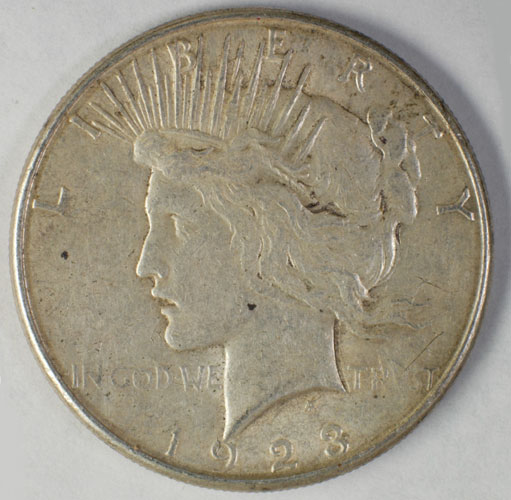 |
| |
Replies: 17 / Views: 7,970 |








 Posted 07/06/2006 7:48 pm


