| Author |
 Replies: 12 / Views: 2,928 Replies: 12 / Views: 2,928 |
|
|
Pillar of the Community
United States
1915 Posts |
While roll searching I come across my fair share of 1992 & 1992D LMC. I have noticed there seems to be a variance in the amount of space between the A & M. What causes this? Can the Wide AM dies vary so much that it is noticeable? Here is an example of what I mean:    Edited by seal006
06/22/2010 9:36 pm
|
|
|
|
Bedrock of the Community
United States
62064 Posts |
As dies start to show wear, they may loose the area between the devices and field making it appear slightly different. But this is just normal die wear. You will note that the location of the M is still centered between the A & E. The wide A M ones are identified by not how close the letters may be to the A, but by the Centering of the M between the AME of AMERICA. The Close AM has the appearance of being a space between the M & E. The centering of the M doesn't change on Wide AM's. The space after the M doesn't change on the Close AM's. Just the difference of the dies design and all come from the same master dies/master hubs/hubs and finally dies. They are not added like the mint marks on pre 1989 Cents. So there can be no variable for these. |
|
Pillar of the Community
 United States
1915 Posts |
Interesting, so the "closer" the letters appear to each other on these particular dies, the later the die state? Is that one way you can identify die state of a coin?
|
|
Bedrock of the Community
United States
62064 Posts |
The best way is to compare the devices facing the rim. The more the distinction of the line between the device and the field, the earlier the die state. When the devices and fields snow drift over each other the coin has reached the VLDS example die state. Here is an image of the MDS/LDS/VLDS examples I have put together to show the differences. 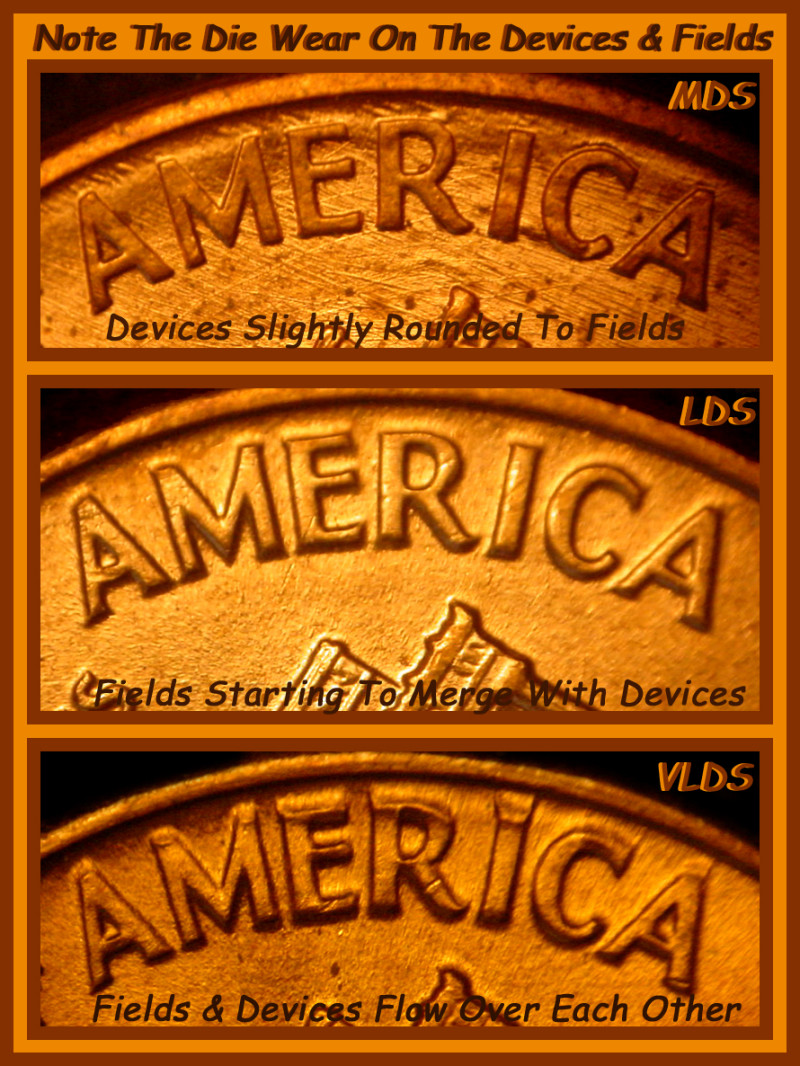 Note on the LDS example the die flow in the fields starting to show. And the outside edge of the devices toward the rim show very worn on the VLDS example. The even get worse with more examples: https://www.coincommunity.com/forum...Die_Wear.jpghttps://www.coincommunity.com/forum..._VLDSrev.jpg |
|
Pillar of the Community
United States
4541 Posts |
|
|
Pillar of the Community
United States
7629 Posts |
I disagree.
The reason for the difference in the width of the space between the devices is due to one of two things:
1. The die was not properly prepared and the devices were not sunk in deeply enough in the hubbing process. This could cause the devices to appear farther apart from one another than on other dies.
2. Die polishing. Because the letters are trapezoidal in shape, the lower the relief the wider the devices. When you polish the fields of a die, the letters actually become narrower, thus spacing them a little farther apart.
Either of these cases are the best explanation for differing spacing on devices, not die wear.
|
|
Pillar of the Community
United States
1915 Posts |
So you are saying the closer the letters appear, the earlier die state? Your reasoning sounds very logical. Could this mean some 92s that are close but not almost touching might very well be Close AM varieties in LDS? |
|
Pillar of the Community
United States
3640 Posts |
There could be a possibility of this happening if there were
a die set re-mismatch. obv/rev (never heard of or saw one though)
The other big diagnostic on the wams/cams is the designers initials
(FG) on the reverse. It is there spacing distance from the memorial.
Interesting thoughts though from both Mr. C's
I would associate field die polishing with later worn dies anyway.
I cannot actually see letter movement from wear but just an appearance of it. I would think the position is set in stone so to speak from the hubs/dies etc. Either way, the 92 cam would have to have both obv./rev. diagnostics anyway to be a confirmed find.
|
|
Pillar of the Community
United States
1915 Posts |
As I understand from my own research and observations on a WAM, the A is always a bit further separated from the M than the E. The reason for this post was that I have started noticing variations in the amount of distance that was from one coin to the next on the 92s I come across and was wondering how this happens. I think coppercoins explination is more logical, of course I think it would also make it appear as a weaker strike as well. But this explanation also makes me wonder if some that look a lot closer, yet further than what we would normally consider to be a 92 CAM, might in fact be a LDS CAM. Edited by seal006
06/23/2010 10:56 am
|
|
Bedrock of the Community
United States
12437 Posts |
I don't think it is possible to hub the coin weakly enough or polish the dies extensively enough to truly confuse a normal coin with a Wide AM. The AM distance is not the only PUP though, the designer initials on a Wide AM are closer the base of the Lincoln Memorial than the Close AM and the Close AM initials are also lacking a serif on the G. |
|
Pillar of the Community
United States
7629 Posts |
Clearing things up... 1. Brand new dies can clash leaving the need for polishing - to remove the clash marks. Polished dies have nothing at all to do with die state. 2. The distance between the A and M on the Close AM cents is not enough to confuse them with Wide AM cents, but for those who ONLY look at that area and expect them to touch on a Close AM, it can be confusing when there's a small gap there. That's why it is important to learn the other diagnostics. 3. To that effect, the ENTIRE design is different between the Wide AM and Close AM cents. If you take a normal cent from 1991 and a normal cent from 1993 (two dates where the opposing reverses are not known) and study the two together, you will find MANY differences in the reverse designs. ONLY ONE of these differences is the spacing in the "TAT" area of "STATES". The Wide AM design has these three letters spaced very evenly, while the A is closer to the second T on the Close AM design. 4. That gap between the A and M is always - ALWAYS - caused by either die polishing or by a weaker hubbing. Die state (die wear) does NOT move devices and create spaces. I have noticed of late a LOT of instances where "die state" was used in a way that it shows that not many here really know much about the subject. Should I teach it? |
|
Pillar of the Community
United States
1882 Posts |
Quote:
Should I teach it? Yes, please do. |
|
Pillar of the Community
United States
1915 Posts |
Mr. Daughtrey, I understood in your first reply where the devices are all trapezoid in shape. So as a field is polished it would make the devices near it appear thinner, and the space between devices wider. Would it not also make a device have less altitude? Would that not represent, or at least appear to represent a weaker strike? I see what you are saying about new dies clashing. My analogy was a bit narrow minded on that point, but heck, I am still learning.
|
| |
Replies: 12 / Views: 2,928 |
|







 Posted 06/22/2010 10:05 pm





