| Author |
 Replies: 7 / Views: 5,843 Replies: 7 / Views: 5,843 |
|
|
Valued Member
United States
360 Posts |
Anyone have any idea what this is? The only thing I can read is the number 25 on the reverse side. It measures 18.7mm and weighs 1.53 grams. Thanks in advance 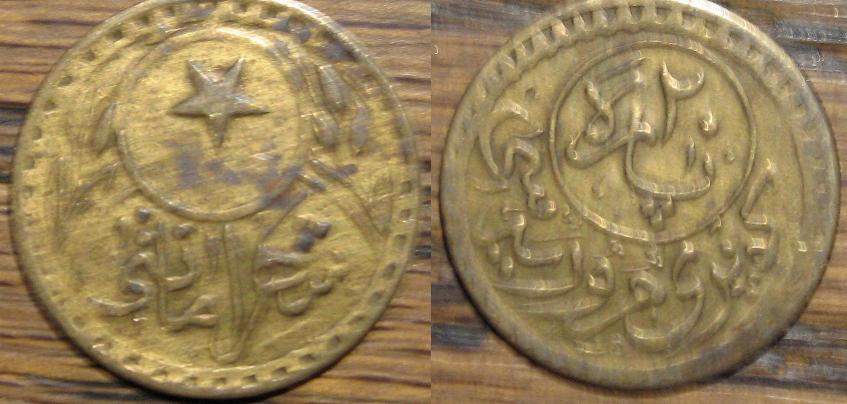 Identified - moved to Tokens forum - Sap Identified - moved to Tokens forum - Sap |
|
|
|
Pillar of the Community
United States
2605 Posts |
Aha, a while ago xshift helped me with this one. The number is actually 20, and it is Turkish 20 para. But it's not a coin but, as you assumed, a token. You can find it on this page. Just scroll down. |
|
Valued Member
 United States
360 Posts |
Many thanks! Great find on your part. The website is most helpful because of folks liky uou. Thanks again.
|
|
Pillar of the Community
Turkey
870 Posts |
The number on the back is Arabic "20". "." is actually the number "0". number 5 is similar to "o".
20 para is one fifth of a Kurus. 100 Kurus makes a Lira.
It is a "Galata Köprüsü Geçiþ Jetonu" it is not Turkish, it is Ottoman. It's the fare you pay to the tills when you cross Galata Bridge, which is a brigde that conencts two districts, Eminönü to Galata, the Muslim part (Eminönü) to the Non-Muslim part (Galata). Galata is an anciant settlement, originally settled by Italian levantens in early 1100's. It was autonomous until 1700's,and had his own ruler, called "Voivoda of Galata". Today, Galata is an old town district, very touristic indeed.
Last friday, I had a cup of coffee there, very close to the image of the brigde shown on the link. :)
|
|
Pillar of the Community
United States
2605 Posts |
"Voivoda" sounds rather Bulgarian than Italian (or, at least Slavic). In Russian it was Voevoda, it meant a military chief in those days.
Do you still need to pay toll for crossing the bridge, and how much? Money or tokens (or should I say jetonler?)?
|
|
Pillar of the Community
Turkey
870 Posts |
Yes, the word "Voivoda" is borrowed from Balkans, back then rulers of semi-autonom regions inside Ototman Empire called "Voivodas". The naming tradition dates back to 1400's, when the Ottomans have both ally voivodas and enemy voivodas in the Balkans. I think it is not Italian, the vowel construction is not fit to the Italian language. (Voi- and -vo, there is no -vo vowel in Italian I think).
The old wooden Galata Brigde got burned down in 1992. A new, steel and metal brigde is made to replace it, since it is in a vital, busy traffic section of Istanbul. Cars coming from Eminönü and Aksaray have to cross it to get to Taksim, Beyoðlu and Galata. It has a twin brigde, called Unkapaný Brigde too, to relieve traffic.
Crossing the Galata Brigde is free today. Only brigdes you have to pay in order to cross are the Bogaziçi and FSM bridges, which connect Europe to Asia. The view is amazing (truly is) in both of those bridges. I used to cross them twive a week by car between 2007-2009. Now I only cross them when I go for a picnic or to a sighseeing to the Asian side :) I live very close to the ancient trading route that Byzantine Empire has established, and Romans did use, but haven't anmed it, long before the Byzantians. I live between two lakes called Büyükçekmece and Küçükçekmece on the European side of the city.
|
|
Pillar of the Community
Turkey
870 Posts |
Slav, it is "Jetonlar" :) (the "o" letter in second wovel of "jeton" makes (-ler/-lar) is plural "s" in english, just like in Coins - not a -ler, but a -lar. So it is "Jetonlar". If it was "Köprü" (meaning brigde) it should be "Köprüler" beacuse "ü" is a soft letter. :) Confusing, aye?
|
|
Pillar of the Community
United States
2605 Posts |
Thanks for the great info, molydeii!
Yeah, in Uzbek language it's a simple "lar" to pluralize any noun.
|
| |
Replies: 7 / Views: 5,843 |
|







 Posted 07/12/2010 6:21 pm





