| Author |
 Replies: 16 / Views: 8,552 Replies: 16 / Views: 8,552 |
|
New Member
United States
17 Posts |
Hello Everyone, Many years ago, and always wanting a colonial coin from the 1700's I found this in a antique shop. It just said 1767 colnial coin! So I bought it. I found out later from a spanish coin dealer what it was. 1767 Potosi 2 reales missing 3rd dot, between mint mark colum. I have looked in a spanish coin price guide, and all it says in there is very rare, less than 100 known! IT does not give any indication of value what so ever! So does anyone have a clue? also what this might grade. Thanks so much for any help! 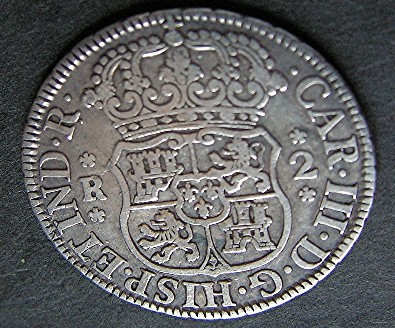 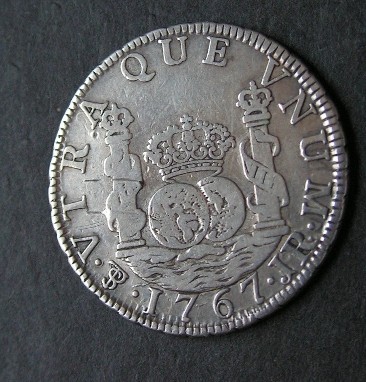 |
|
|
|
Valued Member
Philippines
80 Posts |
1767 was the year when Potosi(Bolivia) finally shifted to milled coinage from the hammered process (cobs).
I've been advised before that 2R along with 8R and 4R are being (had been) widely copied/counterfeited in China.
The forum members usually asks for the coin weight. This will give a hint on the authenticity.
I'm not a 2R expert, but it would be nice if you can supply a link for higher resolution pictures for review. Offhand, I see some inconsistency on the dentils, and spacing on the reverse inscription 'VTRA QUE' is a bit off.
|
|
New Member
 United States
17 Posts |
Hello fireandice556,
I am new on here and I am haveing problems changing my photos to meet the 90 kb max! in my microsoft photo program you have to change
image size..width
size
unite
or pixel dem..........width height!
or resoution and unites, it is taking me hours to get a picture to up load here! JUST WISH I COULD email (orig) PHOTOS TO A MODERATOR, AND LET THEM DO IT!( you can clearly see the elongation of coin in that photo,not sure yet what I am doing wrong!
So that being said, my orig. large detailed photos were emailed to "Dan Sedwick" expert on spanish coins and shipwricks. This coin he had no problem with it being authentic from photos, and if I want to sell, can consign to his auctions!
So that is all I know, at this point.
May I add I am not a coin collector or dealer, I collect art,antiques and objects of history,(which may be coins)
I bought this coin with intenions of having it made into a neckless
after "Dan Sedwick" told me what it was, I thought I better not!
So I bought from him a 1736 (M) mounted in gold, then my pride in joy
a 1424-1427,English Groat made in calisi France, under English rule!
Imagine a coin made in france by the English when "Joan of Arc" was between the age of 12-15, and it is mounted in gold and I ware it every day! sorry for the side track! but now you know!
|
|
New Member
United States
17 Posts |
Also, I forgot, When I worked in a lab, 6 years ago I did weigh this coin, it weighs between
6.5 grams and 6.6 grams, (because of high air flow) in the LAB. iT kept going back-fourth between these 2 numbers!
So hope that helps!
|
|
Valued Member
Philippines
80 Posts |
Quote:
So that being said, my orig. large detailed photos were emailed to "Dan Sedwick" expert on spanish coins and shipwricks. This coin he had no problem with it being authentic from photos, and if I want to sell, can consign to his auctions! There it is! Congratulations on your coin! |
|
New Member
United States
17 Posts |
Thanks fireandice,
Did not mean to ramble on! I just love history!
Yea, I would think in the last 10-20 years, at least one, of this
rare variation of this coin has been sold, some where?
But I cannot find one example, refferance listed anywhere!
I am just curious what one had sold for.
|
|
Pillar of the Community
United States
5362 Posts |
strangenickel I would agree that the coin looks real and that the weight falls in an acceptable range, but I question the issue of rarity. The variety here is catalogued in Gilboy's book as P-2-1a and it lists it as a Rarity S2 (scarce 2). Gilboy lists 6 varieties of the Potosi 2R which are scarcer in this very short series.
Regarding the missing dot - I would have to examine the coin in person before I could determine if that feature could have been removed.
Did Dan Segwick indicate a figure of 100? I was not quite clear on that. It appears from your initial comment that the 100 figure came from a Spanish coin book and that Dan merely authenticated the coin as real.
In any event, it does not look like a Chinese knock off and it is too valuable a numismatic item to be mounted. All of the 14 varieties of the Potosi 2R are valuable.
|
|
Valued Member
United States
420 Posts |
getting around the 90kb forum size can be done easily
open a photobucket account, load your pictures there, and post the IMG CODE in your post and you will have a larger, clickable picture that you don't have to resize
|
|
New Member
United States
17 Posts |
Hello swamperbob,
That info "rare and less than 100 known " DID NOT COME FROM Dan!!
It was printed in a price guide book, maybe(not sure) "Spain portugal and the new world" But I also looked in other books
looking for info, Like world coin price guide? It has been way too many years ago, so not 100% sure which one it was in !
I know when I got the coin, and sent photos and a request to Dan
about what it was, he requested additional photos above the mint mark! After I sent them, He did not think there was ever a dot above that!
But I will post new(up-close) photos here in the next day or two!
Twincam04
Thank you so much! I should have asked, before I ever started posting on hear, but not being a coin collector did not think I would be here very long! But the more I read, the more interesting this fourm becomes!.............So maybe I will stay longer!
Thanks
|
|
Valued Member
United States
420 Posts |
you are welcome  there's a great deal of info on here, and many MANY great people- my journey here started almost 18 months ago, out with my girl friend and got a penny back in change from her birth year- brought up memories of a collection I had years ago i carried that penny in my wallet for over a year before I decided to rekindle my interest- I have completed her birth year set, my set also, and am now working on a set 100 years before our births.. the only problem is, I can't stop the fever - BadThad keeps posting booootiful wheats , and there are others that keep posting this shiny silver stuff LOL - I really am enjoying being back in it i found this place searching for info online, and have come to love it, met some great people, and know i'll meet more along the way enjoy your time here, stick around, you may learn something, you may teach some newbies like me a thing or 2 also |
|
New Member
United States
17 Posts |
Hello Pillar collectors! Hear is a close up of above the Potosi ment mark? For the 1st time I have noticed leters under the you and M of this coin!FRONT FACE!(impressed into the surface?)..under,AND right side of "U" a N,(BACKWARDS) under "M" is a I-T" "NIT" ...backwards! I checked the back and these line up with ETIND"....but the NIT, IS BACKWORDS ON THE FRONT, OF MY COIN! So 1, how did this happen! 2, is this a known variation, on this coin from1767? 3, is this just a defect on my coin? 4, is this a coin minted on top of the back of another!|! PLEASE YOU, 2R Pillar experts, tell me what you think happened! 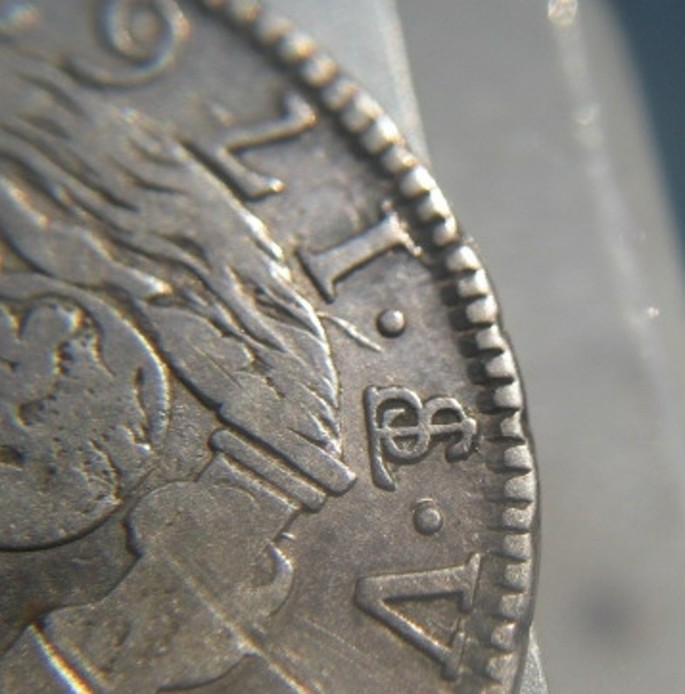 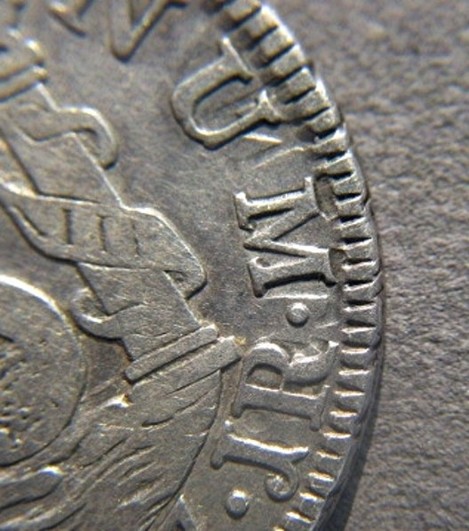 |
|
Pillar of the Community
United States
5362 Posts |
What you have here is a clashed die. When the dies come together without a planchet between them - the dies contact each other directly and the impression of one die transfers to the other. From that point onward every coin struck from the die pair will have both images. The clash image is usually partial and it is always reversed.
These coins were made on hand operated screw presses and were made one at a time. One or Two men turned the long counterweight balance bar that turned the screw while a third man inserted planchets between the moving die (hammer) and the anvil die. This process was prone to clashes because the time available to remove one struck coin and then to insert a planchet was VERY short. Clashes were inevitable. If the clash was too severe - the dies could be ground down to remove the clash traces but that required a stop of production. The three men were paid by the total number of coins minted so they would have no incentive to "stop the press". It was the master of the mint and the inspectors who would have stopped the operation to correct the dies. How much of a clash stopped the press VARIED from time to time and mint to mint.
The presence of a clash can be used for verification (if all other copies have the same clash) but they are also known to exist on forgeries. One of the best executed forgeries I have even encountered is an 1838 Guanajuato 8R with a spectacular obverse star burst clash.
So just because there is a clash is no guarantee of authenticity. BUT most transfer copies of clashed dies give themselves away by the way the surface appears right at the point where the clash happened. There should be a difference in surface texture at the POINT where the dies cut into one another. This changed texture should interrupt the "normal" surface texture of the die. Every fake clash I have observed has a uniform surface appearance on both sides of and right at the contact point. This stems from the fact that on most forged clashes the original host coin already had the clash so that it (the clash) was copied at the same time and with the same resultant surface texture as the balance of the die.
I hope that is clear.
|
|
New Member
United States
17 Posts |
swaperbob,
Thank you so much,
for the life of me could not see in my mind, what could had takened place, unless they already had a minted coin in the die, and put a planket on top of it! So thanks for this very interesting historic info of the minting process
|
|
Pillar of the Community
United States
5362 Posts |
Placing a blank planchet on a struck coin that is still positioned on the die results in a Brockage image. This image is usually more uniform than you see in a clash.
There are cases where suck a brockage coin is then struck. But the image of the brockage gets compressed by the strike in the process and the depth of the relief is essentially eliminated.
A re-struck brockage is a far scarcer error than any clash and the images are usually difficult to see on anything but a high grade copy.
Yours is clearly a clash.
|
|
Valued Member
United States
309 Posts |
Hi Strangenickel,
About the missing dot, Numismatica Espanola by Calico and Trigo shows a 1768 2R (Type 128) with dots. The note in Spanish reads: El tipo 128 existe con roseta de 5 y de 6 petalos asi como con punto y sin punto sobre el monograma de la ceca. It looks to me that your coin has the five petal roses and has all the dots too. The 1767 is the first year of issue for the type and books two thirds higher than any of the other three years (1768-1770).
Thanks,
Pistareen
|
|
New Member
United States
17 Posts |
Hello Pistareen, I have no ideal what a potosi (1768-1770) 2R, would have or not have! But I do know that the 1767 2R, did have a dot above the mint mark! as I show location in next photo. Maybe the other dates did not have this, I have no clue? But I think you for contributing information, that is so hard for me to find! 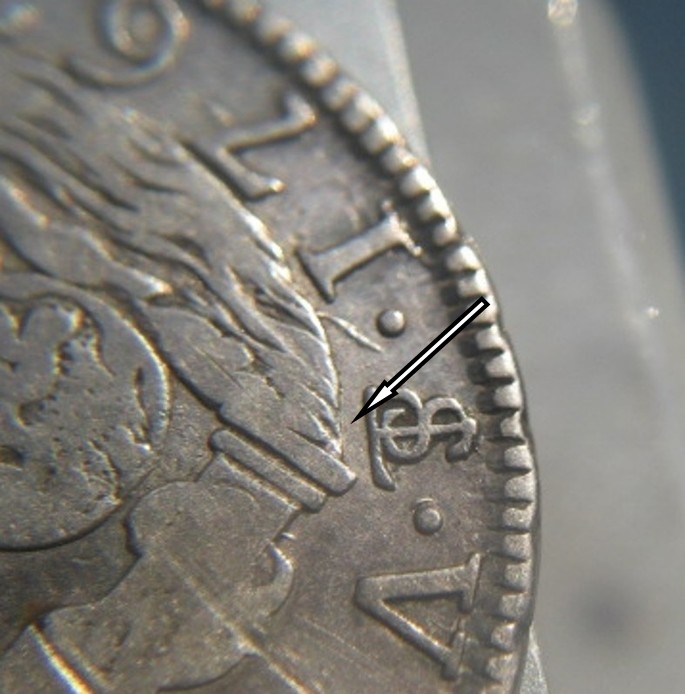 |
| |
Replies: 16 / Views: 8,552 |










 Posted 07/13/2010 10:12 pm


