| Author |
 Replies: 23 / Views: 9,196 Replies: 23 / Views: 9,196 |
|
Pillar of the Community
United States
5362 Posts |
I don't post in this section routinely, my specialty is Mexican Counterfeits, but I do authentications for a local coin dealer and he had purchased a $1000 face bag of silver dollars to provide inventory. One of his helpers pulled out a coin with an odd error on the edge. They asked me to examine it. Here is the edge: 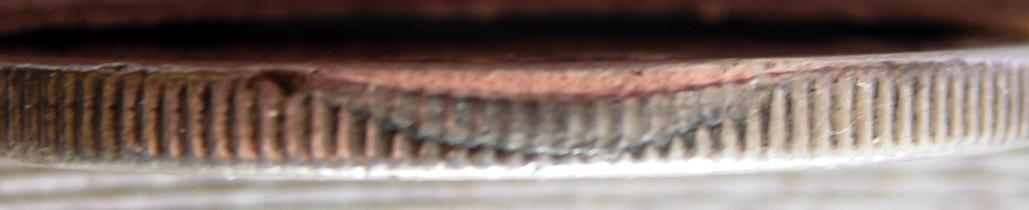 I checked the coin and initially believed it was a rotary wire brushed original. The edge shows metal movement that is clearly post strike and the depression at the edge is the obvious source of the metal transfer. I figured it was someone fooling around on a basically bullion coin. The surfaces on both sides show a dimpling and they show damage to letters and features along one side. Metal movement - post strike seems to be the issue over the whole coin. Here is the obverse: 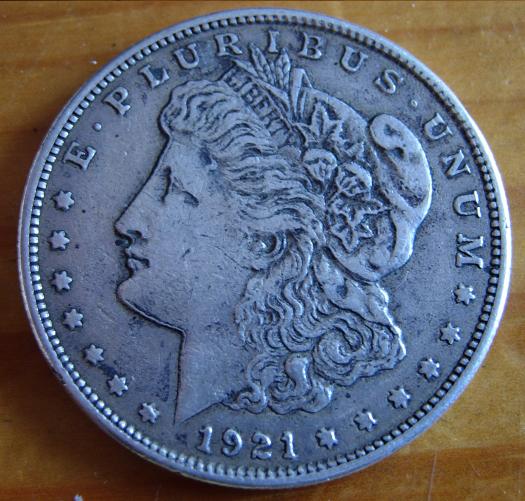 Here is the reverse: 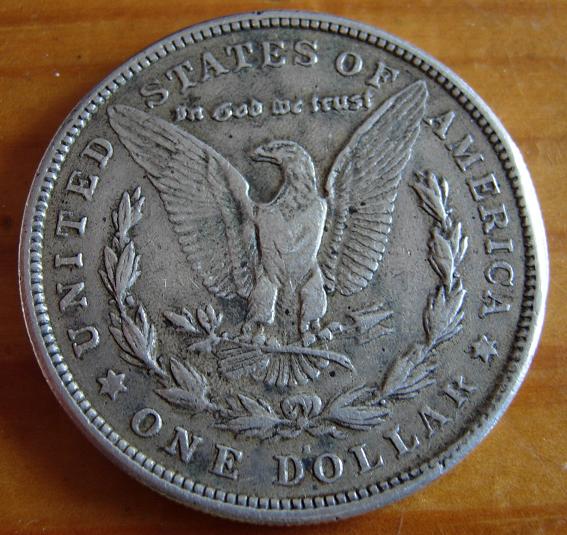 I took the coin home to examine it more closely and I have changed my mind about the authenticity of the coin. The coin weighs 26.57 grams which is about correct for the wear level. But the Specific Gravity bothers me. The coin has an SG of 10.22 which equates to only 0.850 fine. I examined the coin under higher magnification and now believe this may be one of the full weight silver forgeries that were known to have been made in the late 1920s and 1930s to pass as a dollar when the silver prices had fallen well below a dollar. Has anyone seen one like it? Any opinions about authenticity? The SG seems to far out of range to be real. Here are some closer photos: 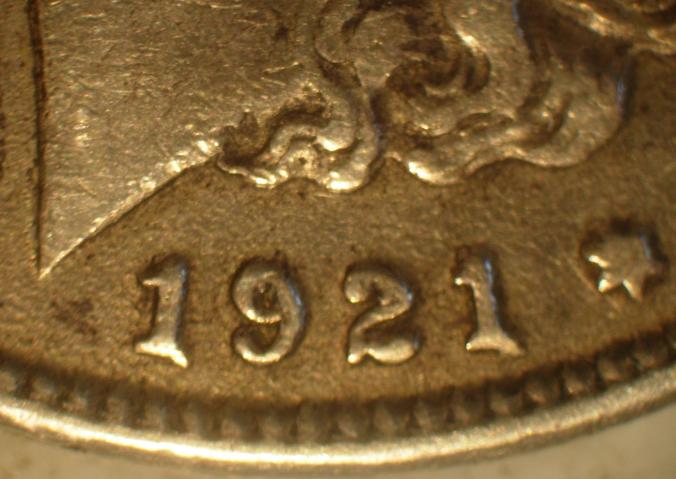 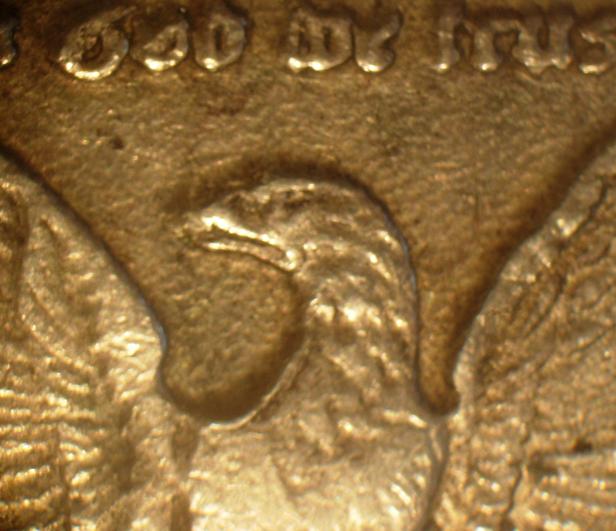 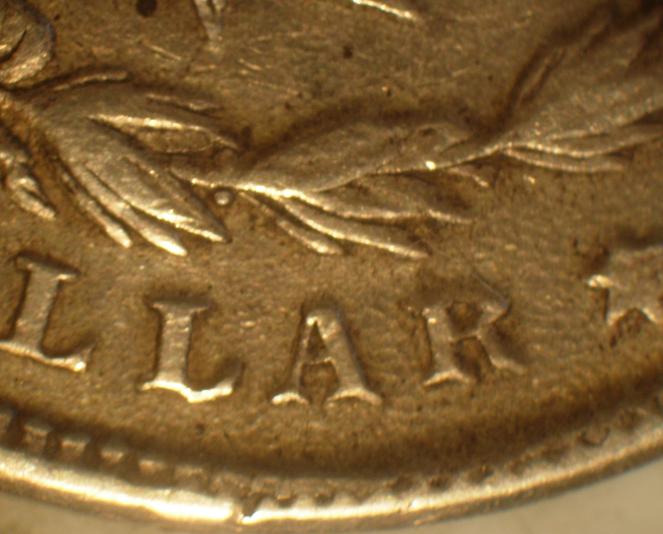 |
|
|
|
Pillar of the Community
3660 Posts |
Counterfeit...... without any doubts about it.
|
|
Pillar of the Community
United States
528 Posts |
If it weighs the same what does specific gravity mean?
Edited by Napoleon31ft
07/20/2010 1:46 pm
|
|
Pillar of the Community
United States
870 Posts |
This is a fascinating tale! Another "contemporary counterfeit"! Sorry, nothing to add really, except that it looks like a sand cast to me. Thank you for posting your findings, swamperbob!  |
|
Pillar of the Community
United States
2120 Posts |
It is definitely a good forgery, if it is in fact one, which I believe it is. The first thought I had when looking at it is, "that's gotta be a fake, it looks grainy and a little porous."
Edited by Namachieli
07/20/2010 1:50 pm
|
|
Pillar of the Community
United States
3294 Posts |
SG is also known as density. If the weight is right but SG is off, then the coin dimensions are wrong, either the thickness, or the diameter.
|
|
Pillar of the Community
United States
870 Posts |
Wait - to arrive at your sg calc, you had to dunk it in water to get a volume, right? So there is some (or are some) dimensions that are off on this, right? (Probably the planes?) Oops, yes, what Nod said (musta posted at the same time) I'll be quiet and go back to... Edited by delaner
07/20/2010 1:52 pm
|
|
Pillar of the Community
 United States
5362 Posts |
Specific Gravity - is the weight of any material expressed as a ratio to the weight of water. It is a world standard of measurement and it often allows a forgery to be revealed without causing damage to the item itself. It is more accurate and far better than acid tests or scratch or any other destructive tests. A ninety percent silver coin has an SG of 10.30.
All you need for a dollar sized coin is an accurate scale that weighs to 1/100th of a gram. A 1/1000th gram scale is better but it is a far more expensive item.
The key to using SG is knowing that pure water weighs exactly 1 gram per cubic centimeter. So if you weigh a coin in air and in water - the VOLUME of the coin is the difference in weight expressed in grams. Subtract the weight in water from the weight in air and you have the volume of the coin. It is just that simple. You don't have to measure anything or do any calculations.
If a silver dollar is 3.00 grams heavier in air than it is in water - it has a volume of exactly 3 cubic centimeters.
The SG for that example is then the weight of the coin in air divided by 3. So if the dollar weighs 26.57 grams it would have a SG of 8.86 and it would be a Non-silver alloy.
But if the same coin (26.57 grams) had a volume of 2.58 Cubic centimeters it would have an SG of 10.30 and would be 90% silver 10% copper.
The volume of the coin in question was 2.60 cubic centimneters not 2.58 so the SG was 10.22. So you can see the need for a very accurate scale because the difference is only 2/100ths of a gram.
The problem with measuring a coin is also accuracy of measurement. Diameter is easy but how about thickness? Measure at rim, high point or fields?
Edited by swamperbob
07/20/2010 2:30 pm
|
|
Bedrock of the Community
United States
10982 Posts |
Quote:
Measure at rim, high point or fields? With silver there are many other cheap metals that can be substituted. Where you measure thickness won't make much difference because it will not be conclusive. The coin looks fake and with the lamination issue, it almost certainly is. |
|
Pillar of the Community
United States
2120 Posts |
Swamperbob, thank you for the explanation. Very interesting tool for determinations.
|
|
Pillar of the Community
United States
2589 Posts |
the crazy thing is if its a contemperary counterfit, its likely worth more than the real thing would be
|
|
Pillar of the Community
United States
2120 Posts |
haha yea, I was thinking that a little bit ago. I wonder if the dealer would sell it to you?
|
|
Pillar of the Community
United States
5362 Posts |
I do intend to ask him if he wants to sell it. But since it is technically illegal to possess I am uncertain of what to offer or if I even want to retain it at all. The balance of my collection of Contemporary Counterfeits are legal to own because they are demonetized and can be proven to have existed since prior to 1974. The SG proves the coin contains $12.87 cents worth of silver. But for me the coin is SUPER INTERESTING. The coin is one of those illusive counterfeits coins I have heard about for years but never actually encountered. In 1959 or 1960, I met an old retired forger in my home town. He told me that full weight silver counterfeit Morgans were actually manufactured by his group for circulation into the 1940's. I found similar stories in period Boston newspapers as well. After years of hunting and coming up with only fakes made from 50% or less silver, I have been wondering if that story was true (and they were all melted to recover the silver) or whether it was actually just another urban myth and that the forgeries were actually heavily debased silver. As a kid (I was about 13 or 14 at the time) using the correct amount of silver to make a silver dollar always seemed somehow fair. I also recall an episode of a TV western where that same issue was raised. The lead character was defending a fellow who was making and passing silver dollars with more silver than the US coins contained. The defense argument was that it was not fraud since there was more silver in his coins and on TV I remember it prevailed. I wish I could remember what TV western it was but that was likely also 50 years ago. But the simple existence of this coin seems to me to prove that the story I heard from the old forger 50 years ago was in fact true. This coin has 0.7254 troy ounces of silver (versus 0.7736). The coin is only 0.048 grams low which is 94% of the full weight. That would have been right at the lower limit for a legal dollar in 1940. At today's silver price it is only about 86 cents lower than an MS Morgan but likely matches the value of a real Morgan in AG. This is certainly one date that neither the Chinese nor any other Modern forger would ever dream of producing with anything near the full weight of silver because a worn 1921 s Morgan with a damaged rim is only bullion. So my final conclusion is that it has to be contemporary and based on my experience it is in fact a VERY RARE counterfeit. Edited by swamperbob
07/20/2010 9:29 pm
|
|
New Member
United States
9 Posts |
Excellent thread, thanks for posting.
The thing that bothered me the most about this coin is the wear on the Eagle's neck and head. Not sure I would've picked up on it at first glance though.
|
|
Pillar of the Community
United States
3076 Posts |
the eagles head does not look even close to what it should be like....
|
|
Valued Member
United States
314 Posts |
Swamperbob - I woke up this morning with the goal of learning 1 new thing and you have certainly taken care of that for me. Thanks for an excellent explanation of how to determine specific gravity. I'm going to copy it off and keep it in a word document.
So, if I have a coin and want to determine it's specific gravity, I can weigh the coin on a microscale (happen to have one), and then weigh it in a container of water after zeroing the scale (or accounting for the weight of the water) to get the "weight in water" and then use your calculation method to determine it's SG. Am I interpreting your instructions correctly? I love the "forum". Woohoo!
|
| |
Replies: 23 / Views: 9,196 |







 Posted 07/20/2010 1:46 pm





